





























7 yellow-flowering annuals to brighten up your garden
Selection of yellow-flowered annuals
Contents
Yellow-flowered annuals bring a sunny, bright touch to the garden that catches the eye. If you enjoy changing your floral displays often and you favour the colour yellow, annuals are a good solution to brighten your outdoor space differently each year. With its palette ranging from pale yellow to golden yellow, this colour will bring softness, cheerfulness or dynamism to your flower beds, borders, rockeries or flowering pots. Rudbeckia, Celosia, nasturtium, Osteospermum, calendula, Tagetes, Nemesia: discover a selection of yellow-flowered annuals to grow in your garden or on your balcony.

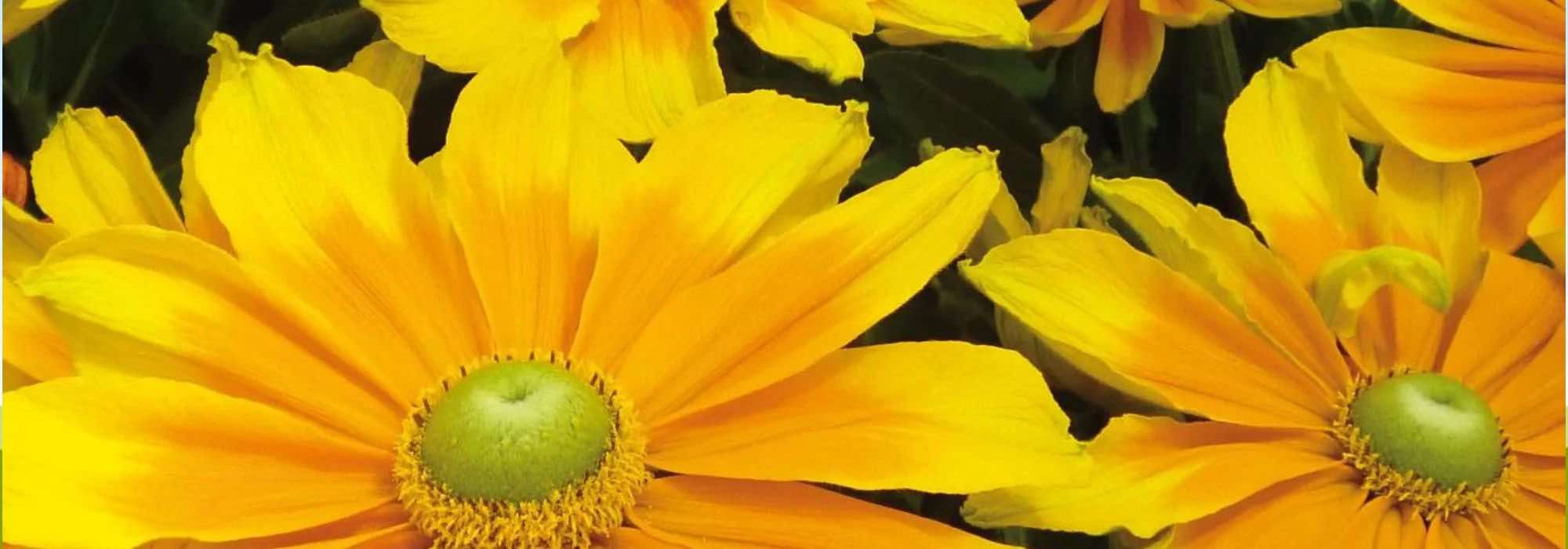
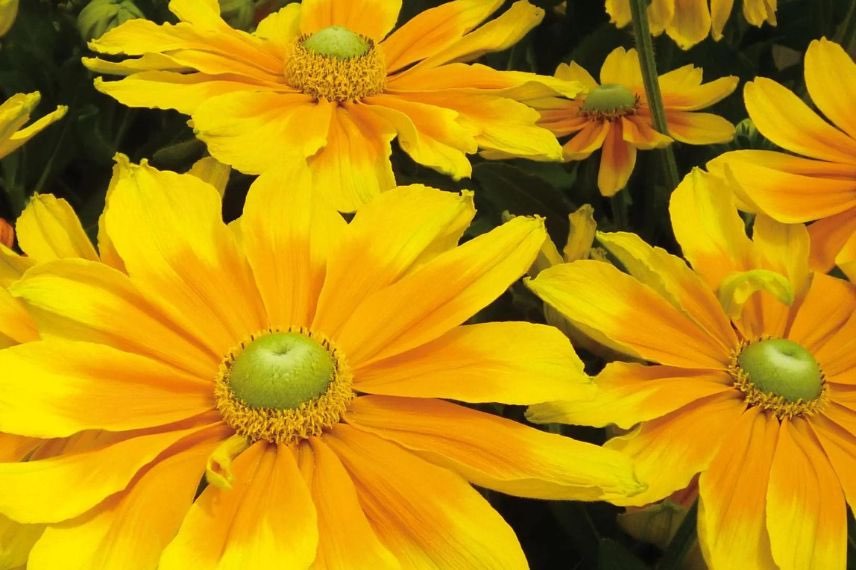
Annual Rudbeckia 'Prairie Sun'
The annual Rudbeckia ‘Prairie Sun’ is a very floriferous annual plant, as it produces hundreds of large yellow daisies from July to October. The flowers take the form of simple golden-yellow to orange-yellow collars with a bright yellow edge and a green, cone-shaped, rounded and flattened centre. The stems reach a height of 70 cm and a width of 30 cm. They are covered in thick, rather rough hairs and at their base are light green, oval, pointed and dentate leaves. Easy to grow, this Rudbeckia enjoys a sunny exposure and ordinary soil, but fairly fertile, which can be occasionally moist or dry. It lights up borders as well as flowering pots from summer to autumn.
Pair this Rudbeckia with a Rudbeckia ‘Autumn Colours’ in intense colours, or with delicate flowers such as the flax or the nemesias. Its sunny colour will be emphasised by strong contrast if you pair it with blue flowers.
Read also
7 yellow flowering shrubsCelosia 'Kelos Fire Yellow'
Celosia ‘Kelos Fire Yellow’, also known as the velvet flower, is an annual plant that is very distinctive and interesting for brightening up borders or pots. It bears striking inflorescences that resemble flames or feathery plumes in a lively bright yellow colour. These plume-like, colourful spikes measuring 10–12 cm long appear from July to September on a tuft of foliage with very bright green leaves. The leaves are broad and lanceolate with prominent veins. Compact, it reaches a height of 38 cm at maturity and can be planted in a border, a bed or a pot. It can also be used in a cut flower arrangement or dried. Plant this celosia in full sun in light, cool soil for maximum display.
Côté association, pair this plume-like Celosia with other Celosias in different colours, such as Celosia ‘Kelos Fire Orange’ or with different forms such as the Celosia argentea cristata to create a unique display.
Nasturtium 'Baby Orange' - Tropaeolum majus
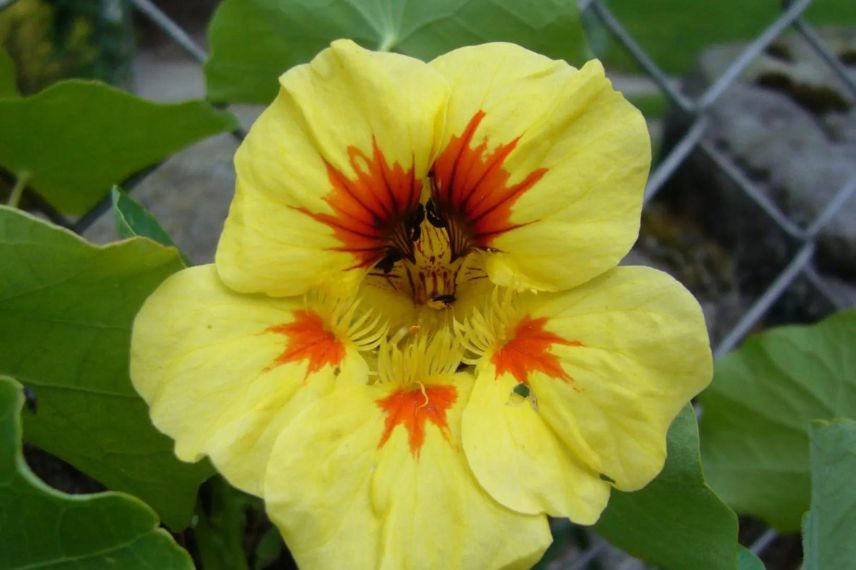
Nothing beats a climbing plant for brightening up a low wall or a trellis! nasturtium ‘Baby Orange’ – Tropaeolum majus is a climbing annual with yellow flowers speckled with orange. It flowers from May to October, reaching a height of 2 to 2.5 m. Its slender blooms offer dynamic, sunlit colours. Fast-growing, it provides continuous flowering on rounded, light-green foliage. It thrives in full sun in moist soil and can be used as a climbing plant as well as groundcover. This South American native has an interesting trait for ornamental gardens as well as the kitchen garden: it attracts aphids to itself, diverting them from other plants or vegetables. Nevertheless, it can be eaten in salads.
Pair it with vegetables and flowers you wish to rid of aphids or, for a more decorative effect, place it beside pelargoniums or petunias.
Read also
Winning duo in white and yellowOsteospermum 'Voltage Yellow'
The Osteospermum ‘Voltage Yellow’ is an elegant plant with bright colours that brighten gardens as much as balconies. This not-very-hardy perennial is grown as an annual. It is a compact, well-branched variety, about 30 cm tall by 40 cm wide when mature. It forms a cushion of green foliage covered with small bright-yellow daisies with golden centres. It offers a long flowering period , from June to October. The glossy green foliage has dentate margins. The small flowers can close if they lack light, so place it in full sun. It tolerates drought well, poor soils, and sea spray. It grows quickly and has received an award in the United States for its early and long-lasting flowering.
Use this compact plant to brighten borders, rockeries, beds or container plantings. It can be paired with bidens or Erigerons.
Pot marigold 'Gitane Yellow' - Calendula officinalis
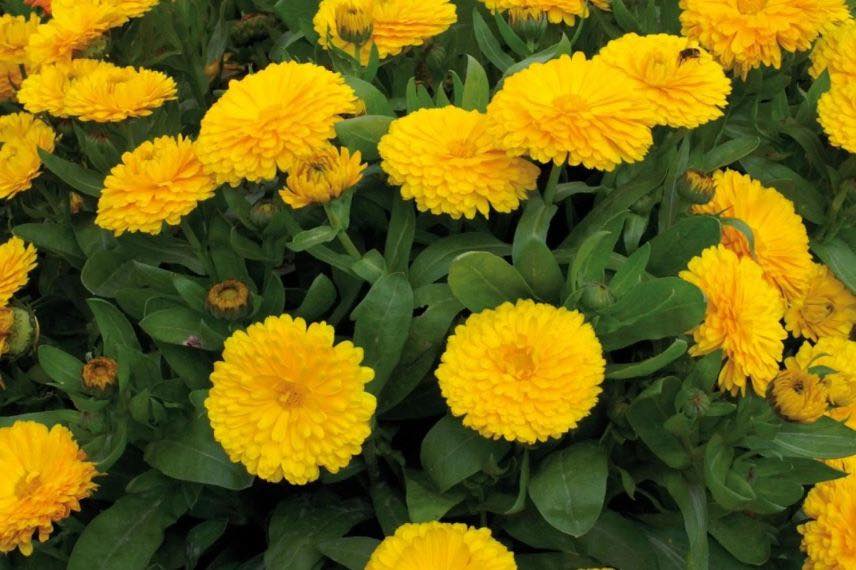
Garden marigold ‘Gitane Yellow’ – Calendula officinalis is a dwarf plant about 30 cm tall with a bushy habit and long flowering. It flowers from June to October. Its double flowers 8-10 cm in diameter resemble flattened pom-poms of bright yellow, with a darker centre. The oblong, velvety foliage is dark green and gives off a scent that deters pests such as aphids or whiteflies. Indispensable for filling window boxes and borders during the warm months, it is easy to care for and thrives in full sun in ordinary soil. It can also be used as cut flowers, lasting well in a vase. It sits alongside dahlias, stachys or California poppies in borders or window boxes to offer a palette of dynamic, vibrant tones.
African marigold 'Durango Yellow'
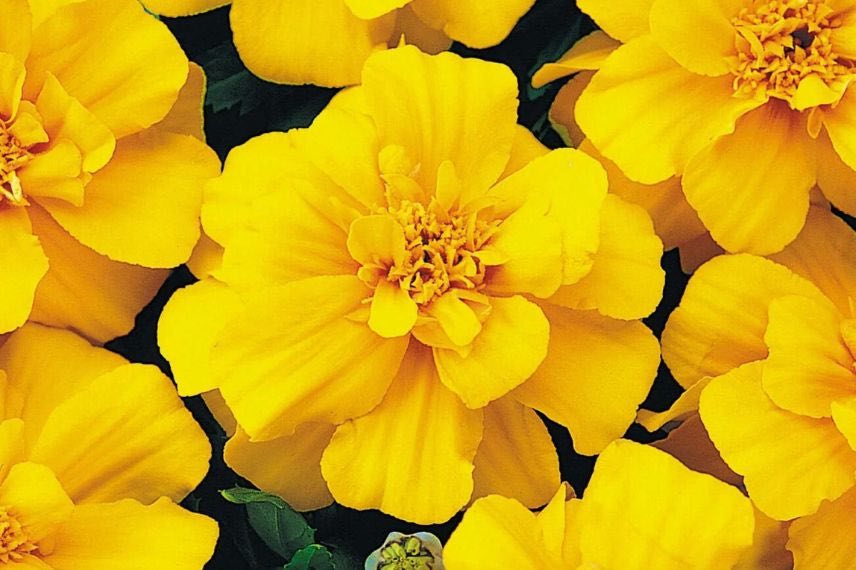
Marigold ‘Durango Yellow’ offers a richly intense golden-yellow flowering from June to September. The flowers resemble small double anemone-like blooms in a uniform pure yellow, and they open on cut foliage similar to ferns. It has dark green foliage. Aromatic, its scent isn’t always to everyone’s taste. This 25 cm tall plant is well suited to window boxes and garden borders. It thrives in full sun in cool, well-drained soil.
Use this vibrant marigold to brighten your pots or borders in small touches. Place it near Stachys to temper its vigour, or near Ageratum to provide contrast, such as the Ageratum dwarf ‘Packstar Blue’.
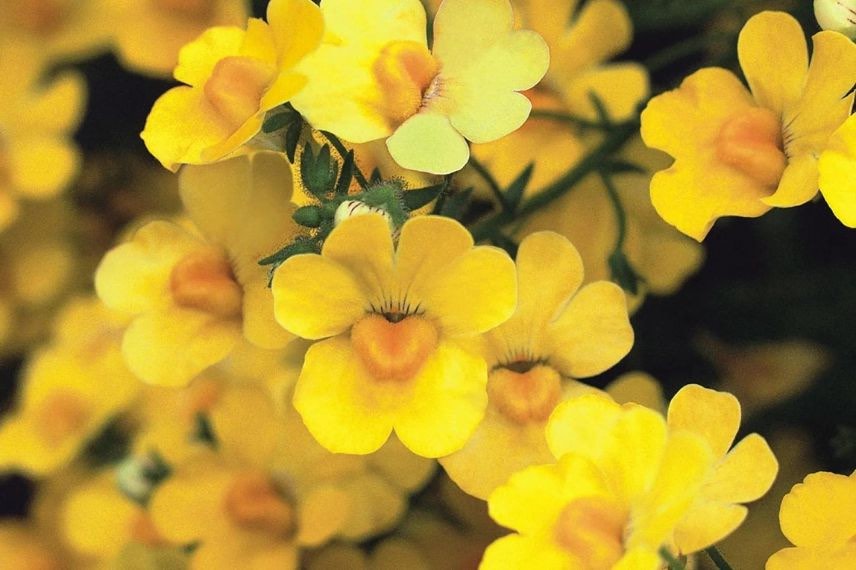
Nemesia 'Sunsatia Plus Pomelo'
Nemesia ‘Sunsatia Plus Pomelo’ stands out for its abundant, sun-loving flowering. It produces large lemon-yellow corollas with a golden centre, lightly scented, from May to October. This compact annual grows to 25 cm tall and 30 cm wide. Its lush growth, with small lanceolate, deeply dentate leaves, makes it ideal for filling hanging baskets as well as balcony window boxes. It thrives in full sun or partial shade in well-drained, fertile soil. It stands up well to inclement weather, whether rain or wind.
For spectacular results, pair this nemesia with geraniums, petunias and lobelias in complementary colours such as blue.
- Subscribe!
- Contents

Comments