




























FLASH SALES: discover new special offers every week!
7 spectacular spring bulbs that will transform your garden

7 spectacular spring bulbs that will transform your garden

Our selection of impressive flower bulbs

Contents

Modified the 12 January 2026  by Leïla 6 min.

Spring is synonymous with renewal in the garden, a time when nature wakes and offers a spectacle of colour and form. Among the main players in this metamorphosis, the spring bulbs hold a place of prominence. These treasures buried in the soil over winter emerge to transform the garden into a living, dynamic palette. In this article, we will discover seven spring bulbs among the most spectacular, those that promise to be visible from afar or to attract all eyes. From striking lilies to the largest alliums, and the impressive Eremurus, these bulbs are chosen for their ability to create captivating displays.

Difficulty

Lilium x regale 'African Queen'

The Lilium x regale ‘African Queen’ is a robust and spectacular lily variety, with visually striking flowers, but also notable for its captivating fragrance. These trumpet-shaped flowers, ranging from deep yellow to apricot, tinged with copper, bloom in June and July. Easy to grow and as reliable as the regal lily from which it is derived, the ‘African Queen’ lends itself perfectly to creating borders or to enhancing large rock gardens. It is also an exceptional choice for cut flower bouquets.
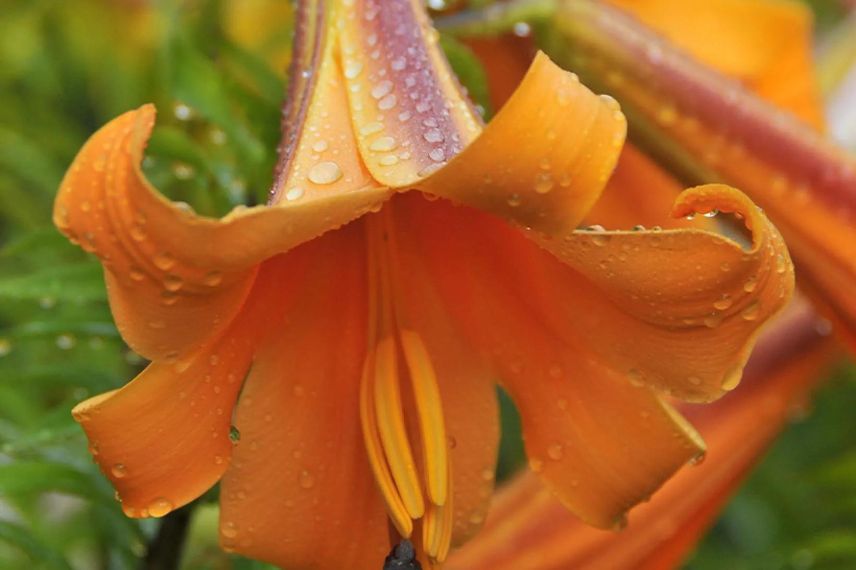
‘African Queen’ is characterised by a narrow, vertical clump habit from spring. In full bloom, the plant can reach a height of 1.2 m, and its tuft broadens gradually thanks to the vegetative propagation of the bulbs. Its stems, of remarkable sturdiness, support lanceolate, dark-green and glossy leaves.

Preferring humus-rich, non-calcareous soils, the ‘African Queen’ lily thrives in well-drained soils. It can be paired with perennial plants that provide shade at its base, helping to stabilise the stems against the effects of wind, for example Coreopsis, the Gladioli, the Daylilies or the bee balm.

Lily

Eremurus 'Cleopatra'

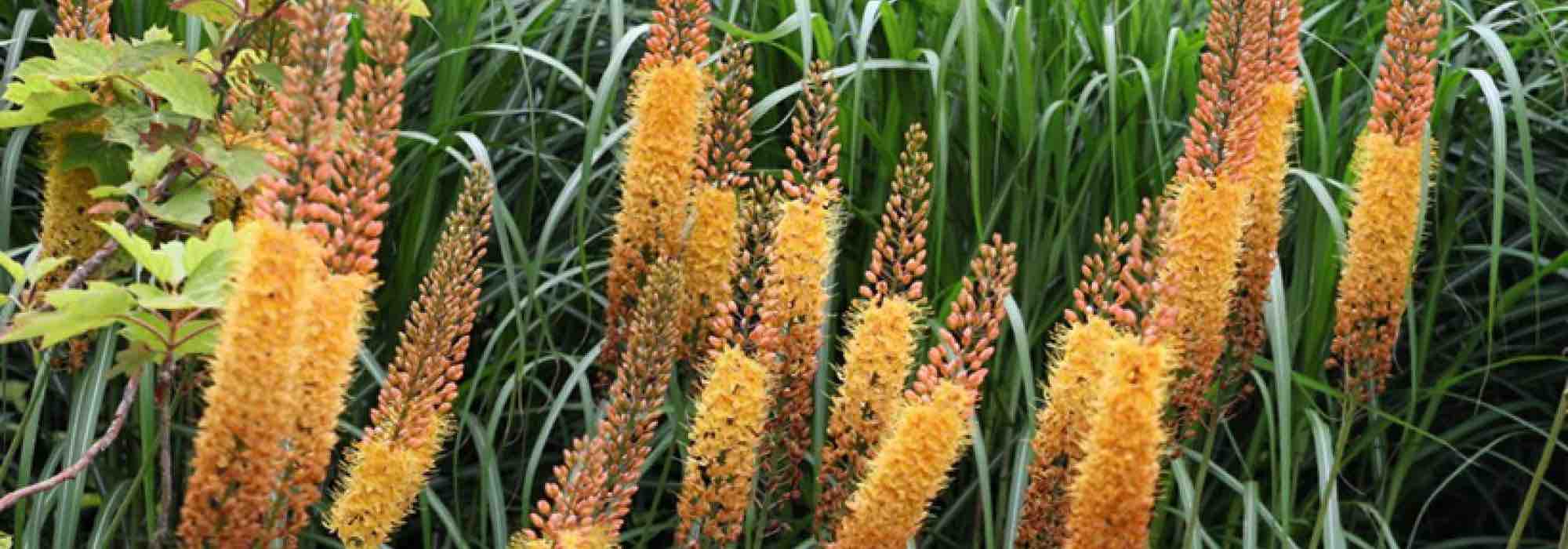
All Eremurus are among the most spectacular garden plants, no matter how tall they are. Let us focus here on Eremurus ‘Cleopatra’, also known as the Steppe Lily or Cleopatra’s Distaff. In June, it develops spikes measuring 20 to 50 cm long, comprising hundreds of small star-shaped yellow-orange flowers, each measuring 1 to 2 cm in diameter. The flowering starts at the base and moves upwards, allowing the plant to be in bloom for several weeks.
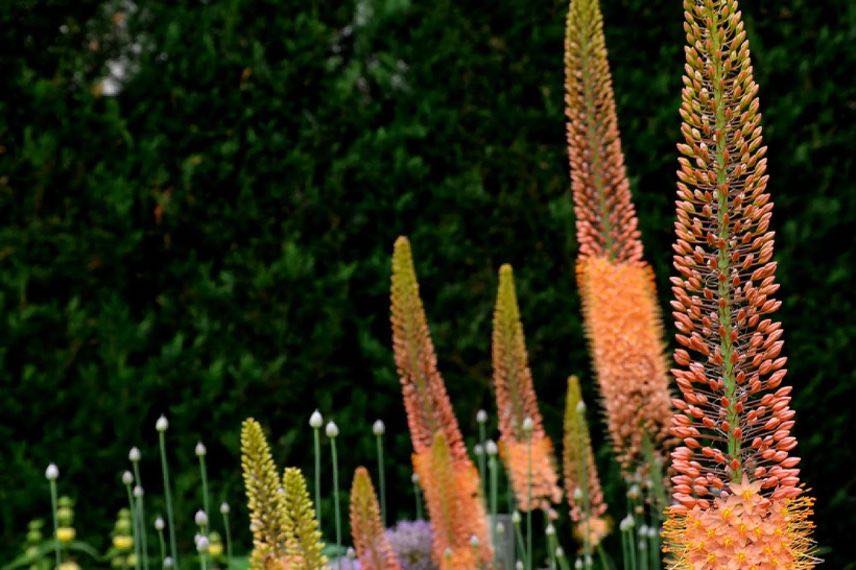
Originating in Central Asia, this desert lily is one of the smallest Eremurus species, reaching about 1.30 m in height. Its bulb is actually a tuberous crown surrounded by roots. This crown produces lanceolate leaves 15 to 30 cm long, which wither as the first flowers appear. Fairly hardy, it tolerates temperatures down to -12°C.

Outdoors, Eremurus ‘Cleopatra’ can be planted in groups, and looks stunning in a vase to decorate interiors. It is suitable for borders, rock gardens, beds and containers in small gardens. It requires ample space to avoid crowding. Plant it with ornamental alliums and agapanthus, slender plants with rounded heads, with eryngiums and Nepetas in a more compact form.

Eremurus

Allium 'Globemaster'

Allium ‘Globemaster’, often described with enthusiasm for its exceptional qualities, offers impressive, round flower heads in a deep pink-lilac, borne on sturdy, upright stems, which appear in borders from the end of spring.
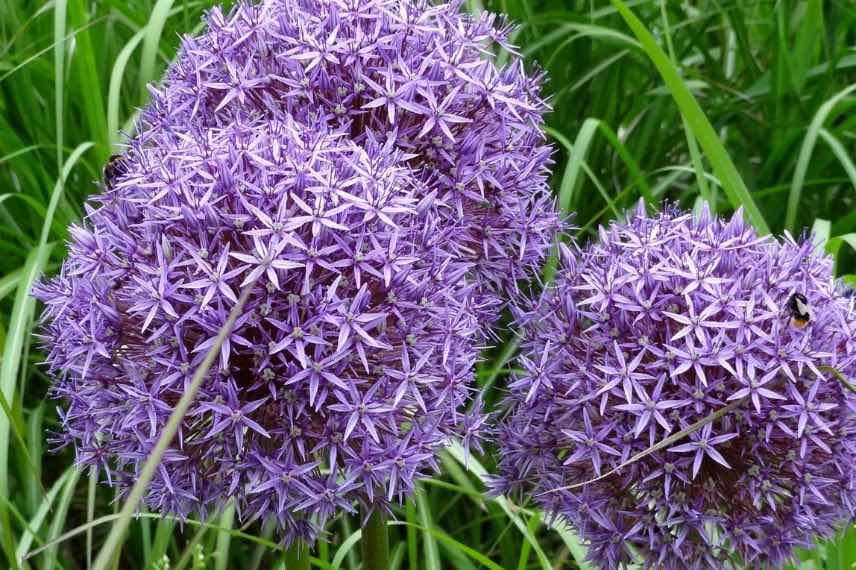
The large bulb of Allium ‘Globemaster’ produces a rosette of long, fleshy, strap-like leaves, green-grey-blue in colour, reaching up to 50 cm in height. This decorative foliage dries off gradually as the flowers emerge. The flowering stems, straight and sturdy, standing about 80 cm tall, appear in late May or early June. They bear at their summit a magnificent spherical inflorescence of 18 to 22 cm in diameter, composed of numerous small star-shaped flowers with six petals. These flower heads, unscented, remain decorative for a long time in borders. Its flowers are perfectly suited to cut flower arrangements, whether dried or fresh.

This plant loves sun and light, with very well-drained soils, with a preference for calcareous soils. Allium ‘Globemaster’ integrates perfectly in a contemporary setting with Stipa tenuissima and lavenders or a romantic mixed-border, surrounded by Stachys byzantina, herbaceous peonies and roses. Pair it with low-growing, bushy plants to hide its base once the foliage has dried.

Allium

Giant lily 'Honeymoon'

The Giant Lily ‘Honeymoon’ is a remarkable hybrid resulting from the cross-breeding of oriental lilies and trumpet lilies, combining the captivating fragrance of the former with the distinctive colours of the latter. This variety is distinguished by its large bulb which, in the second half of summer, produces a flowering stem capable of bearing up to 30 enormous, wide-spreading flowers. Its colouring, a subtle blend of cream and yellow, is enhanced by the elegant shape of the flower. ‘Honeymoon’ is a magnificent garden plant that improves year after year, provided it is planted in well-drained, lime-free soil. Its sturdy flowering stem requires no staking, and it can reach up to 2 m in height!
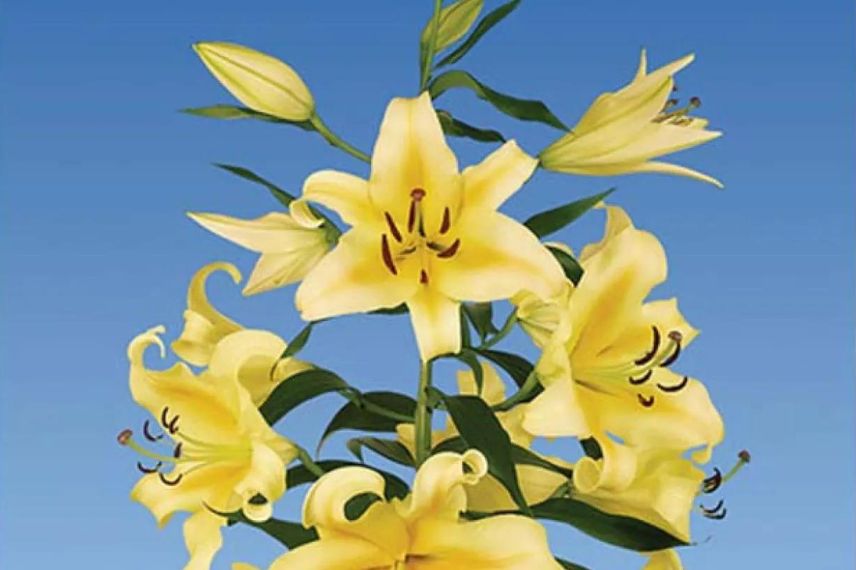
Although this hybrid may take time to establish, it becomes vigorous and hardy with time, especially if the soil is very well-drained and rather dry in winter. The flowers, measuring 15 to 30 cm in diameter, give off a pleasant fragrance in the evening. They consist of six long pale-yellow petals, recurved and undulated at the edges, with cream tips and margins. The throat of the flower is a bright lemon-yellow, without markings, but with papillae. The green stamens with brown-red pollen and the purple stigmas add to its charm.

The Lilium ‘Honeymoon’ pairs harmoniously with white, orange lilies, ornamental grasses and perennials, which provide shade at its feet and stabilise the stems against wind and rain.

lily

Ornamental onion 'Persian Star' - Allium christophii or Allium albopilosum

Allium christophii, also known as the Persian Star or Allium albopilosum, is a remarkable species, even though its flowers are borne on fairly short stems. In May and June, it adorns itself with large, spherical, airy umbels, composed of small star-shaped purple flowers with a metallic sheen, measuring around 20 cm in diameter. This medium-sized bulbous plant does not exceed 60 cm in height when in bloom. It thrives in all soil types, provided it is well-drained. Its flowers, once dried, are superb in bouquets, whether dried or fresh.
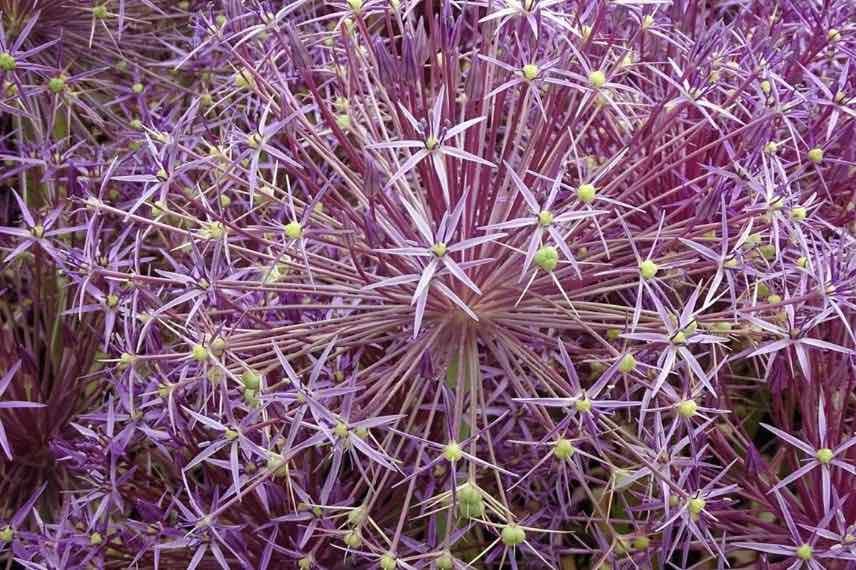
Each umbel comprises around a hundred small star-shaped flowers with six very slender petals, arranged on pedicels of varying lengths, radiating from a central point. After insect pollination, these flowers develop into decorative capsules. The foliage, consisting of 4 to 6 basal leaves, broad blue-green and somewhat velvety, yellows and disappears at the same time as the flowering, thus adapting to hot, dry summer conditions.

‘Persian Star’ is ideal as a focal point in a contemporary or cottage-style border, especially in a dry garden. It truly comes into its own when planted in large groups of 10 to 15 bulbs at a minimum. In a border, pair it with valerians of different colours, Buenos Aires Verbena, and shrubby Artemisia.

Allium

Camassia leichtlinii 'Semiplena'

The Camassia leichtlinii ‘Semiplena’, also known as ‘Quamash’, is a bulbous perennial with a tufted habit and one of the most exuberant camassias. Its flowering, from May to June, is the latest among camassias but is distinguished by its exceptional character. The spikes, bearing around thirty cream-white, star-shaped double flowers, measure 20 to 50 cm long. The inflorescence develops from the bottom upwards, and each flower, 5 cm across, is composed of six petals that twist as it fades.
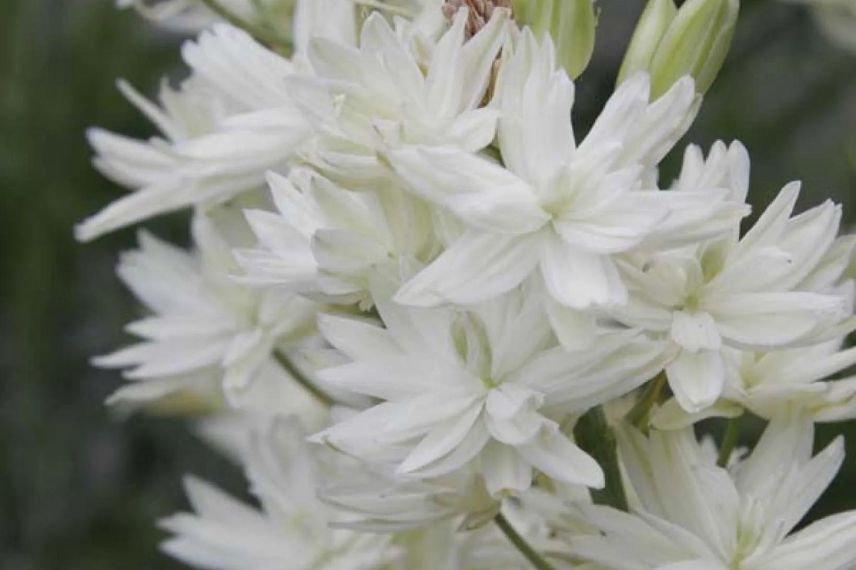
At maturity, Camassia typically reaches 80-90 cm in height, but can attain up to 1.3 m. Its linear leaves, in bright green, measure 20 to 60 cm long and form a tuft from which the flowering stems emerge. Originating from Oregon in the Pacific Northwest of the United States, this plant is hardy and adapts to a range of environments, whether in borders, rock gardens, or rockeries.

Pair Camassia leichtlinii ‘Semiplena’ with late-flowering perennials that will hide its dried leaves in summer, such as Japanese peonies. Its bulbs are not particularly liked by rodents, which makes Camassia one of the hardiest bulbous plants.

Camassia

Urginea maritima – sea squill

Urginea maritima, or sea squill, is a rare bulbous perennial in cultivation that flowers in late summer, from August to October, bearing elongated spikes 15 to 35 cm long, composed of many small star-shaped flowers. These flowers, white with green striate markings on the outside and pinkish-brown on the inside, emit a pleasant fragrance.
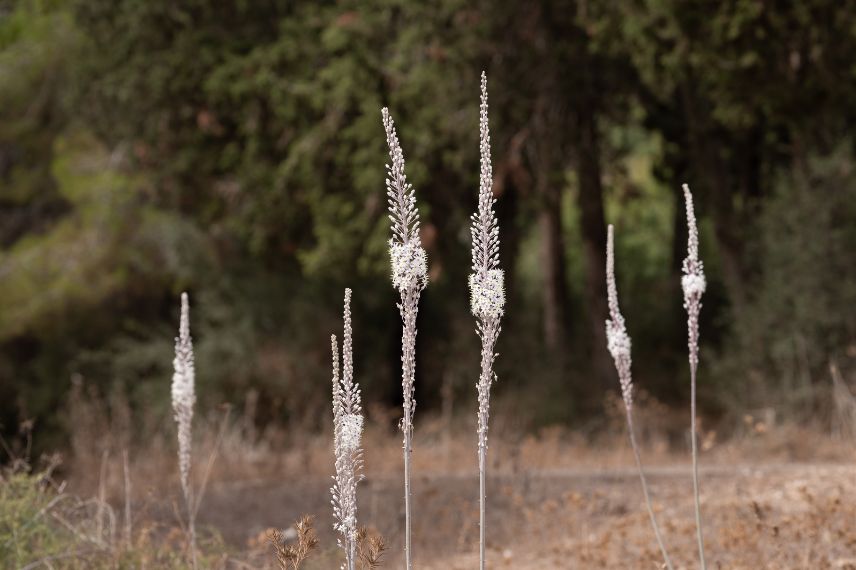
The plant is naked-flowered, meaning the flowers appear before the foliage. The bulb of the Urginea maritima is substantial, measuring up to 20 cm in diameter and weighing up to 2 kg. The leaves, narrow and thick, are bright green and measure from 30 cm to 1 m in length. They are erect and slightly undulated. The central flowering stem can reach up to 1.20 m in height.

Native to the Mediterranean region, Urginea maritima is a moderately hardy species, tolerating temperatures down to around -12°C. It is protected in France, notably in the Alpes-Maritimes. Because of its toxicity, wear gloves when handling it and do not ingest. This plant tolerates drought and sea spray, and grows well in very well-drained soil. It prefers slightly calcareous and cool soils. It can be grown in isolation in a pot, particularly in colder or wetter regions, as its bulb does not need to be buried deeply.

sea squill

Comments

Eremurus 'Cleopatra'