





























7 salvias with pink flowers
The different Salvia species and varieties that offer pink flowering.
Contents
Around 900, the estimated number of sage species and varieties worldwide. Nevertheless, most of them are recognised as medicinal and aromatic plants with their fragrant foliage when brushed. Indeed, the foliage is rich in glandular hairs, abundant in essential oil. And all emit different odours, fruity, peppery, camphoraceous, mentholated… But sage is also an ornamental plant with considerable aesthetic value. Its spike-like flowering features a broad range of colours, allowing you to vary the display. Furthermore, sages bloom abundantly over a fairly long period, from spring to the end of autumn depending on the varieties. Finally, sages adapt to all locations—beds, borders, rockeries or slopes, as solitary plants.
Discover our selection of sages notable for their pink flowering.
For further reading: Sage, Salvia: planting, pruning and maintenance
Autumn Sage (Salvia greggii) 'Icing Sugar'
Originating from Texas, this autumn sage (Salvia greggii) is a drought-tolerant perennial. In its native country, it sometimes grows on rocks! Nevertheless, it will withstand light frosts down to -12°C. It is a very attractive sage, with dark-green, delicate foliage, highly aromatic, and its flowering is very refined. The flowering is nectariferous and melliferous, extending from late summer to the first frosts.
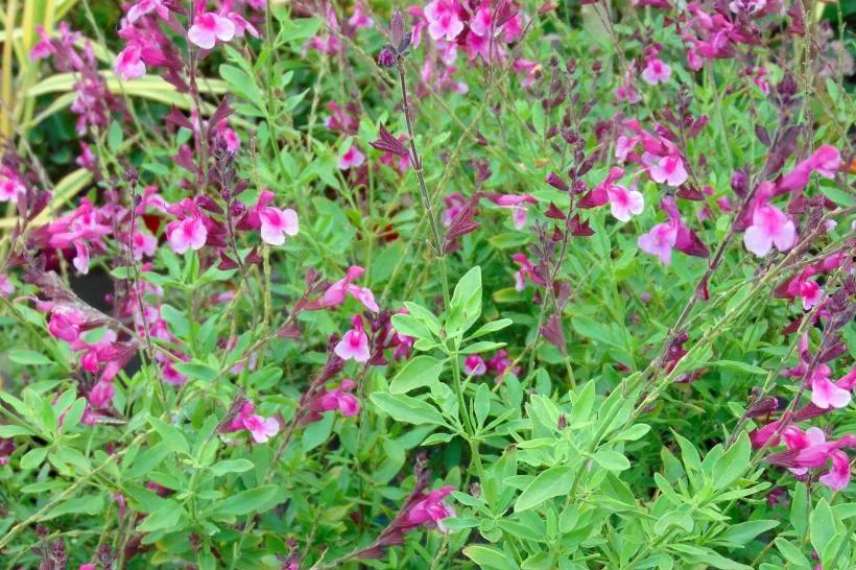
The sage ‘Icing Sugar’
The sage variety ‘Icing Sugar’ offers a bi-colour flowering in two shades of pink. The flower buds display a fairly dark purplish-pink. During the day, they open to reveal flower spikes in a vivid fuchsia pink, with the lower lip a much paler pink. These flowers last only a day, but renew themselves continually.
How to plant it? This sage variety prefers well-drained, light soil and cool conditions. Nevertheless, it adapts perfectly to dry soils. It needs a sunny position sheltered from cold winds. Due to its low hardiness, it can be grown in pots. With a spread of 50–60 cm in all directions, it looks best in borders or rockeries with hardy geraniums, or giant autumn asters (Aster laevis), or bushy autumn asters (Aster turbinellus) or also sedums.
Read also
5 salvias with red flowersShrubby sage 'Pluenn'
Bush sage (Salvia jamensis) is a descendant of autumn sage (Salvia greggii). Its main merit lies in its very ramified bush form with a rounded habit, as wide as it is tall (about 60 cm across). But its flowering, plentiful and long-lasting, is also very attractive in a garden. Indeed, bush sages offer flowers in a range of colours from early summer, in July, to late autumn, in November. The flowers, clustered in spikes on purplish-brown stems, rise from the abundant foliage, attracting numerous nectar-foraging insects and pollinators. As for its semi-evergreen foliage, it is ovate, thick and aromatic. Like autumn-bush sage, this sage is hardy to -10 to -12 °C.
The bush sage variety ‘Pluenn’ is characterised by a pretty salmon-pink colour of flowering, all the brighter because the flowers are adorned with brown bracts. Although short-lived, these flowers are a sight to behold.
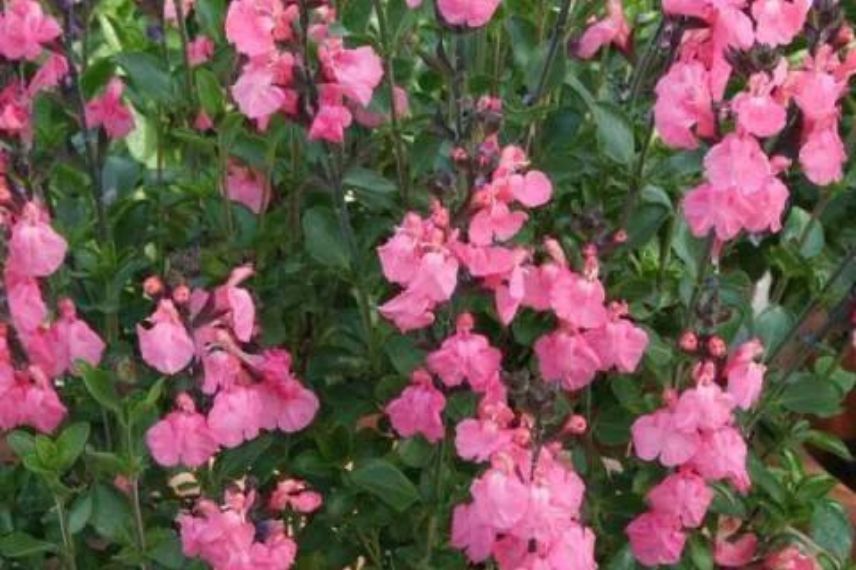 Sage ‘Pluenn’
How to plant it? This sage prefers a light, even sandy, cool and well-drained soil. It needs full sun to flower. It requires virtually no care. It thrives in all situations alongside bushy Potentillas (Potentilla fruticosa) with white flowering, artemises (Artemisia) or dusty miller (Senecio cineraria).
Texas sage (Salvia coccinea) ‘Summer Jewel Pink’
Texas sage (Salvia coccinea) is a short-lived perennial, cultivated as an annual, forming a dense, erect and bushy tuft, measuring 45 cm in height and 30 cm wide. The foliage is broadly pubescent, cordate or triangular, with dentate margins, and, of course, very fragrant. As for flowering, it lasts from June to October.
The variety ‘Summer Jewel Pink’, often awarded at horticultural shows, offers tubular flowers in a very pale and delicate pink, with stamens protruding in pure white. The flowers are arranged in whorls along a vertical stem that rises proudly from the foliage clump. This flowering is light and delicate in both form and colour.
How to plant it? This variety of sage prefers light, somewhat dry and well-drained soils, and sunny positions. Seeds are sown from February to April and indoors at a temperature between 20 and 25 °C. They are then transplanted into pots before being planted out into the open ground as soon as the risk of frost has passed. This short-lived perennial thrives in borders or in mass plantings alongside perennial flax (Linum perenne), Nigella damascena, eryngiums or dahlias.
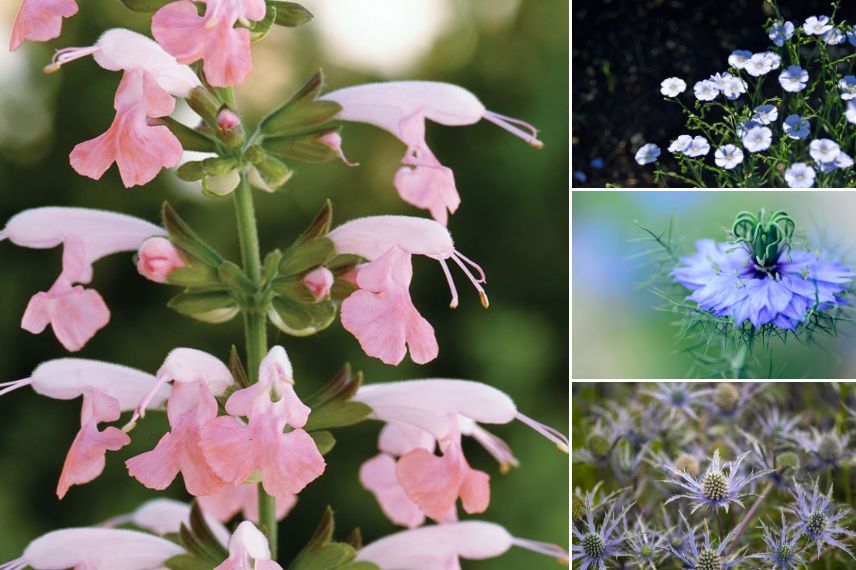
Sage ‘Summer Jewel Pink’ paired with perennial flax, Nigella damascena and eryngiums
Read also
7 blue salviasSage (Salvia involucrata) ‘Bethelii’
The sage (Salvia involucrata) ‘Bethelii’ is a sage particularly imposing in size. It indeed reaches about 1.3 m in height with a spread of roughly the same. In other words, it makes its presence felt, taking the appearance of a small shrub, very ramified and pliant. Its foliage is aromatic like that of all sages, but the leaves are longer and more satin, oval and veined with purple-pink. This sage is hardy only down to -5°C, but it grows perfectly well in a large pot.
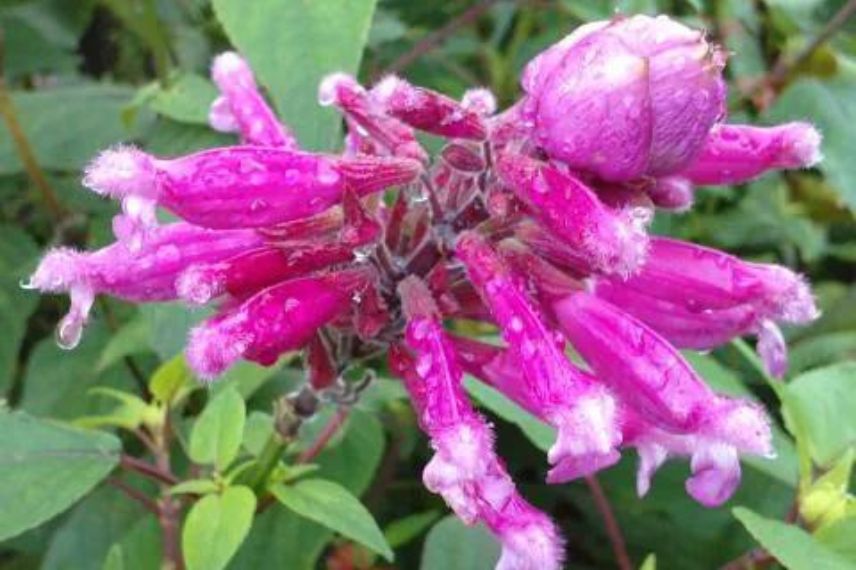
The sage ‘Bethelii’
As for the flowering, it peaks from July to October, and can continue into November. Each flower bud is equipped with brownish-red bracts, which open and fall away to reveal bilabiate flowers in a very vivid pink, almost carmine. The upper lip of the flowers, melliferous and nectariferous, is very villous.
How to plant it? This sage prefers ordinary, fertile humus-bearing soils that are very well-drained. It thrives in full sun in regions with cool summers, and in partial shade when the sun is too intense. In regions with a mild climate, this sage can be planted in the ground alongside rosemary, lavenders, tree mallows and hollyhocks.
Wood Sage (Salvia nemorosa) 'Rose Queen'
Undoubtedly, it is the lavish, abundant flowering that gives all the charm to the wood sage (Salvia nemerosa) ‘Rose Queen’. Indeed, this sage is endowed with an extraordinary flowering in vivid pink with mauve reflections. The flowers are arranged in dense clusters, enclosed by purple bracts and grouped into spikes. This flowering occurs in several waves, first in May–June, then July to September. These flowers attract swarms of pollinating and nectar-foraging insects thanks to their melliferous and nectariferous properties. As for the foliage, it is ovate, pubescent, slightly wrinkled and a handsome dark green. It is mainly aromatic, as with other sages.
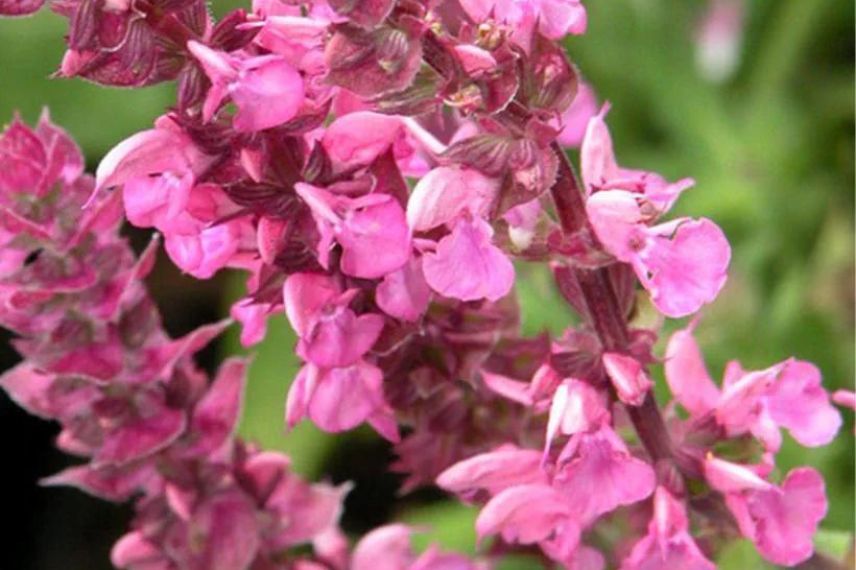
Wood sage ‘Rose Queen’
Hardy down to -20 °C, this wood sage proves hardy. It withstands cold as well as drought, and wind.
How to grow it? This sage should be planted in well-drained, cool soil, but it tolerates drier soils, even calcareous or stony ones. It, however, needs full sun. Short-lived, this sage should be divided every 3–4 years. It thrives just as well in naturalistic garden borders as in dry gardens, alongside penstemons, perovskias or hardy geraniums.
Meadow sage (Salvia pratensis) 'Rose Rhapsody'
Quite similar to woodland sage, meadow sage (Salvia pratensis) ‘Rose Rhapsody’ offers highly branched flowering stems up to 50 cm tall and evergreen foliage that is highly aromatic. This evergreen foliage persists through winter, but new stems emerge in spring. Flowering takes place from late May to July in successive waves. Its bilabiate spikes bear a pretty pale pink. These flowers attract insects to forage on them, thanks to their melliferous and nectariferous properties.
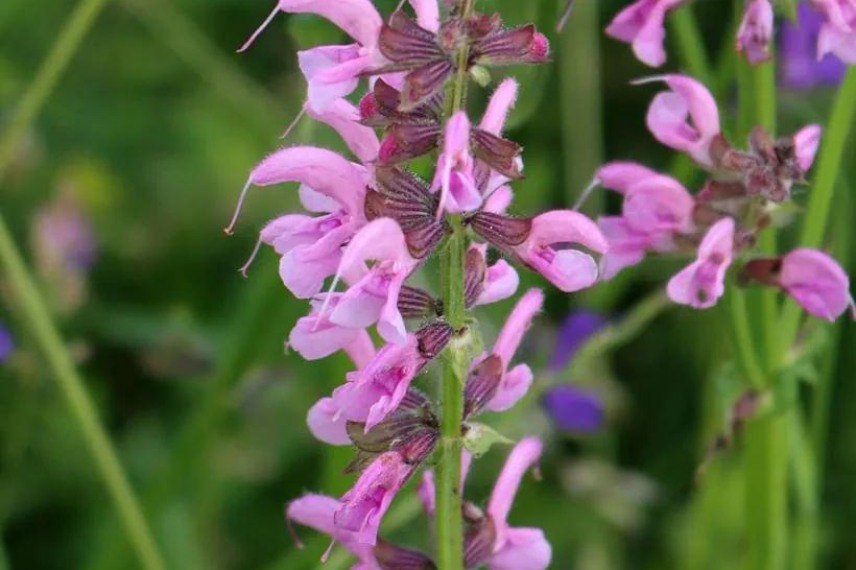
The sage ‘Rhapsody Pink’
Hardy to -30°C, this sage shows good resilience to cold or drought.
How to grow it? This meadow sage is not particularly demanding when it comes to planting. It prefers substantial, well-drained soils, preferably calcareous. If the soil is rich, that’s even better. It, however, requires full sun. In borders, on rockeries or slopes, it thrives in the company of other salvias such as clary sage (Salvia sclarea) or common sage (Salvia officinalis). It can also be paired with nepetas.
Hybrid sage 'Wendy's Wish'
Let’s finish our selection of pink-flowering salvias with hybrid sage ‘Wendy’s Wish’. This is a fairly recent variety with a compact, bushy and ramified habit. Its deciduous foliage is triangular, with dentate margins, and only very slightly aromatic. It is mainly its flowering that makes the difference. With a very bright magenta pink, the flowers, grouped in spikes borne on red stems, emerge from a brown calyx. They emit a delicate scent of citrus trees. It reaches 55 cm in all directions and flowers from late June until the first frosts.
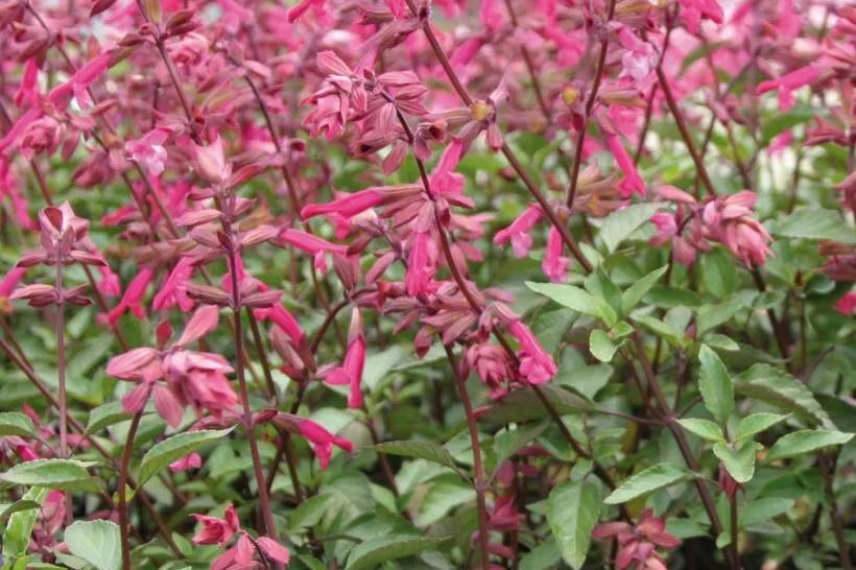
Sage ‘Wendy’s Wish’
This sage is not very hardy (down to -6°C) but easy to grow.
How to grow it? This sage should be planted in a well-drained, light and fairly cool soil. It should be planted in full sun and sheltered from cold winds. It will thrive with companions of agastaches or hardy geraniums.
- Subscribe!
- Contents
Comments