




























FLASH SALES: discover new special offers every week!
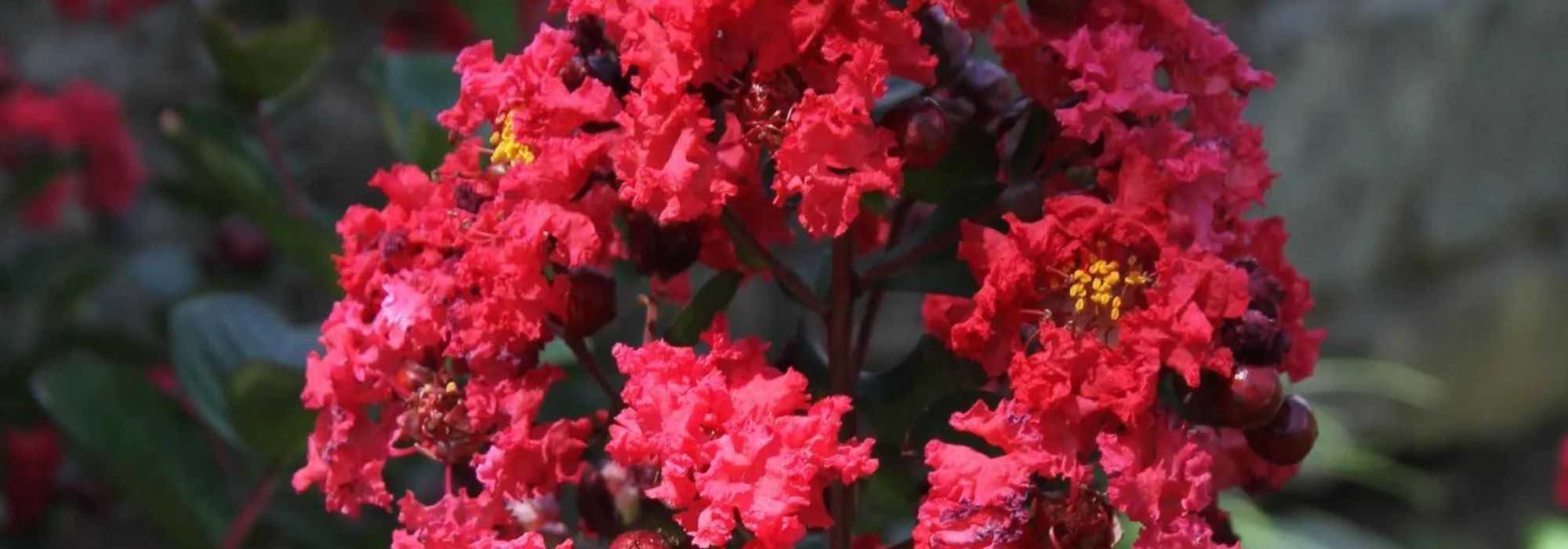
7 crape myrtles, Lagerstroemia with red flowers, for a flamboyant garden.

7 crape myrtles, Lagerstroemia with red flowers, for a flamboyant garden.

The most beautiful varieties

Contents

Modified the 12 January 2026  by Leïla 6 min.

In the world of Lagerstroemia, red-flowered varieties take pride of place, providing a striking visual display. These shrubs, also known as crape myrtle, are generous in more than one sense: in addition to their vibrant summer flowering, their deciduous foliage takes on beautiful colours in autumn and their decorative bark, bare in winter, offers a range of colours. Lagerstroemia plants require, to thrive, a warm, sunny position sheltered from cold winds and a lime-free, fairly cool soil to thrive, though they will tolerate dry soil once mature. They tolerate frosts down to around -10 to -15 °C.

In this article, we invite you to discover seven red-flowered Lagerstroemia varieties, each with its own unique characteristics and its particular beauty. Get ready to find inspiration for your next landscaping project.

→ Read the family sheet on the crape myrtle.

Difficulty

Lagerstroemia indica 'Victoria'

Lagerstroemia indica ‘Victoria’ offers abundant flowering in deep-red panicles from August to September. With a compact, bushy habit, it reaches around 2 metres across at maturity. Its glossy dark-green foliage turns golden yellow in autumn. Hardy, it prefers sunny, sheltered spots, in light, fertile soil.
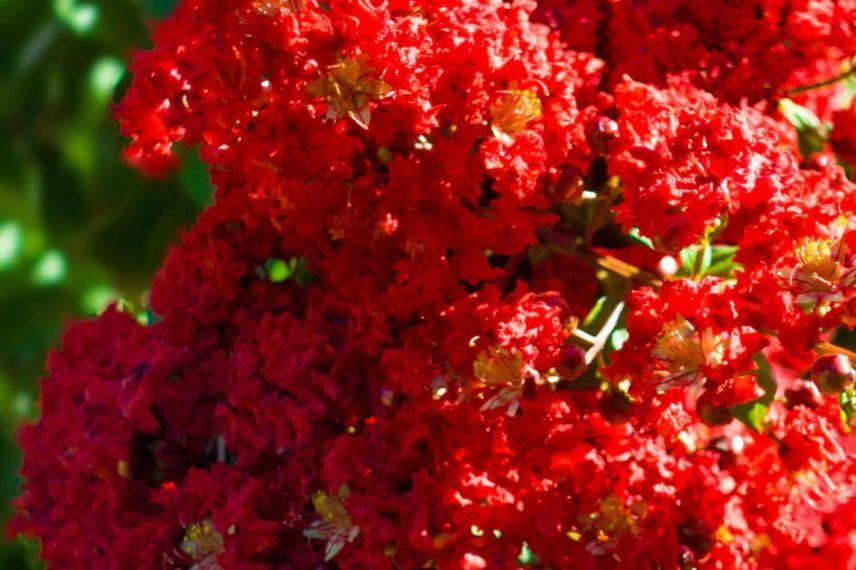
Lagerstroemia indica ‘Victoria’ is a North American selection. Its flowers, in large pyramid-shaped panicles, appear on the current year’s growth. Its foliage, attractive and glossy, is deciduous and turns golden yellow and coppery red before falling, while its bark, as it ages, peels to reveal a smooth beige-gray trunk adorned with distinctive reddish-brown markings, which stand out particularly when planted to the rear of a border or as a standalone specimen near an entrance.

Ideal for South West gardens with a hot climate, but more humid in summer than the Mediterranean climate, crape myrtle also adapts to cooler zones in very sunny, well-sheltered positions. In general, it thrives in full sun, in a sheltered location, on light, fertile soil with little lime. It can be planted as a standalone specimen or paired in a border with perennials such as Nepeta, salvias and Asters. In pots, it brightens terraces with year-round appeal.

crape myrtle

Lagerstroemia indica 'Périgord Pourpre'

The Lagerstroemia indica ‘Périgord Pourpre’, a small crape myrtle, stands out for its very early and long-lasting intense red flowering, from July to October. Hardy and vigorous, it can be grown in many regions and is suitable for the north of the Loire, this deciduous shrub with an upright, compact habit is perfect for pots on the terrace. Its glossy green foliage takes beautiful autumn colours.
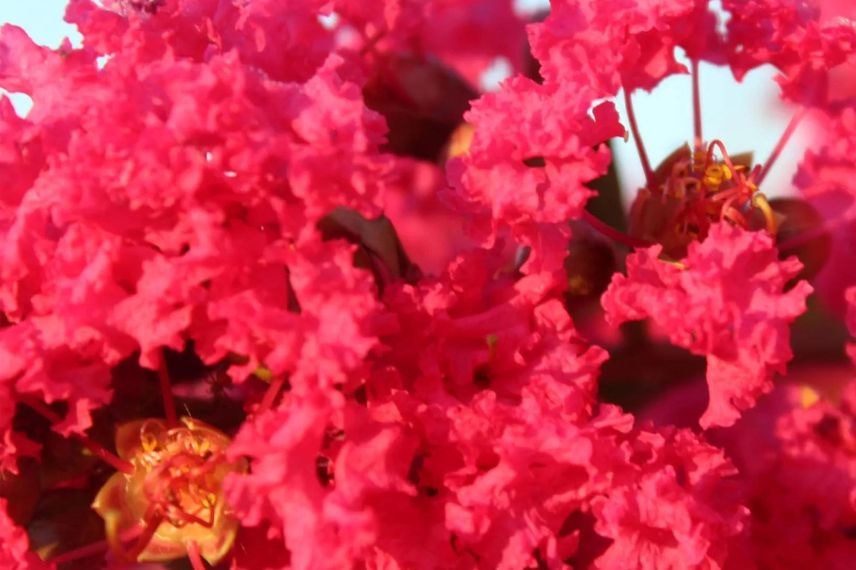
‘Périgord Pourpre’ reaches about 1.5 m in height with a 1 m spread, with an upright, compact habit and fairly rapid growth. Its flowers, in large panicles, are pale red-pink in bud, then intense red. The dark green foliage becomes yellow or red in autumn depending on the climate. The bark, beige streaked with reddish-brown, peels in coloured plates, in cinnamon, wine red, old rose, cream.

Plant it at the back of a border with perennials such as Campanula pyramidalis, Gaura lindheimeri, and with flowering shrubs such as roses.

Summer lilac

Lagerstroemia indica Black Solitaire (Black Diamond) 'Red Hot'

The Lagerstroemia indica Black Solitaire (Black Diamond) ‘Red Hot’ is characterised by its almost black foliage and crepe-like flowers in pure red. Resistant to powdery mildew, frost and moderate drought, this bush is ideal for small gardens and container gardening. Its richly coloured bark is ornamental all year round.
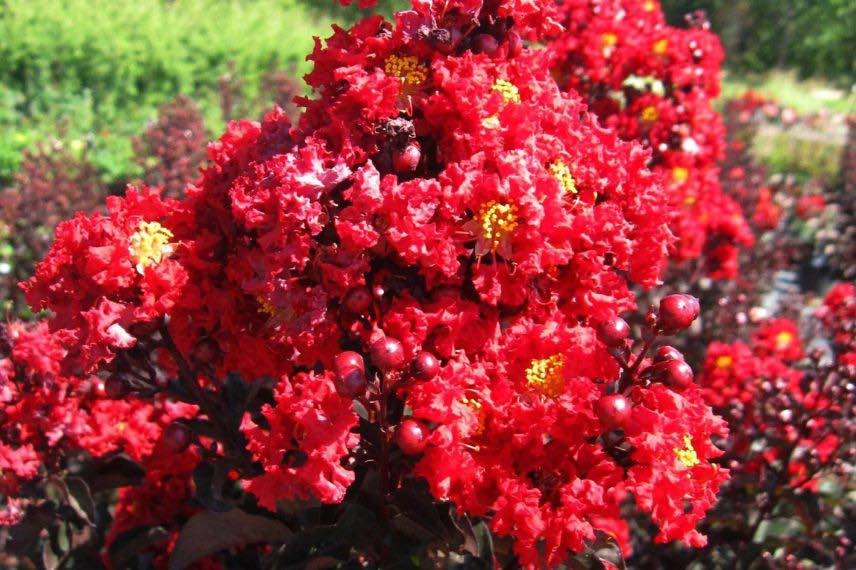
Selected in Texas, ‘Red Hot’ is hardy to zone 7b, and performs best in zone 8 and warmer. Its flowering begins in late July and lasts until September, with dense panicles of bright red flowers. It reaches up to 2.5 m in height and 2 m in diameter with a bushy habit and rapid growth. Its burgundy-chocolate-violaceous foliage turns purple in autumn. The bark, beige with brown-red striations, peels in colourful plates.

On a sunny terrace, in a large container, a groundcover of Stachys byzantina, Nepeta mussini and Iberis sempervirens will highlight its base, bark and flowering.

Red summer flowering

Lagerstroemia indica 'Grand Cru'

The Lagerstroemia indica ‘Grand Cru’ is a crape myrtle with late flowering in blood-red to coral-red thyrses. Its deciduous foliage, tinged red in spring, becomes glossy green in summer and orange-red in autumn. It is vigorous and can quickly become a small tree if pruned meticulously. Ideal for southern regions, it resists powdery mildew well and thrives in full sun.
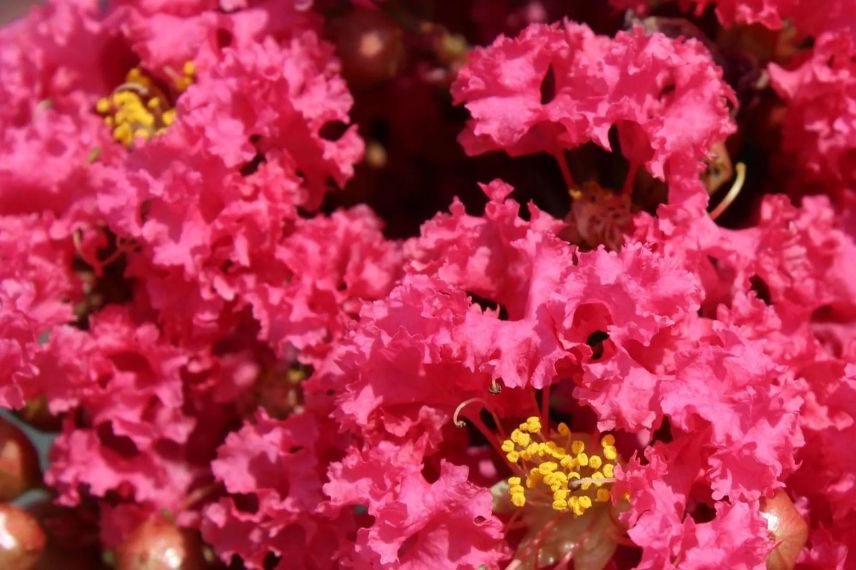
‘Grand Cru’ reaches 3 to 5 m in height with a 3 m spread at maturity, with rapid growth. Its flowering, from August to October, consists of large, densely packed panicles of crepe-textured flowers in a coral-red shade that is uncommon. Its bark, beige with reddish-brown striations, peels away in coloured plates to reveal soft tones.

Perfect for South West gardens, ‘Grand Cru’ prefers temperate oceanic climates. Plant it as a specimen, near the house, to enjoy its numerous benefits. In a shrub border, it accompanies the purple Cotinus and deciduous spindle trees, which also display beautiful autumn hues.

Deciduous shrub

Lagerstroemia 'Braise d'Été'

The Lagerstroemia indica ‘Braise d’Eté’, from the Indiya Charms® range, offers an early, intense red-rose flowering from July. This medium-sized variety, suitable for the north of the Loire where it can bloom abundantly, features bronze foliage at first, then dark green, and an ornamental smooth bark all year round. Enjoying warmth, but also a touch of coolness, it is suitable for small gardens and can easily be planted in a large pot on a terrace.
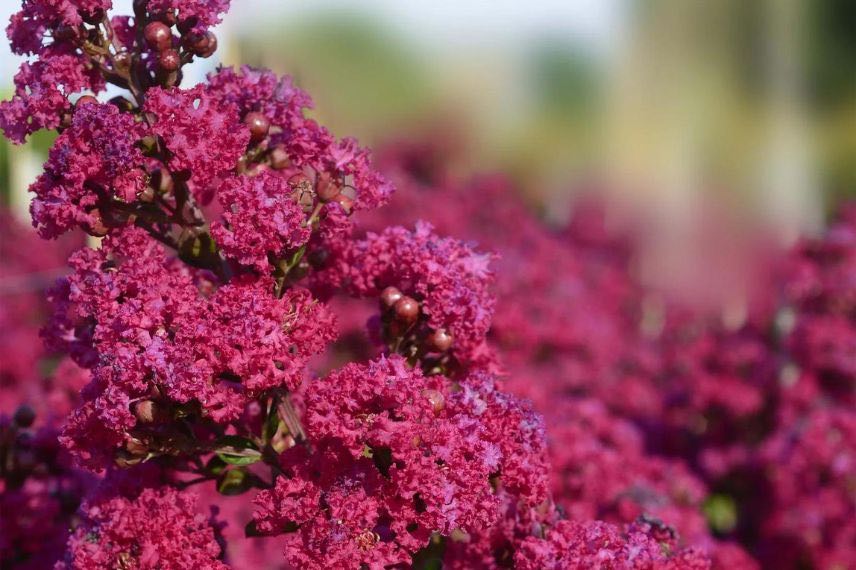
Created in France, ‘Braise d’Eté’ stands out for its unique colour, its precocity, its floribundity and its resistance to powdery mildew. This variety, still not widely distributed, develops a bushy, ramified habit from the base, with a rounded crown and eventually reaches 3.50 m in height with a 2.50 m spread. Its flowering, from July to September, comprises large panicles of flowers with undulate margins in a very intense colour. In autumn, the foliage turns copper and orange.

At the back of a colourful summer border, it pairs well with perennials rich in vibrant colours such as the Echinacea purpurea, the daylilies and the yarrow.  

Crape myrtle

Lagerstroemia indica 'Red Dwarf'

Lagerstroemia indica ‘Rouge Nain’ is a crape myrtle variety with a compact, spreading habit, offering vivid red flowering with yellow stamens. Resistant to diseases, this small deciduous bush is perfect in a pot on the terrace, in a rock garden or at the centre of a border of low perennials. It prefers a warm, sheltered, sunny site, in neutral to slightly acidic soil.
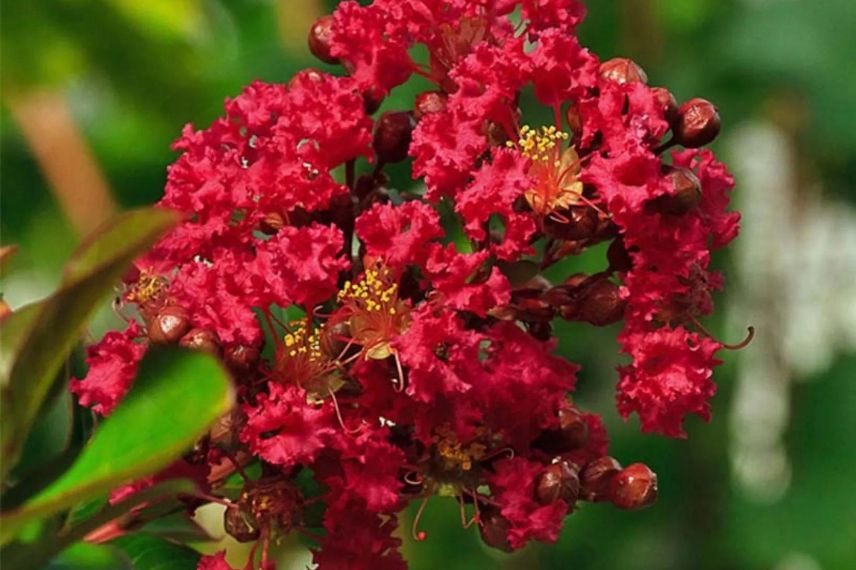
Rare in trade, ‘Rouge Nain’ reaches about 1 m in height and 1.5 m in width. Its flowering, from July to autumn, consists of panicles of bright red flowers. The glossy green foliage turns yellow or red in autumn. Its bark, beige streaked with reddish-brown, peels in coloured patches.

Ideal for south-west facing gardens, ‘Rouge Nain’ adapts to all sunny gardens and terraces sheltered from the wind. In a rock garden, a low bed or in a pot, it enhances the space. Plant lavenders, thymes and oregano at its base.

dwarf bush

Lagerstroemia indica 'Dynamite'

The Lagerstroemia indica ‘Dynamite’ is distinguished by its bright cherry-red flowering in summer. This deciduous and hardy bush has a spreading, rounded habit, dark foliage turning red in autumn, red new shoots and decorative bark. It is one of the finest bushes for summer flowering and deserves a prime place in the garden or in a pot on the terrace.
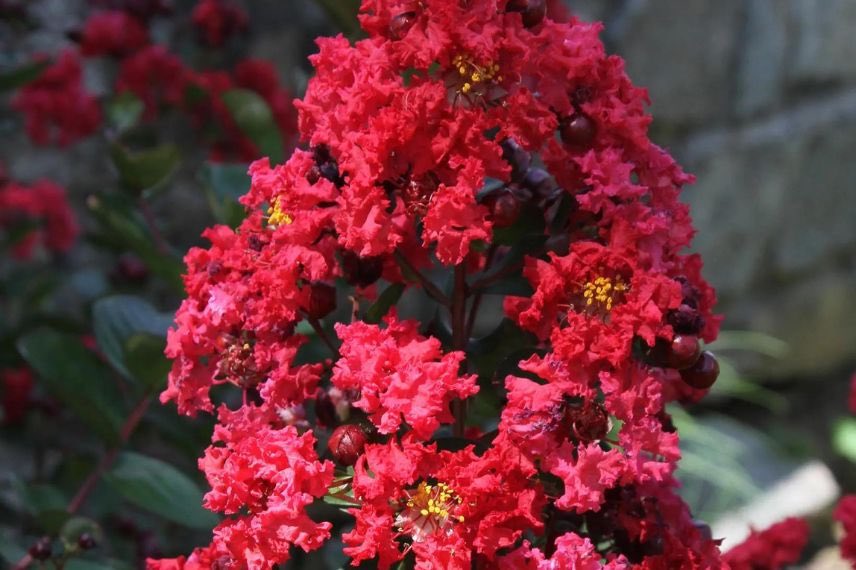
‘Dynamite’ has a bushy habit and reaches up to 4 m in height with a 3 m spread. Its flowering, from July to October, consists of large panicles of cherry-red flowers. Dark green foliage turns yellow or red in autumn. Its bark, beige with reddish-brown striations, peels in coloured plates.

Plant it with ornamental grasses that bring lightness and movement. In autumn, it accompanies colourful asters. Agapanthus, with their blue bell-shaped flowers, provide a striking contrast. shrub roses will pair wonderfully with this Lagerstroemia thanks to their abundant flowering.

crape myrtle

Comments

Lagerstroemia indica 'Victoria'