





























6 climbing plants with decorative fruits
Colourful and unusual fruits to brighten up the garden
Contents
Climbing plants come in many species and varieties, suitable for both large spaces and pot cultivation. Their ornamental qualities generally stem from their long habit, foliage, or flowering. After flowering, some climbing plants continue to delight us with decorative fruits, sometimes even edible. Most bring joy to garden birds and add colour during the cold season.
Here is our selection of 6 remarkable fruiting climbing plants.

The rose ‘Francis E. Lester’, a white cascade producing orange fruits
The variety ‘Francis E. Lester’ boasts many qualities. It is a solid rambling rose, low-maintenance, fairly resistant to fungal diseases, with a simple and natural charm.
Its unique flowering occurs between June and July. It then becomes covered in an abundance of eglantine flowers, with a white hue tinged with pink at the edges. This variety is also well-scented, revealing musky notes.
The flowers then transform into lovely decorative fruits made up of achenes: the hips. They are gathered in clusters and display a vibrant orange colour, brightening the end of the season for several weeks. They even remain on the bare branches in winter, at a time when the garden lacks vegetation. An ideal variety to promote biodiversity in the garden, with its melliferous flowers and fruits highly sought after by birds.
In terms of foliage, this rose offers dark green, glossy leaves that turn orange-copper in autumn before falling, harmonising beautifully with the fruits.
The ‘Francis E Lester’ rose thrives in ordinary soil, in sunny or partially shaded locations. It will adapt to all styles of gardens with a minimum of space to accommodate its silhouette (4 metres in height and 2 metres in spread). This rose will gracefully adorn an old tree, camouflage a wall, or climb a pergola.
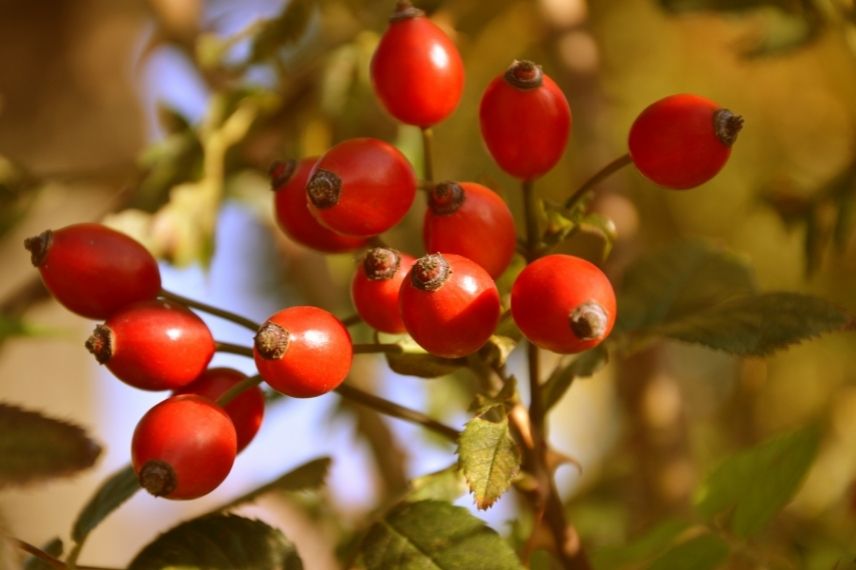
Fruits of the ‘Francis E. Lester’ rose
Hops, aromatic and aesthetic cones
Hops (Humulus lupulus) is a climbing plant with voluble stems, capable of attaching itself to all types of supports available. With a particularly rapid growth rate, this perennial liana can reach several metres in just one season.
It is valued for its large, beautiful, lobed leaves reminiscent of vine. They change colour in autumn before falling.
Hops are particularly known for the use of their aromatic fruits in beer-making for centuries. It is the female aments that are pendulous and oval-shaped, known as “cones”, that give rise to the fruits after summer flowering. These appear as achene measuring about 3 mm long and are attached at the axil of a large bract. They develop on female plants only after fertilisation by a male plant. Highly decorative, the female aments have a scaly appearance, resembling a pine cone. Initially a bright green, they take on yellow hues at ripeness, then turn brown as they age. Fragrant, these cones are covered in a yellowish powdery resin (lupulin). They are used both for their purported therapeutic properties and as decoration in charming floral arrangements.
Easy to grow, low-maintenance, and robust, this climbing plant is perfect in full sun or partial shade, quickly dressing up an unsightly structure or building.
For further reading: « Hops, Humulus lupulus: planting, cultivation, and use ».
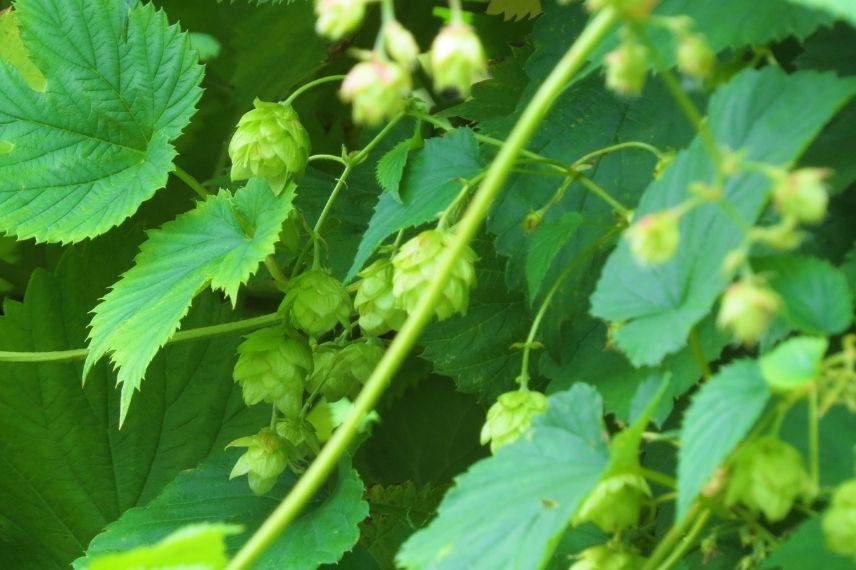
Hops cones (Humulus lupulus)
Discover other Climbers
View all →
Available in 0 sizes
Available in 0 sizes
Available in 0 sizes
Available in 0 sizes
Available in 0 sizes

Available in 1 sizes
Available in 0 sizes
Available in 1 sizes
Available in 2 sizes
Available in 1 sizes
Schisandra chinensis, edible berries renowned for their properties
Schisandra chinensis is a deciduous liana native to China, renowned for its fruits known as “five-flavour berries”.
Flowering occurs in white clusters at the end of spring. Our climbing plant then adorns itself with bright red berries, approximately 6 mm in diameter, grouped in clusters that can reach up to 20 cm in length. While they are particularly decorative, they also have the advantage of being edible. In traditional Chinese medicine, these berries are valued for their properties. They are used dried or ground into powder, but can also be consumed fresh. Their name comes from their taste, which combines the five flavours: salty, sweet, sour, spicy, and bitter. The harvest takes place at the end of summer and the beginning of autumn, from August to October approximately. As a dioecious plant, the schisandra will only bear fruit in the presence of at least one specimen of each sex.
Hardy and vigorous, this climbing plant can reach up to 10 metres at maturity. A low-maintenance plant that is not very susceptible to diseases, it will only require support to grow well. Provide it with a rich, fresh substrate (remaining moist), in a bright location.
For further reading: « Schisandra: planting, berry harvest, maintenance ».
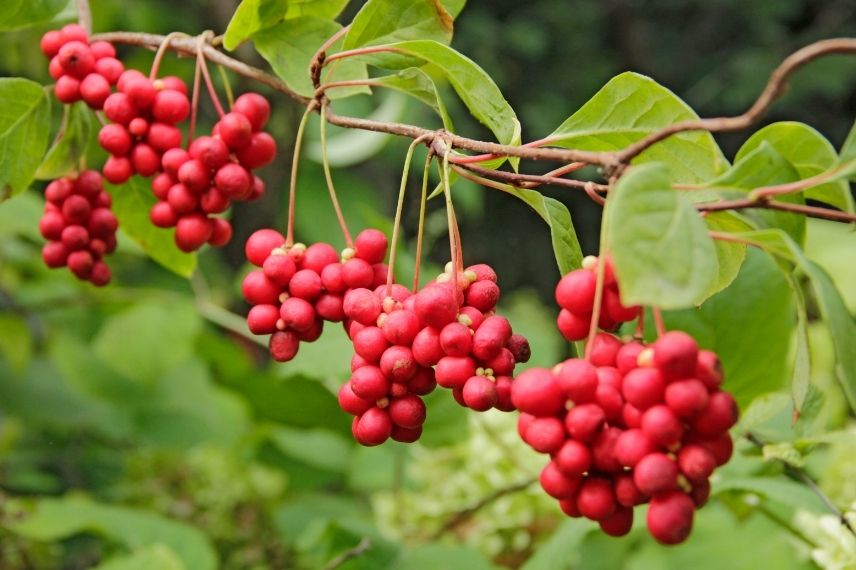
Red fruits of Schisandra chinensis
Read also
6 climbing plants with white flowersVirginia creeper, lovely blue berries for the birds
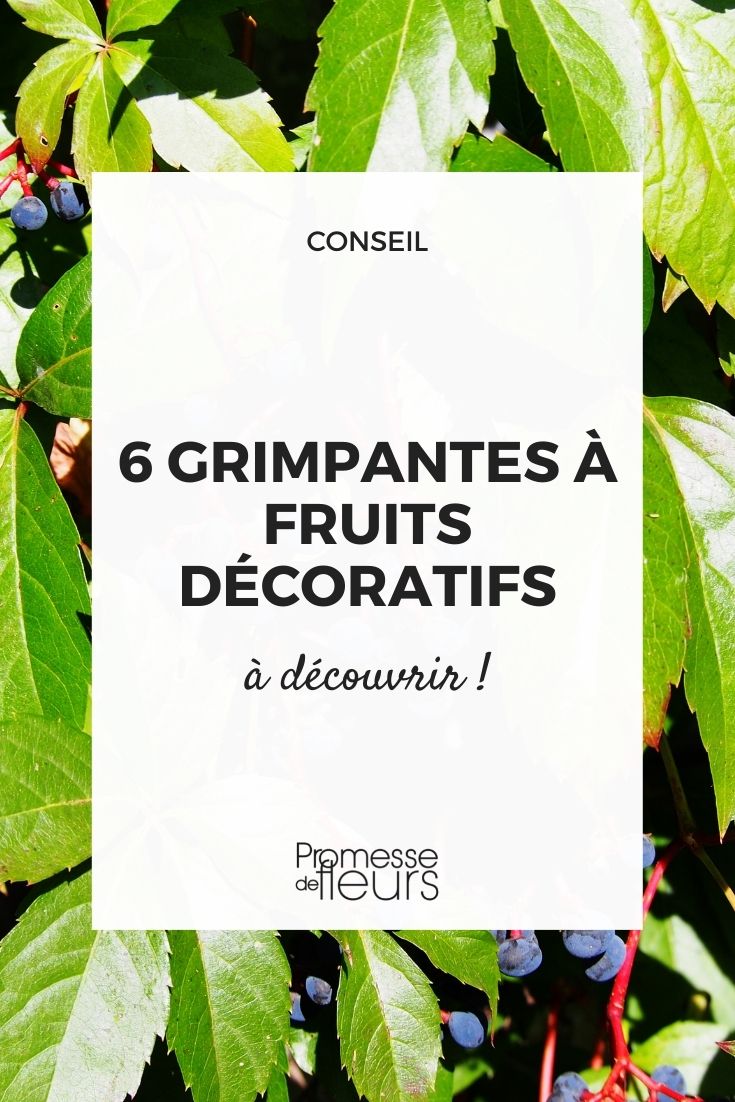
Parthenocissus quinquefolia is more commonly known as Virginia creeper. Its very discreet summer flowering gives way to fruits in the form of berries approximately 5 mm in diameter, of a beautiful blue-black. They are grouped in small clusters and appear at the ends of bright red stems. These fruits are very decorative but inedible, unlike those of the grapevine. However, they are a delight for birds, especially in winter when food becomes scarce.
The dentate foliage displays a lovely glossy dark green before turning vibrant red shades in autumn, then falling.
This climbing plant with a large habit can reach 10 metres in all directions at maturity. It has suckers that allow it to cling naturally to any support without causing damage. It is the ideal candidate for greening a wall or facade quickly, in shaded or semi-shaded exposure.
Hardy, easy to grow, and resistant to diseases, it is an ideal plant, even for beginner gardeners. It will only require maintenance pruning to contain its exuberance.
For further reading: “Virginia creeper: planting, care, pruning.”
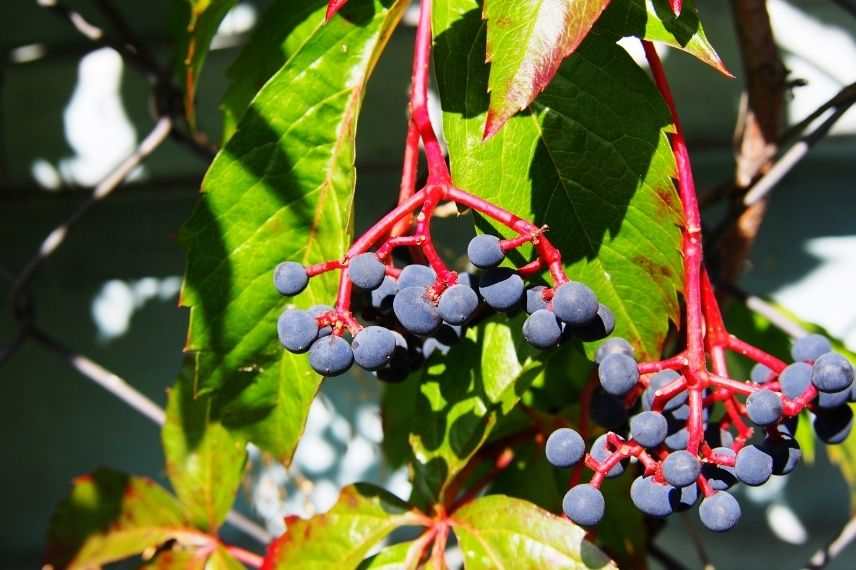
Fruits of the Parthenocissus quinquefolia
Ampelopsis glandulosa maximowiczii, a very original multicoloured fruiting plant
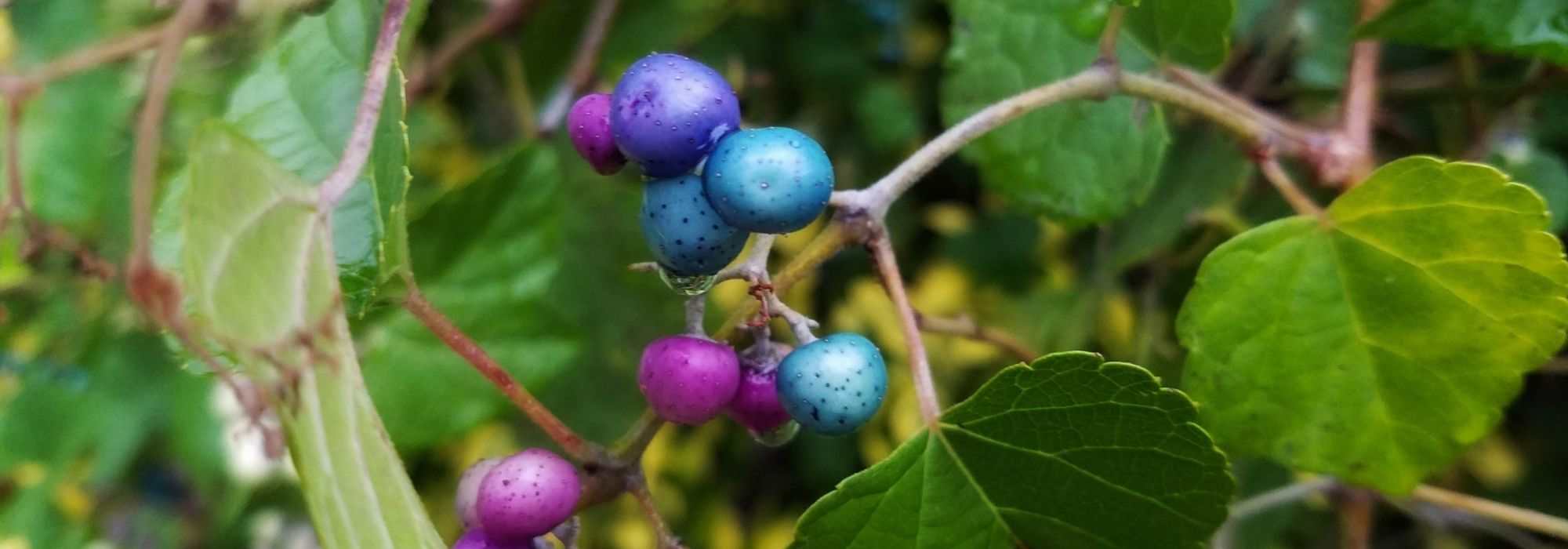
The Ampelopsis glandulosa ‘Maximowiczii’ is another Virginia creeper. A climbing plant, it is particularly interesting for its decorative fruits. Fruiting occurs in autumn-winter, after flowering. Our climbing plant then reveals adorable little berries with a slightly powdery appearance, measuring 5 to 8 mm in diameter. But it is especially their evolving colours that add charm and originality to this climber. Initially pale green, these little pearls then take on an astonishing turquoise blue hue, even blending pink and mauve, before turning purple. These colourful berries beautifully complement the bright green foliage, which becomes vibrant at the end of the season. The berries are also highly appreciated by birds.
With a more moderate growth than the Virginia creeper Parthenocissus, it reaches about 4 to 5 metres in all directions at maturity. Hardy, undemanding, and robust, it will cling with its tendrils to ascend a trellis or pergola.
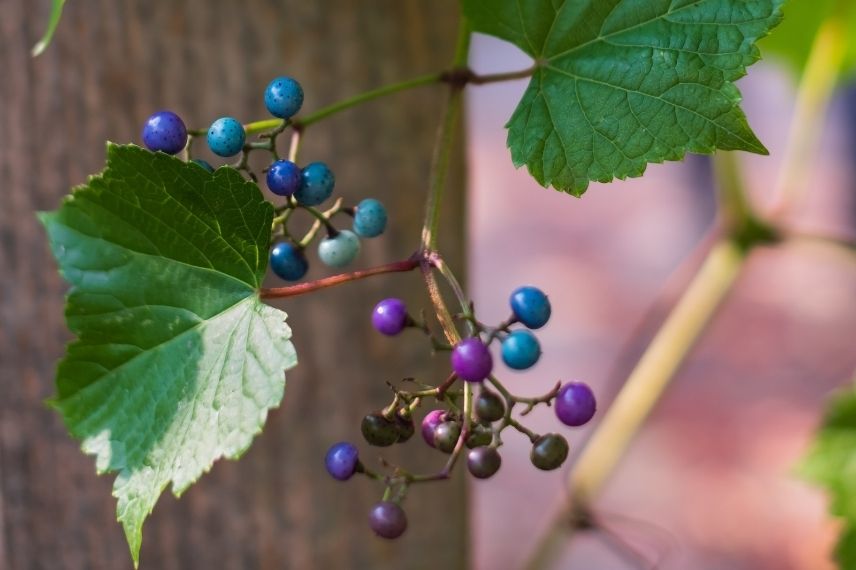
Fruits of the Ampelopsis glandulosa ‘Maximowiczii’
Lonicera periclymenum, flowers and fruits at the same time
Woodbine Lonicera periclymenum, like the variety ‘Scentsation’, is a climbing flowering plant that boasts numerous aesthetic qualities. From June to September, it first reveals incredibly fragrant tubular flowers in white and yellow, which illuminate as much as they perfume the garden.
By July, the first fruits appear alongside, further enhancing the ornamental aspect of the plant. The small berries are a beautiful translucent bright red, giving them a resemblance to currants, and measure about 8 mm in diameter. They are gathered in delightful clusters and persist late into the season. These fruits, inedible for mammals, bring, as is often the case, joy to the birds. The whole is complemented by a green, leathery, and evergreen foliage, provided it does not experience severe frosts in winter.
Of modest size, this honeysuckle reaches a maximum height of 3 metres and a spread of 2 metres. It can thus even be grown in small spaces or in pots on the terrace and balcony. Hardy, it thrives in full sun or partial shade, in soil that remains moist.
For further reading: “Honeysuckle: planting, pruning, and maintenance.”
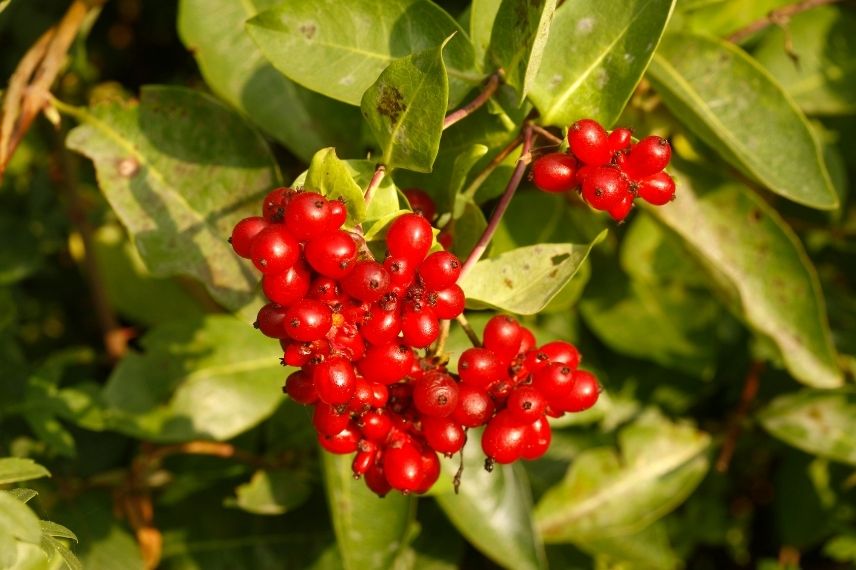
Fruits of Lonicera periclymenum
- Subscribe!
- Contents
Comments