






























5 groundcover brooms
The most beautiful carpet varieties
Contents
Brooms are small bushes that are covered in a multitude of flowers, often yellow, in spring, sometimes white, pink, or purple. There is a great diversity of species and varieties: some have a bushy habit and reach heights of 1 to 2 m, but there are also creeping varieties that form stunning carpets of flowers. They will easily find their place at the edge of borders, in rockeries, on slopes, or on walls. Well adapted to drought, brooms thrive in full sun and prefer well-drained, poor, and slightly acidic soils. Easy to grow, they require very little maintenance once established. Discover the most beautiful varieties of groundcover brooms, along with some ideas for pairing them!
And to learn more about their cultivation, feel free to check our complete guide: “Broom, Cytisus: planting, pruning, maintenance”

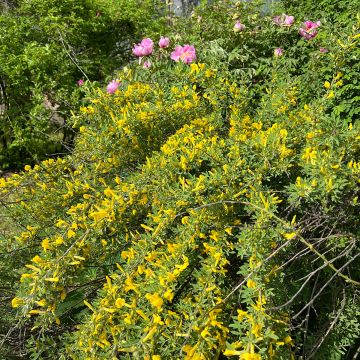
Lydia Broom, Genista lydia
Lydia Broom is a botanical broom, naturally creeping, native to the eastern Balkans and Asia Minor. It forms a shrub with a rounded and bushy habit, featuring arching, thorny branches at the tips. It does not exceed 60 cm in height, with a spread of about 1 m. It blooms in May-June and offers a spectacular flowering display: it is covered in a multitude of bright yellow flowers. Rich in nectar, they are favoured by pollinating insects. It also bears deciduous leaves, approximately 1 cm long, dark green to bluish. It requires a sunny location and well-draining, light, poor soil. It tolerates limestone without any issues.
Lydia broom is ideal for planting in a rockery, on a slope, or in a dry garden, in full sun. It pairs wonderfully with Mediterranean bushes and perennials. For example, plant it alongside lavenders, rosemaries, cistus, helianthemums, and Myrsinites spurge.
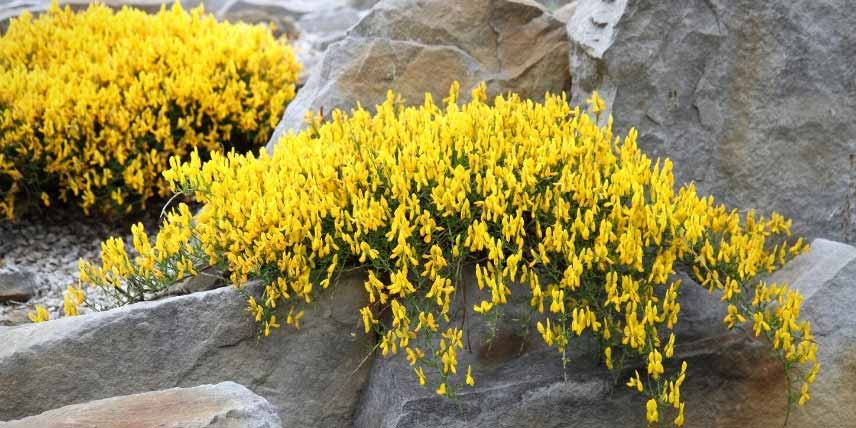
Genista lydia (photo: Cephas)
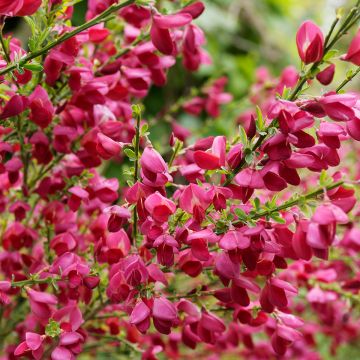
Purple Broom, Chamaecytisus purpureus
The Chamaecytisus purpureus (also known as Cytisus purpureus) is a broom native to South-Eastern Europe distinguished by its purplish pink flowers. It reaches a height of no more than 45 cm and a spread of 70 cm, forming highly ramified branches that are slightly erect before arching and creeping, bearing dark green deciduous leaves that are 1 to 3 cm long. From May onwards, the stems are adorned with countless papilionaceous flowers, ranging from pale pink to purplish pink. Once pollinated, they are followed by the appearance of black pods containing the seeds. Its running root system makes it particularly suitable for planting on a bank or slope, as it helps to stabilise the soil.
The Purple Broom can be grown in a pot and placed on a terrace or balcony, where its trailing stems will create a true cascade of flowers. It can also be included in the display of a romantic garden, featuring white and pink tones. Pair it with Geranium cinereum ‘Ballerina’, Geranium cantabrigiense, the Dianthus deltoides ‘Rosea’, and wallflowers like Erysimum ‘Rysi Moon’. Also consider the stunning Callistemon viminalis ‘Bright Pink’, which offers delicate flowering in bright pink bottlebrush-like clusters.
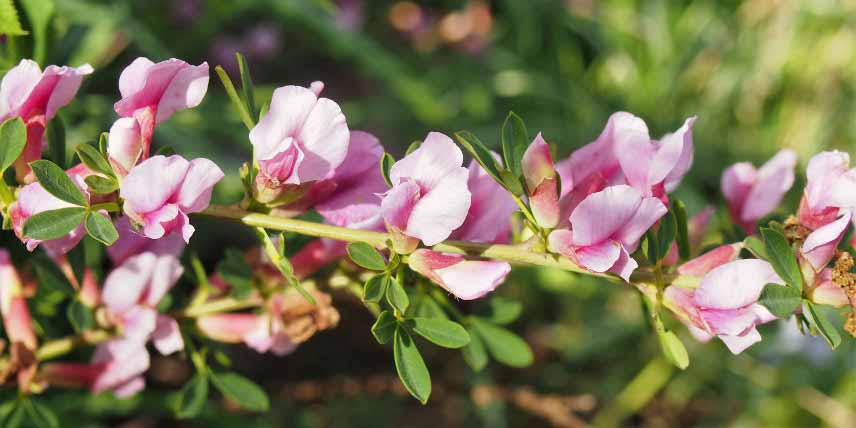
Chamaecytisus purpureus (photo: Agnieszka Kwiecień)
Discover other Broom - Cytisus
View all →
Available in 2 sizes
Available in 2 sizes
Available in 1 sizes

Available in 1 sizes
Available in 2 sizes
Available in 1 sizes
Available in 2 sizes
Available in 1 sizes
Available in 1 sizes
Available in 1 sizes
Spanish Broom, Genista hispanica
Spanish Broom is a small shrub forming a cushion about 50 cm high and 80 cm to 1 m wide. Slightly earlier than other brooms, it flowers as early as April, covering itself with a multitude of bright yellow flowers. Its stiff, thorny branches are adorned with small deciduous leaves. It tolerates limestone and drought very well, and is hardy down to -12 °C. As it is thorny, avoid placing it at the edge of a pathway or a frequently used area.
Incorporate it into a Mediterranean garden, alongside lavenders, santolines, cistus, and helianthemums. You can also play with complementary colours by pairing its yellow flowers with purple blooms, the opposite hue on the colour wheel! These two colours will enhance each other, ensuring an impressive display that catches the eye. Enhance the yellow hue of the broom with Alyssum saxatile, Draba aizoides, Erysimum ‘Jubilee Gold’, and Helianthemum ‘Wisley Primrose’. Then, introduce contrast with the purple flowers of Aubrieta ‘Cascade Purple’, Iris germanica ‘Pagan Dance’, Butterfly Lavender ‘Magical Posy Purple’, and Erysimum ‘Bowles Mauve’. You can also enjoy the stunning flowering of Muscari comosum.
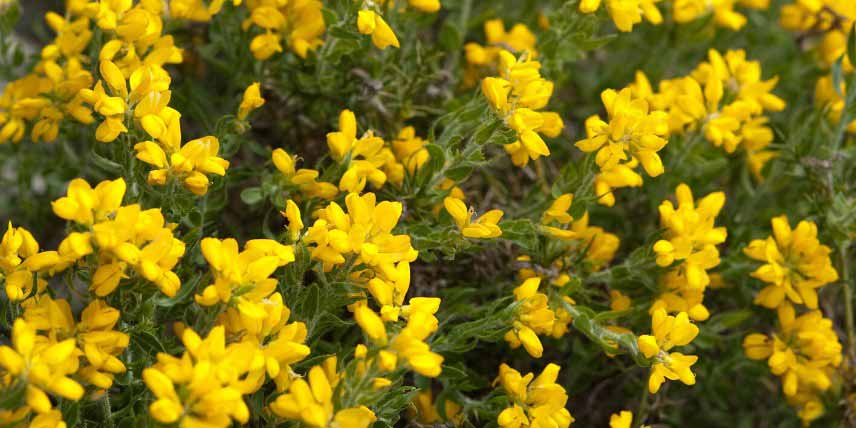
Genista hispanica
Read also
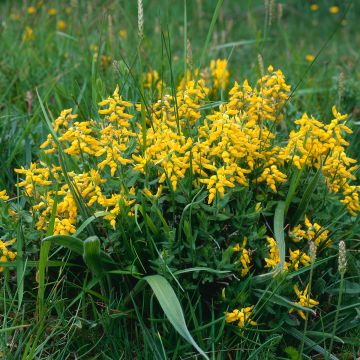
6 ideas for pairing broom plantsThe Winged Broom, Genista sagittalis
The Winged Broom or Genista sagittalis is a small undershrub with very distinctive, pale green, upright stems edged with three broad wings. This broom grows spontaneously in France, mainly in meadows, edges, and clear forests, on acidic soils, and up to 2,000 m in altitude. It measures about 30 cm in height and 1 m in spread, or even more, as it gradually extends its stems that form new roots upon contact with the soil. With its numerous small upright stems, it creates a grass-like groundcover. These also bear small, rather discreet ovate leaves. From May to July, it produces numerous bright yellow flowers, grouped in terminal clusters. They harmonise beautifully with the pale green of the stems. The flowers are followed by the appearance of villous pods, 1 to 2 cm long. Unlike the Spanish brooms and the Lydian brooms, this one is not thorny.
You can pair it with the beautiful flowering of Perennial Flax ‘Heavenly Blue’, as well as the silvery foliage of Senecio cineraria and wormwoods. If you wish to play with colour harmonies, favour yellow or orange flowers, such as those of Yarrow ‘Moonshine’ and ‘Terracotta’, Agastache ‘Apricot Sprite’, Kniphofia ‘Mango Popsicle’, and Hypericum olympicum.
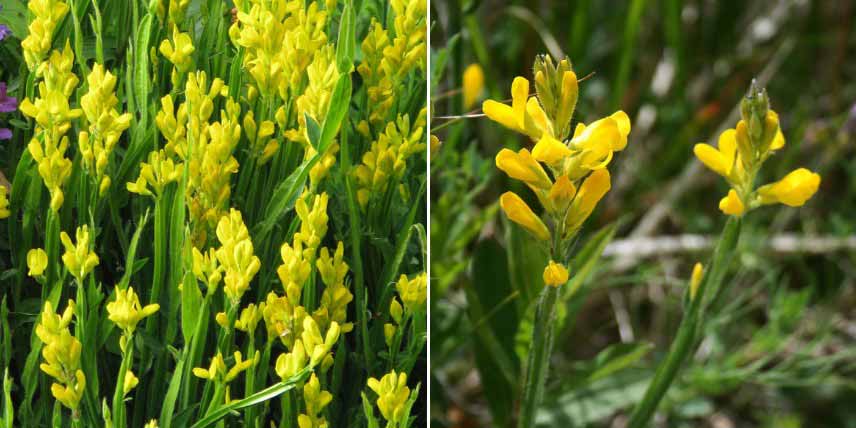
Genista sagittalis
Creeping Broom Cytisus kewensis
Cytisus kewensis forms a beautiful prostrate bush, standing 30 to 50 cm tall and spreading 1 to 1.5 m, or even more. It is a result of a cross-breeding between Cytisus ardonoi and Cytisus multiflorus, developed in the late 19th century at the Royal Botanic Gardens, Kew, in London. This broom produces flexible branches bearing deciduous, single, narrow, dark green leaves, measuring 0.6 to 1 cm in length. They are generally trifoliate (divided into three leaflets) but can also be simple. From May to June, it is covered in a multitude of white to cream flowers on the outside, with a more pronounced yellow at the centre. Quite large, they measure about 2 cm in diameter and are inserted at the axil of the leaves. They are fragrant and release a pleasant honey-like scent.
You can incorporate it into a graphic garden, alongside other blooms in subtle and elegant shades: white, cream, purple, bronze… Consider, for example, Agapanthus ‘Ever White’, Arabis caucasica ‘Snowball’, Cerastium tomentosum, Centaurea ‘Black Sprite’, and Iris germanica ‘Obsidian’. Also integrate some grasses, such as Chinese fountain grasses, Stipas, and blue fescues.
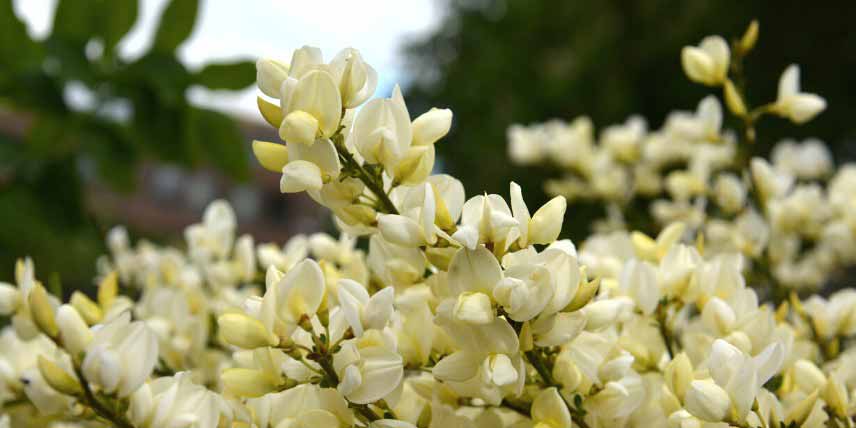
Cytisus kewensis (photo: Beartomcat)
- Subscribe!
- Contents

Comments