





























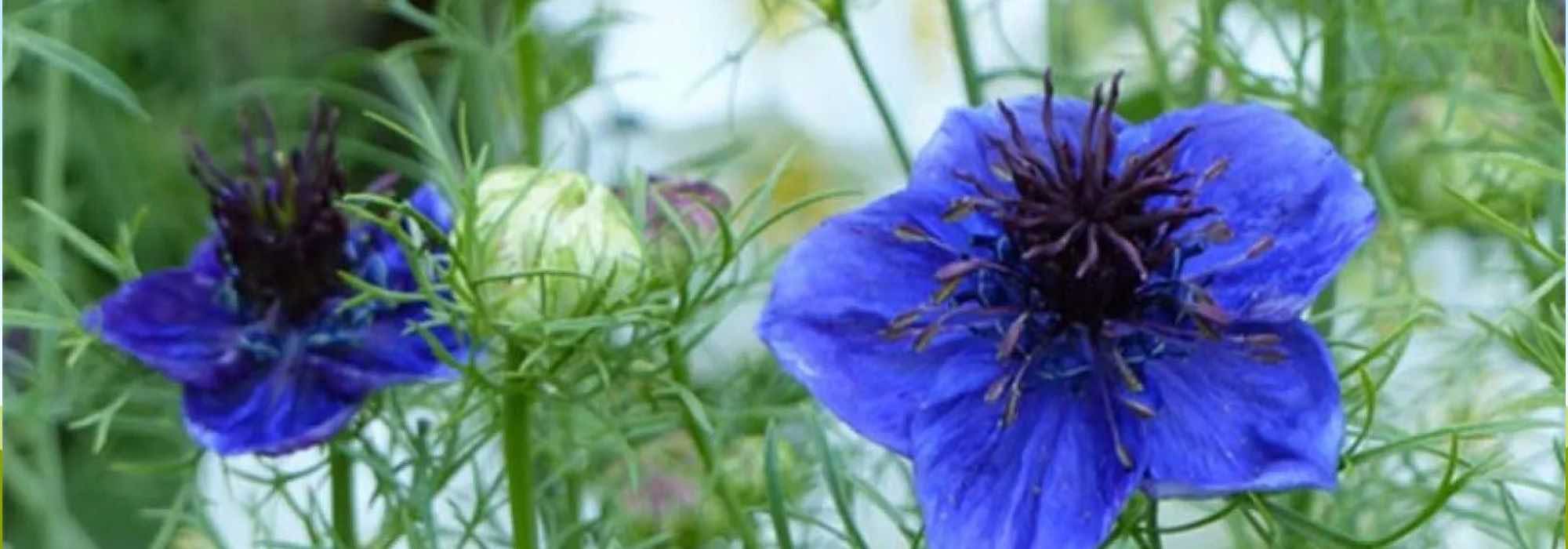
5 annuals for a spring-flowering garden
Selection of spring-flowering annuals
Contents
If you enjoy refreshing the colours and atmosphere of your garden or balcony each year, annuals are ideal. They allow you to refresh your beds or floral displays, either partly or completely. Another advantage is that, if you wish to keep them, they self-seed on site. Poppy, Cosmos, Nigella, Sweet peas and Diamond Euphorbia — discover our selection of annuals that will colour and bloom your garden or pots at varying times in spring.

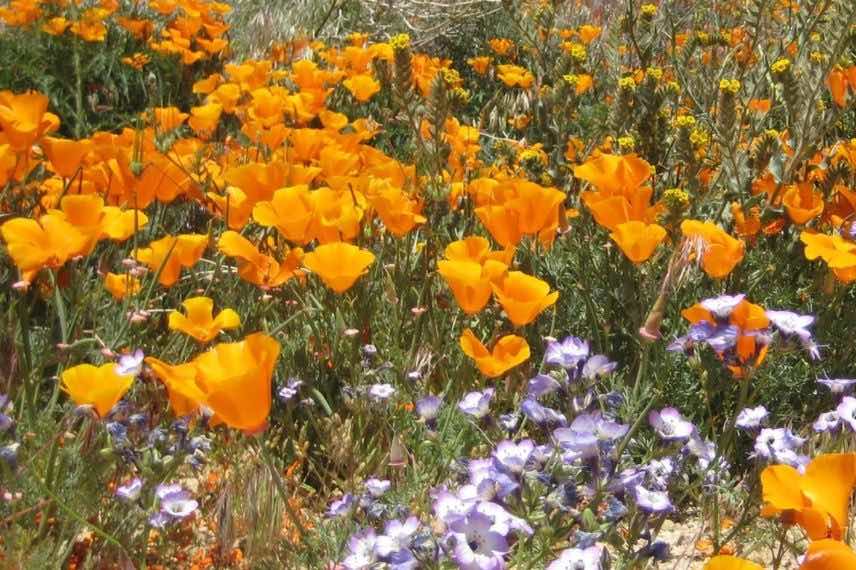
The Californian poppy 'Sun shades' – Eschscholzia mexicana
The California poppy ‘Sun shades’ – Eschscholzia mexicana is an annual plant that stands out for its long, bright flowering from June to September. It offers delicate cup-shaped flowers displaying vibrant shades of orange and yellow. This variety, derived from the Eschscholzia californica native to California and the southwestern United States, features deeply dissected foliage, ranging from blue-green to grey-green, providing a striking contrast with the colours of the flowers. The California poppy quickly forms a clump about 30 cm tall, with flowering from spring to summer depending on sowing time, attracting pollinators with its nectariferous flowers. After flowering, long slender capsules 7–8 cm long appear, containing tiny seeds. Adapted to a range of environments, from a vicar’s garden to refined borders, this plant tolerates heat, drought and poor soils, and self-seeds readily on light soil. Ideal for dry gardens or coastal borders and rockeries, it is easy to grow and blends into borders, in a natural garden, or in pots. Sow the seeds in a sunny position, from March to May or in September, autumn sowings providing flowering in spring. This plant prefers poor, well-drained soil. Place the seeds at 1 cm depth and 15 cm apart. Cover with soil and water regularly.
The California poppies are striking in a wild garden alongside other meadow flowers such as poppies or centaureas and grasses with a light, airy appearance. You can also play with colour contrasts by pairing the orange of the California poppy with blue-coloured plants, its complementary colour.
Read also
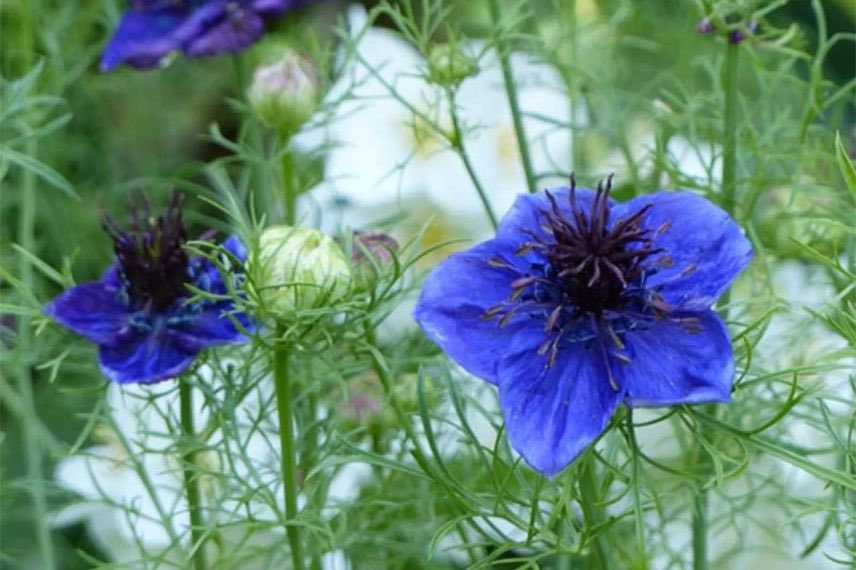
Sweet peas: the most beautiful varietiesSpanish Nigella 'Midnight Blue' - Nigella papillosa
Spanish nigella ‘Midnight Blue’ – Nigella papillosa is delightful with its star-shaped flowers in a deep bluish-violet shade that is unprecedented. They open to a heart almost black, in a frame of fine, cloud-like foliage. Flowering occurs between May–June and September, depending on the sowing date and the climate of your region. The flowers are 5 cm in diameter, arising from yellowish buds veined with green. They are followed by curious fruits, forming a capsule ornamented with styles laid horizontally and containing seeds. A very fast-growing and easy-to-grow flower native to the Mediterranean basin reaches a height of 70 cm and self-seeds in place. Sow the seeds in autumn in well-drained soil in full sun. Cover to a depth of 6 mm and space the seeds 30 cm apart.
Often grown in parish gardens, nigella also sits harmoniously in a naturalistic or wild-style garden, a rock garden, or a border of perennials that it lightens. You can pair it with shrubby salvias, ornamental flax, or bush roses. It can be used as cut flowers.
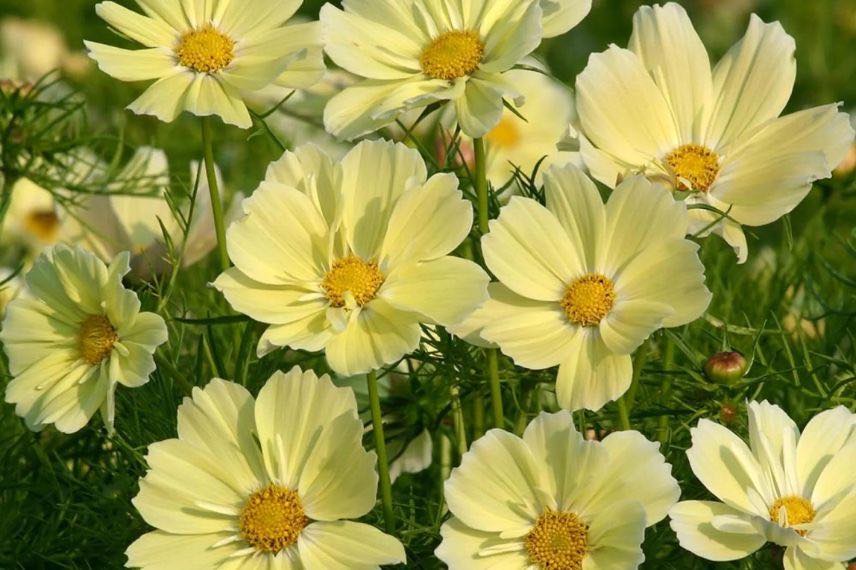
Yellow Cosmos 'Xanthos'
Another delicate and charming flower, Cosmos graces your garden with its cottage-garden blooms set against a backdrop of airy foliage. Cosmos ‘Xanthos’ yellow features cup-shaped flowers in pastel yellow. This annual plant exhibits a long flowering period, from May to October. Stems are sturdy and branched, in dark green colour. The flowers have pleated petals with a small golden disc at the centre that turns brown. They attract pollinating insects and butterflies and look superb in cut-flower arrangements. With a compact, bushy and dense habit, it reaches a height of 60 cm and a width of 40 cm, and benefits from very rapid growth. Easy to grow, it enjoys sun and neutral soil that is moderately fertile, cool and well-drained. Plant it in spring after the last frost. To encourage branching and heavier flowering, pinch the tips of the shoots and remove faded flowers as they appear. Drought-tolerant, this plant is not very susceptible to disease but can be attacked by aphids. It is advisable to water regularly during prolonged dry spells and to mulch around the base to keep it cool.
This cosmos grows just as well in a garden as in a container on a balcony. It creates a cottage-garden atmosphere when paired with white gauras, calendulas or rudbeckias.
Read also
Annuals: seeds, plug plants or pots?The Euphorbia 'Diamond Frost' - Chamaesyce hypericifolia
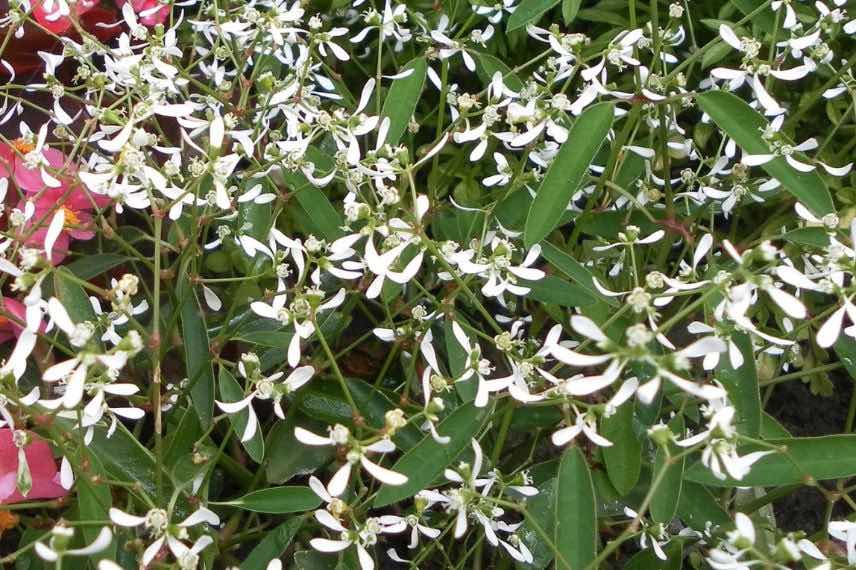
Euphorbia ‘Diamond Frost’ – Chamaesyce hypericifolia is a frost-tender plant grown as an annual that forms a cloud of tiny pure-white flowers on a shrub of small, elongated, soft-green leaves. It forms a tuft about 70–80 cm across in all directions and enhances any plants and flowers with which it is paired. Its flowering resembles snow crystals and lasts from May to October. Having become essential in floral displays, this small Euphorbia pairs with any type of plant and helps lighten the overall display. You can pair it with geraniums or pelargoniums, petunias or hydrangeas, among other flowering plants. With this Euphorbia, almost any combination is possible.
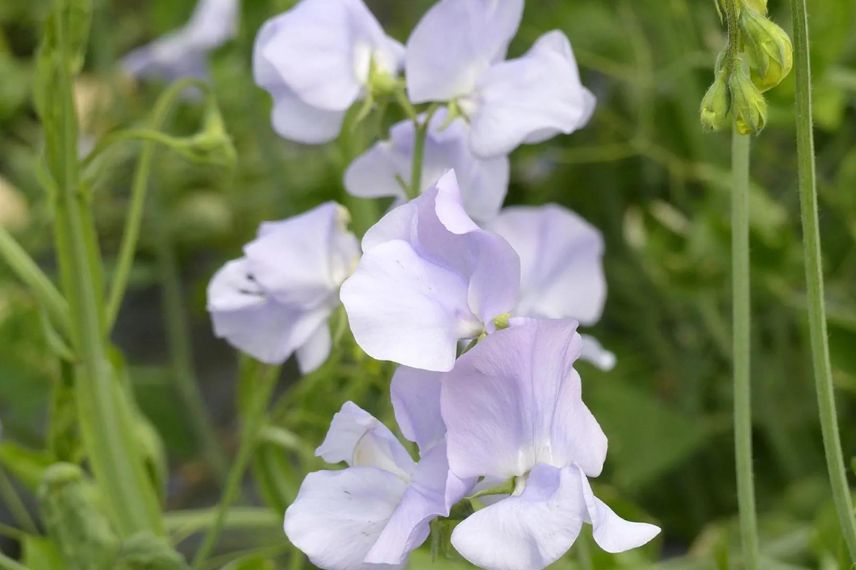
Sweet pea 'Spring Sunshine Light Blue' - Lathyrus odoratus
The sweet pea ‘Spring Sunshine Light Blue’ – Lathyrus odoratus is a new variety that offers early flowering and good heat tolerance, particularly in Mediterranean climates. Floriferous and vigorous, this climbing annual plant reaches a height of 2 metres and flowers from April to June. The sky-blue flowers are scented and borne on sturdy stems with light-green foliage and with an astonishing quadrangular shape. They appear in clusters and are composed of 5 petals forming a lip. After flowering, it produces fruits that resemble flat pods containing seeds. With rapid growth, this plant will cling to the support you provide thanks to its tendrils. It looks wonderful in the garden, but also in cut flower bouquets. Easy to grow, it can be sown under cover in September or October in groups of 2–3 seeds at a depth of 2.5 cm. It requires a few particular cares: pinching back the seedlings, keeping the potting compost fresh. When transplanting into open ground, place the plant in sun in well-drained soil and feed it with a fertiliser for flowering plants. Water regularly, provide a support to climb and deadhead spent flowers as they appear to achieve abundant flowering.
An essential for cottage gardens or a wild, natural look, pair this climbing plant with foxgloves, campanulas or hollyhocks for a natural look.
- Subscribe!
- Contents

Comments