





























"O Christmas tree, O Christmas tree / How I love your greenery! / When, in winter, woods and fields / Are stripped of their charms, / O Christmas tree, O Christmas tree, / You keep your adornment." A winter staple, this song celebrates the persistence of the fir tree, which has become one of the botanical symbols of Christmas festivities. While the tradition dates back a few centuries, the decorated fir tree has only recently taken its place in living rooms.
However, Christmas, as a religious celebration, also honours other plants such as mistletoe and holly, both rich in symbolism. Not to mention the grains of wheat, while hellebores bloom in the garden.
The Fir tree: When the sun triumphs over winter...
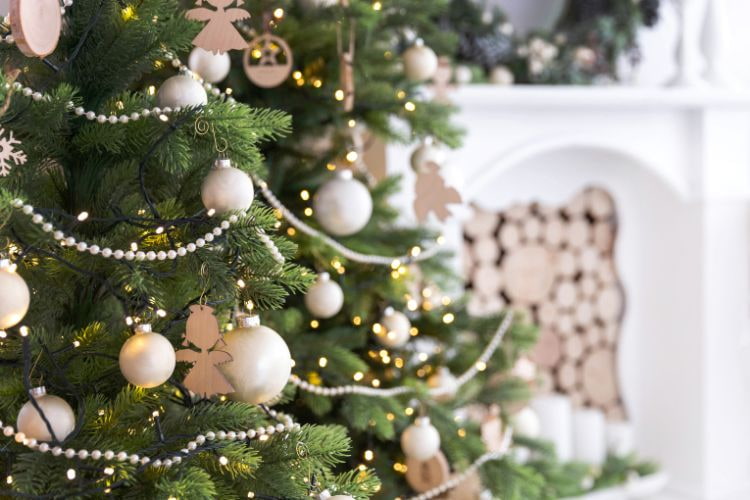
Whether it's a fir (Abies), a pine (Pinus), or a spruce (Picea), the fir tree, having become the most prominent symbol of Christmas, has pagan origins. Every year, a few days (or weeks) before Christmas, families rush to acquire their fir tree, which they will adorn with baubles, garlands, decorations of all kinds, and other sweets... before unceremoniously discarding it in the street. This beautiful fir tree increasingly becomes a lovely mulch to adorn and protect city flower beds.
Yet, behind this fir tree lie numerous traditions and beliefs. These date back to antiquity, as the fir has always held a prominent place in pagan celebrations related to the winter solstice. Simply put, with its lush green foliage, it symbolises the sun and life triumphing over winter, darkness, and the death of other plants.
As for how the fir made its way into our living rooms, adorned with all its decorations, historians' opinions differ. Each one wanting to claim its origin! However, it is certain that this fir originates from the forests of Northern Europe. Latvia? Estonia? Both countries are still disputing its invention... but it is rather towards Alsace in the 16th century (which was German) that we should turn. Protestant families from Germany and Scandinavian countries embraced this tradition, and by the 18th century, through emigration and arranged royal marriages, it spread throughout Europe. Thus, Marie Leszcynska, the Polish wife of Louis XV, installed the first Christmas tree at Versailles in 1738. Queen Charlotte, heir to a German duchy, married to King George III in the 18th century, did the same in the British kingdom. And each has made it a symbol, adapting it to their beliefs, traditions, and history.
As for the baubles hanging from the branches, they also originated in Alsace. In the 16th century, to pay homage to the Garden of Eden, people would hang beautiful red apples on this fir tree. One year, when the harvest was disastrous, a glassmaker had the idea of blowing glass baubles. The story was born, and plastic took over...
Holly, a symbol of immortality
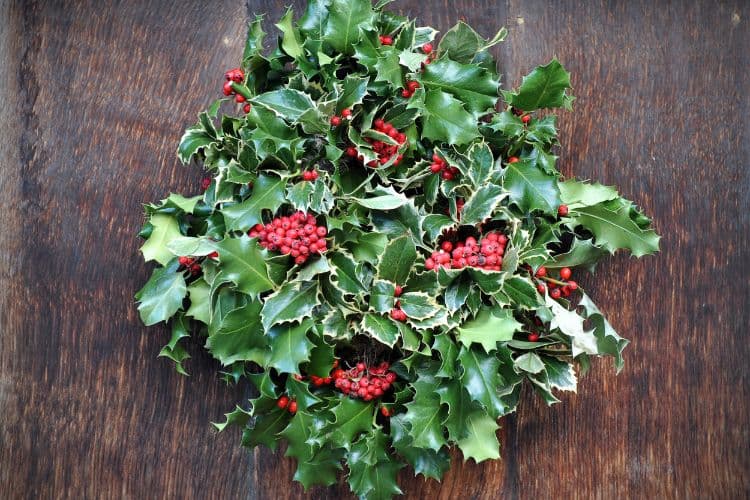
Very present in our interiors, holly (Ilex) is quite decorative with its lovely, glossy green leaves and bright red berries. This plant also carries some beliefs and legends related to Christian Christmas. The leaves are evergreen and refer to eternity and immortality. As for the thorns, they remind us of Christ's crown, and the berries represent the blood shed by Jesus on the cross.
Holly is also found in a legend related to the Holy Family. A legend, as the Gospel does not mention it. Mary, Joseph, and the infant Jesus, during their flight to Egypt, were pursued by Herod's army. They hid behind a holly bush that spread its branches. The Holy Family escaped the soldiers' wrath, and Mary blessed the holly to make it immortal throughout the year. Others see in holly a reference to Moses' burning bush.
In other more Nordic beliefs, holly is a good luck charm. It protects against witches, negative and malevolent spirits, curses, and divine wrath... For all these reasons, a holly wreath was placed on the doors of homes. In Celtic beliefs, it was offered by Druids to the population to bring happiness. And among the Romans, it was newlyweds during the winter solstice who received it to bless their union with success.
Today, it can be found on church altars for Christmas.
In Christmas decor, holly is everywhere. Already because it naturally displays the colours of Christmas! A few branches placed on the festive table or in a vase, on a lovely white tablecloth, are enough to create an atmosphere. Likewise, it is hard to overlook the door wreath, where holly will be mixed with fir branches, pine cones dusted with white, and red ribbons...
Whatever the place of holly in your home, remember that its berries are toxic... and especially very attractive to children. So, refrain from leaving them within their reach, or even that of your young pets.
Mistletoe, another symbol of eternity
Let us open this page of history, traditions, and legends by recalling what mistletoe is. Mistletoe is an epiphytic plant known as hemiparasitic, meaning it has no roots and parasitises host trees, often already weakened by disease or age, from which it sucks sap and minerals. It is frequently found on poplars, willows, linden trees, or even fruit trees like the apple tree. However, it rarely settles on oaks and beeches.

Like holly, mistletoe is very present in mythology and history, attached to many legends. It must be said that mistletoe draws life from the death of trees. Thus, Celtic Druids would cut mistletoe on the sixth day of the Celtic year, as its branches symbolised perpetual life. They also attributed medicinal and magical properties to it. The Druids harvested this mistletoe with a golden sickle. And that which grew on an oak, extremely rare, was imbued with magical virtues.
The Greeks, during the Saturnalia, placed mistletoe at the centre of marriage rituals. It is certainly from there that all the traditions surrounding mistletoe originated. Thus, at the end of the year, a young girl accepting a kiss from a suitor was promised to marry within the year. For Christmas and especially New Year's Day, it is also customary to kiss under a sprig of mistletoe to ensure prosperity and long life. This is where the traditional "Happy New Year" originated.
However, like holly, remember that mistletoe berries are toxic. And at the same time very attractive to young children. That is why it is best to place them out of reach. So why not revive the lovely tradition of kissing under a sprig of mistletoe suspended from the ceiling?
The three grains of wheat for Christmas
Twenty days before Christmas, on the day of Saint Barbara, the tradition of planting grains of wheat from the previous harvest in three saucers still endures in Provence. In pagan tradition, farmers feared that the earth would not nourish them. They offered this wheat to the earth, which was to germinate by Christmas. From then on, the harvest was expected to be good.
The Catholic Church has adopted this tradition, with the three saucers symbolising the Trinity. They are no longer placed in the fields but on Christmas tables. Afterwards, they are placed in the nativity scene until Epiphany.
Hellebore, the false Christmas rose
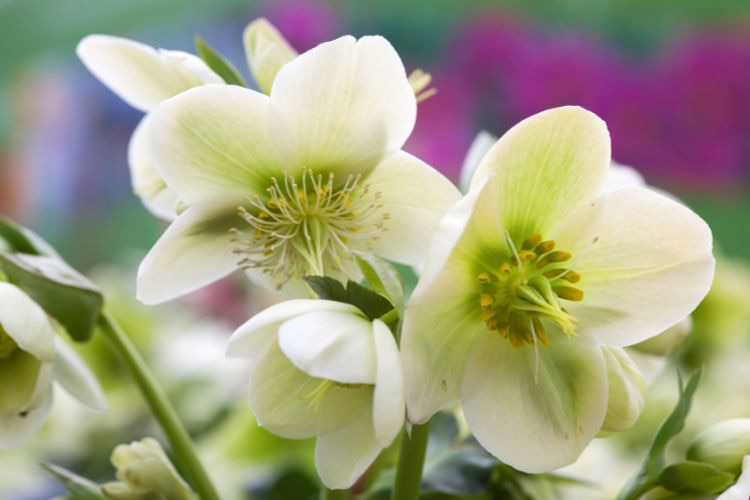
The hellebore is a lovely perennial that blooms from November to February, depending on the variety. Naturally, this beautiful winter flowering has inspired a legend involving a shepherd or shepherdess, depending on the version! This shepherd (or shepherdess) was on their way to Bethlehem to visit the Child Jesus, feeling a bit disheartened in the face of the Magi, their arms laden with gifts. They had nothing to offer. They were very sad: tears flowed from their eyes, which immediately transformed into flowers at the touch of an angel. Thus, the hellebore was born.
- Hellebores: the Sure Values
- Hellebores: Planting and Cultivating
- Hellebore: A New Generation in Our Collection
Poinsettia, the plant of Christmas colours
A few weeks before Christmas, it is also an indoor plant that floods the stalls of florists and supermarkets. Recognisable by its red bracts, the Poinsettia (Euphorbia pulcherrima) blooms in December, with exotic origins from Mexico. There, it was revered by the Aztecs. The legend says that a goddess, who died of a broken heart, shed a few drops of blood on its leaves.
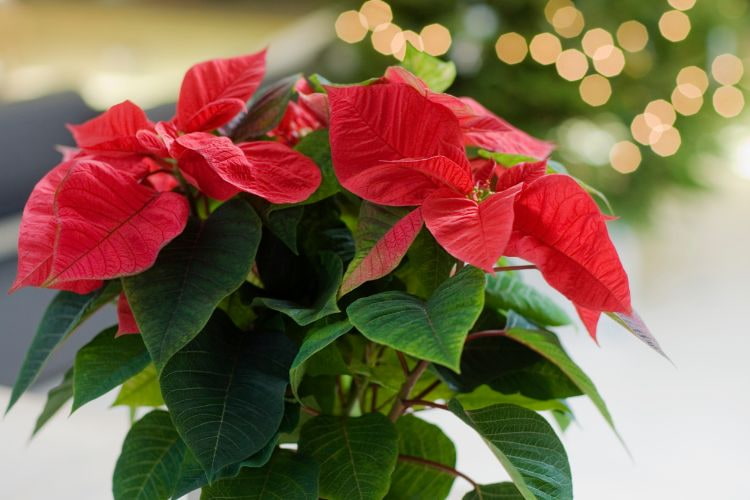
Discovered by Mr. Joel Poinsett in 1828, the plant became a true success in the United States. The man passed away on December 12, 1851. Since that day, December 12 has been declared Poinsettia Day in the United States. Not without purely commercial intentions!
To learn more: Cultivating the Poinsettia, the Essential Christmas Plant.

Comments