





























“I would like a beautiful garden, but without maintenance”. This is what landscapers hear all year round.
Walking barefoot on the grass, admiring the flowers, napping under the trees, hidden by a hedge… a dream.
Mowing, grabbing spade, gouge, pruning shear, and shear: welcome to reality!
A maintenance-free garden: is it possible?
At the risk of seeing you flee, I’ll tell you bluntly: a maintenance-free garden does not exist. Or it’s not a garden, but a pseudo-vegetal landscaping, decorative but static, lifeless and soulless. However, it is entirely feasible to limit the maintenance of the garden, and here’s how.
Limiting maintenance in practice: how?
Garden maintenance is a relative concept that varies depending on the gardener's temperament and level of expectation. Indeed, what is considered a pleasure for some will be felt as a chore for others. Nevertheless, among the tasks that a garden entails, mowing, hedge trimming, and weeding are often the most dreaded.
- Mow less and less often
Limiting mowing in the garden is not an easy task. However, there are a few solutions.
The first is to invest in a robotic mower. I won’t elaborate, we’ve already discussed it here.
The second is, if you have a garden of sufficient size, to practice differentiated mowing.
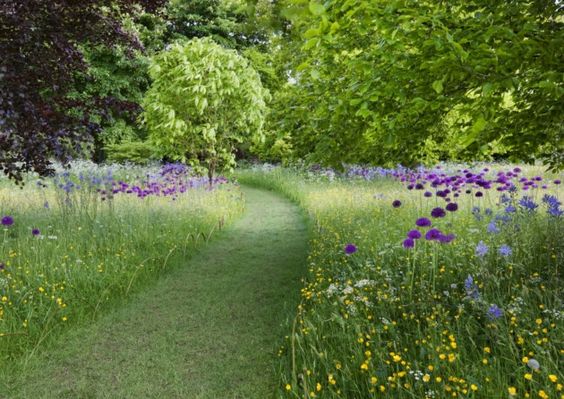 A fine example of differentiated mowing - Source: Pinterest
Inspired by ecological management techniques for green spaces, this type of mowing consists of not mowing the entire garden, but retaining islands or strips of grass of varying heights. By allowing certain areas to grow naturally, you will reduce the mowed area on a weekly basis during the peak season. Differentiated mowing can be practiced everywhere and is particularly recommended in orchards.
The third solution is to choose, from sowing, a “low maintenance” lawn. Composed partly of micro-clover, this lawn grows slower and remains green in summer, even without watering.
Finally, know that grass is not at all essential in a small garden (unless, perhaps, you have young children or grandchildren). A troublesome small lawn can be advantageously replaced by large beds of low bushes and perennial plants, possibly crossed by wooden walkways.
Discover Louis's natural lawn in our video.
- Hedge trimming: long live the free hedge!
When creating a garden, the second most frequent request is: “I would like a fast-growing hedge”.
Indeed, preserving privacy is often a priority, and rightly so. To quickly obtain a tall and sufficiently thick hedge for effective screening, you need to plant closely, which leads, in the short term, to frequent and significant trimming.
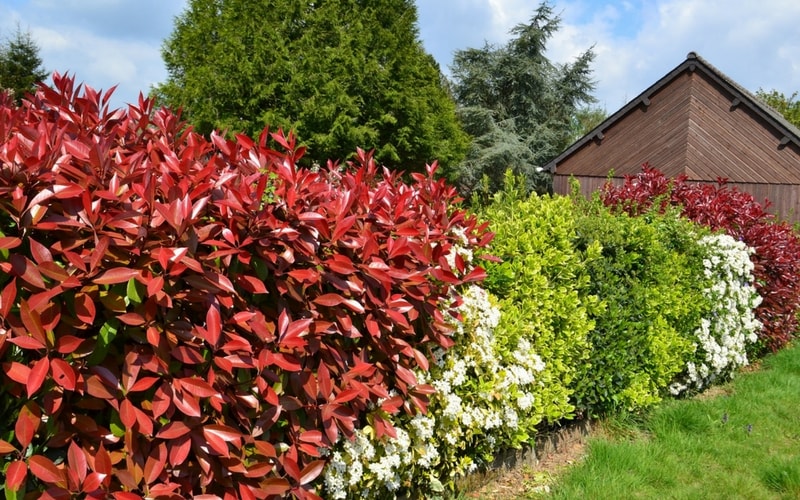 This type of varied hedge effectively screens but requires regular maintenance
To avoid this chore, whenever possible, prefer the free hedge. By planting bushes in a staggered manner and spacing them well according to their size when mature, you will achieve a beautiful hedge without having to trim it every year.
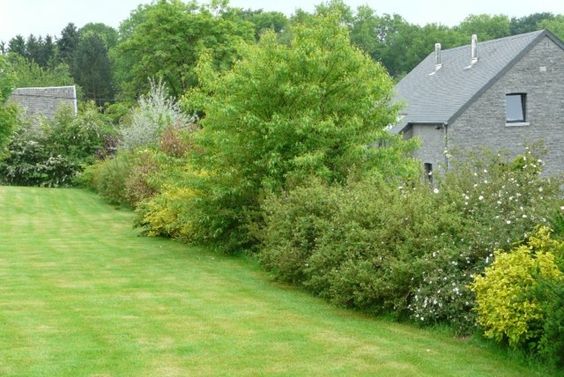 The free hedge: more "bulky" but maintenance-free, or almost - Source photo: Pinterest
Wherever the necessary space is insufficient, why not install a fence or a privacy screen, preferably a bit open to limit the feeling of confinement, and dress them with climbing plants. The effect will be just as aesthetic as a hedge styled as a green wall and… maintenance-free!
- Weeding, the end of the nightmare
Weeding is undoubtedly the most dreaded task for gardeners. This explains the enthusiasm for planting fabrics, which are not, however, a long-term solution. To limit the hunt for “weeds”, it’s quite simple:
- Carefully prepare the soil by removing all adventive plants and as many roots as possible.
- Mulch generously and add mulch regularly in the first few years.
- Install groundcovers because, remember: nature abhors a vacuum. These, whether perennial or shrubby, are champions at occupying the ground… even in difficult situations like slopes or dry shade like under trees.
Note, by the way, that if you anticipate a bit when creating a bed (or vegetable garden), you can weed by occultation, by laying down a tarpaulin, an old piece of carpet, or cardboard for a few months. It’s not very aesthetic, but effective and requires almost no effort.
- Flowers every year, without repeated planting or watering
Does a garden without flowers deserve its name? No! Rather than planting annuals, turn to the bulbs that naturalise, perennial plants, but also grasses, which return every year.
Planted with good density, they will quickly occupy all the space. Their maintenance is simple: it usually consists of a simple cutback at the end of autumn or early spring. By leaving the cuttings on the ground, roughly cut, you will achieve two goals: maintaining the mulch… and avoiding weeding!
Hardy and easy to live with, many perennial plants are even suited to gardens without watering. Euphorbias, salvias, achilleas, stipas, sedums, wormwoods, and Buenos Aires verbena, to name a few, are true camels and withstand the driest summers while often offering beautiful flowering.
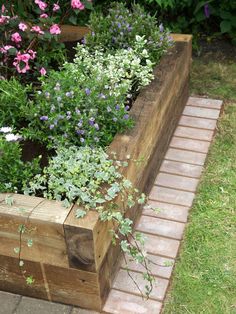 an example of a border that facilitates mowing - Source: Pinterest
Rather than installing raised borders, prefer flat borders or cut your beds with a spade and reserve an unplanted strip for wheel passage… It’s simple and will save you a lot of time.
Finally, opt for a soft and natural garden style, rustic or English… much less demanding than contemporary designs with strict lines, which do not forgive any slack.
The mineral garden: a garden without maintenance?
The gravel garden, Japanese or Mediterranean, is often proposed as a solution to lack of time (or courage!). It often consists of large areas covered with minerals, sometimes coloured or not, and planted here and there with a few bushes and grasses.
This is perfect in certain regions, in poor or chalky soil, and if you accept that the garden follows the dynamics of spontaneous sowing... like here, in Dungeness:
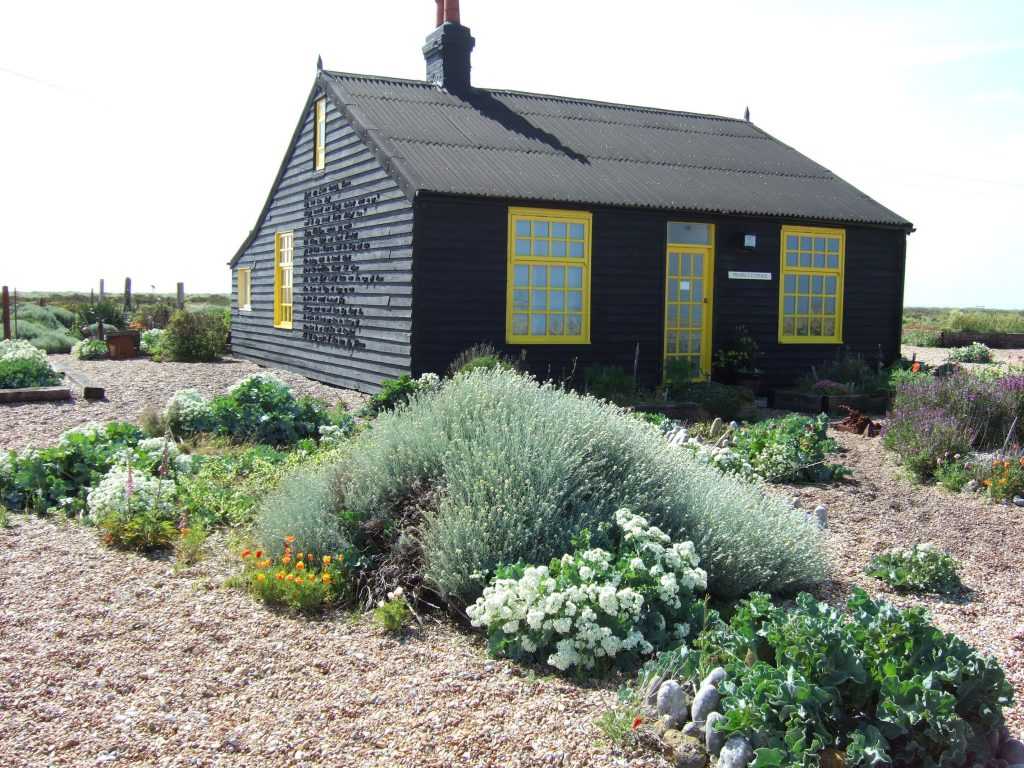 Derek Jarman's garden - Dungeness (Kent) - Source: Wikipedia
In this style of garden reinterpreted (with more or less elegance, by the way), if you think you can maintain the initial state without having to intervene, you are mistaken.
Indeed, over time, wandering plants and adventive plants will settle just like in any other substrate. Worse still, they will stand out like a sore thumb and will be difficult to dislodge, whereas they would pass almost unnoticed in a more natural, generously planted bed.
In conclusion, I would say that the best remedy for garden maintenance is to start gardening, really… and no longer just “cleaning”. This may seem a bit contradictory, but if you plant wisely: with good, hardy, and drought-resistant plants, in the right place, with appropriate spacing, you will ultimately reduce the number of interventions... and the garden will become nothing but pleasure (and the satisfaction of work accomplished)!

Comments