





























Your Gunnera manicata has displayed stunningly large and impressive leaves all summer? Well, it’s high time to protect it if you haven’t already! Why, when, and how? We’ll tell you everything!
It flaunts its bodybuilder foliage all summer... but at the slightest breeze, it shivers and catches a cold! Yes, the Brazilian Gunnera is a delicate little being that deserves attention in winter, or you may not enjoy the spectacle of its large lush leaves the following year. So now, before the severe frosts of January, is the time to protect this creature from the cold.

Gunnera manicata in July.
Step 1: Cut the leaves
First, cut all the leaf stems (the petioles) down to the bud to expose the central bud of the plant. Use a machete, or if not available, pruning shears to cut the petioles. Don’t forget to wear gloves; the petioles are prickly!
Step 2: Protect and pamper the bud
What to do with the dead leaves accumulating in the garden? A thermal protection for the Gunnera, of course! Place a thick layer of dead leaves at the base and over the bud. Don’t hesitate to cover the bud with at least 30 cm of dead leaves. It may seem thick, but remember that they will compress during winter. And it’s this large bud that ensures the plant’s longevity. If it is damaged by frost, the plant will die or struggle to survive (and may die the following season). So, don’t skimp on the thickness of dead leaves. If you don’t have dead leaves, straw, flax shavings, or wood chips will do the trick.
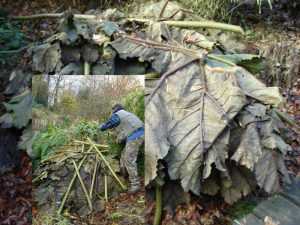
The stump of the Gunnera is covered with dead leaves and then covered with its own leaves.
Step 3: Cover and let it rest all winter
The leaves of the plant that you have cut down serve as protection against moisture. Recut them by separating the lamina from the petiole. Place the lamina upside down on the protection; they will shield against rain and limit the degradation of the dead leaves. Finally, place the heavy petioles on top to hold and stabilise against winter storms!
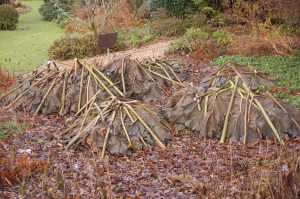
Winter protection for the Gunneras.
Step 4: Don’t touch anything!
It may sound silly, but when the end of winter arrives, we are tempted to remove all those dead leaves to let the plant "breathe." We even see new shoots emerging, so why not clear them from this layer of old, unsightly leaves?
Removing the protection when the plant starts to grow is the best way to damage, or even nullify, the protective work done before winter. The heat released by the decomposition of the dead leaves + the lengthening days = early stimulation that encourages the plant to produce its new leaves, even when morning frosts persist. The young tender leaves develop in a warm cocoon and harden as they grow and reach the surface. As a result, they emerge earlier but are acclimatised and better equipped against late frosts. So leave the protection in place until May; the dead leaves will continue to decompose and provide all the necessary nutrients for an explosive growth of your Gunnera’s foliage.
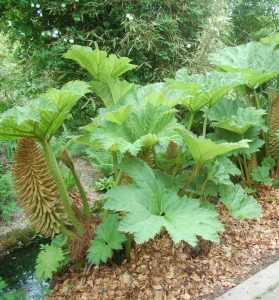 Decomposed dead leaves make excellent compost to give a boost at the start of the growing season.

Comments