





























Very similar to a wisteria, Milletia japonica 'Satsuma', or summer wisteria, is an original climbing plant that hails from Asia, specifically Japan. As voluble as a wisteria, its young shoots wrap around any support, allowing it to reach heights of 5 to 6 m.
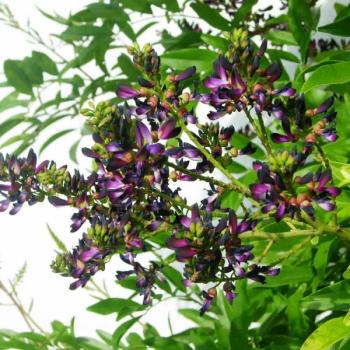
Milletia japonica 'Satsuma'
An original "wisteria": the summer wisteria or Milletia japonica
The originality of this climbing plant, also known as "Red Wisteria", lies in its flowers. They are a magnificent crimson red mixed with violet, of rare intensity, and they bloom not in spring, like many wisterias, but in mid-summer, around July-August, renewing until late in the season. Although spectacular for their crimson red mixed with violet colour, they emit a subtle fragrance, less intense than that of classic wisterias, but still pleasant. Additionally, its apple-green foliage is evergreen, which is a significant advantage when wanting to hide an unsightly wall.
Good to know: the flowers of Milletia japonica 'Satsuma' are very attractive to bees and other pollinating insects, which come to forage in the height of summer, a time when floral resources can be scarce.
A lovely climbing plant that grows quickly…
The Milletia japonica 'Satsuma' is a fast-growing climber, capable of reaching 5 to 6 metres in just a few years if conditions are right. It requires only light pruning at the end of winter to remove dead wood and balance its structure, while guiding its voluble shoots onto a solid support like a trellis or pergola to help it develop well.
...but with somewhat limited hardiness
Milletia 'Satsuma' has many advantages, except perhaps its hardiness, which prevents it from being grown outdoors in cold regions. Hardy down to about -7 °C, this climbing plant is suited to mild and temperate regions. However, when grown against a south-facing wall, its hardiness is enhanced; indeed, older specimens have survived temperatures of -12 °C for short periods in the Paris region. Some even claim it could withstand down to -15 °C. Nevertheless, this lovely climber will delight amateur gardeners, especially those keen on trying new plants. For the more cautious, Milletia can be grown in a pot and brought indoors during winter.
How to grow Milletia japonica?
The Millettia japonica 'Satsuma' prefers well-drained soil, as it is sensitive to excess moisture, especially in winter. A rich, humus-bearing soil will promote good growth and abundant flowering, but it can also adapt to poorer soils as long as they are deep enough. In terms of pH, it tolerates both slightly acidic and neutral soils, but avoid overly calcareous soils that could hinder its development. For optimal flowering, plant it in full sun, ideally sheltered from cold winds, such as against a south-facing wall.
Milletia has moderate water needs: it appreciates regular watering in the first year to establish its roots, but once established, it tolerates drought quite well. However, during prolonged periods of intense heat, occasional watering will encourage generous flowering and vigorous foliage.
The red wisteria is best planted in spring (March to May) or early autumn (September to October), when the soil is still warm enough to promote good rooting before winter.

Comments