





























Vegetable garden: stock up on vegetables for winter.
How to harvest and store vegetables suitable for late cultivation and harvesting?
Contents
Winter will soon be here… Soon, the frost will freeze your garden, the snow will cover it with its white cloak, and the cold wind will sweep away the last dead leaves. And when winter is well established, enjoying a good hot soup made with the vegetables from your garden will surely be the comforting moment of the day. However, to savour this soup, a little anticipation is needed…
Indeed, depending on the region where you live and garden, you will need to take care of these winter vegetables to be able to harvest or store them properly. Some will remain in the ground, protected from the cold, while others will be stored to spend the winter warm.
Let’s explore together which vegetables from the garden will help you get through winter smoothly, with the satisfaction of enjoying the fruits of your labour!

Vegetables from the lily family (allium family)
In the large family of Liliaceae, some vegetables delight us during winter as they can be stored easily for 6 months or more. This is the case for white and purple garlic, shallots, and yellow and red onions (white onion is harvested more in spring and summer and does not store well during winter). As for leeks, they can remain in the vegetable garden.
Whether harvested in autumn or spring, garlic bulbs are generally harvested from late summer, between July and August, to early autumn. They can be stored for 6 to 8 months if stored correctly. However, they must be harvested at the right time! Indeed, garlic, whether white, purple, or pink, is harvested when the foliage is two-thirds yellow, dry, and wilted. To ensure good storage, they should be harvested with a garden fork and left to air dry directly on the ground for 2 to 3 days. Of course, if bad weather is forecast, the bulbs should be dried in a sheltered, shaded, and ventilated area for 4 to 5 days.
Then, to keep them throughout winter, you can store them in crates, braids, or bundles in a dark, well-ventilated place, protected from frost (ideally a garage or attic, but not a potentially damp cellar). Ingrid explains in detail chow to harvest and store garlic.
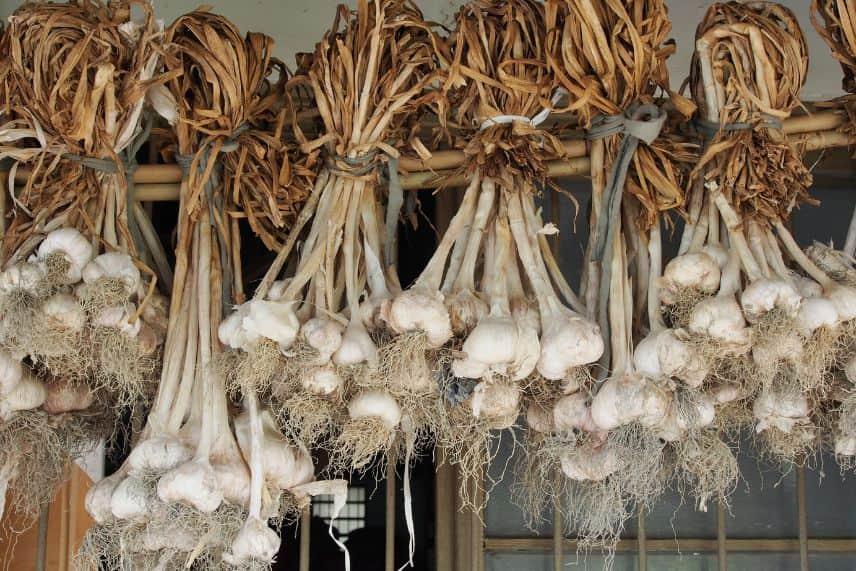
Garlic, shallots, and onions can be stored in bundles or braids during winter
Storage onions are harvested from July to September when the foliage lies flat on the ground, but before it completely dries out. You can lift your onions to be harvested with a fork without pulling them completely out of the ground to stimulate their ripening. Then, leave them to dry in place for 2 weeks before pulling them up completely. Once harvested, onions should dry for 2 to 3 days on the ground in the sun. To store onions, place them in a cool, dry, and ventilated area, on shelves without the leaves or by hanging them in bundles.
Shallots are harvested around the end of July, in dry weather, after the leaves have turned yellow and fallen over onto the ground. It is essential that the leaves are thoroughly dry. Once the shallots are pulled, let them dry on the ground or on a shelf for 2 to 3 days. Shallots can be stored for several months in a cool place, hung in bunches, but without tying the stems.
As the leek is harvested as needed, it can remain in the vegetable garden during winter. However, in regions where frosts are common, harvesting may be difficult in hard soil. That’s why it is advisable to mulch the leeks in the garden with a good layer of straw or fallen leaves to protect them from frost and facilitate harvesting.
You can also place leeks in a sheltered trench. This involves digging a trench about 30 cm deep and placing the leeks (with shortened roots and foliage) at an angle. Then fill the hole, leaving a small part of the bole and leaves protruding. They can be stored for several weeks.
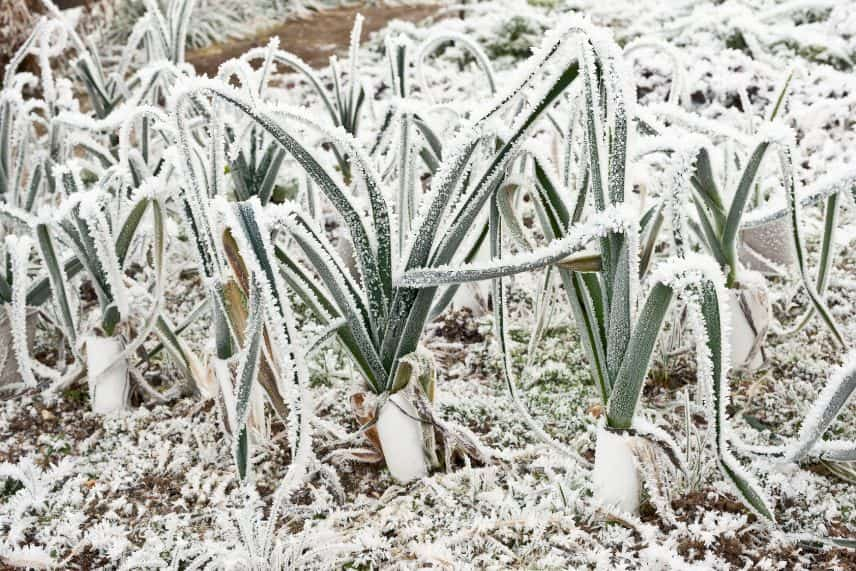
Leeks can remain in the ground during winter
Root vegetables
In the category of winter root vegetables, we find carrots, beetroots, celeriac, turnips, tuberous chervil, kohlrabi, parsnips, and black radishes. In regions with a mild climate, most of these vegetables can overwinter in the garden. The same applies to Jerusalem artichokes, whose flavour is enhanced by frost and cold, and swedes, which can either remain in the ground or be stored like other root vegetables. To prevent your vegetables from suffering from minor frosts, it is always possible to protect them with a tunnel or a thick mulch of at least 10 cm, made from straw, fallen leaves, and ferns.
In regions with harsher winters, root vegetables should be harvested before the first frosts, on dry days, allowing them to dry on the soil for 2 to 3 days before storing for winter. Three methods of winter storage for winter vegetables are possible:
- Silo storage: this is the most suitable method for large quantities of vegetables or for gardeners without a storage area. It involves creating a pyramid of vegetables on a layer of straw placed on the ground, then covering it with well-packed, smooth soil to facilitate rainwater drainage. Finally, another layer of straw is added to cover the pyramid. The main drawback of this technique is the risk of rodents such as voles.
- Sandbox storage: this is the simplest method to implement in a box or any wooden or plastic container filled with fine, dry, or very slightly damp sand. This container should be stored in a location (cellar, garage, attic) protected from frost, at a temperature below 10 °C. There are two ways to proceed with storing the vegetables. Either you cut the leaves and place the vegetables (without them touching) flat in several layers in the sand, or you keep the leaves and place the vegetables upright, roots in the sand and leaves outside. In any case, it is important to very lightly moisten the sand during winter and cover the box to prevent cat urine.
- Trench or gauge storage: this is the same conservation method mentioned in the previous paragraph for leeks. It is reserved for regions with moderately cold winters.
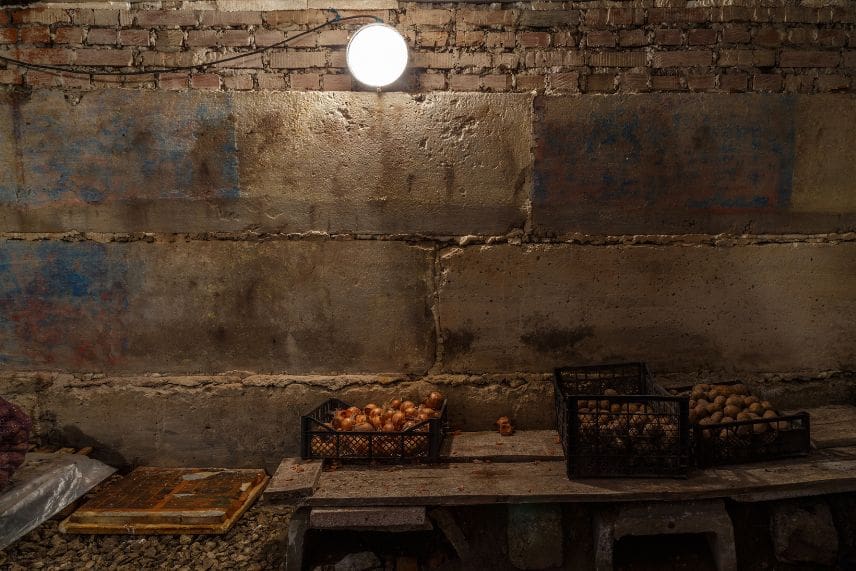 Storing root vegetables and potatoes is ideal in a cellar
Finally, we can classify storage potatoes and sweet potatoes in this category (even though they are not strictly root vegetables). Potatoes and, to a lesser extent, sweet potatoes should be stored in a dry location, protected from moisture, well-ventilated, cool, and dark. A cellar or garage without windows is ideal.
Squashes, pumpkins and company
Undoubtedly, squashes, pumpkins, gourds, and other potimarrons are autumn vegetables that are harvested just before the first frosts to preserve them through winter. Generally, the peduncle has become lignified, and the squashes appear to want to detach themselves. They should also be adorned with their lovely colour, which varies from orange to more muted tones depending on the species. To ensure better preservation, they must be allowed to fully ripen, thus delaying the harvest as much as possible.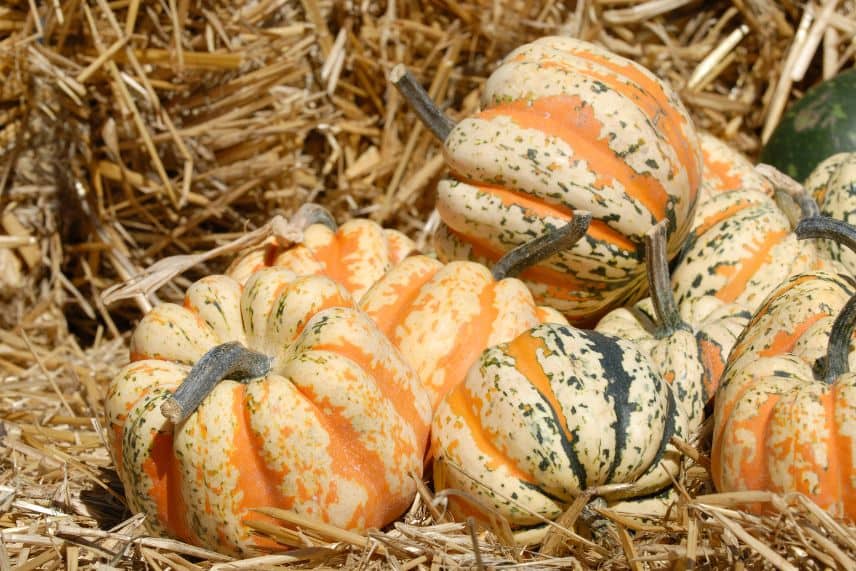
Cucurbits should be harvested with their peduncle and left in the sun for 1 to 2 days to dry. Then, the squashes and their relatives will be stored on wooden boards or dry straw in a room around 15 °C, well-ventilated, and protected from moisture (darkness is not obligatory). Squashes do not store well in places with temperatures below 10 °C.
Late leafy vegetables
Some leafy vegetables can be grown in winter outdoors without any issues simply because they are hardy and late varieties. This is the case for winter lettuces (‘Merveille d’hiver’, ‘Brune d’hiver’ and ‘Bourguignonne’), chicories (Cichorium endivia) such as scarole (for example, ‘Cornet d’Anjou’), lamb’s lettuce, and winter spinach such as ‘Géant d’hiver’…
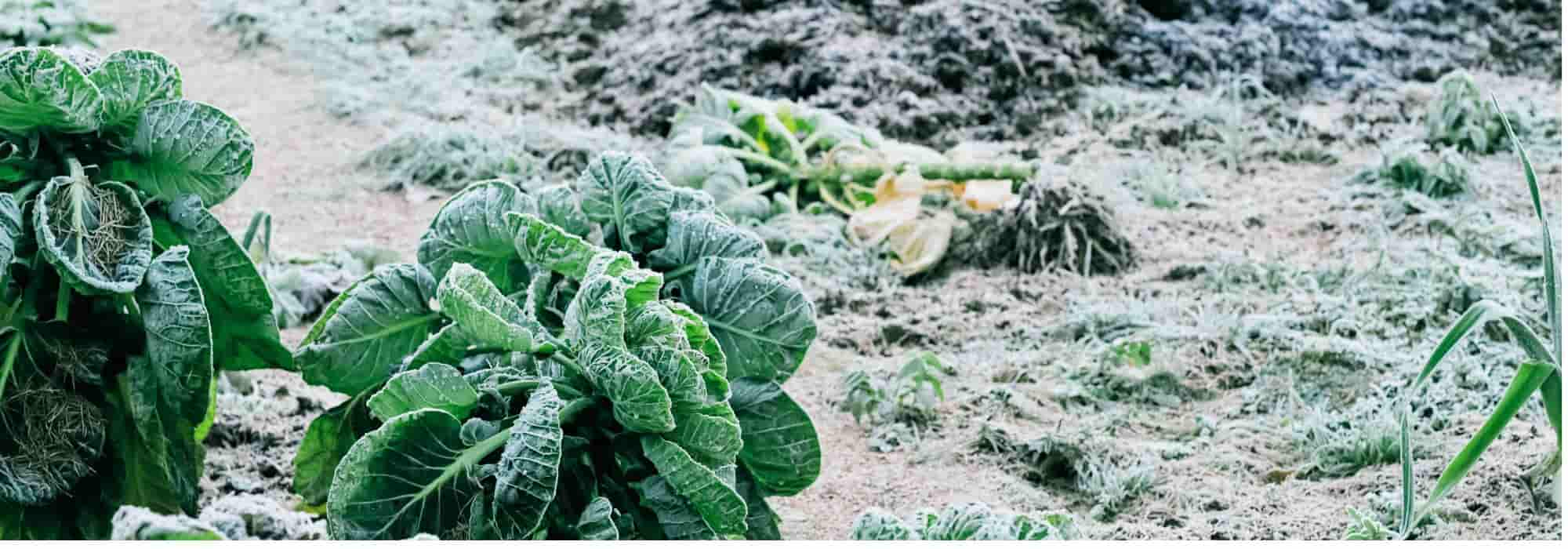
Certain cabbages can also be grown in winter, particularly Brussels sprouts, whose small heads can be harvested as soon as the first frosts arrive. Cabbages and savoy cabbages also remain in the ground and can be harvested throughout winter.
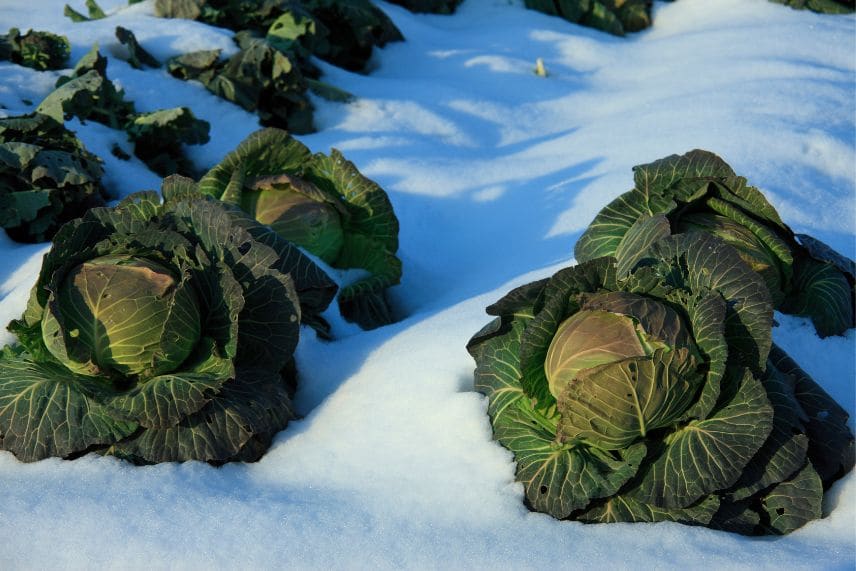
Hardy cabbages are not afraid of the cold
All these vegetables can be stored for a few days in the refrigerator.
- Subscribe!
- Contents

Comments