





























Heart-shaped plants: our Valentine’s Day collection
A selection of heart-shaped foliage or flowers
Contents
Plants offer us such diversity of flowering, foliage, fruiting, or other decorative assets that it can be hard to choose. As Valentine’s Day approaches, a time dedicated to love, we have chosen to offer you a selection of heart-shaped plants. They can be given to declare your love in a poetic, botanical way, a refreshing alternative to a cut flower arrangement, or simply chosen for their delicate design.
Most can be grown in the ground as well as in pots, which will bring a touch of romance to the garden, on the terrace, on the balcony or even indoors.

Ivy: heart-shaped leaves all year round
Ivy are very common plants, hardy and easy to grow. They cover shaded or semi-shaded areas without issue. Some varieties give us year-round evergreen heart-shaped foliage, which adds poetry to the garden.
This is the case, for example, with Persian ivy (Hedera colchica), an exuberant climber that can reach nearly 20 metres in all directions. Thanks to its climbing roots (adhesive roots), it colonises large walls, sheds or other unsightly structures, dressing them with its heart-shaped, slightly dentate foliage. Its large leaves can reach up to 25 cm in length.
For a slightly less vigorous cultivar (about 6 metres in all directions), but with the advantage of tolerating heat and drought, opt for the Canary ivy (Hedera algeriensis) ‘Glory of Marengo’. Its leaves form bulging triangles reminiscent of hearts. Very bright, they are variegated green, silver and cream.
To brighten up a slope or a shaded border, also consider the heart-shaped foliage of creeping ivy ‘Sark’.
And for a variety with a smaller habit (about 60 cm in all directions) that can be grown in a pot, opt for the common ivy Hedera helix ‘Kolibri’. Its evergreen leaves, green with cream variegation, bring a lot of light. Its leaves, more or less lobed, also resemble hearts.
For more tips:
- The climbing ivy, Hedera helix: planting, growing, pruning
- How to grow ivy in a pot?
- Potted ivy: 5 pairing ideas
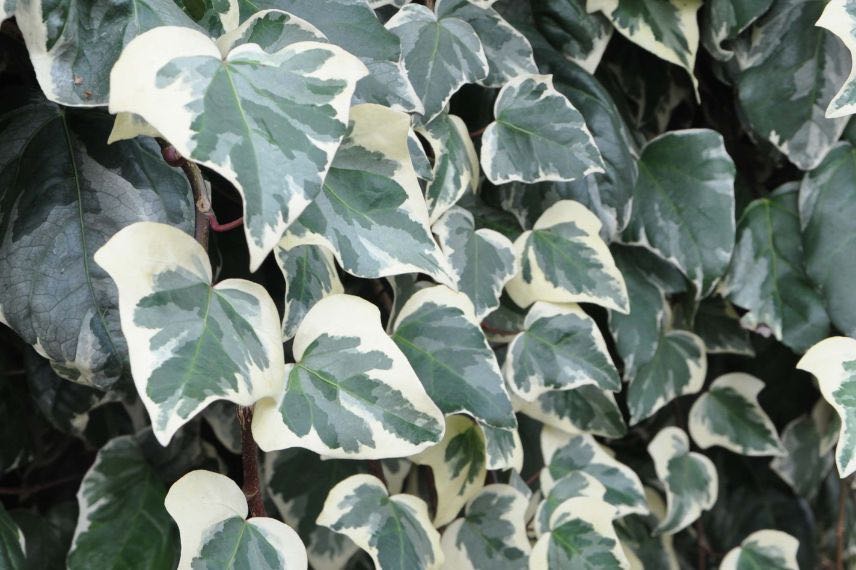
Heart-shaped leaves for Hedera algeriensis ‘Glory of Marengo’
Colocasias: Heart-shaped foliage with an exotic look
The Colocasia is also known as “elephant ears” in reference to its enormous leathery leaves, which can reach nearly 1.5 m in length in the tallest varieties.
These trailing leaves are generally cordate in shape, and add a lovely exotic touch, both to the garden and to the terrace or balcony.
There are different foliage colours:
- ‘Madeira’ produces cordate leaves that are initially green, then dark purple-veined with blue;
- ‘Blue Hawaï’ offers a soft green shade tinged with yellow, veined and with a purple-blue margin;
- ‘Black Magic’ graces us with cordate leaves leaning toward deep plum or chocolate, almost black depending on the light;
- ‘Black Stem’ prefers dark glossy green foliage with purplish veins and stems.
Relatively hardy given their tropical origins, Colocasias can tolerate temperatures down to -10°C to -15°C. The most compact varieties can certainly be grown in pots, kept indoors in winter in the coldest regions.
Give Colocasia a partly shaded position, in fairly moist soil.
For more tips: Colocasia: plant, grow and maintain.

Colocasia ‘Blue Hawaï’ and its cordate leaves
Bleeding Hearts: a spring flowering in clusters of tiny heart-shaped flowers
The Bleeding Heart, also called Dicentra, owes its evocative nickname to the shape of its flowers. From spring to early summer, depending on the variety, this perennial rewards us with abundant flowering that lasts for almost a month. The delicate flowers can be white or in pinkish tones: ‘King of Hearts’ produces, for example, flowers of a vivid purplish-pink, while ‘Bacchanal’ leans toward deep red. Very refined, the variety ‘Ivory Hearts’ offers ivory-white flowers, while ‘Candy Hearts’ prefers a gradient of pink-red with a white tip.
The flowers grouped into clusters have a trailing habit: they hang gracefully along arching stems beneath their weight. They are adorable little coloured hearts.
The foliage is also very ornamental: it is finely cut, and ranges in green, bluish-grey or golden tones depending on the varieties. It disappears in summer, during the plant’s dormancy.
Bleeding Hearts are perfect for brightening cool, damp shade. Their compact silhouette (20 to 60 cm tall for the most common varieties) enables them to be grown both in the garden as well as in pots. Hardy down to about -15°C, they will thrive in many regions.
For more tips:
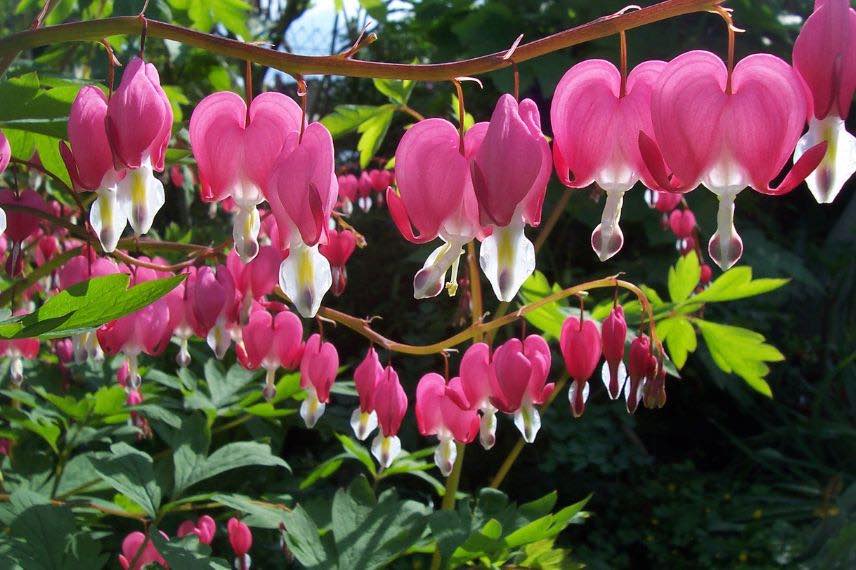
The famous Dicentra, or Bleeding Hearts, whose flower speaks for itself as much as its vernacular name
Houttuynia: a groundcover with heart-shaped leaves
Houttuynia cordata is a hardy groundcover perennial prized for its ornamental foliage. Its nicknames of ‘wood coriander’ or ‘Chinese pepper’ refer to its aromatic qualities, prized in cooking. The sturdy, cordate leaves can come in a range of colours: the type species offers a dark green with bronze highlights, while the cultivar ‘Chameleon’ is prettily variegated with cream, pink and green.
At the end of spring and the start of summer, this foliage is accompanied by small white flowers.
Bright, it will quickly form a carpet about 30–40 cm tall. This Houttuynia cordata will brighten thus semi-shaded and damp areas, around tree bases or along the edges of ponds and basins.
Rapid growth thanks to its suckers, this plant can be invasive. It is therefore often grown in pots, so you can enjoy it on the terrace, balcony or patio.
Hardy and low-maintenance, our cordate-leaved perennial proves easy to grow.
For more tips:

The handsome Houttuynia cordata ‘Chameleon’
Judas trees: colourful heart-shaped leaves
Judas tree, also known as Cercis, is appreciated for its generous spring flowering, usually pink or white. It appears on bare shoots. Only afterwards does the foliage reveal itself: it can be heart-shaped and offer beautiful colour variations.
This is the case, for example with:
- the Cercis canadensis ‘Forest Pansy’ with its bright red-purple heart-shaped foliage;
- the variety ‘Hearts of Gold’, with heart-shaped foliage that starts red, then yellow, before turning green almost fluorescent in summer;
- the Cercis siliquastrum, with heart-shaped blue-green leaves turning golden yellow in autumn.
Hardy and easy to grow, the Judas tree will thrive in a sunny position, in soil rich in organic matter.
For more tips: Judas tree, Cercis: plant, prune and maintain
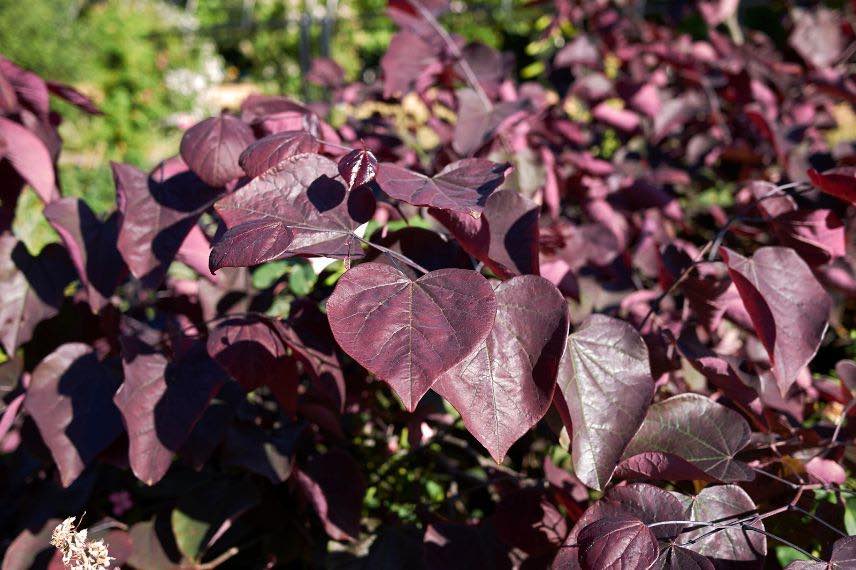
The beautiful leaves of Cercis canadensis
From houseplants to heart-shaped foliage
And to brighten up our interiors, some plants won’t even require a garden, balcony or terrace.
This is the case, for example:
- of Alocasia (cousin of Colocasia), such as ‘Mayan mask’ with its large glossy, heart-veined leaves ;
- of Anthurium, with glossy heart-shaped leaves ;
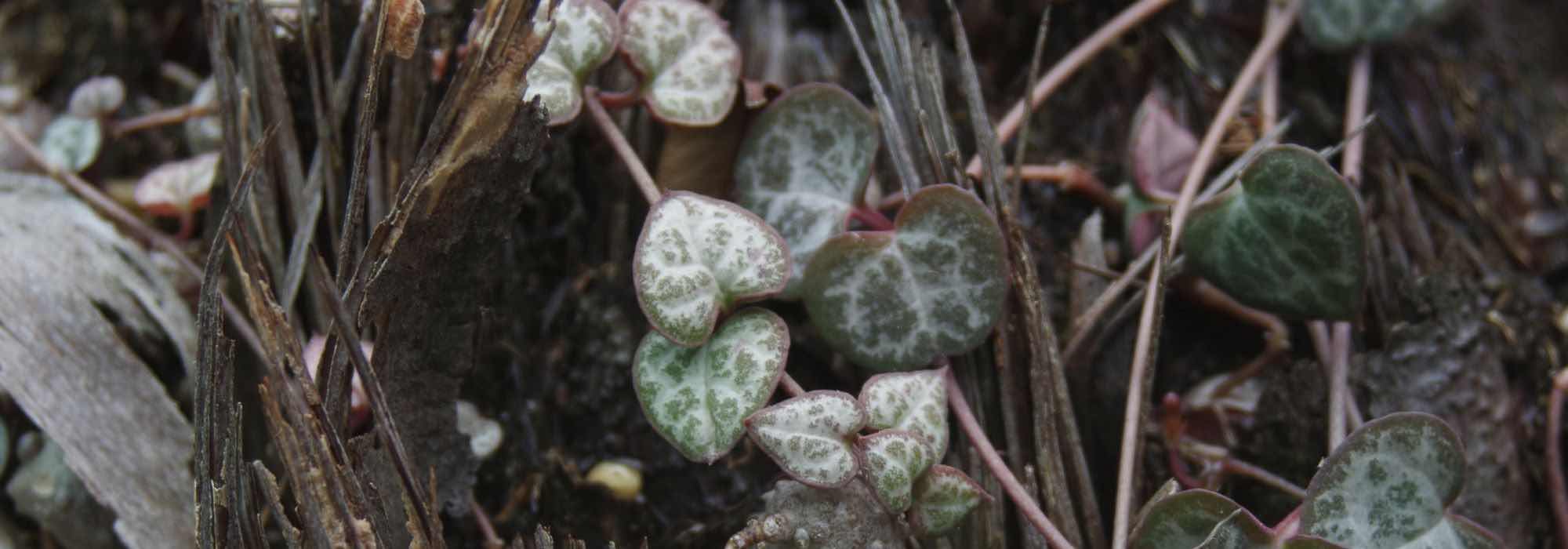
- of the Ceropegia woodii, also known as ‘string of hearts’ in reference to its cascade of tiny graphic leaves ;
- of Hoya Kerrii, a small perennial succulent plant with many evocative nicknames (“Love Plant”, “Lucky Heart” or “Cactus Heart”);
- of Philodendron scandens, nicknamed the heart-leaf climbing Philodendron.
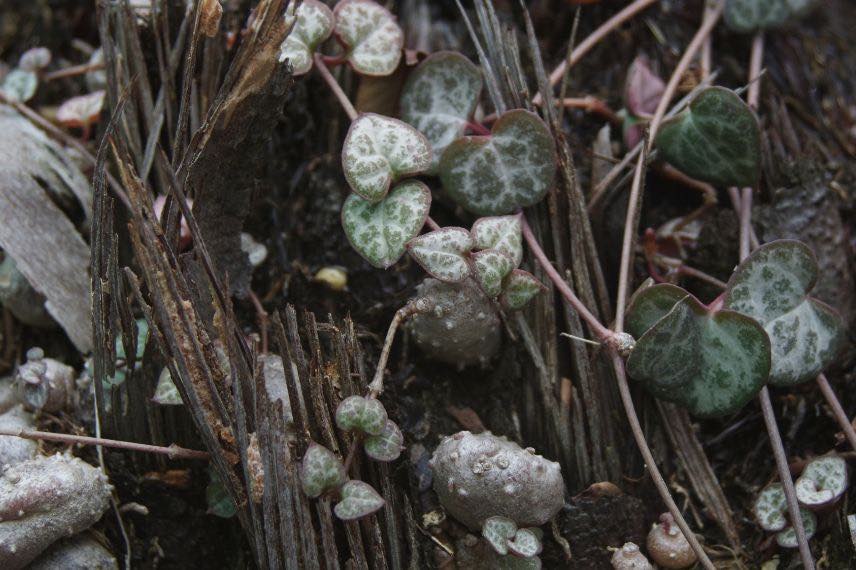
The miniature heart-shaped leaves of Ceropegia woodii
- Subscribe!
- Contents
Comments