




























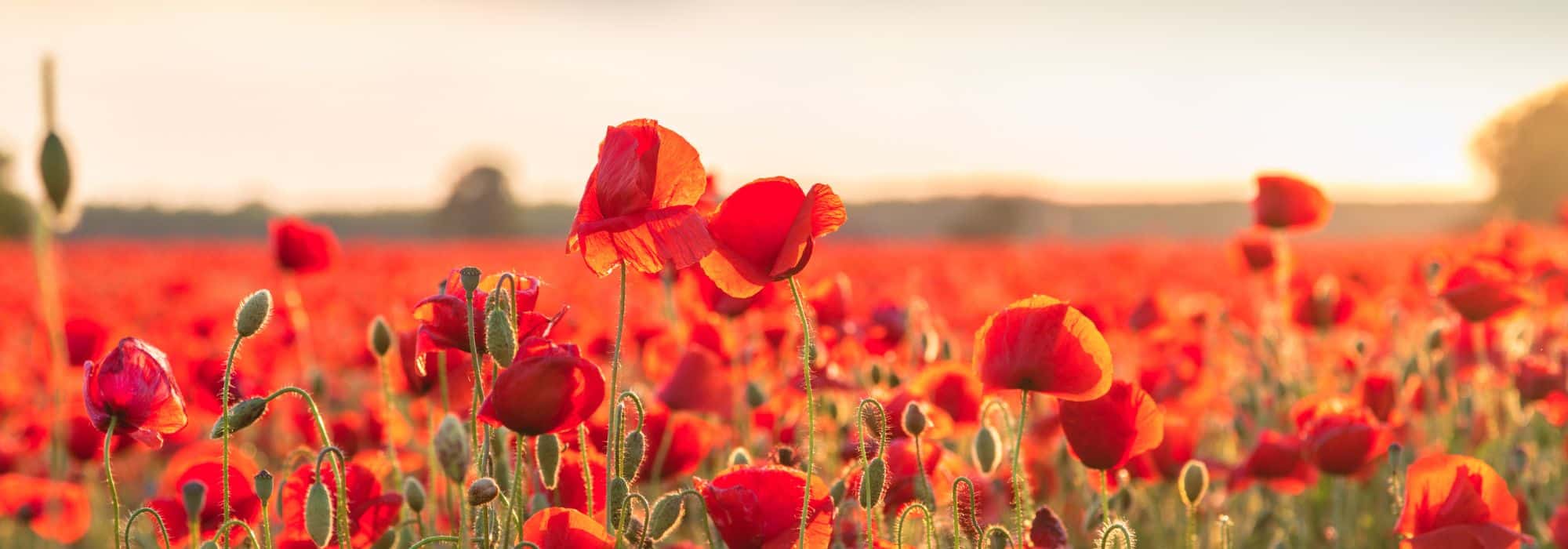
Let's plant native species to attract pollinating insects
How native species are the foundation of a natural garden?
Contents
In nature as in a garden, plants and insects are dependent on each other. Pollinating insects (bees, butterflies, wasps, ladybirds…) feed on the nectar of flowers. In return, they enable the pollination of plants and vegetables by transporting the precious pollen on their legs or wings, which is essential for the success of our vegetable and fruit harvests, as well as the flowering of our ornamental plants.
Unfortunately, for several decades, the decline of pollinator species (and birds in the sky, but that’s another topic!) has been alarming. The causes include the indiscriminate use of pesticides, habitat destruction, urban development, and intensive agriculture… While it is obviously difficult for an amateur gardener to influence these factors, you can still adopt more respectful practices to garden naturally. The goal is to (re)create an ecosystem and promote biodiversity to restore balance within your garden and vegetable patch.
Among these practices, the (re)introduction of plants close to the native flora is a key step in creating an ideal garden for pollinators.
What exactly is a native plant?
An indigenous plant is a plant that grows spontaneously in a given location, without any human intervention whatsoever. Indigenous plants are therefore plants that are naturally present in a region, wild plants that have been growing for hundreds of years. They do not need anyone to live, survive, develop, fruit, and multiply.
At the outset, it may be useful to clarify: indigenous plants are distinct from so-called naturalised plants, which have been introduced by humans for centuries and have escaped from gardens through spontaneous sowing to acclimatise sustainably to the surrounding nature. However, the difference is quite subtle and requires solid knowledge in botany to truly discern. So, let’s say that a “naturalised” plant that grows naturally along our paths, in our meadows, or by waterways is indigenous. In the sense that it has perfectly adapted to local conditions in terms of climate, soil… 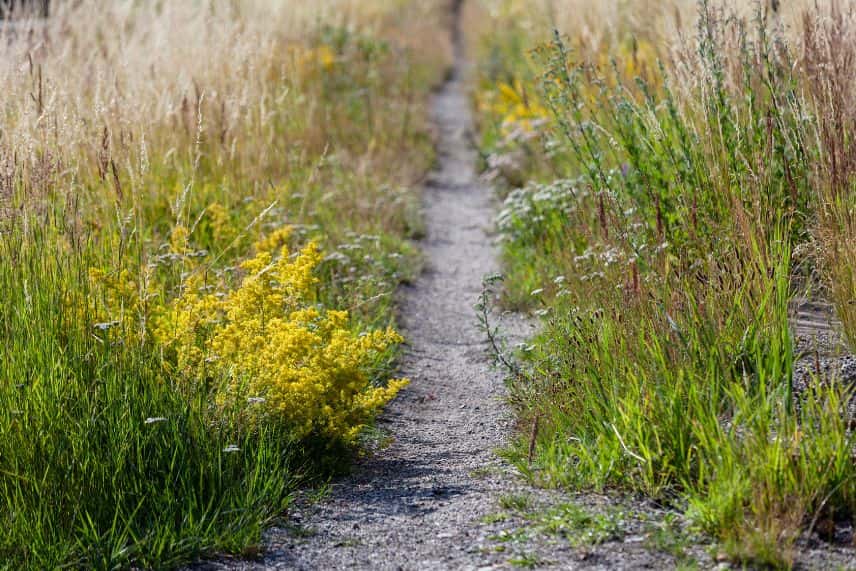
To recognise an indigenous plant specific to your region, it is essential to open your eyes to the nearby nature. Simply observing wild hedges, banks, woodland edges, and path borders can help identify some indigenous plants. Generally, they return year after year, thrive effortlessly, and sometimes reach impressive sizes.
Read also
10 good reasons to let weeds growThe benefits of planting species close to native flora
By definition, a native plant is a self-sufficient plant. Therefore, in a garden, it offers numerous advantages:
- It has an ideal resistance to the cold that prevails in your region. Indeed, native plants are hardy in their natural habitat
- It can also withstand drought if it grows naturally in southern areas
- It requires no special maintenance as it manages its own needs for water and sunlight
- It develops increased resistance to the pathogenous and parasitic agents present in the medium where it grows. Thus, the use of fertilisers and pesticidal products is unnecessary
And above all, these native plants, thanks to their continuous and regular flowering, provide food as well as shelter for insects that are themselves adapted to the climate of their region. Logically, these pollinating insects maintain very close relationships with native plants where they are sure to find what satisfies their appetite. Therefore, planting melliferous and nectariferous native plants helps preserve and sometimes restore the local small fauna. Planting locally thus ensures cover and shelter for the little critters in the area. Because the nectar from the flowers of native plants perfectly meets the nutritional needs of local insects. While exotic plants, hybrids, and cultivars do not always satisfy their needs. Foraging on them proves counterproductive, even sterile, for these insects.
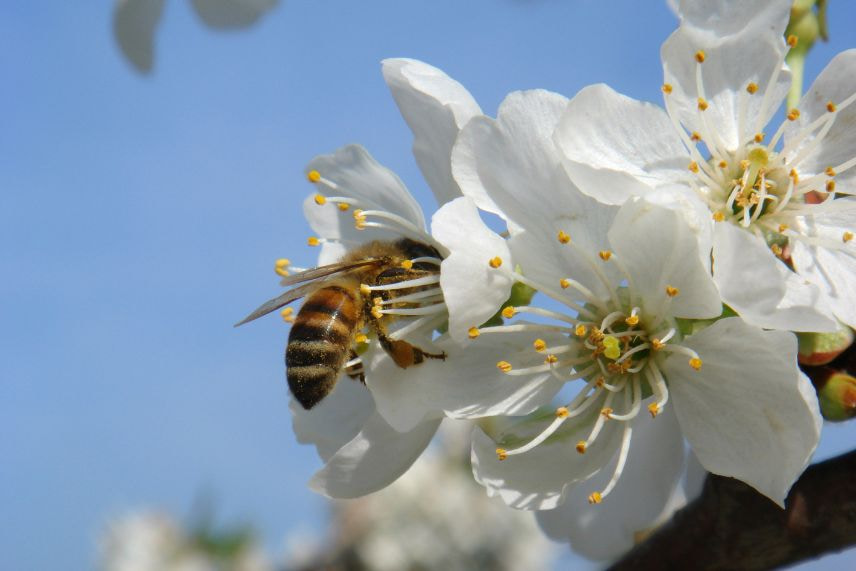
On a flower of bird cherry (Prunus avium)
This is crucial when we know that 90% of flowering plants and a third of food crops are entirely dependent on animal pollination (Figure from the book The Forgotten Pollinisators by Buchman and Nablan, published in 1996).
However, nature being made of diversity, prioritising native plants does not mean banning other plants from afar at all costs. Many of these plants are also perfectly melliferous and nectariferous and can nourish bees, butterflies, and other beetles earlier or later than native plants.
How to maximise the potential of native plants?
Introducing a native plant into your garden is beneficial, as it provides a food source for pollinating insects. However, this is not enough. To restore balance and recreate a virtuous ecosystem, it is essential to increase the number of native species and implement a genuine strategy:
- Install several species of native plants that flower at different times of the year. Bees, wasps, flies, and others do not only feed in summer. Therefore, it is important to select native plants that provide nectar and pollen throughout the seasons.
- Plant the smaller native plants in groups to maximise the chances of attracting specific insects. Group planting creates a large patch of colour, as insects are sensitive to colours. Additionally, it helps to release more fragrance, which is also attractive to insects.
- Eliminate the use of pesticides or fertilisers, even organic ones, to avoid disrupting the natural resistance of native plants to unwanted insects and, most importantly, to continue attracting beneficial insects for pollination and biological pest control.
- Recreate natural habitats around native plants. Simply leave the dead leaves of these native plants on the ground, which will provide shelter for insects in winter. This will also serve as a food source for others through the decomposition of organic waste. Similarly, do not hesitate to create a water point, no matter how small, to allow insects to drink. Finally, piles of branches or dry stones also provide shelter for the hibernation of these pollinating insects, just like installing an insect hotel.
Our tips for planting and maintaining native species beneficial to pollinators
By planting native plants in your garden, you restore the habitat and cover for insects. However, it’s essential to plant and maintain them correctly! First, you need to research the soil and sunlight requirements of these native plants. After that, planting is straightforward.
Maintenance is just as simple, although a few essential actions are required. Thus, in the first year, while they establish themselves, it is wise to water them, especially during heatwaves or high temperatures. Once the first year has passed, the root system is developed, and the native plants can manage on their own.
Native plants are adapted to the local climate and are therefore hardy in their native habitat. However, during the first winter, it is advisable to leave a mulch made of dead stems and leaves. This winter mulching will also benefit many living species that will spend the winter there.
Finally, native plants attract beneficial insects that will help naturally combat pests.
Some examples of native plants
It is difficult to make an accurate inventory of native plants, as by definition, they are local. Thus, the native plants found in Northern France are quite different from those around the Mediterranean. However, some native plants grow everywhere and are particularly useful to pollinators.
In a lawn or a wild garden, you can rehabilitate:
-
- yarrow (Achillea millefolium)
- cornflower (Centaurea)
- viper’s bugloss (Echium vulgare)
- poppy (Papaver rhoeas)
- musk mallow (Malva moschata)
- meadow sage (Salvia pratensis)
- heath (Calluna vulgaris) and heath (Erica cinerea)
- common daisy (Leucanthemum ircitianum)
- lemon balm (Melissa officinalis)
- creeping bugle (Ajuga reptens)
- wood spurge (Euphorbia amygdaloides)
- germander (Teucrium)
- common avens (Geum urbanum)
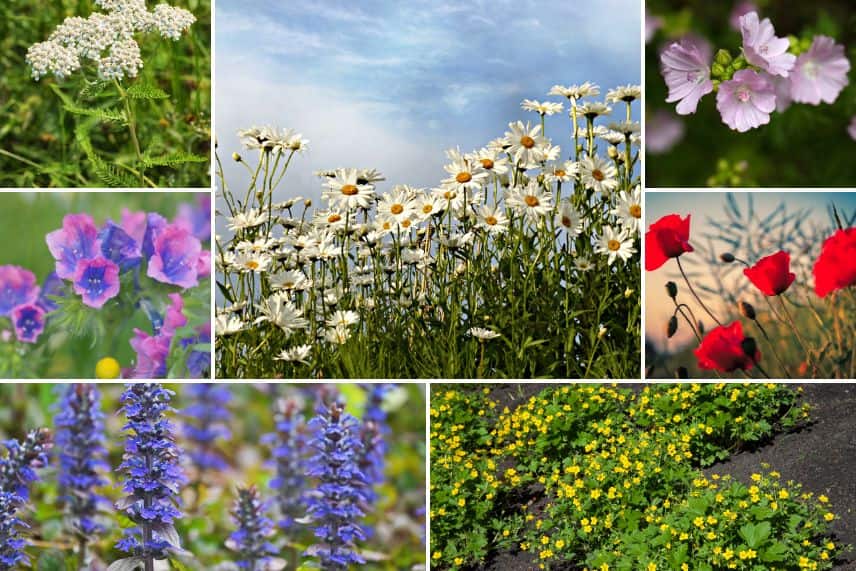
yarrow, viper’s bugloss, creeping bugle, daisies, musk mallow, poppy, and common avens
Let’s also think about climbing plants, bushes, shrubs, and trees:
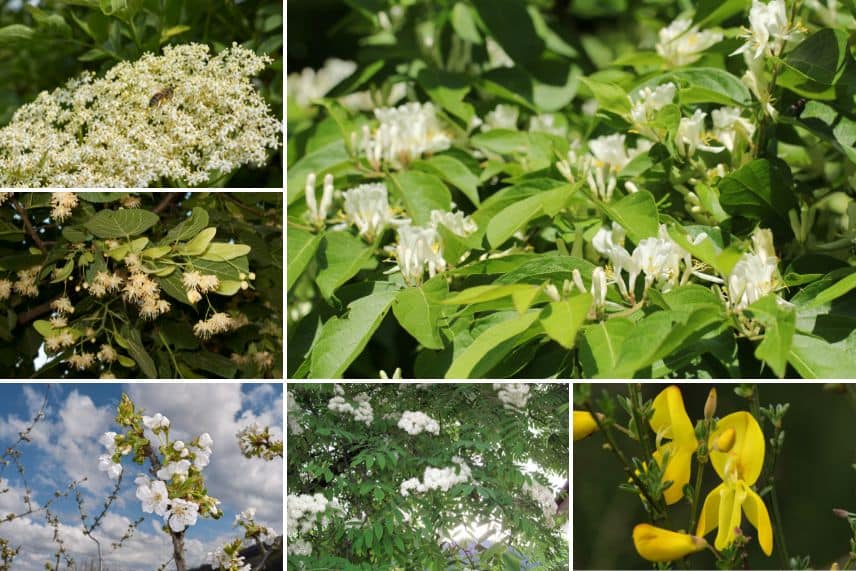
- black elder (Sambucus nigra)
- hawthorn (Crataegnus)
- small-leaved lime (Tilia cordata)
- bird cherry (Prunus avium)
- dog rose (Rosa canina)
- blackthorn (Prunus spinosa)
- rowan (Sorbus aucuparia)
- broom (Cytisus scoparius)
- ivy (Hedera helix)
- broom-leaved honeysuckle (Lonicera xylosteum)
- goat willow (Salix caprea)
- whitebeam (Sorbus aria)…
- Subscribe!
- Contents
Comments