





























How to pair Russelia?
Ideas and inspiration for in-ground or container planting for different garden styles
Contents
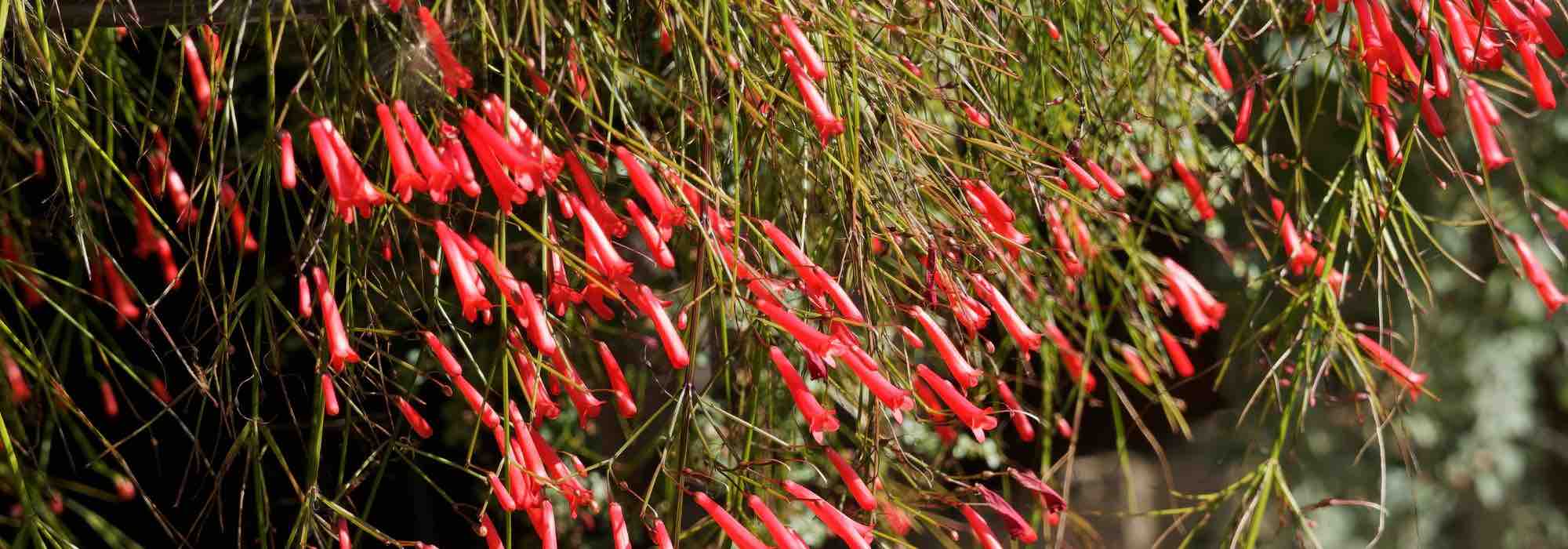
Russelia is a beautiful perennial with a weeping habit, which does not go unnoticed during its long flowering. From late spring to autumn, it unveils a multitude of tubular flowers, which can be white, orange, yellow or coral red in Russelia equisetiformis. This colourful flowering has earned it the nicknames ‘coral plant’, ‘coral fountain’ or ‘blood drop’.
The cultivation of this frost-tender plant will be confined to the mildest regions of southern France, where frosts fall below -6°C. But potted cultivation is entirely feasible elsewhere. The Russelia will enjoy the sun, in well-drained soil that does not retain excess water.
To create an exotic ambience, in a colourful rock garden, in a pot or in a Mediterranean border… Discover various companion-planting ideas with Russelia to inspire you.

For an exotic and colourful ambience
Owing to its colourful and vibrant flowering, the Russelia equisetiformis is ideal for creating an exotic atmosphere that enlivens the garden. Its red flowers will harmonise perfectly with yellow and orange flowering, adjacent colours on the colour wheel, together they create a sunny and vibrant display. As a complement, choosing green, decorative foliage will create a beautiful colour contrast.
For an exotic border, couple Russelia with yellow- or orange-flowering Cannas. Choose, for example, ‘En Avant’, ‘Confetti’, ‘Felix Ragout’ or ‘Queen Charlotte’. Their flowers will accompany our bushy perennial from summer to autumn. Cannas will also add exotic flair and a luxuriant look thanks to their lush foliage.
Continue with other flamboyant flowering displays, such as Crocosmias, or Kniphofias with their impressive flower spikes. Also consider the exotic spikes of Hedychium.
Add ample, ornamental foliage, such as that of dwarf banana plants (Musella lasiocarpa), Colocasias and small palms (Chamaerops humilis ‘Vulcano’). The ribbon-like, colourful foliage of cordylines will also work beautifully alongside them. And to bring another graphic touch, add Fargesia murielae ‘Bimbo’ (Fargesia murielae ‘Bimbo’). Agaves can also be woven into this flamboyant, tropical-looking display, as can an impressive Tetrapanax papyrifera ‘Rex’ if the soil stays relatively cool.
And to bring lightness and year-round persistence, incorporate grasses, such as fescues or blue oat grass.
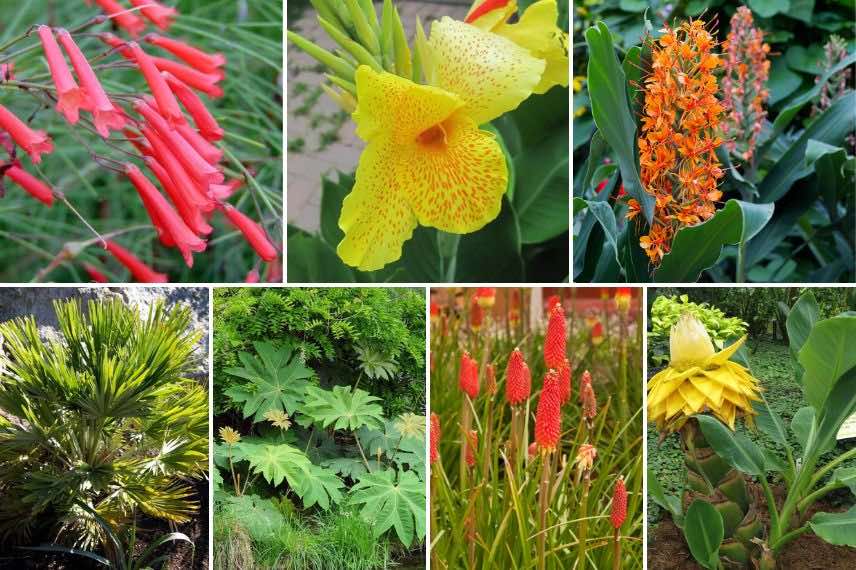
Clockwise from the top left: Russelia equisetiformi, Canna ‘En Avant’, Hedychium coccineum ‘Tara’, Musella lasiocarpa, Kniphofia, Tetrapanax papyrifera ‘Rex’, Chamaerops humilis ‘Vulcano’
Read also
Growing a Russelia in a potTo dress a low wall or rockery
These are certainly the sites that best showcase Russelia’s trailing habit: the top of a dry-stone wall or the top of a rockery. Placed high up or overhanging, our perennial can indeed show the full extent of its beauty, transforming into a real cascading blaze for many weeks. A low wall and a rockery also provide the plant with the drainage it needs.
In this dry, mineral backdrop, introduce other plants that enjoy warmth and withstand drought. The Senecios will be excellent companions, as with Senecio mandraliscae with silvery-blue foliage. The silvery-green foliage of a Senecio greyi ‘Sunshine’ will also harmonise with our Russelia.
Think then of shrub euphorbias (Euphorbia characias), the houseleeks which will fill the smallest gaps, but also Sedum and Achillea.
Add the coloured flowers of annuals such as the California poppies, or the exotic charm of nemesias. Shrubby salvias will also make good candidates.
Finally, complete with the soft grey fluffy foliage of a Cerastium tomentosum ‘Yo Yo’ or the deeply dissected leaves of a Cineraria maritime ‘Silver Dust’.
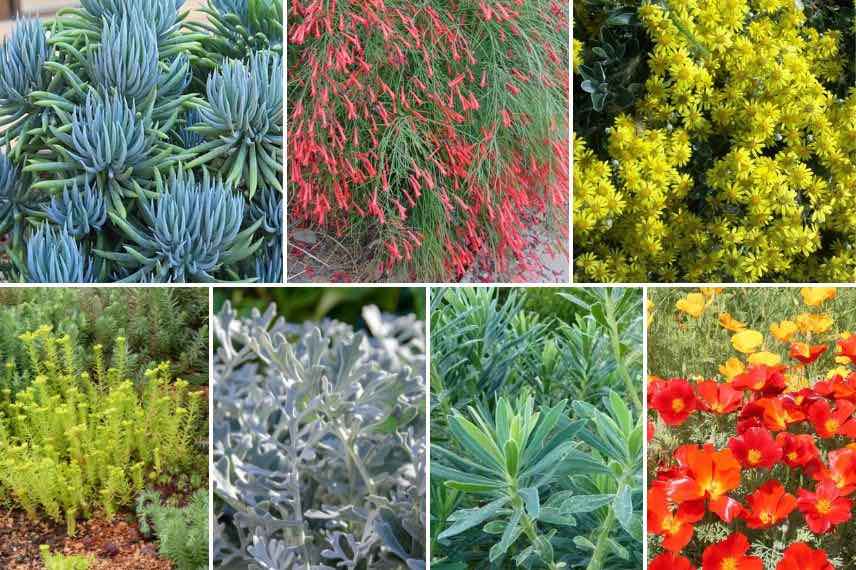
Senecio mandraliscae, Russelia, Senecio greyi ‘Sunshine’, California poppy ‘Red Chief’, Euphorbia characias, Cineraria maritime, Sedum ‘Angelina’
In pots on the terrace or balcony
Growing in pots has several advantages. It first allows you to green up areas without in-ground soil, for example on a terrace or balcony. But it also lets you grow frost-tender plants, which will enjoy sunny days outdoors, but can spend the winter protected from frost. The Russelia will require a fairly large and deep container (at least 50 cm in diameter), its root system developing well horizontally. Opt for a large urn, a hanging basket or a trough. A classic pot will also work very well, especially if placed high to showcase the plant’s trailing habit.
Alongside the Russelia, grow other potted plants that you can also bring indoors in winter if needed, such as Agapanthus.
You can opt for dark purplish, or even almost black, foliage, which softens the impact of the red flowering. Choose a Pennisetum x advena ‘Rubrum’, which produces ribbon-like leaves in purple to dark chocolate colour in sunny exposure. Its summer inflorescences in purple-tinted plumes, which will pale as they fade, are equally ornamental. A Physocarpus opulifolius ‘Lady in Red’ will also make a striking pairing with our Russelia. Its red-purple foliage contrasts beautifully with the white corymbs, which will bring light and avoid a too dark display.
The foliage of a Pittosporum tenuifolium ‘Tom Thumb’ consists for its part of small leathery bronze-violaceous leaves with metallic sheen. Its flowering, also red, emits a delicious vanilla-and-honey fragrance. In tandem with the Russelia, they will create a very contemporary display in cool tones. Add airy grasses, such as the Carex flacca with its pretty green filament-like leaves.
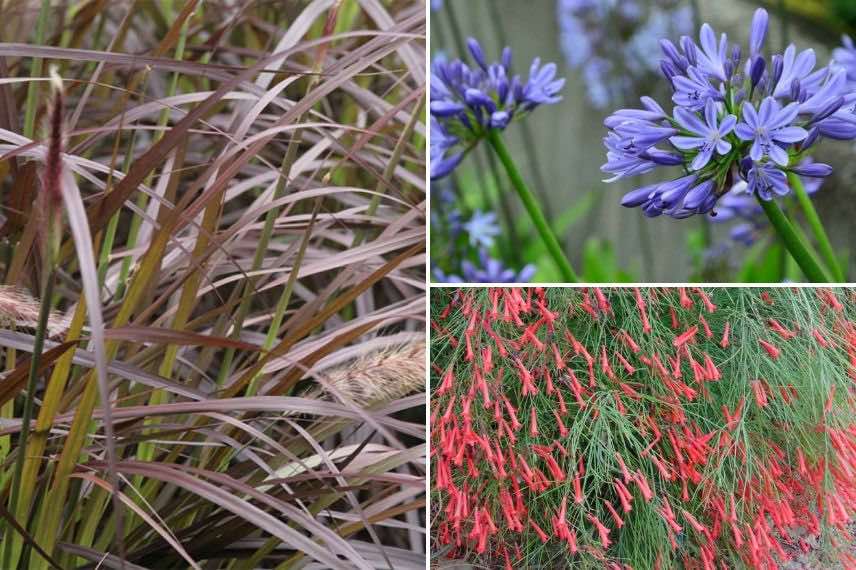
Pennisetum x advena ‘Rubrum’, Agapanthus ‘Blue Giant’ and Russelia
Read also
Pairing red or purple flowersIn a Mediterranean-inspired garden
Mediterranean regions will readily grow Russelias in the ground, alongside other sun-loving plants, exposed to sea spray and well-drained soil. Elsewhere, Russelia can be grown in a pot. It will thus be protected from frost in winter and brought out into the garden during the warmer seasons, from late spring to autumn. Many Mediterranean plants feature green-silvery foliage, which contrasts very well with Russelia’s red flowering. A Helichrysum italicum, a Santolina and a common sage will thus make good companions. Add regionally typical aromatics, such as the rosemary, the thyme and the savory.
White-flowering lavenders will pair with a red-flowering Russelia, while the more classic blue-violet varieties will contrast wonderfully with a yellow-flowered Russelia (Russelia equisetiformis ‘Yellow Gold’).
For other flowering displays, add the delicate crumpled flowering of a Convolvulus cneorum or silvery bindweed, which will appear from April. Pensez aussi à la délicate floraison chiffonnée d’un ciste et aux lauriers-roses à fleurs blanches ou jaunes (‘Angiolo Pucci’).
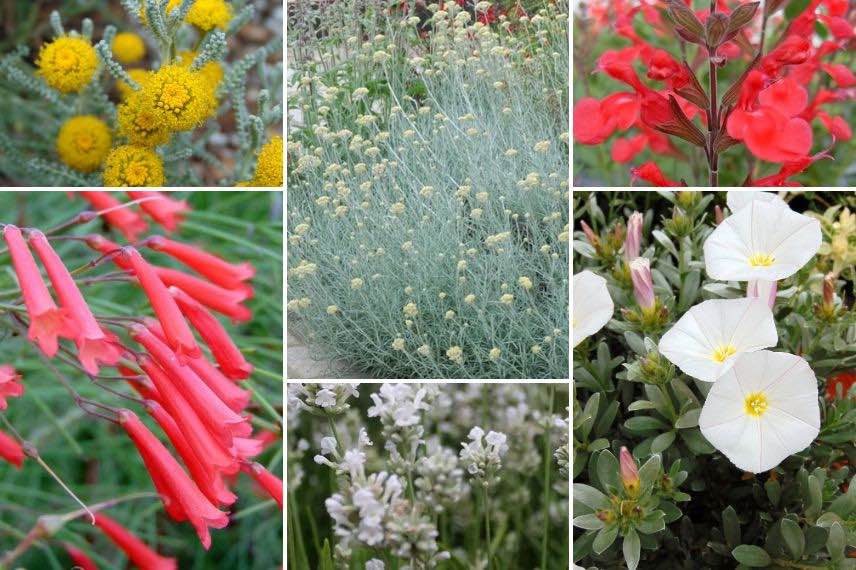
Santolina chamaecyparissus, Helichrysum italicum, Salvia jamensis ‘Flammenn’, Convolvulus cneorum, Lavandula ‘Arctic Snow’, Russelia
- Subscribe!
- Contents
Comments