





























How to pair Hardenbergia?
Our best pairing ideas
Contents
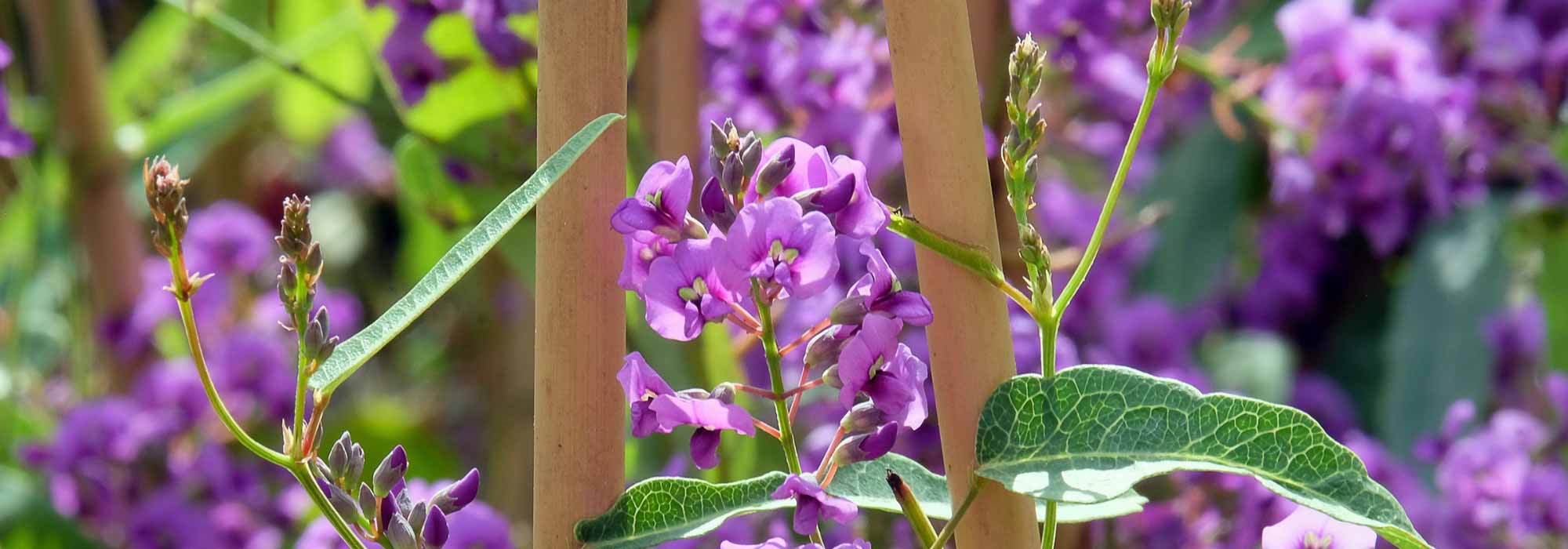
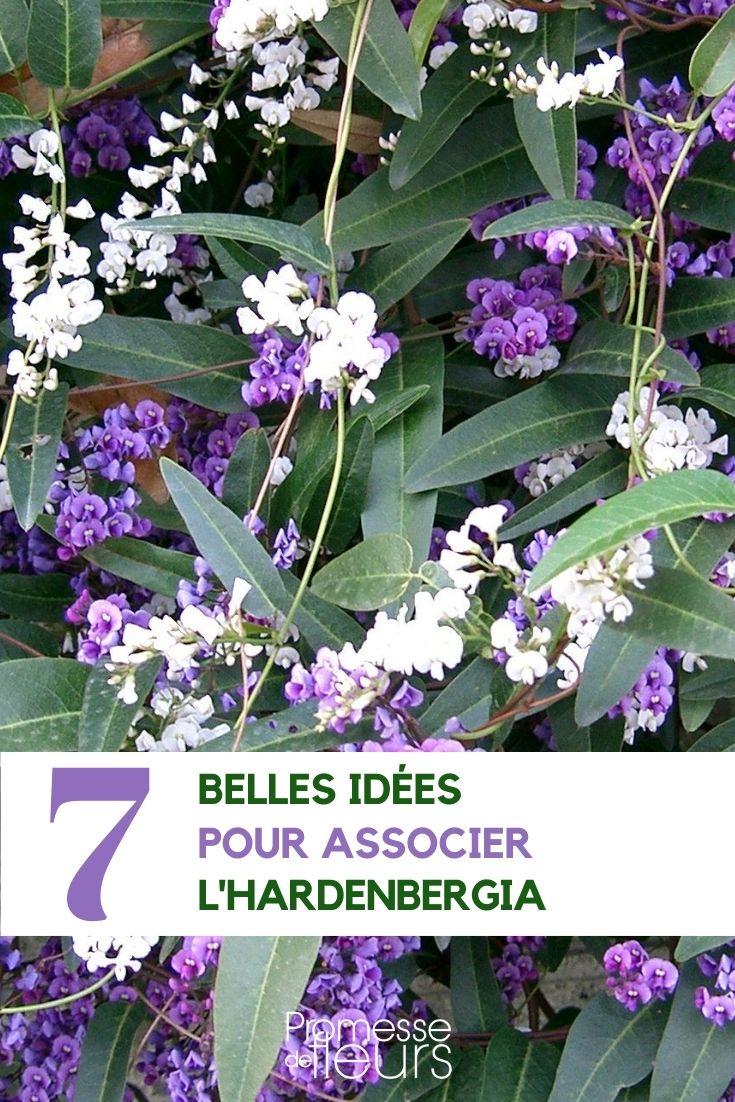
Hardenbergia, also known as Australian wisteria, is a climbing plant native to Australia, valued for its purple, clustered flowers and evergreen foliage. It flowers early, usually from February–March and into June, depending on the climate. Its abundant flowering consists of small mauve-purple pea flowers, sometimes pink, blue-tinged or white depending on the varieties. It climbs gracefully over trellises, pergolas or fences, adding a splash of colour to your garden in late winter and spring. Only hardy to around -5°C; cultivation in open ground should be reserved for regions with mild climates, such as the Mediterranean basin or the Atlantic coast. In colder regions, it can be grown in a pot, which allows it to be easily sheltered indoors to protect it from frost in winter. It prefers well-drained and cool, non-calcareous soils, and is fairly drought-tolerant. To showcase it in the garden or on a terrace, discover which plants it pairs best with. We present seven beautiful ideas for pairing Hardenbergia and creating stunning planting schemes.

In a flowering border, with perennials and grasses
You can plant Hardenbergia at the back of a border, for example by training it to climb against a wall or a pergola, and plant perennials and grasses in front of it to create a colourful border. To accompany it, choose salvias (for example the Salvia jamensis ‘Reve Rouge’, with scarlet flowers, or the Salvia microphylla ‘Grahamii’), Centaurea dealbata, and avens, which also offer a light and airy flowering, ideal for a border with a very natural style. Also include columbines, wallflowers, alliums, irises, as well as hardy geraniums or erodiums. Finally, to create a subtle contrast between Hardenbergia’s climbing habit and lighter forms, ornamental grasses are excellent companions. These plants provide an airy, graceful effect, perfect for balancing the dense foliage and the flower clusters of Hardenbergia. Among the grasses that pair well with it, choose Miscanthus, Stipa gigantea, spectacular with its tall, light and airy plumes, as well as some smaller and colourful grasses such as Carex comans ‘Milk Chocolate’ or Blue Fescue.
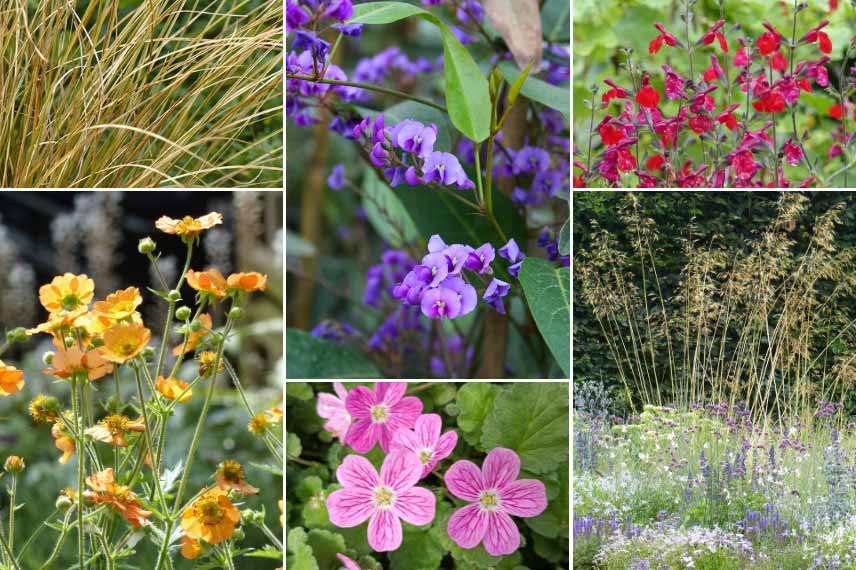
Carex comans ‘Milk Chocolate’, Hardenbergia comptoniana, Salvia microphylla ‘Reve Rouge’, Geum ‘Totally Tangerine’, Erodium ‘Bishop’s Form’, Stipa gigantea
Read also
How to grow Hardenbergia in a pot?In a cottage garden
The cottage garden is synonymous with rustic charm, with a profusion of flowers, colours and textures interwoven freely in a lush, abundant way. Hardenbergia, with its long climbing stems and clusters of purple flowers, sits perfectly in this informal and romantic garden. To emphasise this atmosphere, you can pair it with plants that flower generously and with soft tones that evoke the floral abundance typical of cottage gardens. Go for pastel colours: blue, purple, mauve, soft pink, white, apricot, salmon… Old-fashioned roses and peonies are essential companions in this type of setting. Pair them with a clematis (for example the variety ‘The President’), which will climb elegantly alongside Hardenbergia, for a lush effect. To fill out the borders, perennials such as campanula, purple foxglove and alchemilla, with its small chartreuse-green flowers, create an ideal floral backdrop. Also consider Alliums, Oriental poppies, hardy geraniums (for example ‘Johnson’s Blue’) and the lovely Verbascum ‘Sugar Plum’. Don’t hesitate to mix in a few foliage-rich plants as well, such as ferns, Cynara cardunculus and acanthus. You will thus achieve a garden that looks spontaneous, yet elegantly orchestrated, in a natural and lush style.
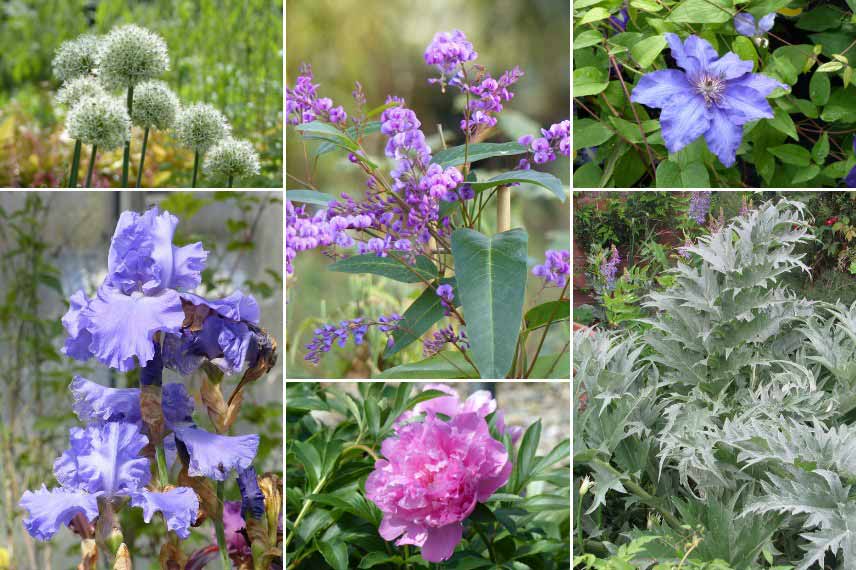
Allium stipitatum ‘Mount Everest’, Hardenbergia violacea, Clematis ‘The President’, Iris germanica ‘Yaquina Blue’, Paeonia lactiflora ‘Monsieur Jules Elie’ and Cynara cardunculus (photo : Peganum)
With other climbing plants for a lush effect
If you want to boost the lush effect of your garden, pair Hardenbergia with other climbing plants, training them against the walls of your house or on a pergola or trellis. They are ideal for creating a jungle garden, playing with heights and textures to form a dense, spectacular living screen. Think of theAkebia quinata, which offers charming palmately divided foliage, divided into five oval leaflets, or the Akebia longeracemosa, which is distinguished by its long racemes of purple flowers. You can also opt for the bougainvillea ‘Violet de Méze’, whose flowers will harmonise beautifully with Hardenbergia’s! Bring brightness with the vigorous Banksiae rose with yellow flowers, Rosa banksiae ‘Lutea’ and the trumpet creeper Campsis capreolata ‘Tangerine Beauty’. Think of the spectacular wisterias, whose flower colours will harmonise easily with Hardenbergia’s, as well as clematis, which will delight you with their large star-shaped flowers. Also discover the Stauntonia, an evergreen climber that is little known, which in spring bears small bell-shaped flowers, often pale pink or purple.
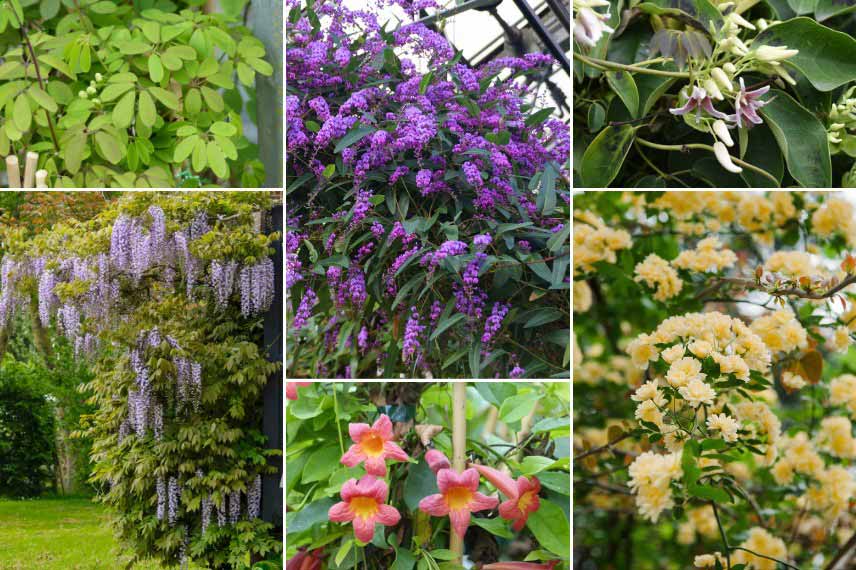
Akebia quinata, Hardenbergia violacea ‘Happy Wanderer’, Stauntonia hexaphylla, Wisteria floribunda ‘Macrobotrys’, Campsis capreolata ‘Tangerine Beauty’, Rosa banksiae ‘Lutea’
Read also
7 ideas for white garden bedsIn a white and silver flower bed
There is nothing quite like white flowering to showcase Hardenbergia! You can either create contrast by surrounding the purple flowers of the Hardenbergia violacea with white flowers and silvery foliage, which will really make its flowering stand out, or opt for the white-flowering variety, Hardenbergia violacea ‘Alba’, and take the opportunity to incorporate it into a monochrome, white-silver garden. White gardens are especially soothing and they make for a backdrop that feels timeless, while remaining very chic and elegant. These are calming gardens, far from the bustle that can come with a multitude of colourful flowering displays, and they are particularly suited to small spaces, as they create a sense of space, giving the impression that the garden is larger than it actually is. To accompany Hardenbergia, pair it with Digitalis purpurea ‘Alba’, the carnation Dianthus deltoides ‘Albiflorus’, the Allium Allium stipitatum ‘Mount Everest’ and the Salvia Salvia pratensis ‘Swan Lake’. Surround these pure-white blooms with silvery foliage, such as Artemisia stelleriana ‘Silver Brocade’, Salvia argentea, Senecio ‘Angel Wings’ and Stachys byzantina. These downy leaves will create a very soft and luminous ambiance.
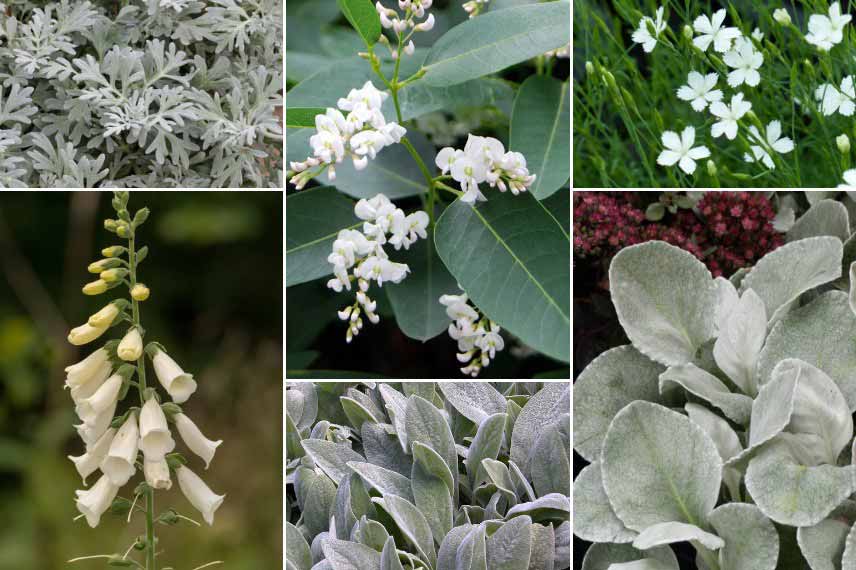 Artemisia stelleriana ‘Silver Brocade’, Hardenbergia violacea ‘Alba’, Dianthus deltoides ‘Albiflorus’, Digitalis purpurea ‘Alba’, Stachys byzantina (photo: Carl Lewis), Senecio ‘Angel Wings’
In a Mediterranean-style garden
For a garden with a Mediterranean feel, Hardenbergia can be paired with plants typical of that region, which share the same growing conditions. Think of aromatic plants, such as rosemary, the common sage, the lavender, the Helichrysum… Discover notably butterfly lavender, Lavandula stoechas, very decorative with its purple bracts that evoke tiny butterflies. You can also incorporate Corsican spurge, Euphorbia myrsinites, a small creeping plant with bluish foliage and spring flowering from chartreuse to yellow. Don’t hesitate to let a Bougainvillea climb up beside Hardenbergia. For shrubs, think of rockrose (for example Cistus monspeliensis, which offers a beautiful white flowering), as well as the Grevillea rosmarinifolia, the Arbutus unedo and the Anthyllis barba-jovis. Not forgetting, of course, the majestic silhouette of the olive tree, which will form the centrepiece of your Mediterranean garden. To add a touch of the exotic, you can include palms such as the Chamaerops humilis ‘Cerifera’, as well as agaves, aeoniums and opuntias. Also discover the splendid Madeiran viper’s-bugloss, Echium fastuosum, very decorative with its long blue spikes.
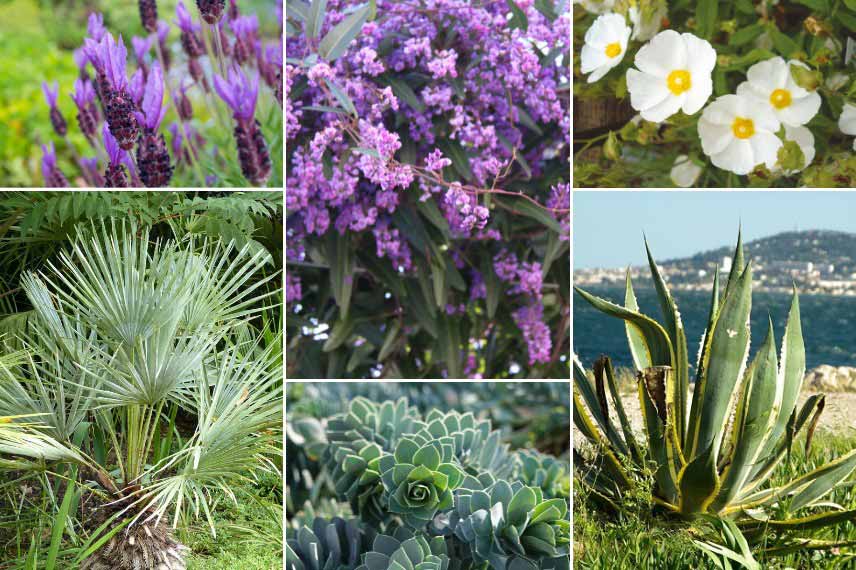
Lavandula stoechas, Hardenbergia violacea, Cistus monspeliensis, Chamaerops humilis ‘Cerifera’, Euphorbia myrsinites (photo : Guilhem Vellut), Agave americana ‘Variegata’
To play with complementary colours
To highlight the purple flowering of Hardenbergia, don’t hesitate to play with complementary colours by pairing it with yellow flowering plants! Indeed, purple and yellow are two opposite colours on the colour wheel, and when combined these colours create strong contrast and reinforce each other. You can thus bet on the bright flowering of the Euryops chrysanthemoides, the Achillea tomentosa ‘Aurea’, the Iris ‘Grand Canari’ and Erysimum ‘Zwerg Jaune’. At the front of the border, think of low-growing carpet-forming plants such as the Delosperma ‘Royal Ranger Yellow’, the Lampranthus aurantiacus, the Hypericum olympicum and the Draba aizoides. To reinforce the contrast and accompany Hardenbergia, include other purple-flowering plants, such as the Salvia nemorosa ‘Caradonna’, the Loire Violet sage, the Lavandula stoechas, as well as Aubrietas.
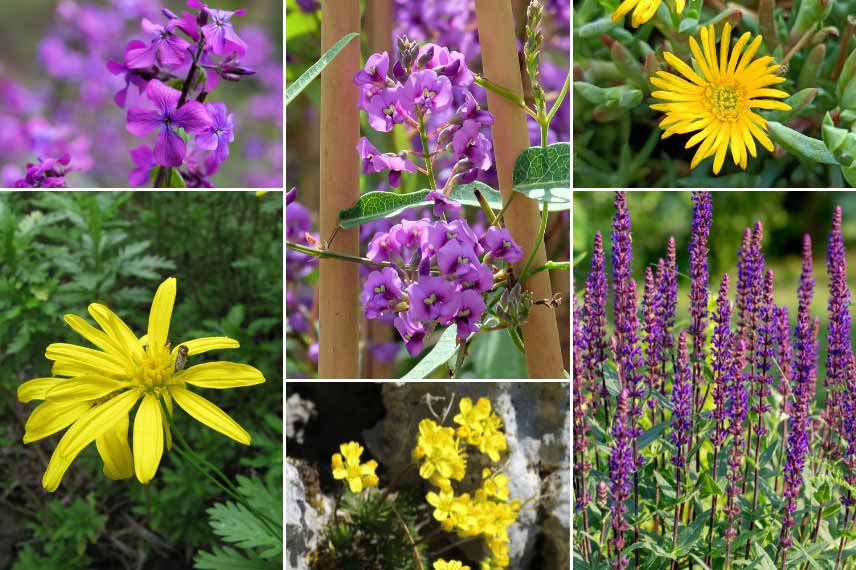
Lunaria annua, Hardenbergia violacea, Lampranthus aurantiacus, Euryops chrysanthemoides (photo : Leonora Enking), Draba aizoides (photo : Björn S.), Salvia nemorosa ‘Caradonna’
In a large pot on the terrace
Hardenbergia is not very hardy, so it is perfectly possible to grow it in a large pot and bring it indoors for the winter to protect it from the cold. You will take it out in spring onto your patio to enjoy its splendid flowering. Place beside it a Phormium tenax, ideal for adding a strong exotic look thanks to its long, upright leaves, as well as a dwarf palm Chamaerops humilis ‘Compacta’, which, with its compact size, is particularly suited to pot culture. Bring colour with the flowering of oleander, and of Salvia ‘Amethyst Lips’. Also go for succulent plants such as agaves, whose silhouette immediately provides a striking graphic presence, and create pretty pot displays by pairing Delosperma cooperi, Sempervivums and Sedums.
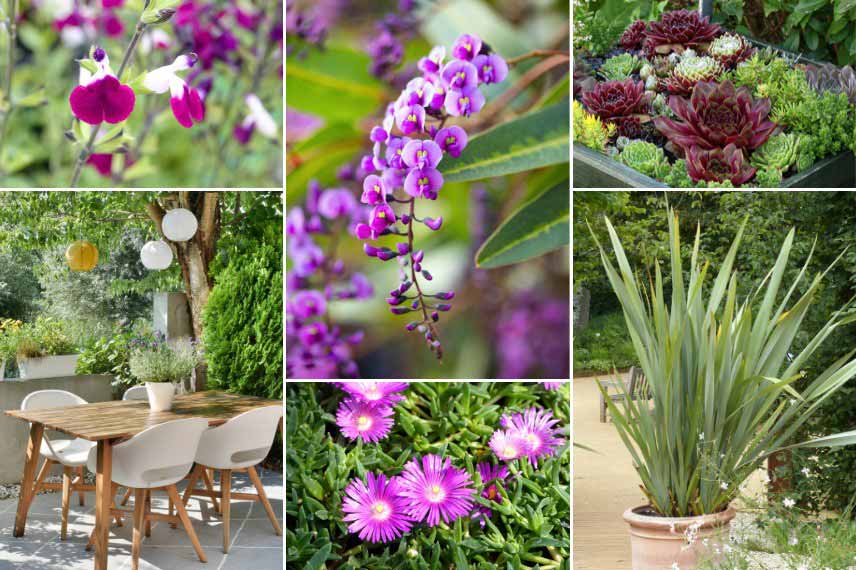
Salvia jamensis ‘Amethyst Lips’, Hardenbergia violacea, Sempervivums and Sedums, Delosperma cooperi, Phormium tenax
- Subscribe!
- Contents
Comments