





























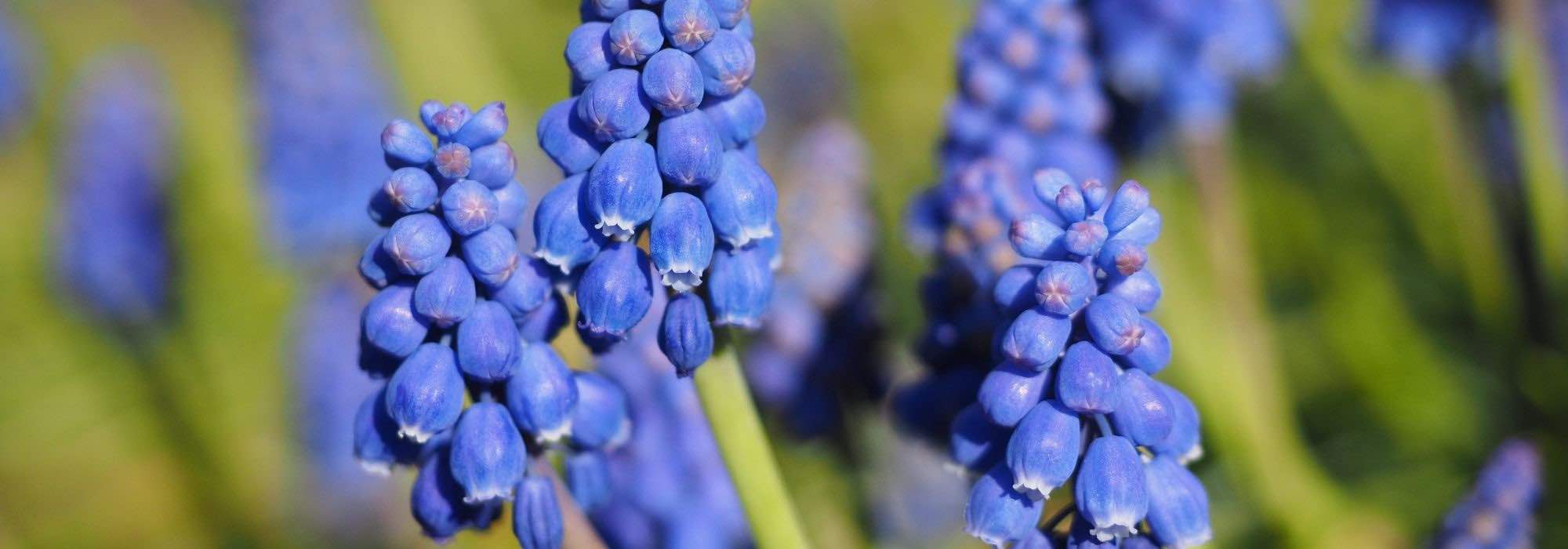
Growing Muscari in pots
For fresh and spring-like arrangements
Contents
The Muscari is a small bulb flower with spring flowering, whose iconic colour is blue. Although the Muscari bulb naturalises easily and can colonise large areas, it is also perfectly suited for pot cultivation. Its small size and low requirements make it highly appreciated in pots and window boxes, where it looks delightful, either alone or mixed with other bulbs. Take the opportunity to plant less well-known muscaris than the typical species Muscari armeniacum, which produce less foliage and are best admired up close. These little treasures hide more than one secret, which is best enjoyed in pots at eye and nose level.
Here are our tips for growing this lovely bulb in pots. You will quickly understand in the first chapter of this article how much I love muscaris.
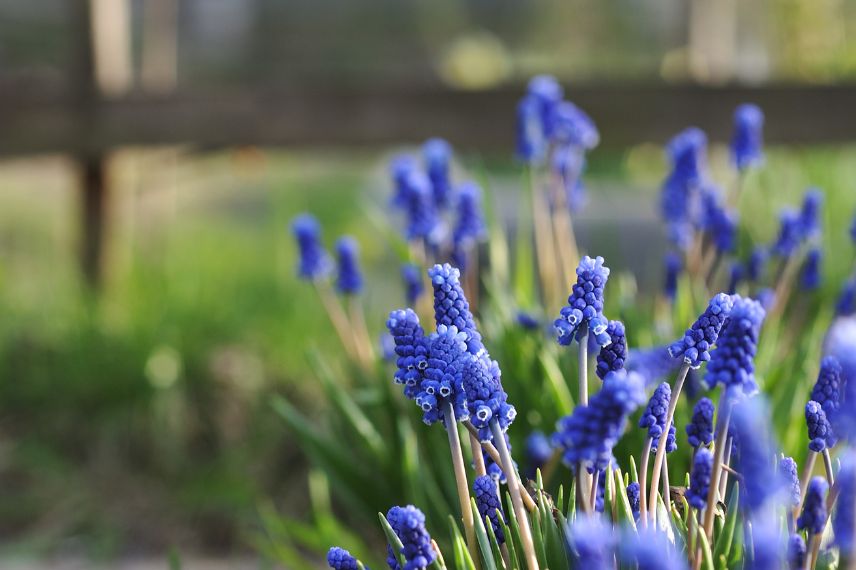
The lovely blue muscaris

What species and varieties?
All species and varieties of muscaris are suitable for pot planting. However, there are some differences in growing conditions for a few rarer and very interesting species, which may actually benefit from pot planting:
- The species and cultivars of Muscari armeniacum, Muscari aucheri, Muscari azureum, Muscari latifolium, Muscari comosum and Muscari neglectum all have the same growing conditions. They are quite hardy.
- Muscari macrocarpum is more frost-sensitive, but its cultivar ‘Golden Fragrance’ can withstand frosts down to about -15° C in perfectly drained soil. This Muscari requires a warm exposure, and its bulb needs to “cook” in the summer underground to bloom well in spring.
Let’s talk ornamental! The type species of Muscari armeniacum is the fastest spreading, but its foliage is quite bulky and neglected, even from the time of flowering. In the ground, this is not a problem, as it can be mixed with other bulbs and perennials that can hide this unsightly foliage, but in a pot, it is more troublesome. I therefore advise you to favour other species that develop less loose, thicker, shorter, and less prolific foliage. In Muscari azureum, the foliage is short, and in Muscari neglectum, it is particularly fine. Finally, Muscari latifolium develops only one ribbon-like, fairly broad leaf per flower stem.
Regarding flowering, explore the different species and varieties to make your choice, beyond the type species of Muscari armeniacum, which is commonly seen, there are really some very lovely muscaris that are less frequently planted and a few botanical curiosities. Already, all the cultivars derived from Muscari armeniacum have superior ornamental interest compared to the type species, with whimsical accents, small white rings here and there, or even very pretty colours on refined conical flowers. There is plenty to explore carefully to create unique and exciting pot arrangements! Concerning the others:
- Muscari macrocarpum ‘Golden Fragrance’, mentioned earlier, produces a beautiful two-tone flowering, yellow and violet, with a fruity fragrance reminiscent of banana.
- Muscari azureum, so gentle, delights us with a flowering of azure blue, soft yet intense, on its short foliage.
- The variations of Muscari aucheri (‘Cool Blues’ for example) are all worthy of interest, featuring very pretty colours, often pastel, and bicolour flowering impressions.
- The Muscari comosum, a muscari with a purple tuft, and Muscari comosum ‘Plumosum’ are two curiosities worth exploring.
- The Muscari latifolium, fine and very beautifully bicoloured, deserves attention, as does its cultivar ‘Grape Ice’.
- The Muscari neglectum is very beautiful, very dark, with an almost black blue, contrasted with white rings.
Muscaris bloom as early as March for some, such as the cultivars of Muscari armeniacum. But most muscaris bloom in April and May. Muscari is one of those bulbs whose cultivation can be forced to achieve pot blooms as early as December.
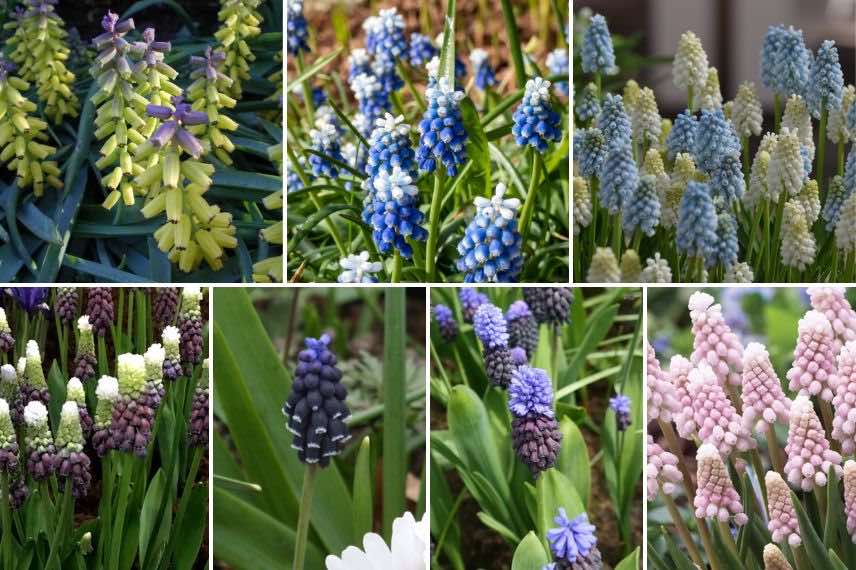
Clockwise: Muscari macrocarpum ‘Golden Fragrance’, Muscari ‘Mount Hood’, Muscari aucheri light blue and white mix ‘Ocean magic’ and ‘White magic’, Muscari ‘Pink Sunrise’, Muscari latifolium, Muscari neglectum, Muscari latifolium ‘Grape Ice’
Read also
Muscari: planting, growing tips and careWhat type of pot? What size?
The choice of pot size depends on the number of flower bulbs you plan to plant. If you intend to include other bulbs or perennials in the pot, opt for something large and deep. Round pots or rectangular planters work very well. If you are only planting muscaris, a pot 15 to 20 cm deep is suitable. For the width or diameter, calculate with a slightly tight planting arrangement, as you may need to divide the bulbs after about three years. It is recommended to space the bulbs 6 cm apart. You can plant a little closer, but just slightly, as muscaris grow quite quickly.
Choose the material of your preference, just keep in mind that in porous terracotta, water is quickly absorbed and does not stagnate, but it requires more frequent watering.
If you live in a very rainy region during winter, favour terracotta to prevent water from saturating the substrate for too long in the bad season.
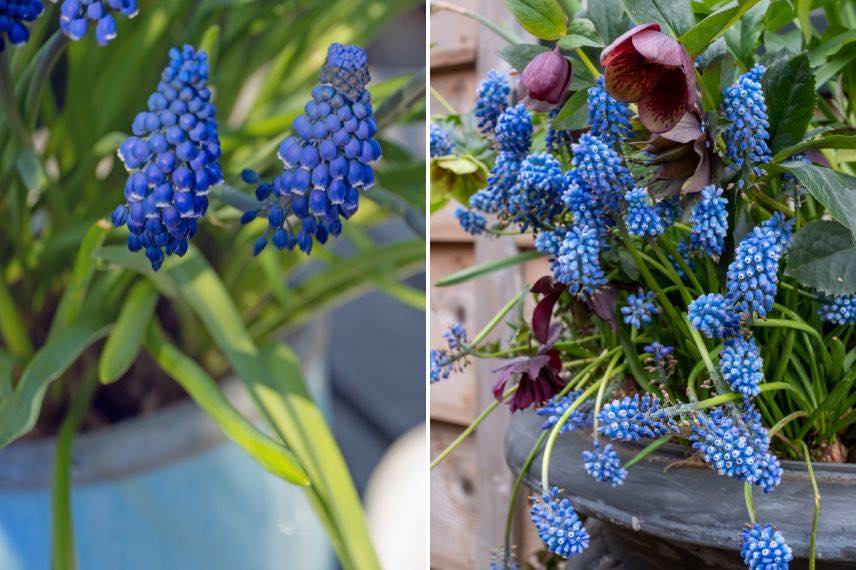
Muscaris in small pots
What substrate?
Plant in a good quality standard potting compost that offers both good water retention and drainage.
You can also create a mix consisting of 1/3 compost or well-rotted manure, 1/3 river sand, and 1/3 garden soil. If you do not have access to all these components, you can also mix 20 to 30% river sand with 70 to 80% quality compost.
In any case, ensure proper drainage at the bottom of the pot using clay balls, pumice, or gravel. Also, consider adding a mulch on top of the pot.
Read also
Muscari: 8 beautiful associationsWhen and how to plant?
Plant your muscari in autumn, from September to mid-November. For pot planting, choose a fairly sunny location.
Proceed as follows:
- Pour a layer of drainage a few centimetres deep at the bottom of the pot using clay balls, gravel, or pumice.
- Separately, mix the various components of the substrate.
- Pour a little substrate into the pot.
- Place the bulbs about 8 cm deep, spacing them 6 cm apart. They should be covered with 2 to 3 times their height of soil.
- Fill in with substrate, pressing down lightly and evenly.
- Fill to a few centimetres below the rim of the pot and press down again.
- Water lightly.
- When the water has been absorbed, add a little substrate if necessary, if any gaps have appeared.
- Mulch with about 2 centimetres of material.
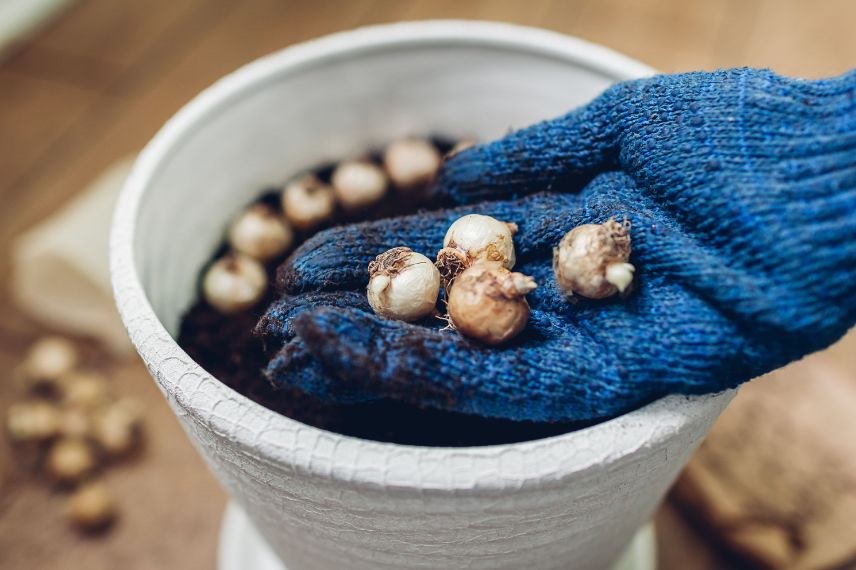
Muscari bulbs planted at a depth of about 8 cm
If you are planting other bulbs in the same pot, first plant the larger bulbs and gradually move up, following the rule of covering the bulbs with two to three times their height of soil according to their size. Each bulb size will thus be planted at different depths.
→ See Sophie’s article: the depth guide for spring bulbs.
Watering
After autumn planting, water only occasionally if winter is dry. If the pot is exposed to rain, do not water. From the start of growth, in late winter or early spring, water more regularly while always allowing the substrate to dry out between waterings, about halfway down the pot. Be careful that the substrate does not dry out and pull away from the edges, as it becomes difficult to rehydrate afterwards. Do not water again during the summer dormancy period.
Care
- Only cut the foliage when it has faded to allow the bulblets time to replenish their reserves during the summer dormancy period.
- In autumn, make a application of decomposed compost by scratching it into the base of the plants; this will help the bulblets to flower well the following spring. If you do not have access to this, in years when you do not repot your bulblets, add worm compost on the surface and incorporate it by scratching as well.
- After 3 to 4 years, when the foliage turns yellow in summer, it is time to divide the muscaris to maintain good vigour. Lift the bulblets and separate them before replanting.
- Subscribe!
- Contents
Comments