





























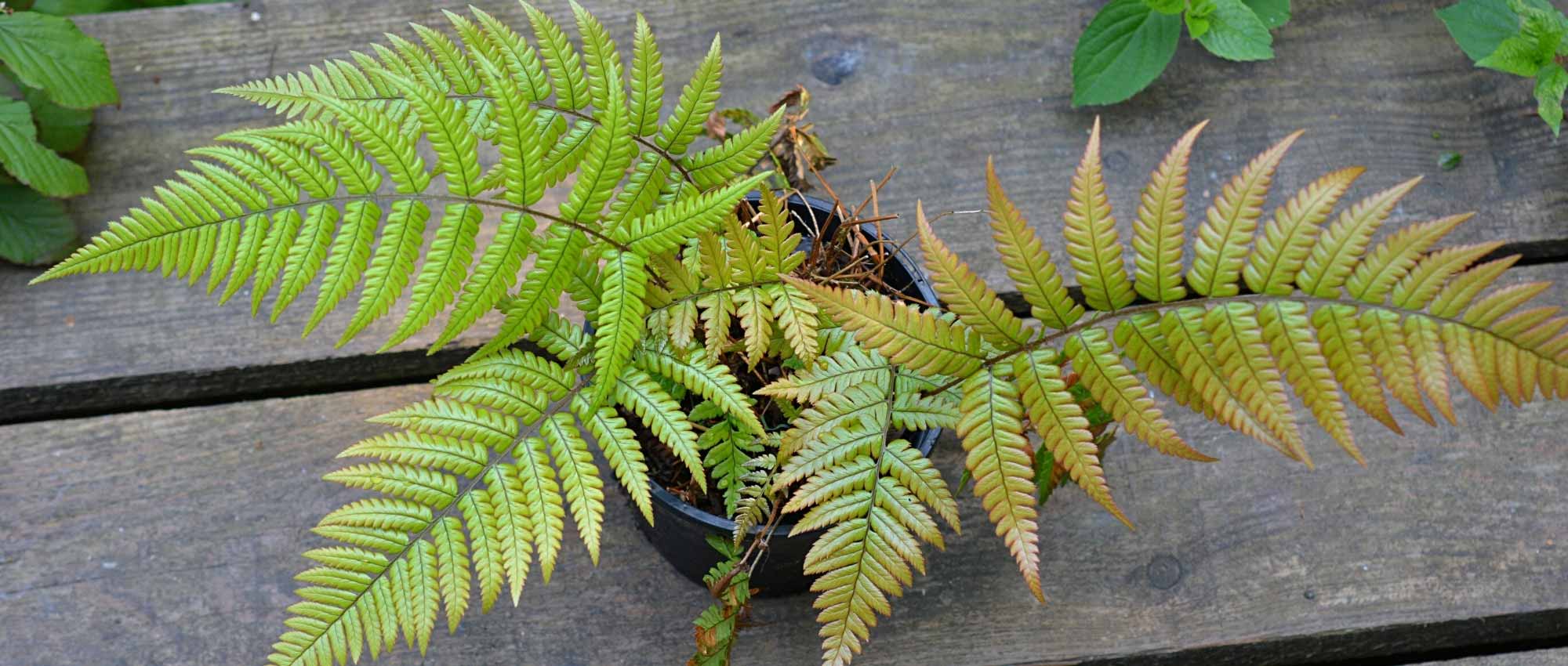
Growing ferns in pots
To enhance a shaded terrace, balcony, or patio
Contents
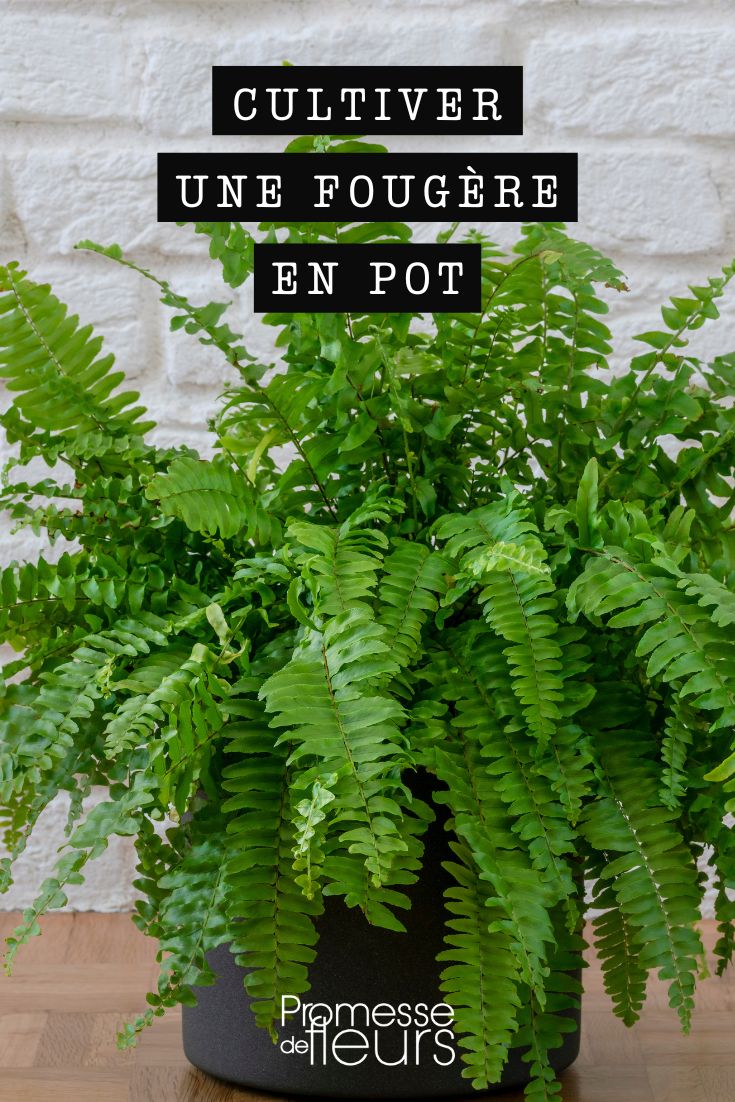
Appreciated for their highly decorative foliage, formed of finely cut fronds, ferns create a natural, lush, and graphic atmosphere in the garden. Some, like the scolopendria or Athyriums, adapt very well to pot cultivation and can beautifully enhance a terrace, patio, or courtyard. You can pair them with other shade or partial shade plants, such as hostas, Japanese maples, and Hakonechloa. Some exotic ferns are typically grown in pots as houseplants, but here we will focus primarily on hardy garden ferns that can survive the winter outdoors.
Discover which varieties of ferns to grow in pots, how to plant them, and how to care for them.
And to learn more about ferns, feel free to check our complete guide: “Ferns: plant and grow”

Which varieties to choose?
Many varieties of ferns can be grown in pots, but it is better to choose compact, non-running varieties that grow in clumps. Here are some examples of ferns you can select:
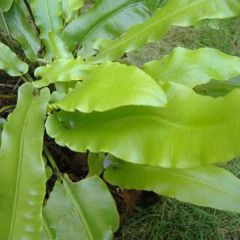
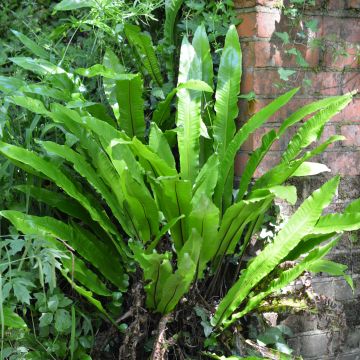
Phyllitis scolopendrium
- Height at maturity 45 cm
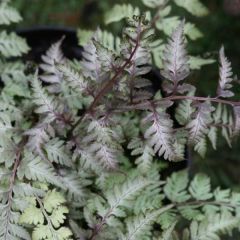
Athyrium niponicum var. pictum - Painted Fern
- Height at maturity 30 cm
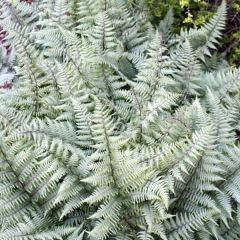
Athyrium niponicum var. pictum Ghost - Painted Fern
- Height at maturity 60 cm
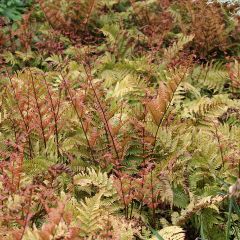
Dryopteris erythrosora - Copper Fern
- Height at maturity 70 cm
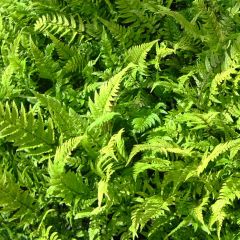
Polystichum tsus-simense - Korean Rock Fern
- Height at maturity 40 cm
Tree ferns, such as Dicksonia antarctica or Cyathea cooperi, can also be grown in a large pot. This allows them to be brought indoors for the winter to protect them from the cold.
Read also
Ferns: growing and plantingWhat type of pot to choose?
Plastic pots are perfectly suitable for growing ferns. You can also opt for a terracotta pot, which has the advantage of being more aesthetically pleasing and environmentally friendly, but the substrate will dry out a bit faster: watering will therefore need to be more frequent. Terracotta pots also allow for better aeration, enabling water and air to circulate. It is important that the pot is fitted with drainage holes to allow excess watering to escape.
The size of the pot should be appropriate for the fern: it should measure about three times the size of the root ball. To give you an idea, if your fern forms a clump of 30 cm in all directions, a pot with a diameter of 15 to 20 cm should suit it well. When planting or repotting, check the spread of its roots to choose a pot that is slightly wider than them each time.
Discover other Asplenium
View all →
Available in 2 sizes
Available in 1 sizes
Available in 1 sizes
Available in 2 sizes
Available in 2 sizes
Available in 2 sizes
Available in 1 sizes
Available in 2 sizes
Available in 1 sizes
Which substrate to choose?
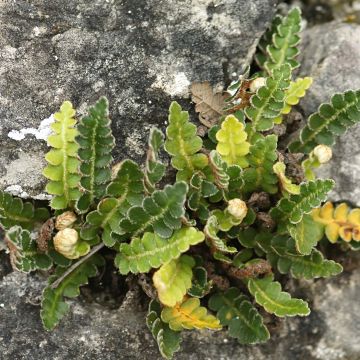
Ferns require a light substrate that is rich in humus and somewhat acidic. For example, you can prepare a mixture consisting of half a good potting soil, one quarter well-decomposed compost, and one quarter heather soil. However, make sure to check the needs of the fern you are growing: the hart’s-tongue fern, for instance, prefers calcareous substrates, while Cheilanthes lanosa will appreciate a very well-drained substrate, even stony or sandy.
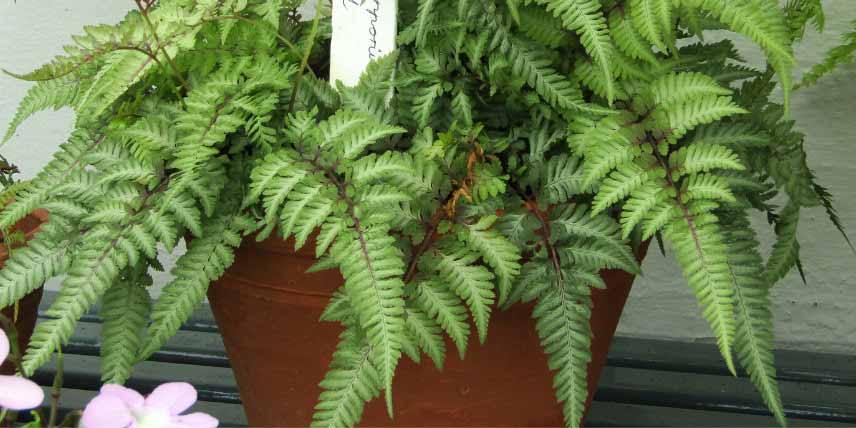
Athyrium niponicum ‘Ursula’s Red’ adapts very well to pot cultivation
Read also
Ferns: how to choose them?When and how to plant a fern in a pot?
You can plant your ferns in autumn or early spring.
- Start by placing the fern in a basin filled with water: this allows the root ball to rehydrate
- Take a pot with drainage holes
- Place a drainage layer (gravel, clay balls, broken pot pieces…) at the bottom
- Then install the substrate in the pot up to about 1/3 of its height
- Place the fern right in the centre
- Fill in by adding potting soil all around the clump, then firm it down
- Water generously.
- Feel free to add a layer of organic mulch on the surface: in addition to being aesthetic, it will help keep the substrate moist for longer. You can use pine bark, straw, dead leaves, etc.
Then place the pot in shade or partial shade, for example on a shaded terrace or balcony, in a courtyard, or simply under the shade of trees and bushes. You can pair your ferns with Japanese maples, Nandina domestica, heucheras, Hakonechloa macra, and Carex oshimensis for a very graphic atmosphere!
Care
Watering
Ferns need the soil to remain relatively cool: watering should therefore be regular. Water once or twice a week in spring and summer (more during heatwaves), and reduce watering in autumn and winter. However, avoid letting water stagnate in the saucer. We recommend using rainwater rather than tap water, as the latter may be too calcareous for them. Also, feel free to mist the foliage in summer, as ferns appreciate humid environments. For deciduous ferns, there is no need to water in winter as they are in dormancy during this period.
Also consider adding a small layer of organic mulch on the substrate: this will prevent it from drying out too quickly, allowing you to limit watering.
Regarding fertilisation, we recommend simply adding a bit of well-decomposed compost, to be superficially integrated into the potting soil at the end of winter or in spring. It is also possible to use a slow-release organic fertiliser, such as ground horn.
Repotting
Ideally, repot ferns every year, placing them in a slightly larger pot each time. If your fern is already in a large pot, or if you skip a year, at least perform a surface topping by replacing the potting soil on the top few centimetres.
Pruning
At the beginning of spring, prune the fronds that have dried out, being careful not to damage the new fronds that are emerging from the centre of the clump.
For further reading
- Discover our entire range of ferns
- Subscribe!
- Contents
Comments