





























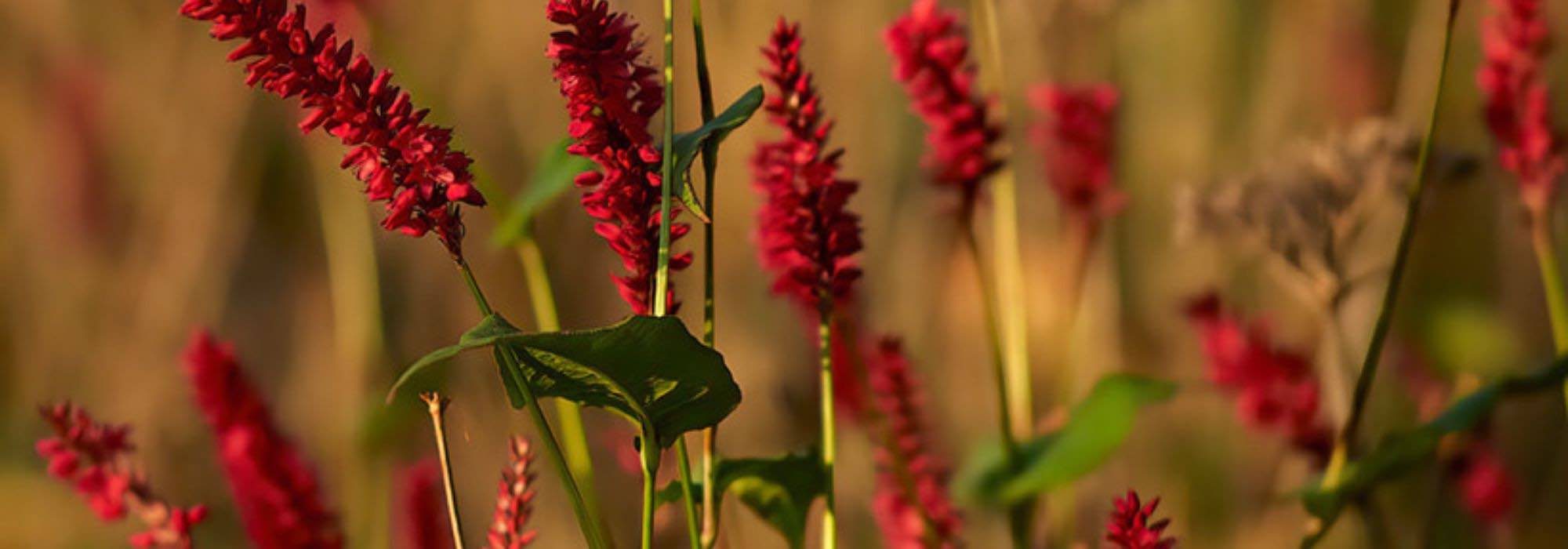
Choosing a Persicaria
Consider persicarias in a cool garden.
Contents
Installed in slightly moist soil gardens, Persicarias are essential perennials for borders, edges, and the vicinity of water features, where they bring their dynamism and unpretentious poetry. They are very hardy, long-lived, and highly floriferous from summer to autumn, for months on end. Also known as Persicaria or Knotweeds, there are numerous botanical species and many cultivars. Very low or particularly tall, in white, pink, or red, with simple foliage or adorned with sophisticated patterns, find the one you need in our buying guide.
→ To learn everything about growing Persicarias, feel free to check our article “Persicarias or Knotweeds: planting, cultivation, and maintenance”.

According to height
Persicarias come in various heights depending on the species and varieties. Among the shortest are Persicaria affinis, miniature plants and prolific groundcovers. In the middle range, Persicaria amplexicaulis are the most represented, well-known for their dancing spikes and minimalist form. Finally, some botanical species of Persicarias form beautiful and large specimens with remarkable flowering.
Small Persicarias, 20 to 40 cm in height
These are mainly Persicaria affinis such as the cultivars ‘Darjeeling Red’ or ‘Kabouter’ found in this category. They reach a height of 20 cm and spread about 50 to 60 cm, forming a dense and highly floriferous carpet. Some botanical species are also very interesting and equally effective for ground coverage:
- The Persicaria vacciniifolia
- The Persicaria runcinata and runcinata ‘Needham’s Form’
- The Persicaria tenuicaulis
- The Persicaria kahil
Some cultivars of Persicaria amplexicaulis are very compact and form clumps of 40 cm in height with a roughly equivalent width. They are attractive in border plantings and have good coverage qualities for a slightly taller, yet still modest size:
- The Persicaria amplexicaulis ‘Inverleith’
- The Persicaria amplexicaulis ‘JS Delgado Macho’
- The Persicaria amplexicaulis ‘Pink Elephant’
→ See the article Persicaria: the best groundcovers
Medium-sized Persicarias, between 50 cm and 1 m in height
This is the realm of Persicaria amplexicaulis, which, depending on the varieties, flourish between 70 cm and 1 m in height when in flower, even reaching 1.20 m for the tallest.
- The Persicaria amplexicaulis ‘JS Caliente’ reaches 70 cm in height with an equivalent spread
- The Persicaria amplexicaulis ‘High Society’ can grow up to 1.20 m in height when in flower
This height category also includes the stunning Persicaria bistorta and some rarer species:
- The lovely Persicaria bistorta ‘Superba’
- And bistorta ‘Hohe Tatra’
- The unpronounceable and rare Persicaria dshawachischwilii
- The Persicaria weyrichii
- The Persicaria ‘Indian Summer’
Finally, at these heights, you can discover the beautiful cultivars with delicate and intricately patterned foliage such as:
- Persicaria runcinata ‘Purple Fantasy’
- Persicaria microcephala ‘Red Dragon’
- Persicaria virginiana ‘Painter’s Palette’
- Persicaria filiformis
- Persicaria ‘Indian Summer’
- The Persicaria campanulata can reach up to 1.20 m in height
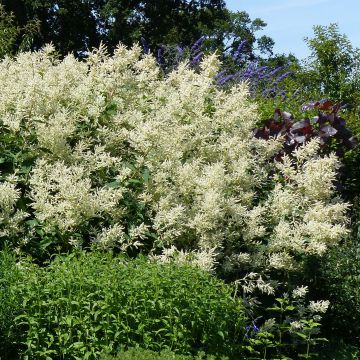
The Persicaria polymorpha, a very tall specimen at 2 m
Alone in its category, much taller than the others, the Persicaria polymorpha with its shrubby stature forms a very beautiful specimen.
→ Watch Olivier’s video on Persicaria polymorpha
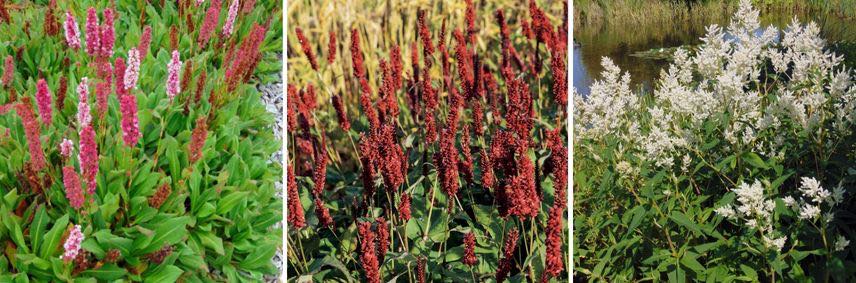
Persicaria affinis ‘Kabouter’, Persicaria amplexicaulis ‘Blackfield’, Persicaria polymorpha
According to the colour of the flowers
Persicarias bloom simply, in white, pink, and vibrant red.
White-flowered Persicarias
Many botanical species bloom in white. The Persicaria polymorpha has large, ramified corymbs. The Persicaria dshawachischwilii and Persicaria weyrichii are smaller species but bloom in fairly close panicles. The very lovely Persicaria amplexicaulis ‘Alba’ features fine, supple spikes. The low-growing Persicaria kahil blooms in somewhat unruly spikes, giving it a wilder appearance. Finally, the very attractive foliage of Persicarias like Persicaria microcephala ‘Red Dragon’ and Persicaria runcinata ‘Purple Fantasy’ has a much more understated white flowering, providing a lovely contrast with the foliage.
Pink-flowered Persicarias
Often pink, Persicarias mostly bloom in a bright pink, varying from pale to dark, without any blue or yellow tint. This is the case for Persicaria affinis, which showcases a gradient of soft pink, raspberry, and carmine between the blooming and fading of the flowers. Similarly, Persicaria amplexicaulis typically blooms in medium pink. The Persicaria amplexicaulis ‘Orange Field’ blooms in coral pink.
Red-flowered Persicarias
The Persicaria filiformis blooms in coral red. The Persicaria ‘Indian Summer’ blooms in ruby red. Other numerous red blooms are found among Persicaria amplexicaulis. Notable cultivars include the beautiful ‘Vesuvius’ and ‘Blackfield’, both in intense red.
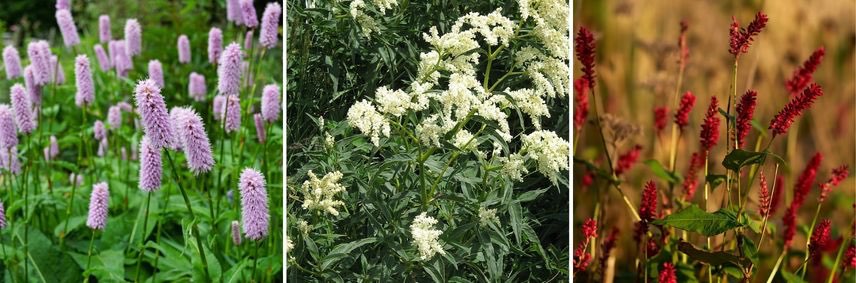
Persicaria bistorta, Persicaria alpina, Persicaria amplexicaulis Vesuvius
Discover other Persicaria
View all →
Available in 1 sizes
Available in 3 sizes

Available in 2 sizes
Available in 2 sizes
Available in 1 sizes
Available in 1 sizes
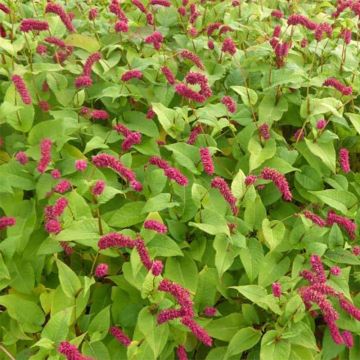
Available in 1 sizes
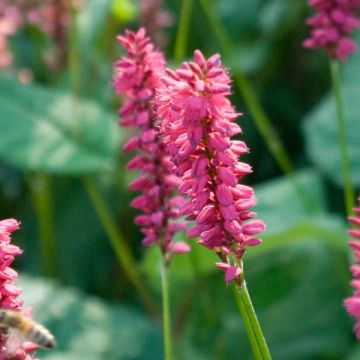
Available in 1 sizes
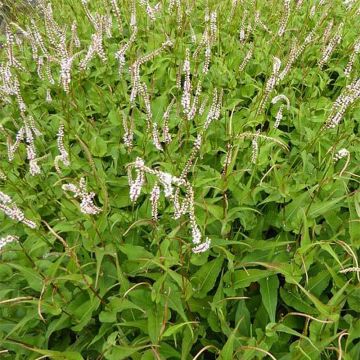
Available in 1 sizes
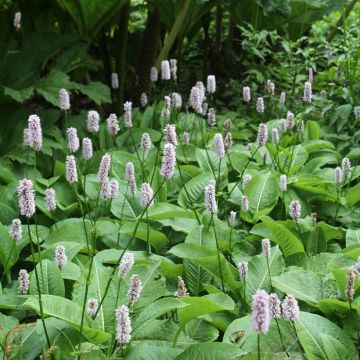
Available in 2 sizes
According to the shape of the flowers
Well known for their dancing spikes, which can be fine, airy, thick, or bushy, Persicarias carry these spikes high above the foliage. For many months, they come alive under the effects of the wind and changes in light. They are composed of a multitude of small flowers with 5 petals. These spikes are sometimes drooping, as seen in Persicaria amplexicaulis ‘Pink Elephant’ or Persicaria amplexicaulis var. pendula.
We previously mentioned other types of flowering: those with ramified panicles from the larger botanical species. There are also the globular flowers of Persicaria runcinata, featuring tiny spherical heads 1 cm wide.
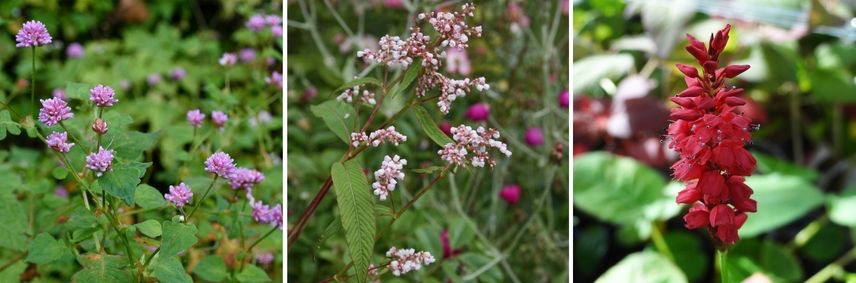
Persicaria runcinata, Persicaria campanulata, Persicaria amplexicaulis ‘Taurus’
According to the colour of the foliage
As touched upon in the first chapter, some very beautiful specimens delight us with their sophisticated foliage:
- The Persicaria microcephala ‘Red Dragon’ features original lanceolate brown-purple leaves, marked with a black triangle highlighted in silver.
- The Persicaria runcinata ‘Purple Fantasy’ offers geometric leaves, shaped like triangles, maculate with a brown “V” at the centre and marginate in silver.
- The Persicaria virginiana ‘Painter’s Palette’ has ovate foliage, where green, white, pale yellow splashed with pink mingle. It is also marked with a chocolate-coloured “V” at the centre of each leaf.
- The Persicaria filiformis, on bright vivid green foliage, offers a contrasting macule, you guessed it: in the shape of a “V” and in chocolate brown.
- The Persicaria campanulata, more discreet, has very veined lanceolate leaves, particularly decorative.
Note that the foliage of the stem-clasping Persicarias, of a medium green, turns purple in autumn, while that of the Persicaria ‘Indian Summer’ turns purple in the sun.
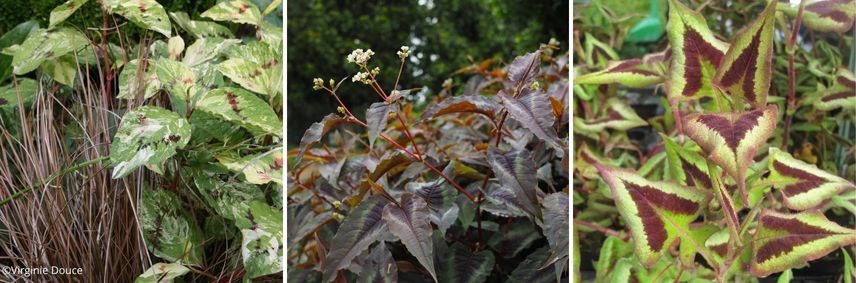
Persicaria virginiana ‘Painter’s Palette’, here with a bronze Carex, Persicaria microcephala ‘Red Dragon’, Persicaria runcinata ‘Purple Fantasy’
Depending on the use
Persicarias bring their lightness to all styles of gardens, whether contemporary or romantic, English or naturalistic. With their upright flowering, they provide simplicity and dynamism to all borders, adding a poetic touch with their dancing spikes alongside more elaborate flowers.
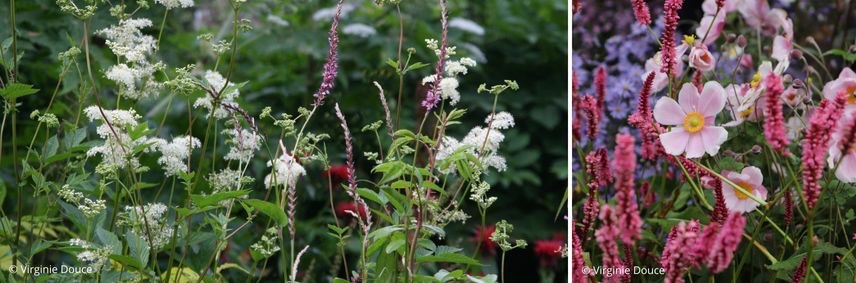
As groundcover and borders
Persicaria affinis such as ‘Superbum’ and the small-sized botanical species mentioned in the first chapter, like Persicaria tenuicaulis, are perfect groundcovers for cool soils, where they quickly establish semi-evergreen foliage and bloom for a long time. All are perfectly hardy and require no maintenance, but they do suffer in dry conditions. However, they tolerate wet and heavy soils well.
In the middle and back of borders
Plant all medium-sized species and cultivars in borders, reserving the taller ones, reaching 1 to 1.2 metres, for the back of the beds. They thrive in soil that remains slightly moist, in full sun or partial shade, making them suitable for edges or along the banks of a water feature. Some Persicarias can even prosper in marshy conditions.
As a specimen
The unique Persicaria polymorpha is best planted at the back of a border or as a specimen, where its beautiful stature and plumes of white flowers are enough to create a focal point.
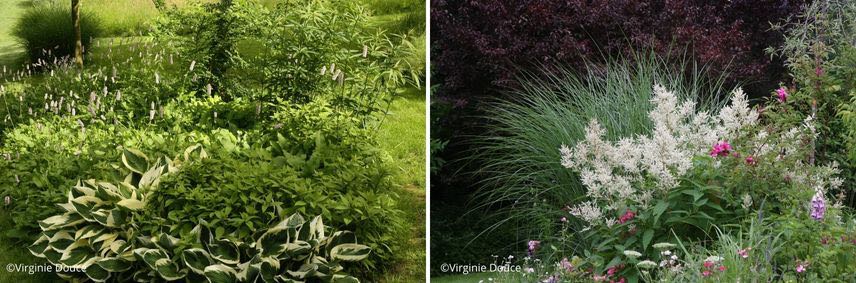
On the left, a Persicaria bistorta in a white scene with Hosta, Lysimachia clethroides, and Veronicastrum. On the right, a Persicaria polymorpha in front of a Miscanthus with a Rose
In the kitchen
Do you know Polygonum odoratum or Persicaria odorata, also known as Rau Ram in Asian grocery stores? It is sometimes found in packets, but it can be grown as an annual, as a culinary herb. It is very prominent in Vietnamese cuisine and Asian cuisine in general. Often compared to coriander, it has a unique flavour that is difficult to replace or compare.
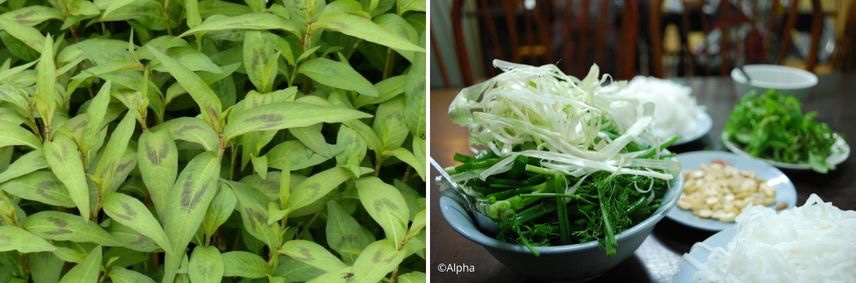
Persicaria odorata or Polygonum odoratum, also known as Rau Ram, in cooking
- Subscribe!
- Contents
Comments