






























Pairing ideas with Leptospermum
7 companion planting ideas to try with tea tree
Contents
Leptospermum, also known as tea tree or New Zealand myrtle, is a finely-leaved, aromatic, evergreen bush that is covered, from May to July, in small melliferous pink, red, or white flowers. It can reach a height of between 30 cm and 3 metres and is grown in full sun in a region with mild winters and well-drained, poor, acidic to slightly calcareous soil. It is a perfect bush for creating a flowering hedge, filling a heather soil bed, enhancing a seaside garden, or even for growing in a pot on a balcony. Discover our ideas for pairing Leptospermum with other bushes and plants in your garden or on your terrace.

In a flowering hedge
If you want to create a privacy hedge in your garden that shields you from the gaze of neighbours while being decorative, Leptospermum is a plant that might appeal to you. It offers a palette of colours, ranging from white to red, including pink, and is adorned with lovely flowering in spring and summer. To create a flowering hedge, select a tall variety of Leptospermum such as the Leptospermum scoparium ‘Apple Blossom’ which grows up to 2 metres high or the Leptospermum scoparium White which reaches 3 metres at ripeness. Plant alongside other evergreen shrubs like laurustinus ‘Variegatum’ with variegated foliage and the ceanothus arboreus ‘Trewithen Blue’. All combinations of colours and foliage are possible. Also consider the photinia with its beautiful evergreen foliage that turns red.
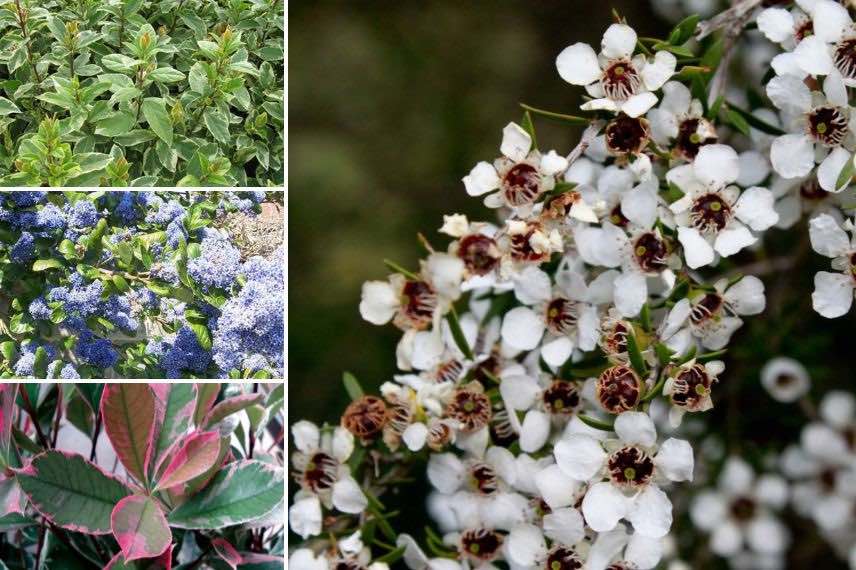
Clockwise: Viburnum tinus ‘Variegatum’, Leptospermum scoparium ‘Apple Blossom’, Photinia fraseri ‘Pink Marble’, Ceanothus arboreus ‘Trewithen Blue’
In an exotic bed
With its charming small flowers and fine foliage, Leptospermum can be used in an exotic bed, planted in a region with a mild climate and winters. Install a Leptospermum scoparium ‘Martini’ in full sun, featuring spectacular pink flowering, which appears between May and July. Plant alongside an original Callistemon (x) laevis, which offers surprising bright red bottlebrush-shaped flowers from May to June. For an even more lush effect, add an Hawaiian palm with its large, majestic fan-shaped leaves. You can also opt for a dwarf banana or Musella lasiocarpa. For even more flowers and red, you can also plant some cannas at the foot of this exotic bed.
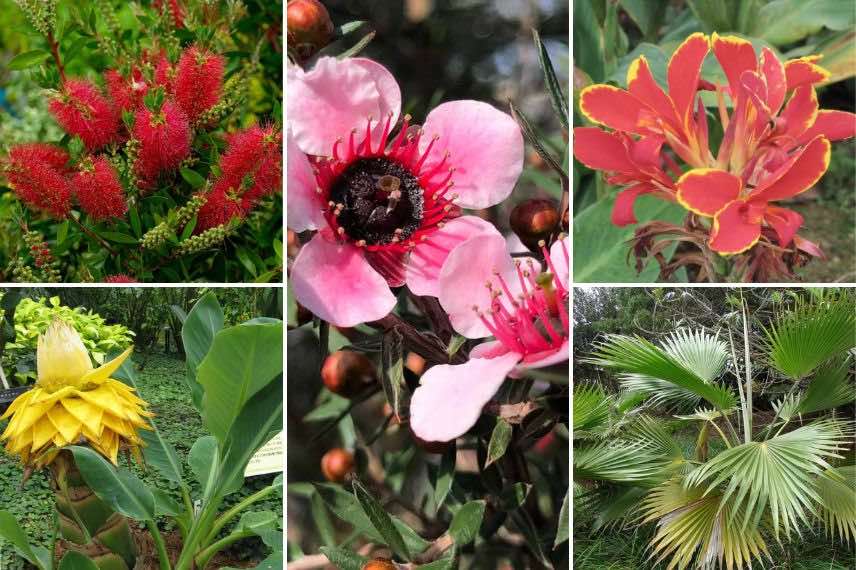
Callistemon laevis, Leptospermum scoparium ‘Martini’, Canna ‘Lucifer’, Musella lasiocarpa, Hawaiian palm
In a dry garden
Leptospermum is a shrub that thrives in full sun and is drought-resistant, making it an ideal plant for a dry or gravel garden. In a region with mild winters, you can plant a Leptospermum scoparium ‘Red Damask’ alongside everlasting flowers like Bracteantha ‘Heliana White’ and Bracteantha ‘Granvia Gold’. The crimson red flowering of Leptospermum, from May to June, will provide a striking contrast to the immaculate white and bright yellow of the Bracteantha, which bloom from July onwards. You can also add Celosia Flamingo ‘Pink NT’, which also enjoy sunny conditions and produce delicate pink spikes in May and June.
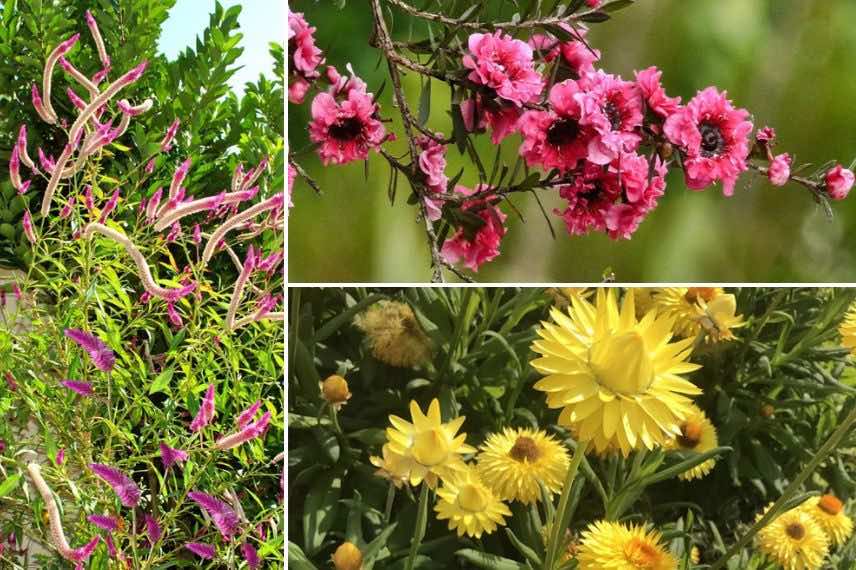
Celosias ‘Flamingo Pink NT’, Leptospermum scoparium ‘Red Damask’, Bracteantha ‘Granvia Gold’
In a seaside or Mediterranean-style garden
Leptospermum is known for its ability to withstand sea spray, making it easy to insert into a seaside garden. You can plant a Leptospermum scoparium ‘Red Damask’ with its red flowering and pair it with other unique and uncommon plants such as Echium fastuosum or Madeira viper’s bugloss, which offers gigantic blue spikes. At their feet, use, as groundcover, delospermas, succulent plants suited to coastal areas that provide vibrant blooms. You can also plant dwarf date palm – Phoenix roebelinii to enhance the seaside atmosphere.
Another option is to plant several Mediterranean-type shrubs, such as rockrose, juniper, or lavender, alongside the Leptospermum. In a sunny rockery with well-drained soil, install a Leptospermum scoparium ‘Wiri Kerry’ with red to purplish-pink flowers alongside lavender angustifolia ‘Munstead’ with its bright violet-blue and Montpellier cistus with its lovely crumpled white flowers.
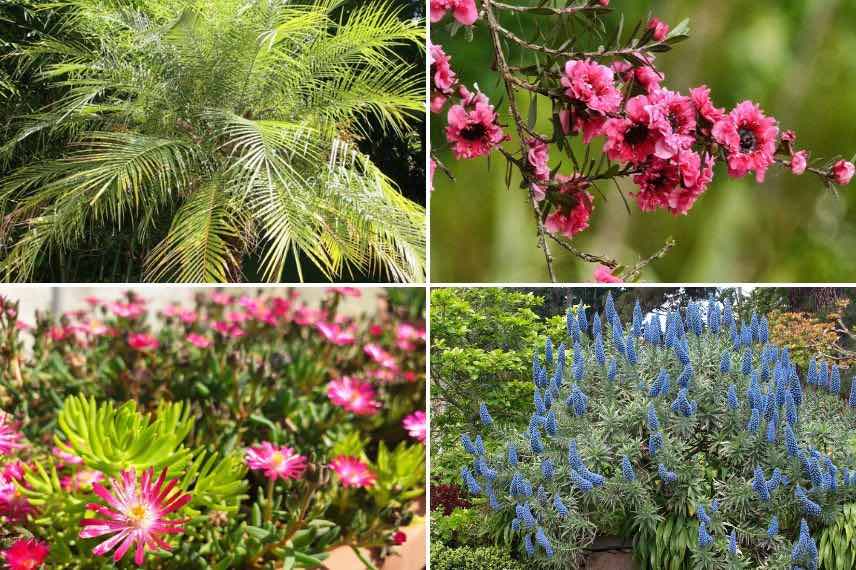
Phoenix roebelinii, Leptospermum scoparium ‘Red Damask’, Delosperma, Echium fastuosum
In an acidic soil bed
Leptospermum thrives in an acidic substrate, making it suitable for insertion into a heather soil bed. You have free rein to pair it with camellias, heathers, as well as rhododendrons and azaleas. Place for example in the background, in partial shade, a Japanese maple – Acer palmatum ‘Bloodgood’, whose finely cut leaves change colour with the seasons. Add a Japanese azalea ‘Melle’ or hybrid rhododendron. Enhance with some heather plants and install a Leptospermum ‘Silver Sheen’ or woolly tea tree, which is one of the easiest Leptospermums to grow. You can also place a classic camellia – Camellia ‘Dahlonega’, which will bring light to the bed with its elegant white flowers in winter and spring.
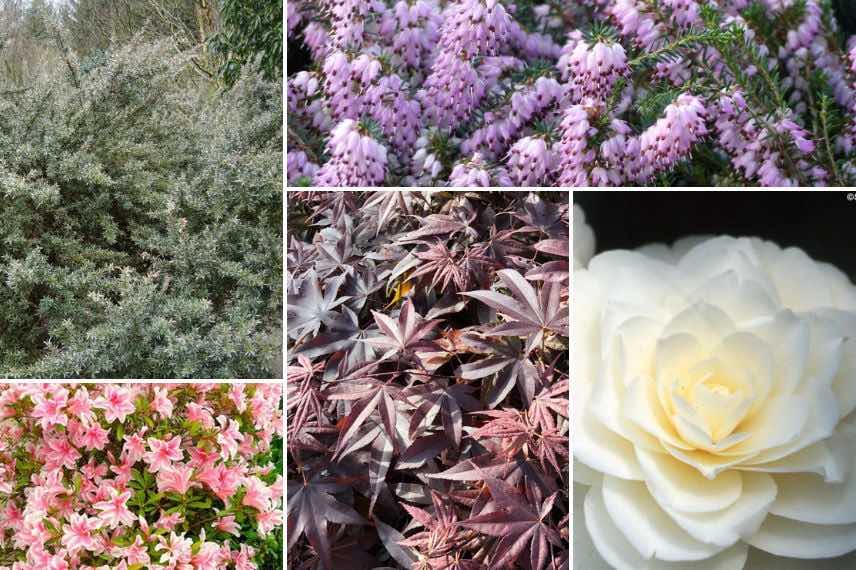
Leptospermum ‘Silver Sheen’, Erica carnea ‘December Red’, Japanese azalea ‘Melle’, Acer palmatum Bloodgood, Camellia ‘Dahlonega’,
On a balcony
There are compact varieties of Leptospermum or tea tree that acclimatise well to pot cultivation. Of modest size, they allow for the creation of beautiful flower displays to place on a balcony or terrace. You can try for example the combination of Leptospermum ‘Nanum Tui’, which produces soft pink flowers on fine foliage in bronze to burgundy tones, and original black Persian fritillaries or Fritillaria persica ‘Adiyaman’ for a combination of dark and light tones.
Another idea is to pair a Leptospermum scoparium ‘Jubilee’ with guinea fowl fritillaries featuring charming bells adorned with a surprising purple and white checkerboard pattern.
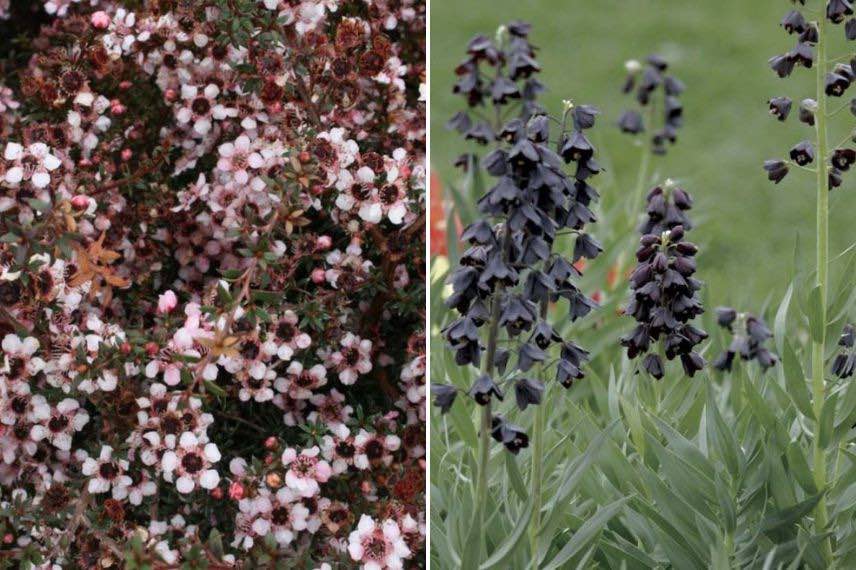
Leptospermum ‘Nanum Tui’, Fritillaria persica ‘Adiyaman’
In a bed or container of aromatic plants
Originating from Australia and New Zealand, Leptospermum is also known as tea tree due to the use of its fine aromatic leaves for making infusions. Rich in vitamin C, the leaves allowed the Maoris to consume hot beverages. This practice was adopted by Captain Cook and his crew to counteract the lack of vitamin C, which sailors suffered from at that time, and to prevent scurvy. Aromatic plant enthusiasts can create a border or take a wooden container and insert small Leptospermum scoparium ‘Nanum Kiwi’ plants alongside mints, common verbenas, thymes, and other fragrant plants.
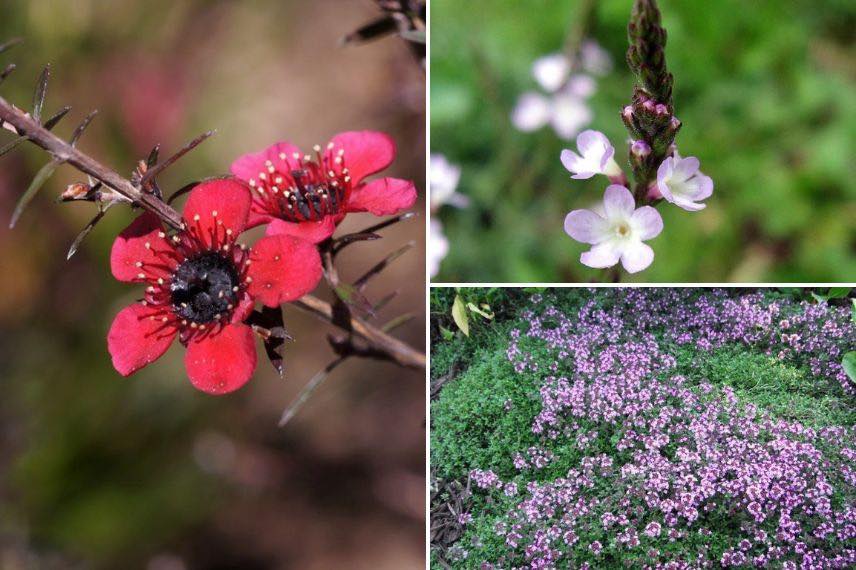
Leptospermum scoparium Nanum Kiwi, common verbena, Thymus praecox ‘Coccineus’
- Subscribe!
- Contents
Comments