






























Alpine flowers: 7 bulbs to plant in your garden
Enjoy the beautiful flowering of these hardy bulbs!
Contents
Mountain gardens are subject to particular climate and geological conditions: Winters are particularly long and cold, winds can be strong there, soils are very well-drained, generally rocky and prone to erosion… Creating a mountain garden is therefore a real challenge; plants chosen need to be hardy. The advantage of bulbous plants is that they pass the dormant season in the soil, which allows them to protect themselves from the cold. They then complete their growth cycle over a short period (leafing, flowering and fruiting). Some of them therefore tolerate these challenging conditions without issue. With their generous flowering, these bulbs are perfect for enlivening the garden and bringing beautiful splashes of colour.
Discover our selection of bulbs best suited for flowering mountain gardens, with a few ideas on how to pair them!

Martagon lily
Martagon Lily (Lilium martagon) is a splendid lily that unfolds in early summer, usually in June or July depending on the region and altitude, with large flowering stems consisting of pinkish-purple flowers dotted with purple spots. They measure 2 to 5 cm in width and are composed of six tepals recurved upwards, towards the back of the flower. They reveal at the centre six long orange stamens. When in flower, the Martagon Lily can reach up to 1.5 m in height. Each flowering stem can bear between 3 and 20 flowers. The Martagon Lily also bears deciduous pale green foliage. The leaves are elliptical and whorled in groups of 4 to 8. It can grow up to 2,800 metres in altitude, in the southernmost regions of its range. You can plant the Martagon Lily in partial shade, in association with ferns, yellow gentians, hardy geraniums such as the Geranium nodosum…
Don’t hesitate to plant beside it the magnificent Himalayan giant lily, Cardiocrinum giganteum. The Martagon lilies can also find their place in a cool and shaded rock garden, for example alongside the fern Coniogramme emeiensis, the Corydalis flexuosa, and the Carex oshimensis ‘Everest’.
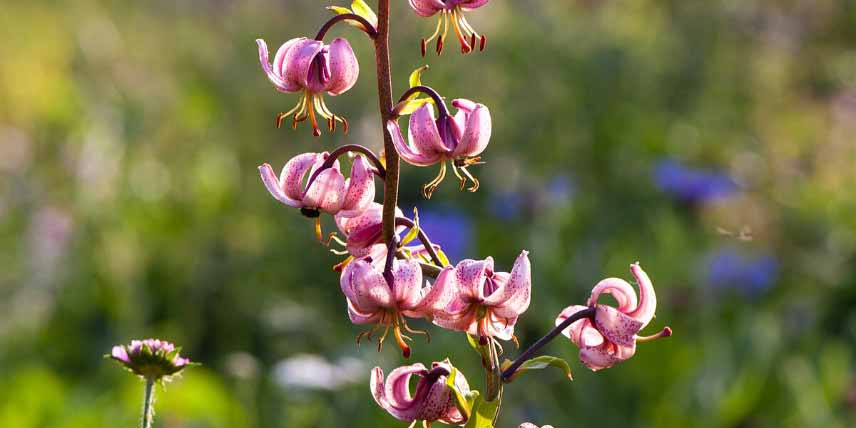
Lilium martagon (photo : Michael Apel)
Poet's Narcissus
The Narcissus poeticus is the true poet’s daffodil. It offers in May beautiful flowers formed of six petals of immaculate white, surrounding a central yellow crown, edged with red or orange. Its flowers are delicately scented. We also appreciate the brightness they bring to the garden! It flowers somewhat later than the other narcissi, but offers flowers with a more natural and delicate look. It reaches up to 40 cm tall. It grows spontaneously in France, mainly in the Alps, Jura and the Massif Central, up to 2,300 m in altitude. Its leaves are slender and elongated, resembling those of a sedge, green, sometimes with a bluish tinge.
Its flowers are ideal for creating cut-flower arrangements. In the garden, pair it with camassias, muscaris and ornithogalums.
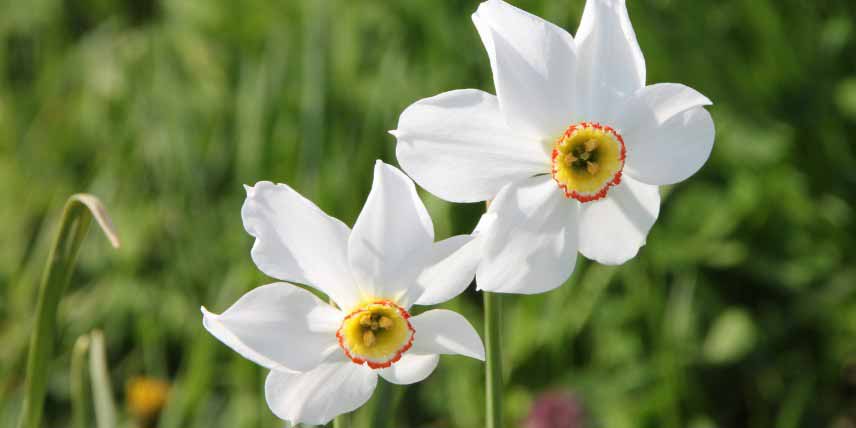
Narcissus poeticus ‘Recurvus’
Ornamental garlic
Some species of ornamental allium are particularly well-suited to mountain planting. This is the case, for example, with l’Allium senescens subsp. montanum. From early summer through September, it bears beautiful pale-pink spherical inflorescences, measuring between 2.5 and 3 cm in diameter. They reach about 35 cm in height and consist of a multitude of small star-shaped flowers. You can also opt for l’Allium cyathophorum var. farreri, native to the mountains of China, where it grows up to 4,600 metres in altitude. It flowers in June–July and then bears pink-purple flowers, carried at a height of 30 cm. Its rounded inflorescences measure up to 6 cm in diameter and consist of tubular flowers with pointed petals. Also discover the impressive Allium karataviense, as well as Allium sikkimense!
In the garden, you can pair these ornamental alliums with Iris sibirica, scabious and Centaurea montana.
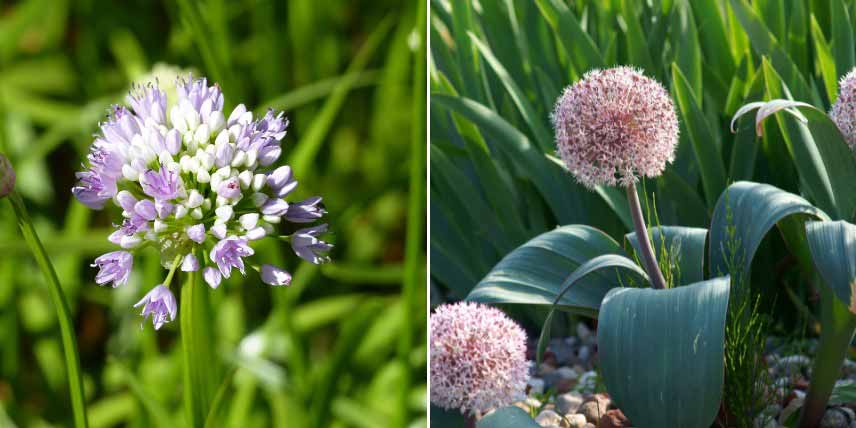
Allium senescens var. montanum ‘Glaucum’ and Allium karataviense
Read also
Which shrubs for a mountain hedge?Erythronium
Erythronium, sometimes called dog’s-tooth violet, offers in spring (usually in April–May) lovely bell-shaped flowers in yellow, pink or white, which resemble small lilies. It belongs to the same family, the Liliaceae. Very hardy, the Erythronium dens-canis grows wild in mountainous regions, notably in the southern Alps, but also in the Pyrenees and the Massif Central. It is found up to 2,300 metres above sea level, and grows in deciduous forests, at the edge of woodland, as well as in heathlands and calcareous meadows. It forms graceful little pink flowers, nodding towards the ground, formed of six recurved petals, surrounding a cluster of protruding stamens. It reaches 15–20 cm in height, and bears two basal elliptical leaves, glaucous green, maculated with brown-red blotches. You can also opt for Erythronium ‘Pagoda’, which bears beautiful yellow flowers, very bright. In the garden, Erythronium thrives in cool, rich, shaded soil, and will easily find a place in a woodland garden.
Pair it with other spring bulbs, such as botanical tulips, snake’s-head fritillaries, grape hyacinths and crocus. In woodland, plant it alongside ferns, hostas and bluebells.
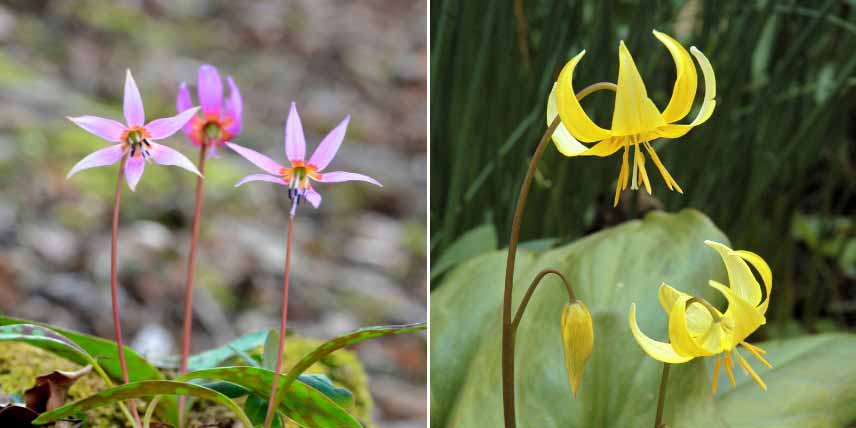
Erythronium dens-canis and Erythronium ‘Pagoda’
The Crocus
Spring Crocus, Crocus vernus, ranks among the first plants to flower! It flowers from February to April, depending on region and altitude. Its flowers sometimes break through the snow and wake up the garden. It bears simple, cup-shaped flowers that flare upward toward the sky, in purple mauve or white, with long orange stamens at the centre. They are formed of three petals and three tepals, of the same appearance (six tepals). Its flowers resemble those of autumn crocuses, which bloom in autumn. The Crocus opens its flowers to the sun, and closes them in the evening or in cloudy weather. It grows in alpine meadows up to 2,500 metres above sea level! Its leaves are linear, very fine and unobtrusive, dark green, with a white central vein.
In the garden, pair it with daffodils, Chionodoxa, snowdrops and spring snowflakes. It will also be perfect to accompany the yellow flowers of winter aconite, Eranthis hyemalis.
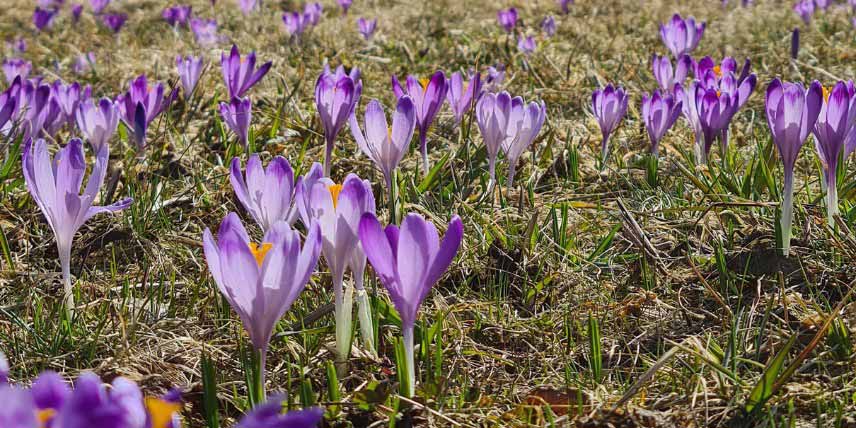
Crocus vernus
Guinea-fowl fritillary
Snake’s-head fritillaryor Fritillaria meleagris is a charming bulbous plant that, in March–April, offers bell-shaped flowers that nod toward the ground. They are formed of six purple petals, featuring a very distinctive chequered pattern! Snake’s-head fritillary is a perennial plant that naturalises easily. Its flowers have a very delicate appearance. When in bloom, it reaches about 25 cm in height. It also bears green, linear leaves that are rather unobtrusive. You can also opt for the Kamchatka fritillary, very distinctive with its purple chocolate flowers, as well as Fritillaria pallidiflora or Fritillaria sewerzowii.
In the garden, plant the fritillary at the foot of deciduous trees or on the woodland edge, alongside snowdrops, hellebores, anemone blanda, wood hyacinths and erythroniums, to create a very natural atmosphere!
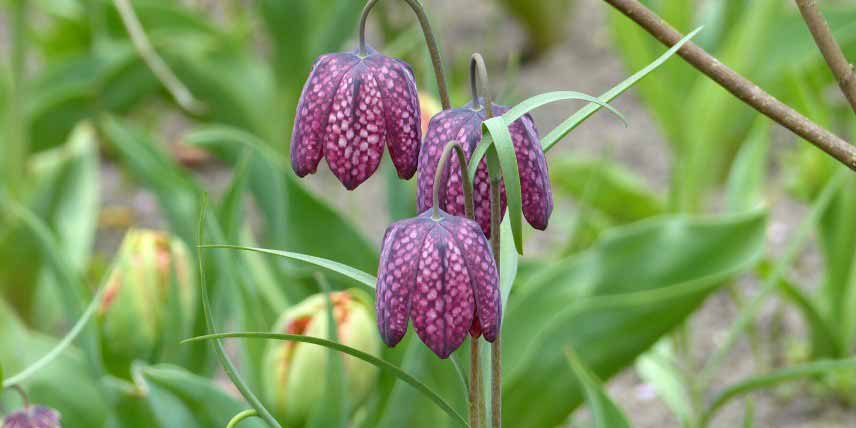
Fritillaria meleagris
The Tulipa sylvestris
Tulipa sylvestris, also known as the woodland tulip, is a charming botanical tulip bearing beautiful star-shaped flowers, bright yellow. They consist of six slender petals, surrounding a cluster of stamens, and reach a height of 30–40 cm. Its flowers emit a light lemon fragrance. It usually flowers from March to April, and can easily naturalise in the garden. It grows in the wild in France and can be found up to 2,000 metres in altitude. You can also opt for the Tulipa linifolia, which in April–May produces scarlet-red flowers, fully opened.
Pair these botanical tulips with narcissi, camassias, chionodoxas and fritillaries.
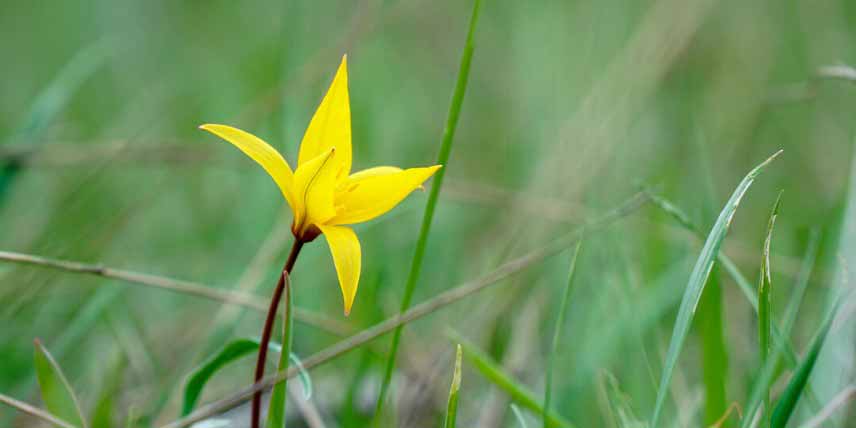
Tulipa sylvestris
- Subscribe!
- Contents

Comments