





























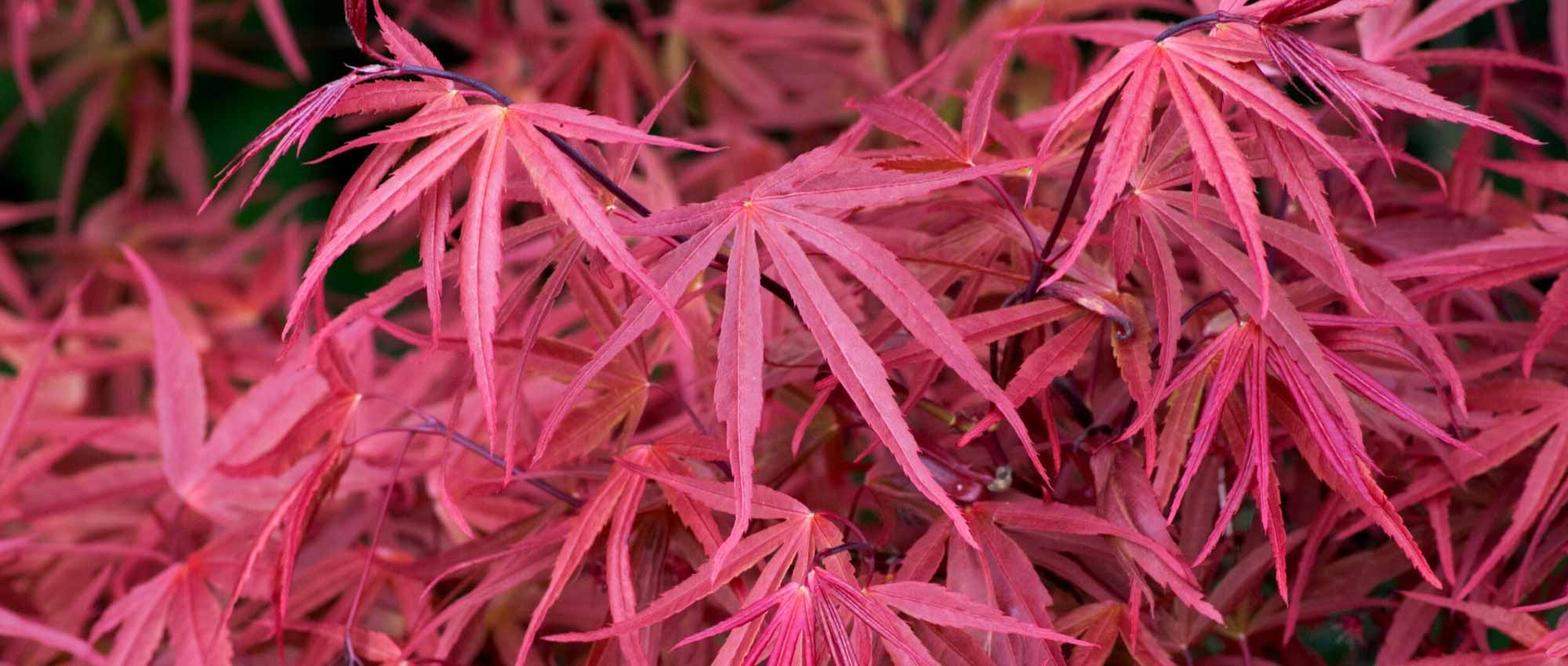
7 Japanese maples with red foliage
The most beautiful varieties with scarlet leaves
Contents
We appreciate Japanese maples for their beautifully palmate and colourful foliage, which takes on lovely red or orange hues in autumn. Some of them stand out with their foliage that remains red all year round, evolving through the seasons between bright red, dark red, purple, burgundy, and reddish-orange shades… Their leaves also offer a great diversity of shapes, ranging from simply palmate to finely laciniate. Particularly graphic, they are perfect bushes for small gardens and terraces. They thrive in partial shade, sheltered from the wind, in cool, well-draining, slightly acidic soil. Discover the 7 most beautiful varieties of Japanese maples with red leaves.

Acer palmatum 'Dissectum Garnet'
TheAcer palmatum ‘Dissectum Garnet’ is a stunning Japanese maple with dark, burgundy to purple foliage. Its leaves take on a brighter hue in autumn. At maturity, it reaches about 3 m in height and 2 m in spread. Its leaves measure 5 to 10 cm long and are deeply dissected, with 5 to 7 narrow, dentate lobes, creating a chiselled effect. This gives the bush a very light and airy style. It also produces beautiful red winged fruits from September onwards. Over time, it develops a rounded and spreading habit, forming trailing horizontal branches at the tips.
In the garden, use this Japanese maple to create a lovely heather soil bed alongside other acidophilous plants. Consider azaleas and rhododendrons, Kalmia, and Japanese Andromeda (Pieris japonica). You can also incorporate daphnes and camellias.
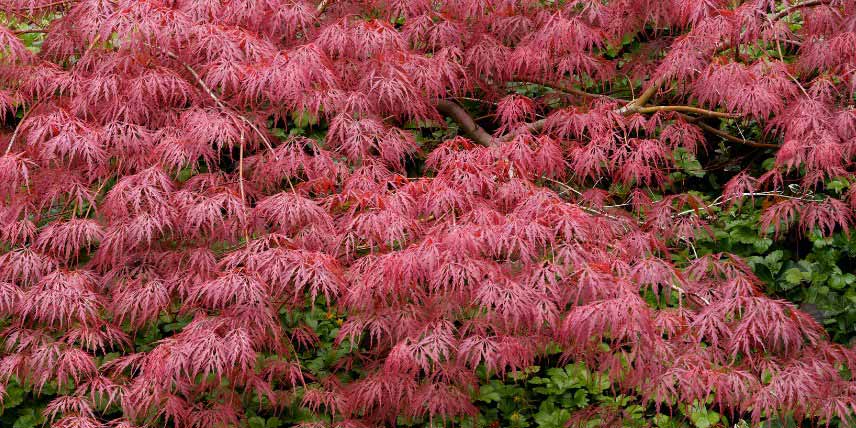
The very fine foliage of the Acer palmatum ‘Dissectum Garnet’
Acer palmatum 'Bloodgood'
The ‘Bloodgood’ Maple is a variety with bright red foliage in spring, purple in summer, finishing in a range of brown and red in autumn. It thus evolves in a red spectrum, showing no trace of green. Its leaves are glossy and beautifully palmate, measuring 5 to 10 cm long and divided into 5 to 7 lobes. At maturity, it reaches about 2 m in all directions.
The Acer palmatum ‘Bloodgood’ will integrate wonderfully into a zen garden, alongside bamboos, cloud-pruned pines (niwaki), a dogwood Cornus controversa ‘Variegata’, and a Viburnum plicatum ‘Mariesii’, with a particularly graphic habit. For perennials, consider Hakonechloa macra, Asian primroses, ferns, and Japanese anemones.
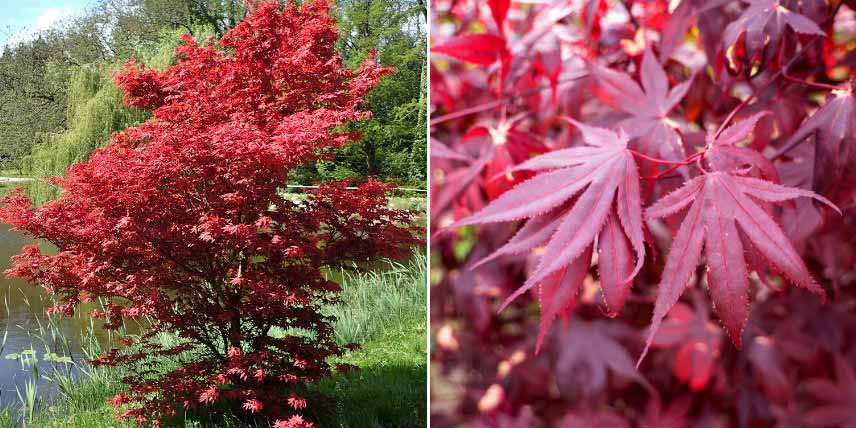
The Acer palmatum ‘Bloodgood’: overview and detail of the foliage (photos: Krzysztof Ziarnek / F. D. Richards)
Acer palmatum 'Inaba-Shidare'
‘Inaba-Shidare’ is a stunning Japanese maple with deeply dissected leaves, creating a very fine and light effect. They change through various shades of red throughout the year: first dark red – purple in spring, the leaves then become purplish in summer, before turning scarlet red in autumn, before falling. Particularly graphic, this Japanese maple forms a bush with a spreading habit, featuring horizontal and slightly trailing branches. It reaches up to 3 m in all directions at maturity.
It will be perfect in a pot on a terrace to create a graphic and modern atmosphere, alongside other very light foliage, such as that of ferns. Consider, for example, Athyrium niponicum, Blechnum spicant, or Dryopteris erythrosora. Integrate grasses like Hakonechloa macra, as well as hostas, for their very graphic foliage.
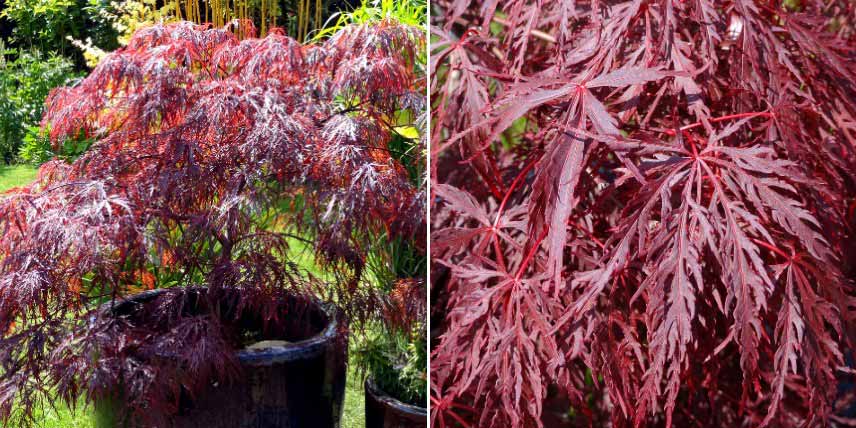
Acer palmatum ‘Inaba Shidare’ is a Japanese maple with deeply dissected dark red foliage and an almost weeping habit
Acer palmatum 'Dissectum Firecracker'
Acer palmatum ‘Dissectum Firecracker’ forms a bush with a rounded, spreading habit, reaching about 2.5 m in height and 3 m in width at ripeness. It bears laciniate leaves, very finely cut, measuring 5 to 8 cm long, divided into beautifully dentate segments. Their colour is initially bright red in spring, turning dark red – burgundy in summer. The leaves then blaze in autumn, becoming fiery red.
The Acer palmatum ‘Dissectum Firecracker’ fits perfectly into zen, Japanese-style gardens. Its feathery foliage will complement that of astilbes, ferns, Nandina domestica, and grasses. In the background, plant bamboos such as Phyllostachys nigra or Fargesia nitida.
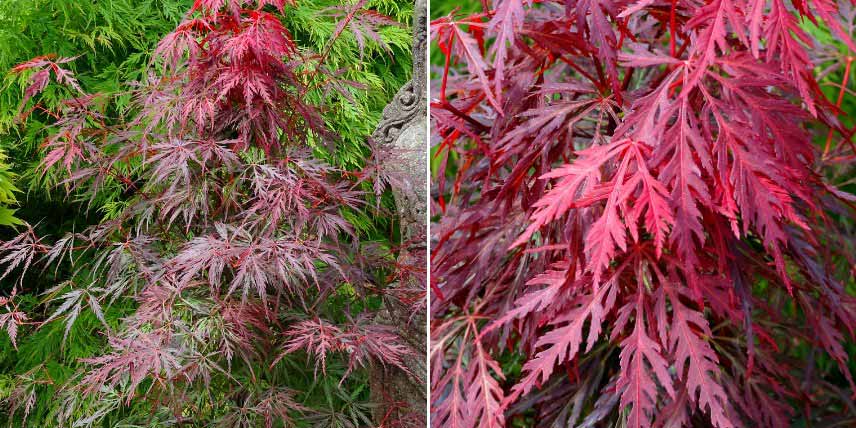
The Acer palmatum ‘Dissectum Firecracker’ features very fine and delicate, feathery foliage, initially bright red and later turning dark green.
Acer palmatum 'Deshojo'
The Japanese maple ‘Deshojo’ is a beautiful bush with changing foliage: first bright red in spring, the leaves turn green in summer, then orange-red in autumn. In the interim, they can display a lovely gradient of red and green, as the young leaves remain scarlet while the more mature ones gradually shift from red to green. Its leaves, measuring 3 to 6 cm long, are divided into 7 dentate lobes. Carried by brown to reddish branches, they have a fairly ordinary palmate shape and are not laciniate like previous varieties. This maple does not exceed 2.50 m in all directions at maturity and can easily be planted in a large pot or container on a terrace. Initially, it has a slender and upright habit, then later develops horizontal branches giving it a more spreading habit.
Take advantage of this Japanese maple to create a very graphic flowerbed. It will be perfect alongside horsetails, ferns, and bamboos. Also consider Choisya ternata and Nandina domestica, two shrubs with very graphic foliage!
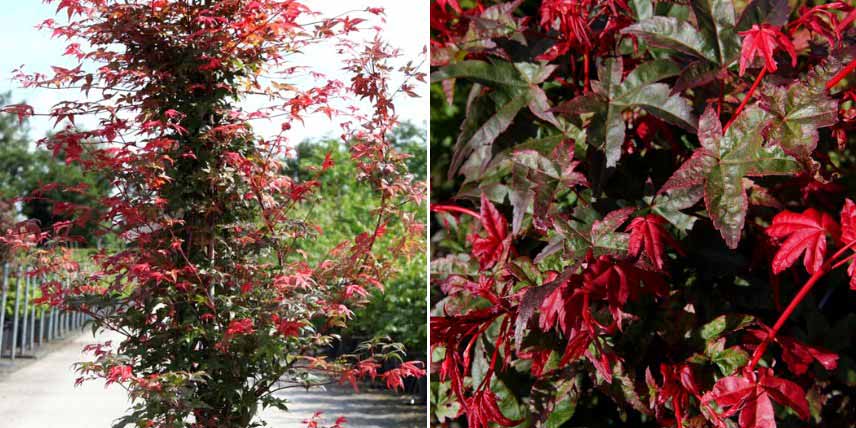
The young leaves of Acer palmatum ‘Deshojo’ are bright red, gradually turning dark green (photos: Denolf)
Acer palmatum 'Shaina'
‘Shaina’ is a variety with deep, scarlet red leaves, but not laciniate. The foliage is particularly dense, with leaves being very numerous and tightly packed together. With no trace of green, they evolve in shades of red: first bright orange-red in spring, they then turn brownish-purple in summer, and finally crimson red in autumn. With a slow growth rate, this Japanese maple takes on a compact and semi-spreading habit, reaching about 2 m in height and 1.60 m in spread. Smaller than previous varieties, it adapts very well to pot cultivation. It forms short branches that bear leaves clustered in bouquets. These measure 2 to 5 cm and are divided into 5 to 7 linear lobes. Its bark is brown to reddish.
Create a flamboyant, colourful bed with the Japanese maple ‘Shaina’! To accompany it, plant alongside warm-toned perennials, such as heuchera ‘Marmelade’, Hakonechloa macra ‘All Gold’, and Persicaria runcinata ‘Purple Fantasy’. You can also pair it with some shrubs with colourful foliage, such as Berberis ‘Admiration’, the oak-leaved hydrangea Hydrangea quercifolia ‘Little Honey’, the elder ‘Plumosa Aurea’, and the Japanese maple Acer palmatum ‘Sangokaku’.
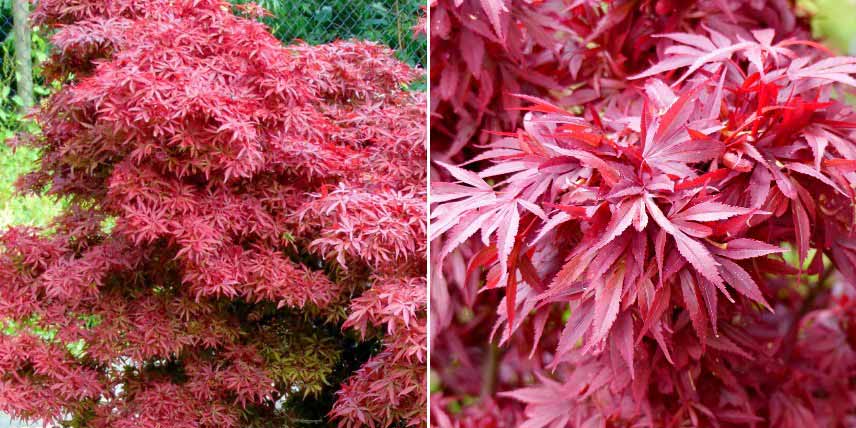
The dense foliage of Acer palmatum ‘Shaina’
Acer palmatum 'Crimson Queen'
The Japanese maple ‘Crimson Queen’ is an elegant variety with a spreading, cascading habit, giving it an almost weeping appearance. It bears leaves that are very finely cut and feathery in appearance. The young leaves are light red in spring, turning purple in summer, and then scarlet orange in autumn before falling. It belongs to the ‘Dissectum’ group, which includes Japanese maples with laciniate leaves that show better tolerance to heat and sun. It reaches up to 2.5 m in height and 3 m in spread. Its leaves measure 5 to 8 cm long and are divided into 5 to 7 deeply dentate lobes along the edge of the lamina.
You can create a lovely colour contrast with this Japanese maple by pairing it with the golden foliage of Acer shirasawanum ‘Aureum’, hosta ‘August Moon’, and heuchera ‘Lime Rickey’.
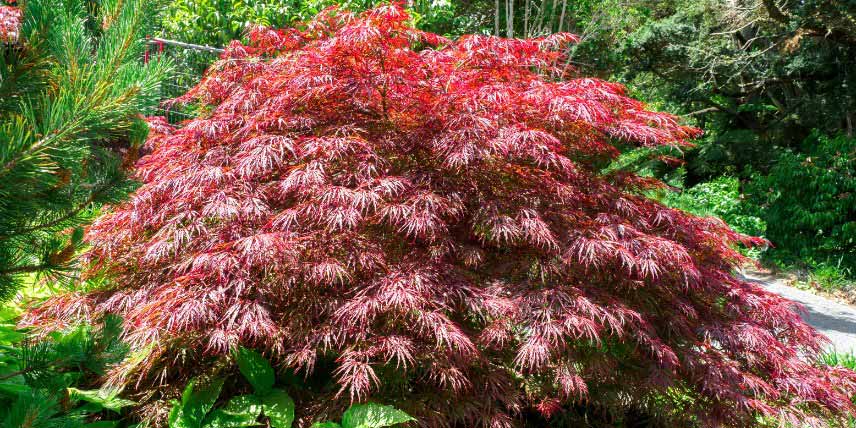
The Japanese maple ‘Crimson Queen’ is a beautiful variety with a rounded and spreading habit, and finely cut dark red foliage
- Subscribe!
- Contents
Comments