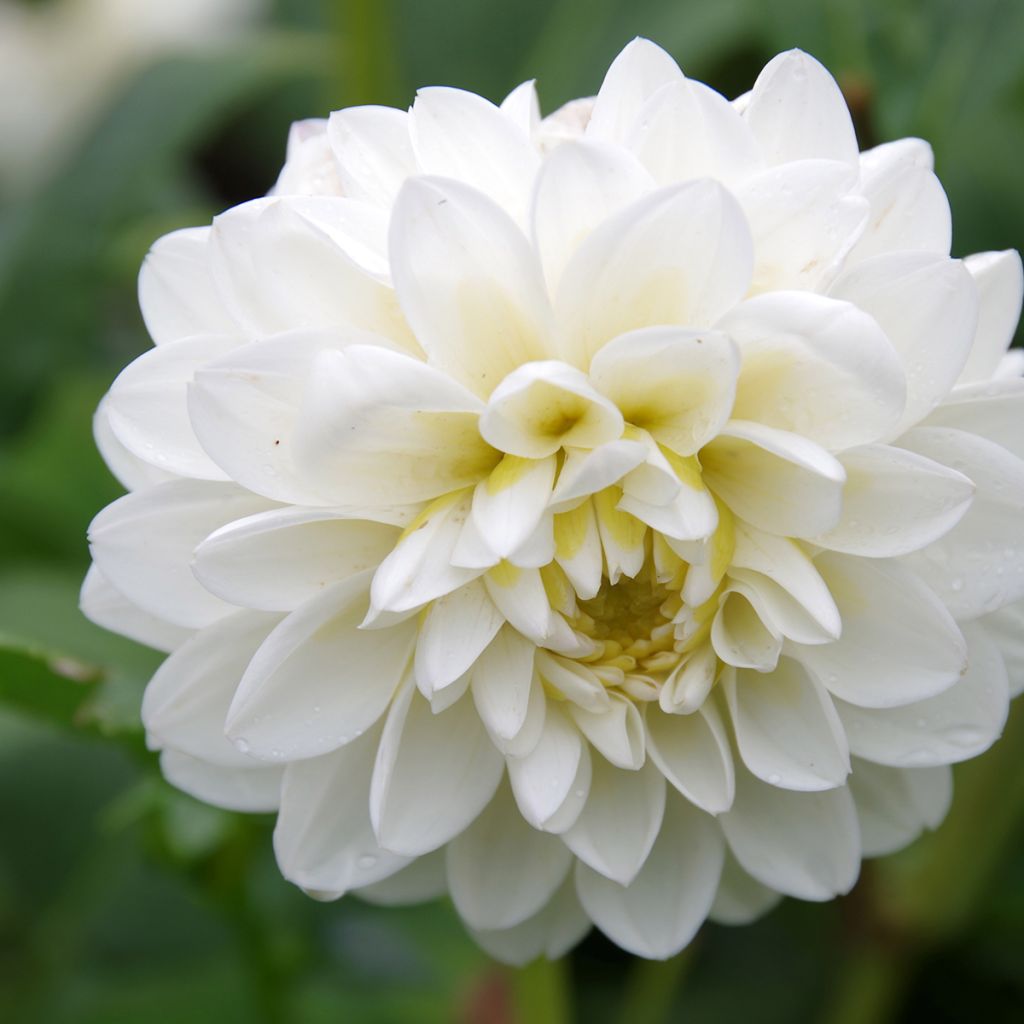
Dahlia White Onesta
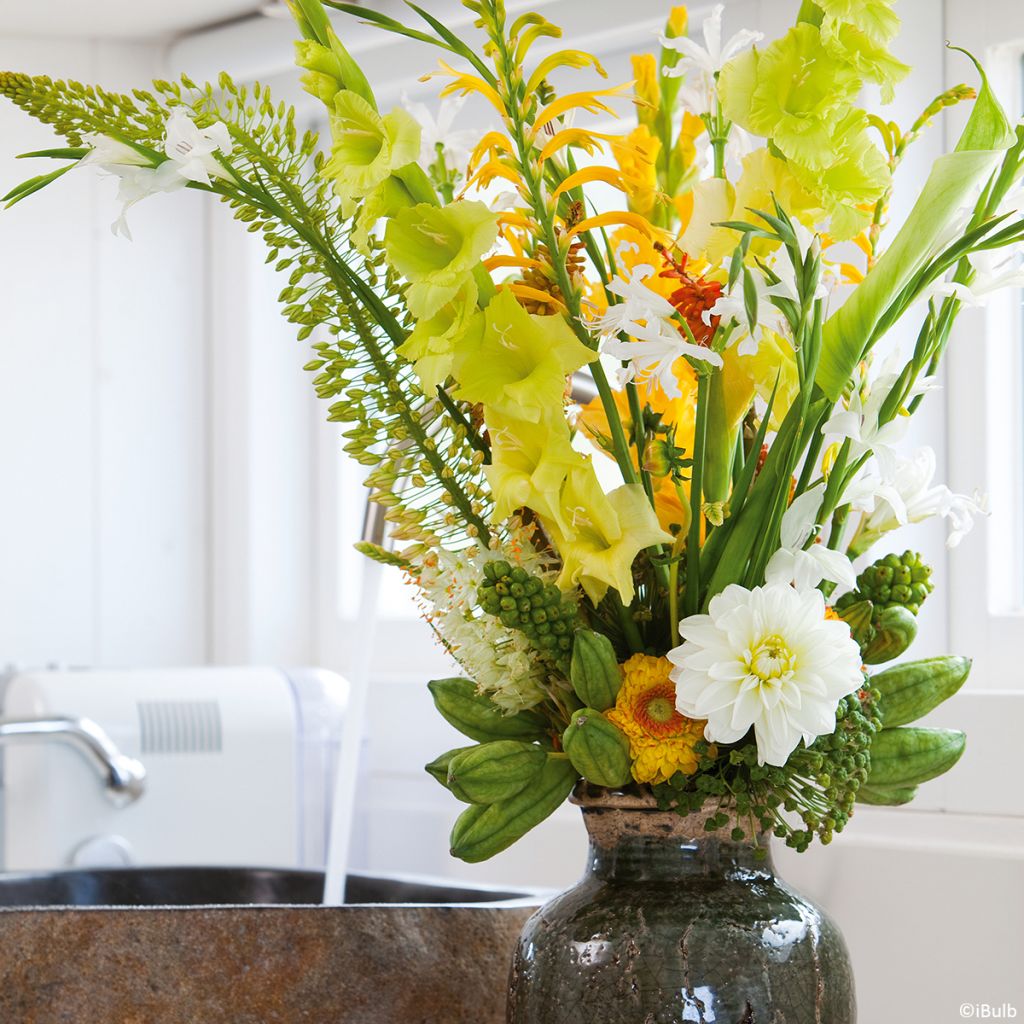
Dahlia White Onesta
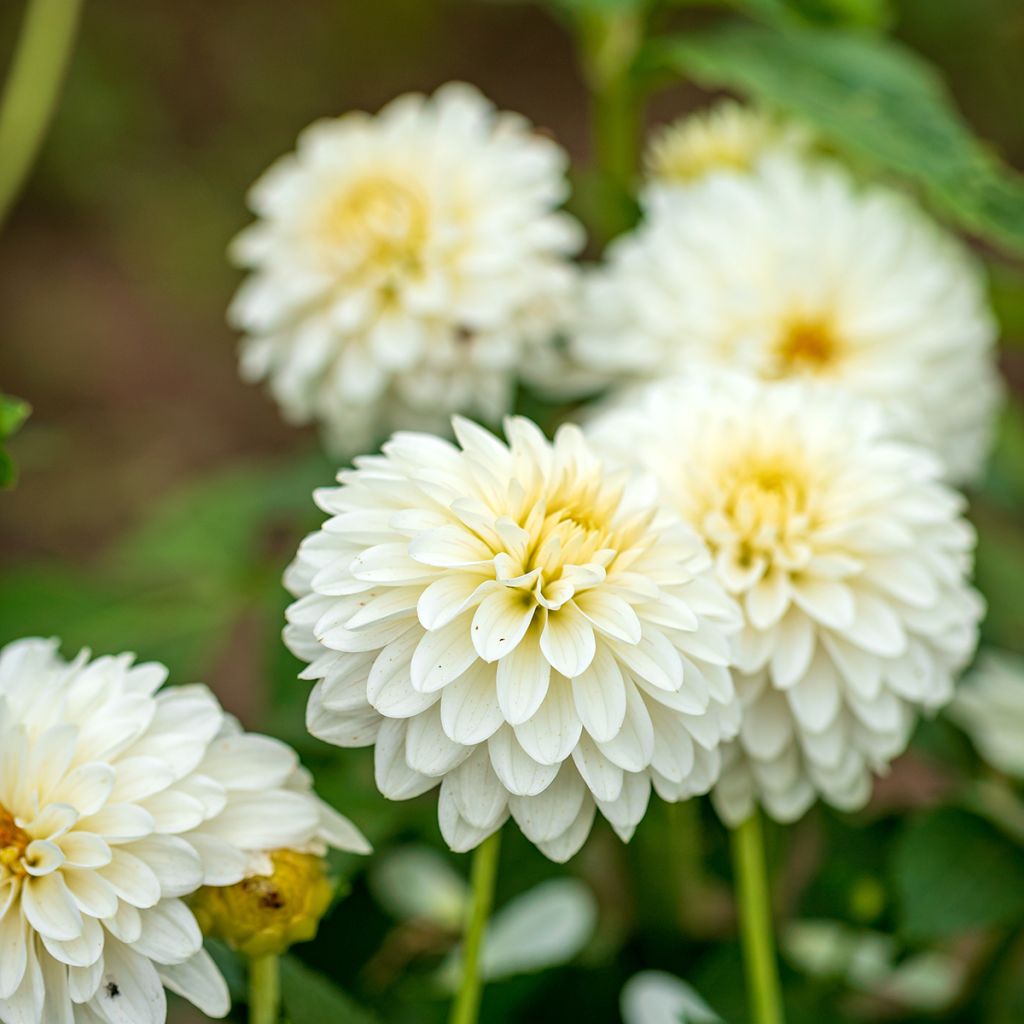
Dahlia White Onesta
Dahlia White Onesta
Dahlia White Onesta
Waterlily dahlia
Back-to-school special offer!
Get €10 off for every €50 you spend! And get up to €40 off on a single order.
How does it work?
1. Shop your favourites
Add your favourite plants to your basket. For every €50 you spend (excluding delivery charges, store credit and the plastic-free option), you’ll receive a €10 voucher.
€50 spent = €10 voucher
€100 spent = €20 voucher
€150 spent = €30 voucher
€200 spent = €40 voucher
2. Place your order
Once your basket reaches one of the spending thresholds, place your order. You can even choose your delivery date!
3. Receive your voucher
As soon as your order has been shipped, you’ll receive an email containing your personal voucher code and its value.
4. Use it on your next order
Your voucher is valid for 90 days from the date you receive it. It can be used once only, on a new order worth at least the value of the voucher, excluding delivery charges.
Please note: Vouchers can be combined with other offers, but cannot be split or refunded.
This plant carries a 6 months recovery warranty
More information
We guarantee the quality of our plants for a full growing cycle, and will replace at our expense any plant that fails to recover under normal climatic and planting conditions.
Does this plant fit my garden?
Set up your Plantfit profile →
Description
Dahlia ‘White Onesta’ is a white dahlia with a lemony centre which double flowers resemble water lilies. From July until the first frosts, it produces a profusion of medium-sized heads, held above bright green foliage. Of medium stature, it is an excellent dahlia for sunny borders, tall borders, white cut flower arrangements and wedding displays.
Botanically, ‘White Onesta’ belongs to the genus Dahlia and the Asteraceae family, just like the Zinnia. Native to the high plateaus of Mexico and Central America, dahlia is a tender tuberous perennial: the stems and foliage, which are deciduous, disappear after the first frosts, but the tubercle, if kept dry and frost-free, will form a new young plant the following spring. Horticulturally, this variety is classified in the group of decorative dahlias of the "waterlily" form: the flower is very double, with wide, slightly incurved ligules (or "petals"), arranged in a shallow cup.
'White Onesta’ is a Dutch introduction from Berg & Daal (Warmerdam), introduced around the year 2000; it is a mutation of the cultivar 'Onesta' which regularly features in selections of dahlias for cut flowers. The plant has a bushy, upright habit, well ramified from the base, forming a dense clump 0.90 to 1.10 m in height and 50 to 60 cm in width. The stems are sturdy, firm enough to support the flowers, except in windy sites where staking will be necessary. The foliage is medium green, formed of pinnate leaves with ovate to lanceolate lobes, 8 to 15 cm, with slightly dentate edges. The heads measure 10 to 12 cm in diameter; they are filled with wide, rounded, white external ligules, washed with cream near the centre. In the centre, ranks of shorter ligules tighten around a small greenish-yellow heart; this "lime" effect is highly sought after in contemporary displays. Flowering lasts from July to October, until the first frosts, provided you regularly remove spent flowers. In autumn, the aerial growth blackens due to the cold, while the tubercle enters dormancy.
In the garden, this white dahlia with a lemony centre integrates wonderfully into white borders or elegant cut flower arrangements. Its flower contrasts pleasantly with the plum and mauve tones of a dahlia ‘Crème de Cassis’, or with the very dark small balls of ‘Dark Spirit’. To lighten the overall effect, you can use grasses like Pennisetum orientale ‘Karley Rose’ with its smoky pink feathery spikes. In a cut flower arrangement, this dahlia pairs very well with this grass, but also with tall verbenas like Verbena officinalis 'Bampton' or slightly fuzzy foliage, for contemporary, airy and luminous displays.
Dahlias were first introduced to Europe in the 18th century not for their flowers, but as a vegetable plant: the tubercles, rich in inulin, were tested as a vegetable, their taste reminiscent of artichoke, before their incredible diversity of forms and colours established them definitively as ornamental plants.

Dahlia White Onesta in pictures
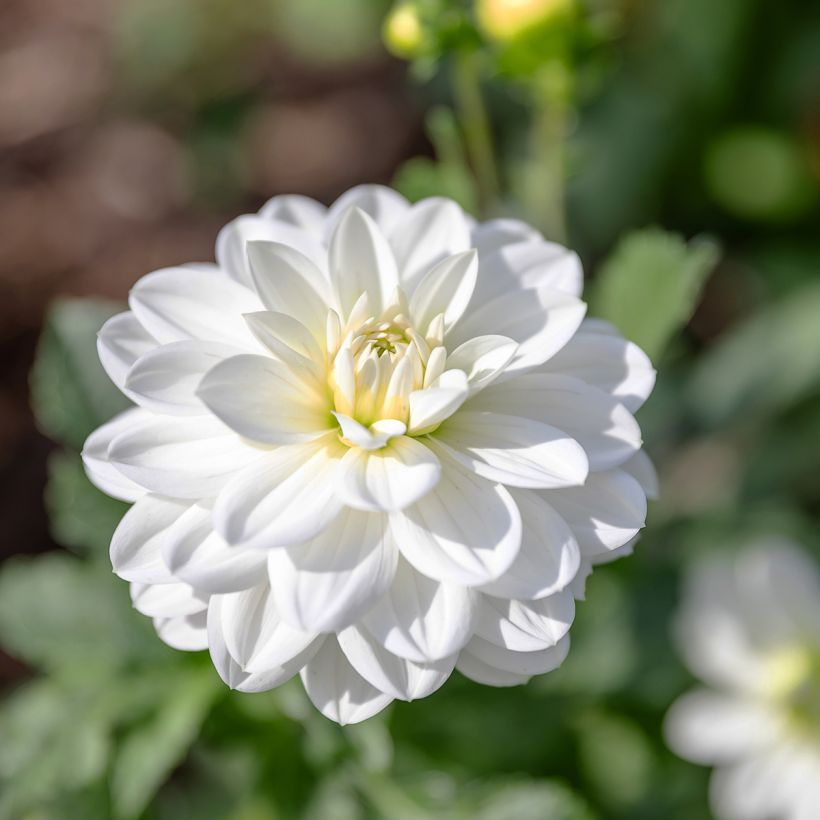
Plant habit
Flowering
Foliage
Botanical data
Dahlia
White Onesta
Asteraceae
Waterlily dahlia
Cultivar or hybrid
Planting and care
Dahlia 'White Onesta' is easy to grow in all regions. For generous flowering, it is good to follow a few simple rules: plant the tubercles in full sun after the last frosts; rich, cool, well-drained soils are perfect. However, stagnant moisture would encourage tubercle rot. Do not hesitate to amend the soil with compost and sand if needed. Work the soil deeply and enrich it, for example, with ground horn or dried blood. Place your tubercle and crumble the soil well to backfill without air pockets. Your dahlia should be covered with about 6 cm of soil. At the end of planting, water thoroughly once, then repeat this watering regularly for the first 6 weeks to help rooting.
Dahlias are sensitive to cold and need to be overwintered. In November, the first frosts blacken the foliage; this is the time to lift them. Dig up the tubercles carefully. Remove as much soil as possible. Allow the foliage to dry so that the tubercles can replenish their reserves. Then cut the stems to 10 cm. Spread your bulbs in a crate on newspaper. Store them frost-free in a dry, cool, dark place, such as a frost-free garage or an attic. In southern regions, near the coast, experiencing only a few frosty days per year, it is possible to leave them in place. In this case, simply cover the soil with a carpet of leaves or straw as protection.
This Dahlia, with its hollow stems, is still sensitive to strong winds or heavy rain. To overcome this drawback, you can stake it, but, you must admit, it is not very aesthetic. On the other hand, by pinching the stems early or removing the axial flower buds, you will spread the habit of the plant, which will offer more resistance to bad weather. At the same time, you thus channel the influx of sap onto a single flower, which will become larger and stronger.
Planting period
Intended location
Care
Planting & care advice








This item has not been reviewed yet - be the first to leave a review about it.
Recently viewed products
Haven't found what you were looking for?
Hardiness is the lowest winter temperature a plant can endure without suffering serious damage or even dying. However, hardiness is affected by location (a sheltered area, such as a patio), protection (winter cover) and soil type (hardiness is improved by well-drained soil).
In temperate climates, pruning of spring-flowering shrubs (forsythia, spireas, etc.) should be done just after flowering.
Pruning of summer-flowering shrubs (Indian Lilac, Perovskia, etc.) can be done in winter or spring.
In cold regions as well as with frost-sensitive plants, avoid pruning too early when severe frosts may still occur.
The harvesting period indicated on our website applies to countries and regions in USDA zone 8 (France, England, Ireland, the Netherlands).
In colder areas (Scandinavia, Poland, Austria...) fruit and vegetable harvests are likely to be delayed by 3-4 weeks.
In warmer areas (Italy, Spain, Greece, etc.), harvesting will probably take place earlier, depending on weather conditions.
The sowing periods indicated on our website apply to countries and regions within USDA Zone 8 (France, UK, Ireland, Netherlands).
In colder areas (Scandinavia, Poland, Austria...), delay any outdoor sowing by 3-4 weeks, or sow under glass.
In warmer climes (Italy, Spain, Greece, etc.), bring outdoor sowing forward by a few weeks.
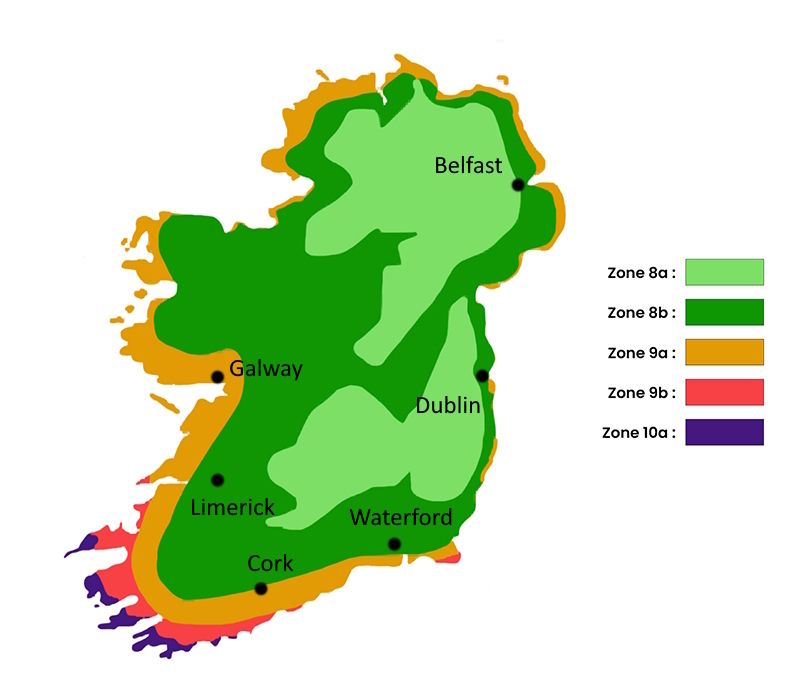
The planting period indicated on our website applies to regions in USDA Zone 9a (East Coast and Midlands: Dublin, Wexford, Waterford, Kilkenny, Portlaoise). It will vary depending on where you live:
- On the west coast and in the north-west (Galway, Limerick, Sligo, Donegal, Westport), delay planting by 1 to 2 weeks in spring and bring it forward by 1 to 2 weeks in autumn compared to the dates given, preferably choosing periods without strong winds.
- In the inland hills and plateaus (Wicklow Mountains, Macgillycuddy’s Reeks, Connemara, Killarney), it is best to plant in spring (April–May) or autumn (September–October), avoiding periods of waterlogged soil in winter and strong winds, which pose the main risk to newly planted trees in these areas.
The flowering period indicated on our website applies to regions in USDA Zone 9a, such as the East Coast and Midlands, including Dublin, Wexford, Waterford, Kilkenny and Portlaoise.
This will vary depending on where you live:
- On the west coast and in the northwest (Galway, Limerick, Sligo, Donegal and Westport), it will be delayed by one to two weeks compared to the given dates, due to stronger Atlantic winds and less spring sunshine.
- In the inland hills and plateaus (the Wicklow Mountains, the Macgillycuddy's Reeks, Connemara and Killarney), flowering will be delayed by two to three weeks. Flowering mainly occurs between May and July, with the limiting factors being less frost and more of the excessive humidity, strong winds and lack of sunshine that are characteristic of these areas.
Shipping country and language
Your country of residence may be:
Your country of residence is:
For a better user experience on our website, you can select:
Your shipping country:
-
 Austria
-
 Belgium
-
 Bosnia & Herzegovina
-
 Bulgaria
-
 Croatia
-
 Cyprus
-
 Czechia
-
 Denmark
-
 Estonia
-
 Finland
-
 France
-
 Germany
-
 Greece
-
 Hungary
-
 Iceland
-
 Ireland
-
 Italy
Italy
-
 Latvia
-
 Liechtenstein
-
 Lithuania
-
 Luxembourg
-
 Malta
Malta
-
 Netherlands
-
 Poland
-
 Portugal
-
 Romania
-
 Serbia
-
 Slovakia
-
 Slovenia
-
 Spain
Spain
-
 Sweden
-
 Switzerland
Language:
-
French
-
 English
-
Spanish
-
Italian
-
German
-
Portuguese
-
Dutch
-
Finnish
My Account
Hello
My wish lists
My cart
Log in / Register
Existing customer?
This form is protected by reCAPTCHA - the Google Privacy Policy and Terms of Service apply.
New customer?
Create an account to track your orders, access our customer service and, if you wish, make the most of our upcoming offers.