





























Growing citron trees
... and enjoying its ornamental and culinary qualities
Contents
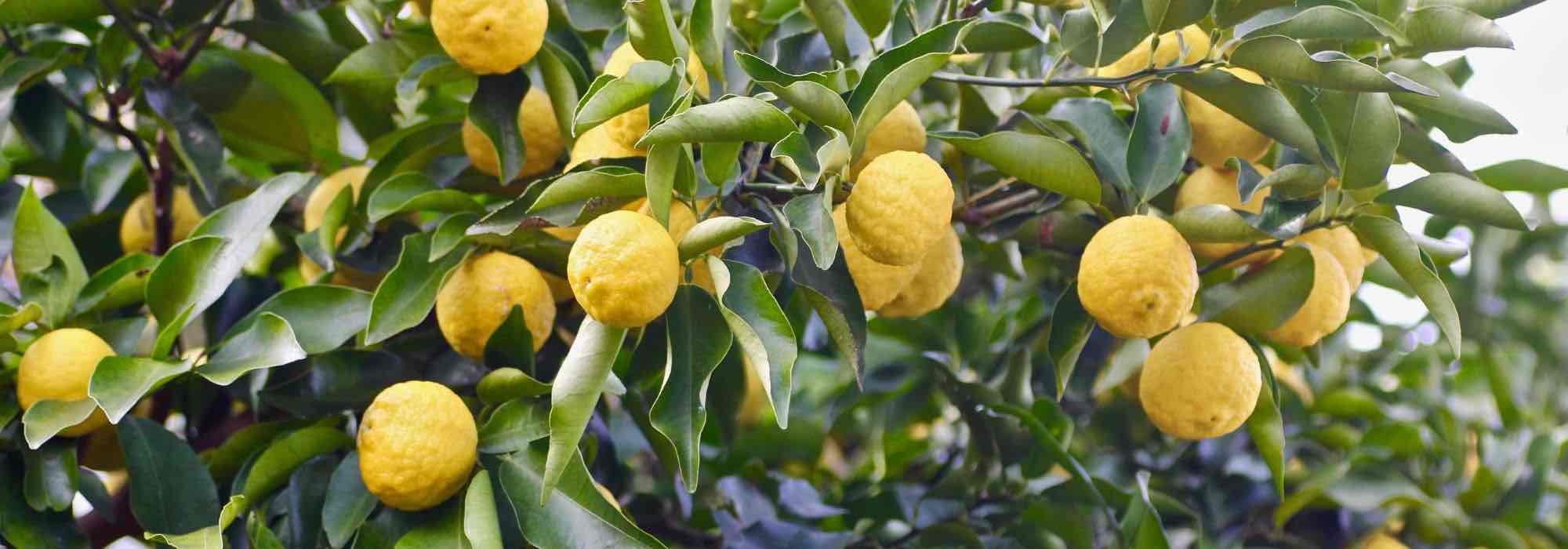
The citron tree, ancestor of the lemon, forms an ornamental bush with thorny branches that bear large white flowers tinged with purple in spring, highly fragrant, before producing fruits called cedrats in autumn, resembling large lemons with bumpy skin. Its evergreen foliage is dark green, and its young leaves are purple. In this citrus, it is the bark that is consumed. Several varieties are available, and it is only moderately hardy, tolerating temperatures down to -3°C at most. Finally, it dislikes scorching exposures.
Discover how to grow a citron tree, our care tips, and how to use it.

Where does it grow?
The citron develops into a small tree with thorny branches. It is planted in spring, in March-April, when temperatures rise. There are a few varieties appreciated by collectors, such as Citrus medica ‘Pigmentata’, blood-red and highly aromatic, and Citrus medica ‘Maxima’, which has particularly large fruits.
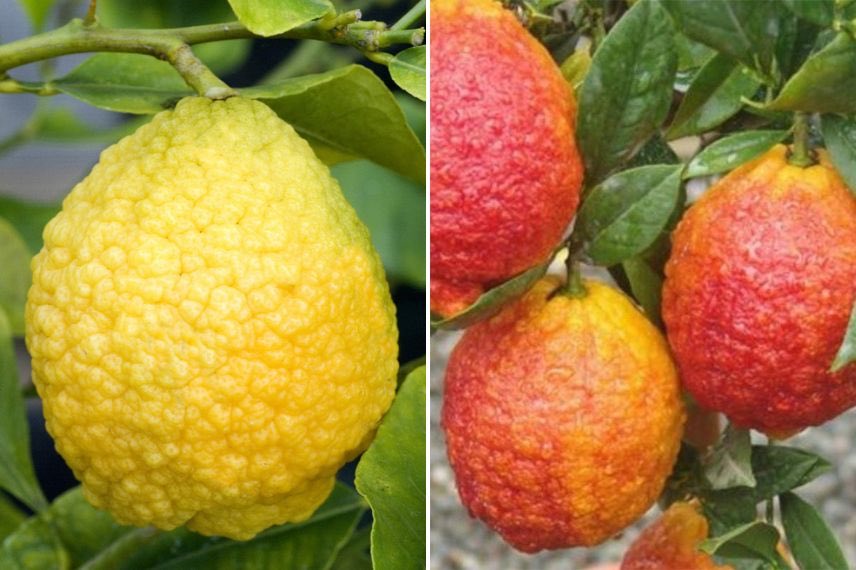
Citrus medica ‘Maxima’ and ‘Pigmentata’
Its planting in open ground is only possible in an area spared from frost, such as USDA zone 9b, along the Mediterranean coastal strip, as it is very sensitive to frost, tolerating only brief frosts below -3° C.
Elsewhere, it is grown in pots outdoors and brought indoors for the cold season.
Choose a warm, sunny location for its cultivation, but not scorching, sheltered from winds and sea spray. It fears drought and scorching sun.
The citron, like other citrus trees, needs rich, fertile, light, and well-draining soil. It dislikes limestone and is best grown in neutral to acidic pH soil.
Read also
Citrus trees: planting and maintenancePlanting in open ground and pot planting
To plant a citron tree, whether in the ground or in a pot, you will need sand, compost, fertiliser, as well as potting soil, drainage for the bottom of the planting hole or pot, and organic mulch to keep its base cool.
Planting in the ground
- Soak the root ball in a bucket of water for about ten minutes to allow it to rehydrate properly.
- Dig a planting hole approximately 2 to 3 times the size of the root ball.
- Mix your soil with well-decomposed compost, river sand, and possibly potting soil. Feel free to also add a special citrus fertiliser, preferably organic.
- Install a layer of drainage at the bottom of the planting hole (gravel, pumice, clay balls, etc.).
- Add a portion of your soil mixture.
- Place the root ball in the centre of the hole, adding your mixture until the roots are covered, but without burying the grafting point (a sort of bulge at the base of the trunk).
- Firm the soil.
- Form a wide basin around the base of your citron tree to retain watering water effectively.
- Water generously.
- Mulch carefully to limit water evaporation and space out watering.
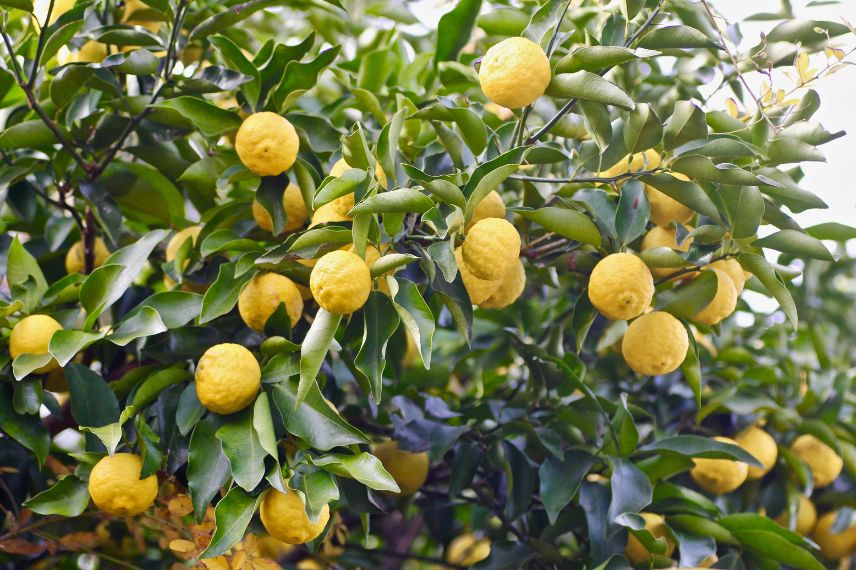 Adult citron trees in the ground[/caption>
Planting in a pot
Choose a container 2 to 3 times larger than the root ball, such as a terracotta pot or a wooden box, which must be drilled or can be drilled by you, to prevent the roots from stagnating in water.
Use a special citrus potting soil or create a substrate consisting of 50% potting soil, 30% compost, and 20% sand.
- Soak the root ball in a bucket of water for about ten minutes to allow it to rehydrate and facilitate the removal from the nursery pot.
- Place a layer of drainage at the bottom of the pot using clay balls or gravel a few centimetres thick (pumice is heavier and should be avoided in pots).
- Pour the potting soil or mixed substrate until about halfway up the pot. You can also add a special citrus fertiliser.
- Remove the nursery pot and loosen the roots at the bottom of the root ball.
- Place your citron tree in the pot.
- Fill in with your substrate without burying the collar.
- Firm the soil.
- Water generously.
- Mulch carefully to a thickness of several centimetres.
Care
The care of the citron is summarised in two main areas: watering and fertilisation.
Outdoor cultivation
Water regularly during the first few years, allowing the citrus to develop its root system. Afterwards, water mainly during dry periods, preferably using rainwater. Plan to water once a week in summer, more often in case of prolonged drought. Reduce watering in autumn, then stop or significantly reduce it in winter (adjust according to winter rainfall). Mulch around the base, as this helps to keep the soil cool for longer while limiting weed growth. Place dead leaves or organic mulch around the trunk.
Apply organic fertiliser or well-decomposed compost to nourish the bush.
In autumn, when temperatures cool, you can place a fleece over the aerial parts to protect the fruits, which are more sensitive to frost.
Pot cultivation
Water regularly from spring to autumn, providing water as soon as the substrate becomes dry (watering once or twice a week). Use rainwater whenever possible. Avoid letting water stagnate in the saucer. The citron is nutrient-hungry, so apply liquid fertiliser about once a month. You can also use slow-release fertiliser. In winter, reduce watering and fertiliser applications.
In autumn, around October, bring it into a frost-free shelter, such as a cold greenhouse or a conservatory. Choose a bright but unheated location: ideally, the temperature should be between 7 and 10 °C. In spring, take your bush back outside, placing it in a sunny spot.
Repot your citron approximately every two years, preferably in spring. This way, you renew its substrate and provide more space for its roots and growth. In years when you do not repot, perform a top dressing: remove the surface substrate by a few centimetres and replace it with fresh potting soil.
The difference between lemon and citron? Uses
The harvest of citron takes place from December in the sunniest regions.
Despite their apparent similarities, citron is quite different from lemon. Indeed, while citron resembles a large, bumpy lemon, it does not have the same juicy flesh that is so commonly used in lemons. Its flesh is drier, although it is fragrant. The bark of citron is thick, slightly bitter, aromatic, and highly concentrated in essential oils.
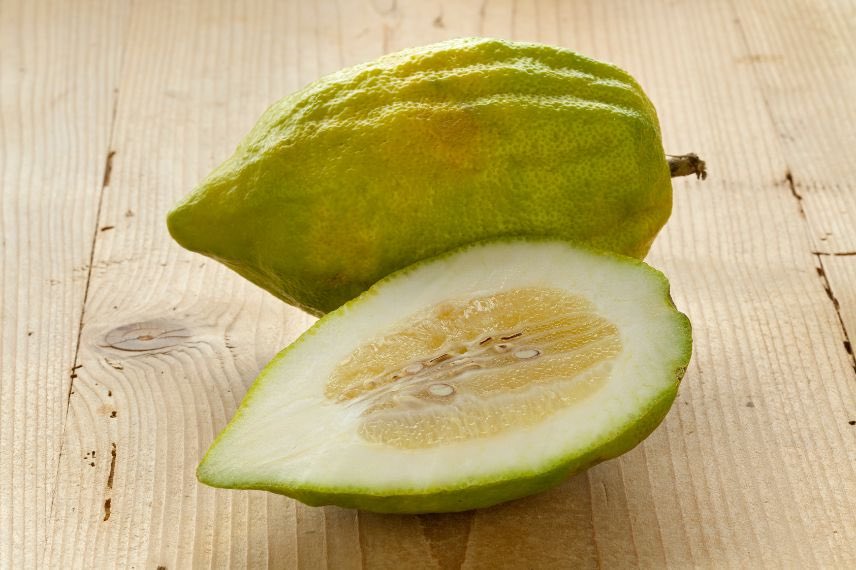
Citron consists mainly of bark and albedo (the white part), unlike lemon where the pulp is essential
But it is indeed the albedo that is highly sought after in this fruit, most often candied in culinary tradition. Candied citron is used to flavour cakes and brioche. It can also be coated in chocolate like candied orange peel. Additionally, it can be made into jams. Its zest can also be grated and, for example, added to a lemon curd made with lemon.

The tradition of candied citron
When and how to prune a citron tree?
Pruning of the citron tree takes place after fruiting, at the end of winter, before the resumption of growth. Prune lightly approximately every two years, making clean and neat cuts. Disinfect your tools to avoid transmitting diseases. Also, apply a healing paste to the wounds.
For a bush in a pot, you can intervene more frequently to control growth, even several times a year, with light pruning each time.
Pruning is straightforward and involves:
- Removing dead wood and branches that cross inside, to allow air and light to circulate within.
- Giving a balanced shape to the bush and making harvesting easier by limiting the height of the plant.
- Determining the general shape of the bush in the first few years (rounded or stemmed).
What are the diseases of the citron tree?
Citrus trees, like other citrus fruits, are susceptible to several diseases and pests. If the growing conditions are suitable and regular pruning is carried out to aerate the branches, using disinfected tools, this limits the risk of their appearance.
The leaves can be affected by chlorosis due to hard water.
Mal secco, a fungal disease, blocks the circulation of sap, leading to the drying out of branches and the decline of the bush. Cut and burn the affected branches as soon as you notice the onset of the disease.
Gummosis is characterised by the secretion of a translucent amber substance at the site of a wound. It is necessary to cure the affected areas and treat with Bordeaux mixture. Then apply a healing and fungicidal paste or clay. A bush that is too affected should be uprooted.
In a confined atmosphere, in pots and under glass, the citron tree can be affected by mealybugs, whiteflies, and red spider mites. For the first two, spraying black soap on the foliage is helpful. Red spider mites thrive in dry conditions: do not hesitate to mist the foliage.
Aphids also attack the citron tree. The use of black soap is also recommended here.
Finally, for the following three pests, cut and burn the affected leaves. The Mediterranean fruit fly lays its eggs in the fruit. The larvae feed on them, causing premature drop. The caterpillars of the lemon moth nibble on flower buds and young leaves. The leaf miner burrows white, sinuate galleries within the thickness of the leaves, visible to the naked eye. The leaves then tend to curl, yellow, dry out, and eventually fall off.
- Subscribe!
- Contents

Comments