





























Pomegranate: pairing it in the garden or in pots
5 ideas for companion planting with your flowering or fruiting pomegranate
Contents
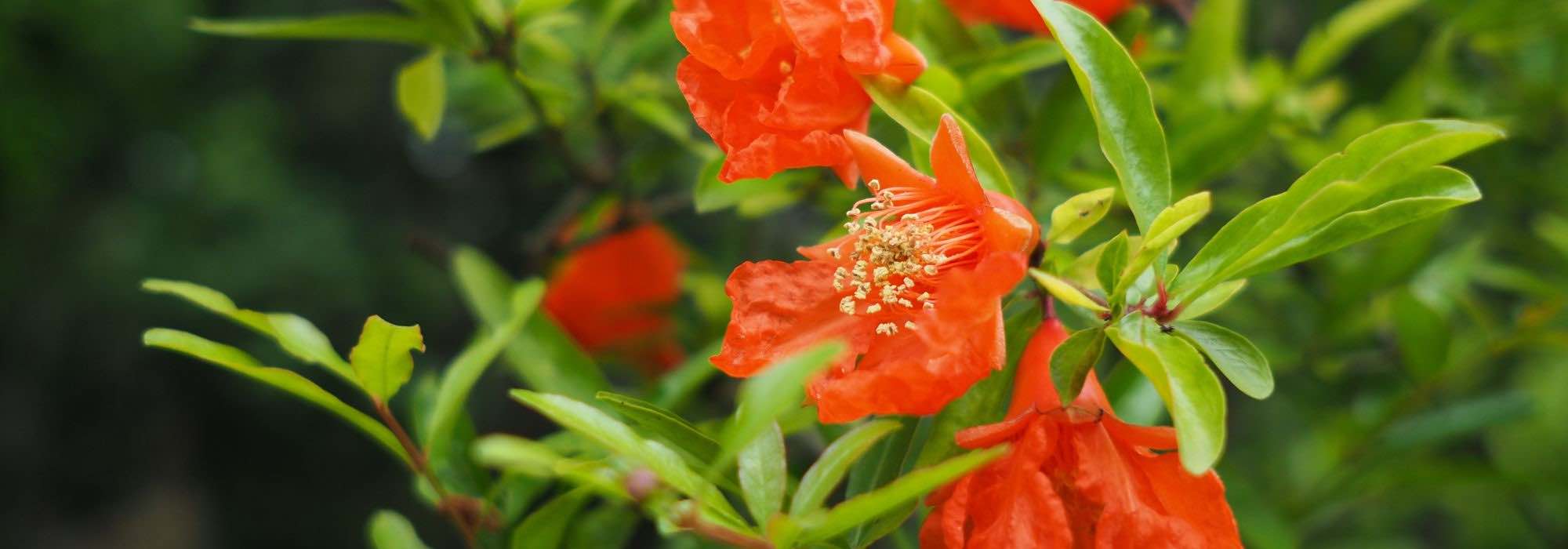
Pomegranates or Punica are decorative fruit shrubs valued for their generous flowering and delicious fruits. Between spring and summer, beautiful single or double flowers, more or less crumpled, adorn their branches in shades of red to orange. Flowering pomegranates are renowned for their spectacular blooms and produce little or no fruit. Other varieties, however, offer beautiful pomegranates of real culinary interest after a long, hot summer. The deciduous foliage is green in season and turns a lovely golden yellow in autumn. A bush that is low in water and not demanding regarding soil type as long as it is well-drained, the pomegranate thrives in full sun and in winters that are not too cold. The various cultivars offer dwarf shrubs not exceeding 1 m, as well as specimens that can exceed 6 m, allowing for adaptation to garden size and enjoyment even on balconies where pot cultivation poses no problem. A plant is often more interesting when mixed with others, discover 5 pairing ideas to make the most of your pomegranate’s qualities. Integrate it into a hot border with fiery tones, a sun-drenched Mediterranean bed, a delectable display for the eyes and taste buds, a colourful hedge, or even in a pot assortment on a balcony.

A fiery hot-border
The hot border is the result of combining plants with warm, vibrant, and bold tones that transform your flowerbed into a blaze. With its striking orange-red flowering, Punica granatum ‘Maxima Rubra’ is an excellent starting point. To enhance these fiery hues, pair it with shrubs such as Callistemon with its unique bottlebrush flowers. Other possible candidates include a Rosemary-leaved Grevillea, a Broom with papilionaceous flowers, and a Potentilla fruticosa ‘Tangerine’ whose yellow-orange flowers brighten the mid-level. For perennials, the choice is also very broad, including Achilleas, Euphorbias, Helianthemum, Knautia, or Heliopsis, to name just a few plants to intersperse in your display. The Helianthemum ‘Golden Queen’ can thus form a border of bright yellow against which the yellow-orange corollas of a group of Achillea ‘Terracotta’ stand out, supported by the graphic spikes of a Verbascum olympicum whose shades are similar to those of the border, emerging here and there. A clump of Sage ‘California Sunset’ can create a lovely surprise and ensures a long-lasting flowering in apricot tones.
Complete your scene with grasses that highlight their neighbours while adding lightness, grace, and movement. Stick to warm tones with Carex testacea ‘Prairie Fire’ in orange to place in the foreground or Panicum virgatum ‘Kulsenmoor’ whose red tones become more pronounced at the end of the season. You can also consider Pennisetum ‘Rubrum’ (to be treated as annuals) or select Phormium whose lanceolate foliage echoes the graphic nature of certain grasses.
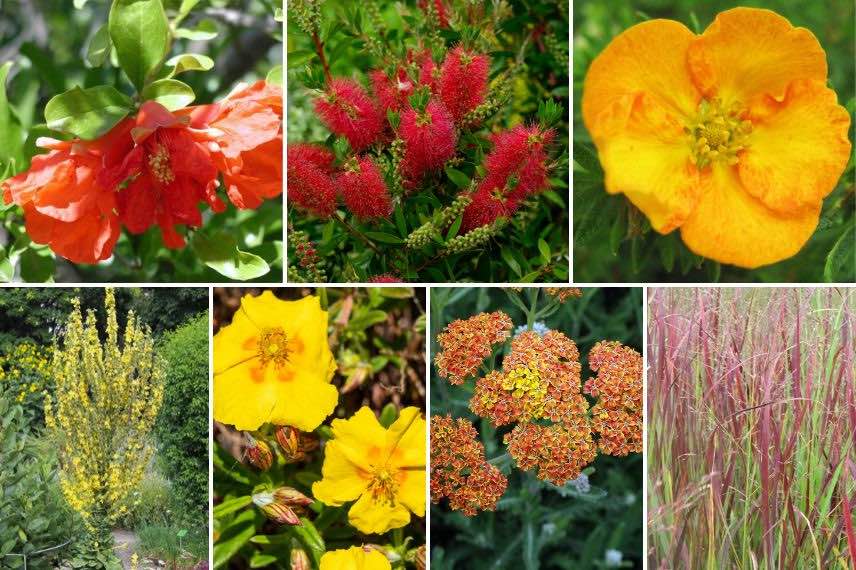
Clockwise from top: Punica granatum ‘Maxima Rubra’, Callistemon laevis, Potentilla fruticosa ‘Tangerine’, Panicum virgatum ‘Kulsenmoor’, Achillea ‘Terracotta’, Helianthemum ‘Golden Queen’, Verbascum olympicum
A Mediterranean bed with a holiday vibe
Pomegranates are bushes particularly suited to the heat and low rainfall offered by the Mediterranean climate and can be paired with many plants that thrive under the same conditions. Punica ‘California Sunset’ (or ‘Madame Legrelliae’) is a variety that does not produce fruit but instead offers beautiful double flowers with attractive shades of orange, cream, and salmon. Plant it alongside iconic Mediterranean plants such as the Provence Cypresses, ideally in odd numbers for a balanced effect. Cupressus ‘Garda’, which hardly bears fruit, maintains a neat narrow habit. Among palms, you can certainly opt for a Trachycarpus fortunei, one of the hardiest, but in a warm climate and provided you have the necessary space, you might consider the large, gracefully trailing fronds of a Phoenix canariensis. Evergreen, beautiful, and sometimes fragrant, oleanders bloom generously in summer in a wide variety of tones. Dress their base with Cistus, whose flowers appear to be made of tissue paper, bringing colour earlier in the season with their spring flowering. Essential, lavenders provide lovely accents and their white, blue, mauve, or pink spikes fill the air with their distinctive fragrance. Some varieties, like Lavandula ‘Platinum Blonde’, add a touch of originality with their variegated foliage.
Also consider certain roses that are undeterred by hot, dry conditions: the ‘Hansa’ rose with its delightfully fragrant purple-pink flowers that renew throughout the beautiful season is an excellent candidate, as are all other rugosa roses. Complete with some perennials and grasses such as Catananche, Delopserma, Helictotrichon, or Ceratostigma. You will then have a beautiful composition that lasts for long months and is low in water requirements.
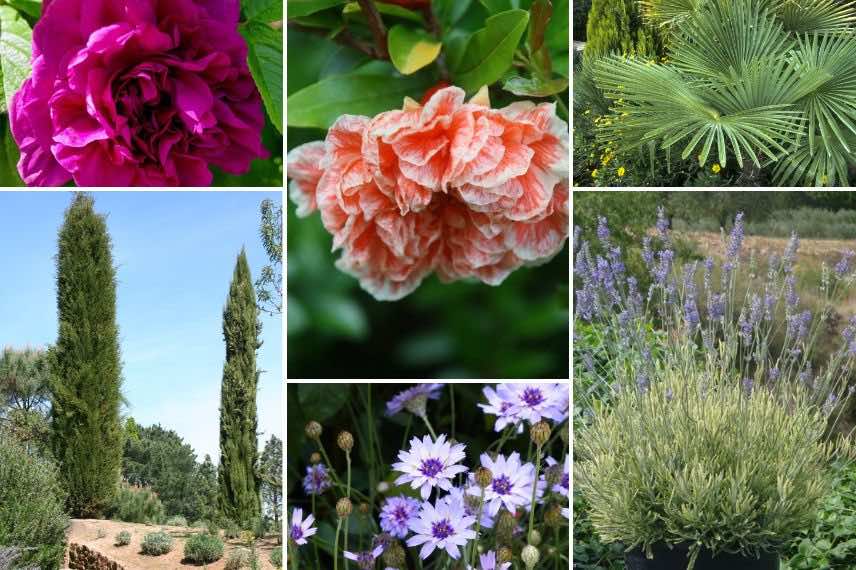
Rosa ‘Hansa’, Punica ‘California Sunset’, Trachycarpus fortunei, Lavandula ‘Platinum Blonde’, Catananche caerula, Cupressus sempervivens
A gourmet garden
If flowering species are appreciated for the quality and abundance of their flowering, fruiting pomegranates are certainly not to be overlooked. In addition to a flowering display in warm, often orange tones, they produce delicious fruits if the summer has been warm and long enough (a trend we may need to get used to in the coming years). This can be an opportunity to create a small orchard or at least a bed that provides you with fruits to enjoy fresh or cooked in pies, juices, or jams. The Azarole is a slightly thorny hawthorn that produces small yellow to red berries with a tangy flavour. The Feijoa is a deciduous bush that boasts beautiful white flowers with prominent red stamens and fruits resembling kiwis with flavours of pineapple, strawberry, and guava. A Japanese Goumi rewards its gardener with a fragrant spring flowering and small red berries with medicinal properties; however, due to its rapid growth, its sprawling character should be considered.
Also interesting in this gourmet palette is the Strawberry Tree, whose evergreen foliage is adorned with this year’s flowering of white or pink bell-shaped flowers and fruits that resemble strawberries, though less tasty. This palette is both beautiful to observe and a source of numerous culinary delights.
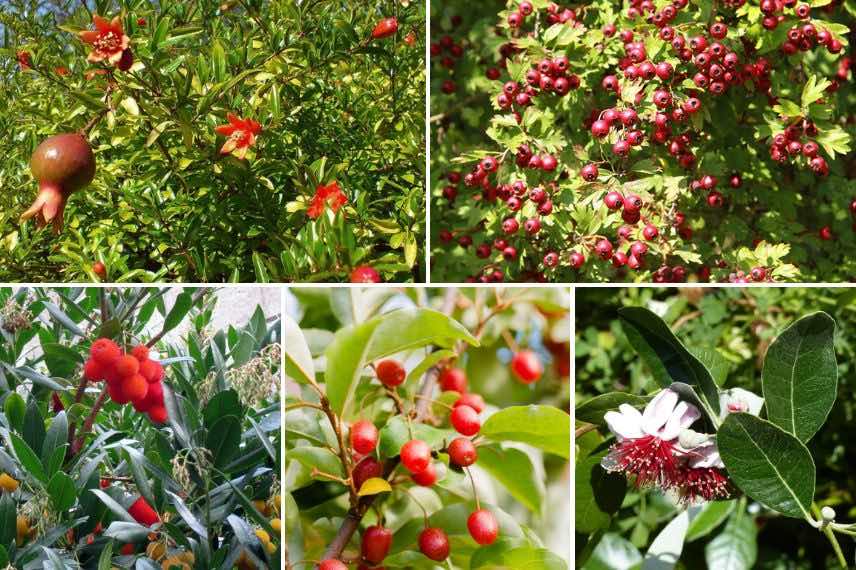
Punica granatum ‘Nana’, Crataegus azarolus, Acca sellowiana, Eleagnus multiflora, Arbutus unedo
A mixed and flowering hedge
Pomegranates can be used in free and varied hedges in regions where their hardiness is not compromised. For example, you can combine a Punica ‘Fina Tendral’, which boasts beautiful orange flowering and large, tasty fruits, with Eleagnus. Their evergreen foliage can be green to silver-grey or variegated, and their autumn flowering is unforgettable due to its fragrance. Well-suited to dry conditions, Cotinus are also hardy. With foliage colours ranging from light to dark, fluffy plumes, and autumn hues, it’s easy to be captivated. Equally interesting for the diversity of their foliage colours, as well as for their flowering and decorative fruiting, the Berberis come in deciduous and evergreen species, hardy to very hardy depending on the case. Their thorns also form a very good barrier to limit intrusions. You can integrate attractive, even spectacular colour spots at different times of the year by adding Lilacs (which also have fragrant flowering!), Japanese Quince (the double flowers in delicate salmon-pink shades of Chaenomeles ‘Falconnet Charlet’ are full of romance), and Ceanothus with blue, pink, or white flowering. A Buddleia scents the air with its honey-like aromas, while a Chaste Tree can complete the palette in suitable regions.
And for those who appreciate exotic touches, a Callistemon showcases its original bottlebrushes, which you can choose in red, white, mauve, or even yellow with Callistemon ‘Widdicomb Gem’, which happens to be one of the hardiest in the genus, all things considered.
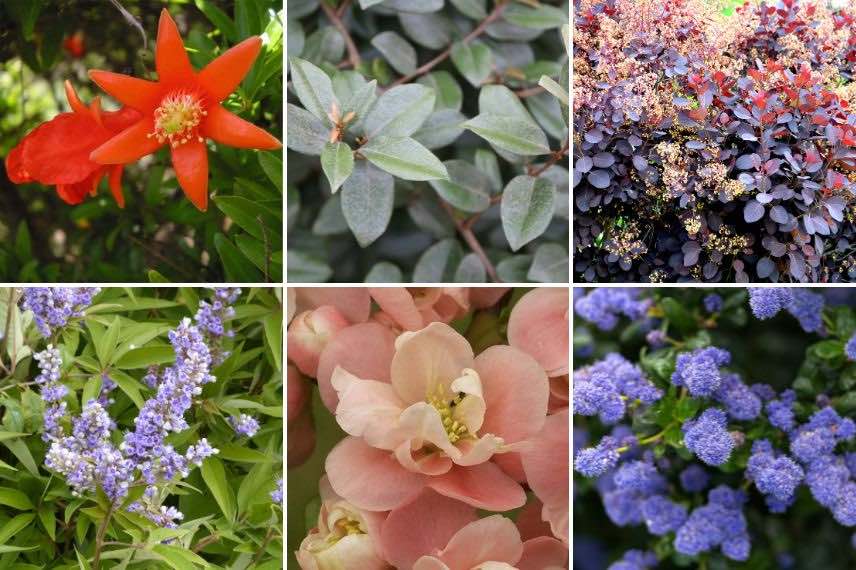
Punica granatum ‘Fina Tendral’, Elegnus ebbingei, Cotinus coggygria, Ceanothus, Chaenomeles ‘Falconnet Charlet’, Vitex agnus castus latifolius
A balcony like a garden
You don’t need a garden to enjoy yourself. Whether you have a small balcony or a large terrace, you should adapt the number of plants to the available space, but don’t be afraid to green it up generously, which, in addition to being beautiful, creates a beneficial microclimate in all seasons. A dwarf pomegranate like Punica ‘Nana’ fits nicely in a good-sized pot and adorns your summer with numerous orange flowers. Pair it with suitable companions that can thrive in full sun. This is the case, for example, with Abelias, whose foliage can be just as decorative as their long flowering period, or Choisya, these evergreen shrubs whose aromatic foliage and repeat flowering are just two of their many qualities. For decorative foliage, Eucalyptus gunnii ‘France Bleu Rengun’ adds a touch of blue through its foliage, supported by a silhouette that is both light and architectural. Also consider the autumnal blue to mauve flowering of a Caryopteris, perhaps incorporating the originality of a variegated species like Caryopteris ‘Electrum’ or a bright Caryopteris ‘Sunny Blue’ that beautifully highlights the contrast between golden yellow and deep blue. A Daphne ‘Pink Fragrance’ or ‘Eternal Fragrance’, depending on whether you prefer pink or white, blooms in successive waves and literally scents the air.
A plant of Ceratostigma ‘Forest Blue’ can dress the foreground with its soft, slightly trailing habit. Its green foliage turns red early in autumn, while a multitude of deep blue flowers stand out against this vibrant carpet. Don’t forget to adapt the substrate to the plants you select, ensuring they can withstand a winter in your area or that you have space to winter them sheltered from frost.
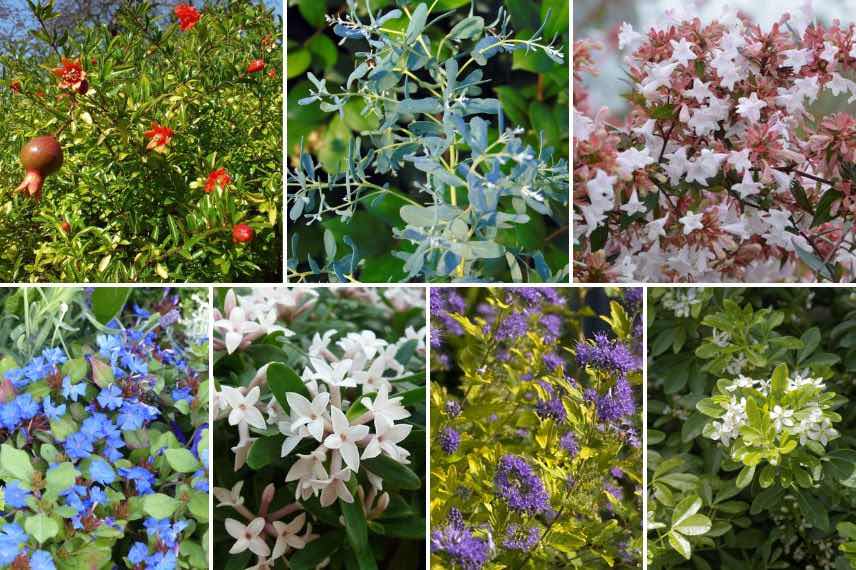
Punica granatum ‘Nana’, Eucalyptus gunnerii ‘France Bleu Rengun’, Abelia, Choisya, Caryopteris ‘Sunny Blue’, Daphne ‘Eternal Fragrance’, Ceratostigma
Further reading...
→ Discover all our varieties of flowering and fruiting pomegranates in our online nursery.
→ Everything you need to know about planting, maintaining, and pruning flowering pomegranates!
→ Fruiting pomegranates: how to plant, grow, and harvest them?
→ All our tips for properly pruning pomegranates.
- Subscribe!
- Contents

Comments