





























Organic indicator plants: what are they?
These weeds that say a lot about the soil in our garden
Contents
Couch grass, field bindweed, dandelion, broadleaf plantain… these adventive plants, often referred to as “weeds,” tend to fill your (gardener’s) nights with nightmares. You spend your days trying to eradicate them by any means, sometimes using the most disreputable methods (in the eyes of a gardener, of course!). But what if you changed your paradigm? What if one morning you woke up thinking that these unwanted herbs might actually have their uses in the garden? And especially that they don’t grow in your vegetable patch, flower beds, or lawn by chance. Indeed, these adventive plants can be considered bio-indicator plants, meaning they are valuable informants about the health and nature of your soil. Plants that will allow you, as a gardener, to aerate, enrich, or lighten your soil wisely.
Discover with us these famous bio-indicator plants to understand what they reveal to us.
Otherwise, you can also eat them! Olivier whets our appetite with weeds to put on our plate.

What exactly are organic indicator plants?
The concept of bio-indicator plants is not new. Botanist Gérard Ducerf has even created a three-volume encyclopedia in which he presents 750 bio-indicator plants, both edible and medicinal. He discusses the bio-indicator plants, common in our fields, meadows, and vegetable gardens, which can become true allies for farmers and gardeners.
Indeed, these plants do not root in a particular spot by mere chance. They do not germinate randomly, as if by magic. A soil contains a multitude of seeds that will only germinate if they find the conditions that meet their needs in terms of humidity, structure, acidity, and so on. Once all the conditions are met, they grow spontaneously and naturally because the soil suits them (even if other factors like temperature or climatic conditions also play a role).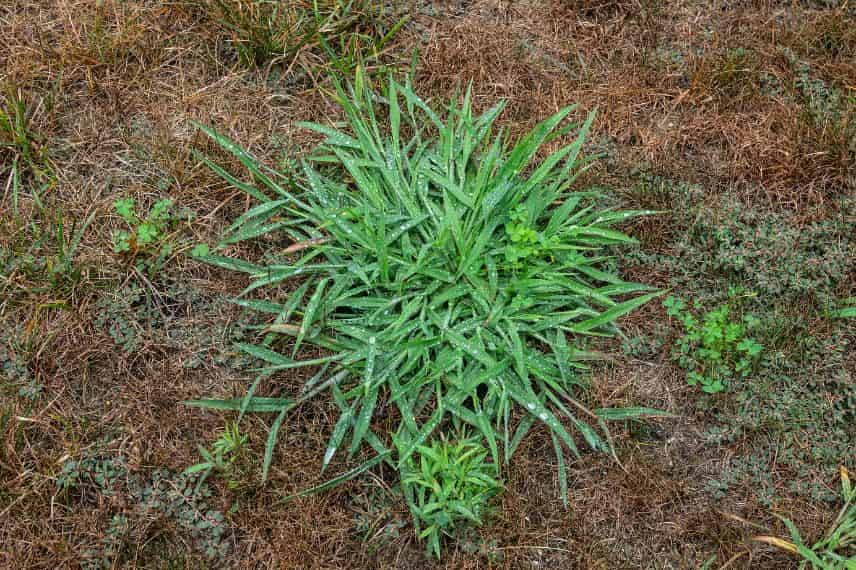
In short, these herbs, often deemed undesirable, are carriers of rich information about the nature of the soil, its properties, its health status, its excesses or deficiencies…
They provide us with valuable data on:
- The fertility of the soil and its richness in organic matter
- The structure of the soil (is it airy, compact, or compacted?)
- The texture of the soil (is it clayey, loamy, or sandy?)
- The acidity of the soil
- The degree of degradation or pollution of the land
- The water retention capacity of the soil.
Read also
10 good reasons to let weeds growHow to know if a plant is an indicator on your land?
A lonely dandelion lost in the middle of your lawn or the presence of a young plant of garden purslane among your salads may not necessarily be considered a bio-indicator plant. Indeed, for it to be seen as such, this herbaceous plant must be present in sufficient numbers, even dominating a given area.
A fairly simple method can be applied to diagnose your soil. However, it requires some time to observe and read your land accurately:
- Define an area of 1 or 2 m² in which you will conduct a very precise inventory of the plants that grow spontaneously. Obviously, this inventory implies that you have enough knowledge in botany to differentiate these various adventive plants. You can use a plant identification app or any relevant book;
- Assess their presence rate to determine which plants are dominant and which are less represented. Thus, the presence of a plant is truly significant when it occupies at least 70% of the defined area, just like the following, which should be present at least 50%.
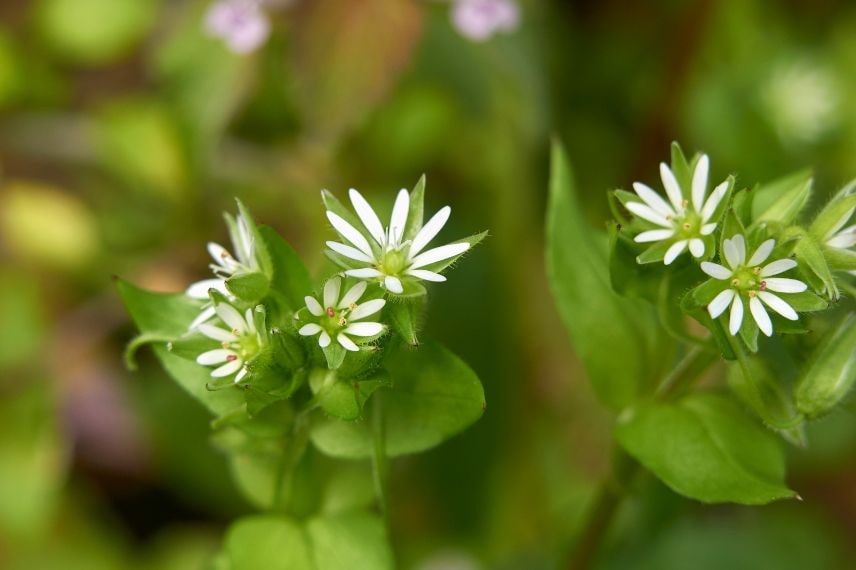
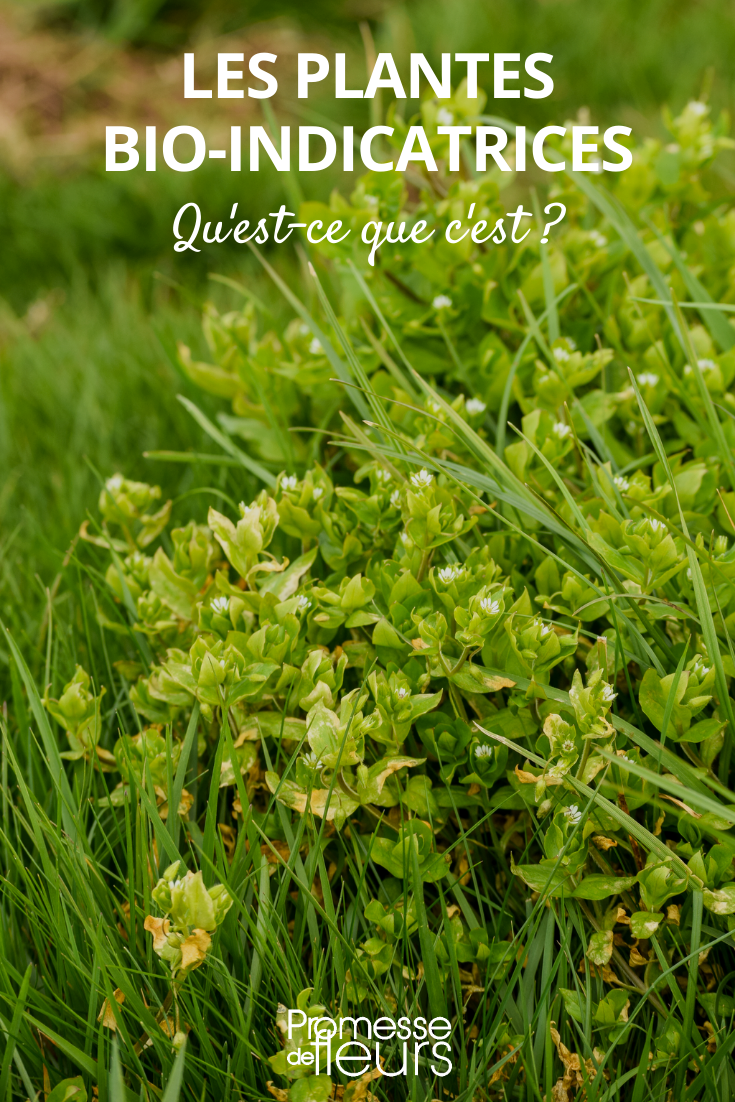
Having chickweed in your land is a sign of good soil balance
To make this inventory task easier (for example, on an unworked plot), here are some tips:
- Choose a homogeneous and representative space
- Prefer spring for this inventory, as weeds come back to life after their winter dormancy
- Avoid mown or cut areas
- Conduct a strict and precise count (a gardener often tends to overestimate the presence of certain weeds that seem to taunt them)
- Take your time to accurately identify the species of a plant, as well as its different varieties that may germinate and grow in different mediums.
The main organic indicator plants found in our gardens
Certainly, the presence of all these plants cannot replace a proper professional soil analysis, achievable with an easy-to-use kit that allows for precise determination of the physical and chemical characteristics of soil. However, they are valuable indicators that should be taken into account.
Let’s compile a brief inventory of the plants most frequently encountered in a terrain and the indications they provide regarding the nature, texture, or health of the soil (with a small note on their nutritional benefits):
- White chickweed or bird’s chickweed (Stellaria media): Well-balanced and healthy soil. A must-have in your vegetable garden! The leaves can be eaten raw in salads or cooked.
- Dioecious nettle or great nettle (Urtica dioica): Excess of plant or animal organic matter, overly rich soil. Young shoots, before flowering, can be eaten cooked in soup.
- Field bindweed (Calystegia sepium): Soil rich in nitrogen and organic matter, but too compacted and asphyxiated.
- Dock (Rumex obtusifolius): Compacted, waterlogged soil that is too rich in nitrites. Leaves and young shoots are edible but high in oxalic acid.
- Great plantain (Plantago major): Soil that is too compacted and lacks air. Young leaves from the centre can be eaten in salads.
- Field couch grass (Elytrigia campestris): Tired, compacted soil with an excess of nitrates and potash. Parts of the rhizome are edible.
- Dandelion (Taraxacum officinale): Soil saturated with animal organic matter, but also too compacted. Everything in the dandelion is edible, raw or cooked.
- Creeping buttercup (Ranunculus repens): Waterlogged soil, too leached, poor in nutrients. Toxic plant.
- Common thistle (Cirsium arvense): Arid soil, saturated with phosphorus.
- Datura: Polluted soil. Toxic plant.
- Garden purslane (Portulaca oleracea): Soil with low water retention capacity. Edible plant, but contains oxalic acid, so should be consumed in moderation by those with kidney issues.
- Daisy (Bellis perennis): Deacidified soil, beginning to erode and leach. Young leaves and flowers are edible, raw or cooked.
- Purple dead-nettle (Lamium purpureum): Excess nitrogen and organic matter in calcareous soil, eroded and leached soil. Only the aerial part is consumed as seasoning.
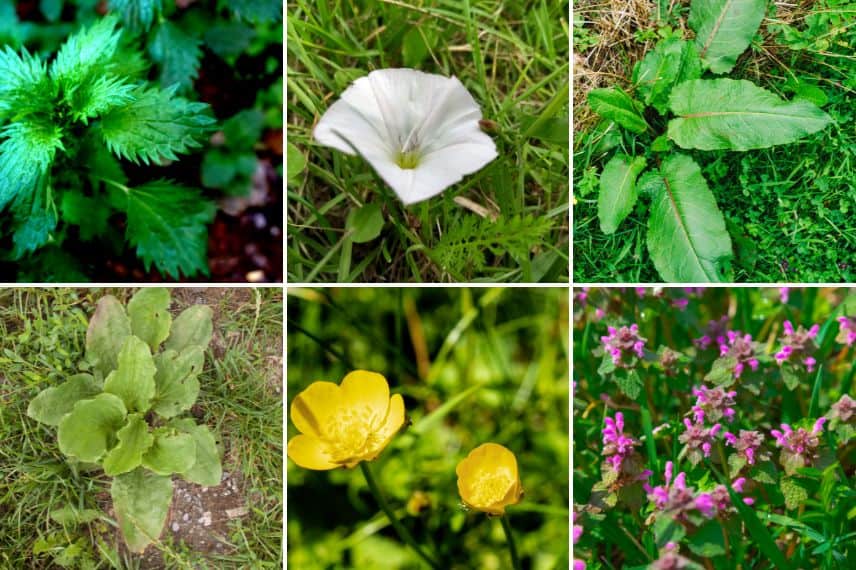
Dioecious nettle, field bindweed, dock, great plantain, creeping buttercup, and purple dead-nettle are bio-indicator plants.
Which plants indicate nitrogen-rich soil?
In soil, nitrogen (N) is essential for plants as it contributes to their healthy growth. It helps produce proteins, vitamins, enzymes, and chlorophyll. It primarily affects the development of stems and leaves. However, it is also crucial for the transformation and degradation of organic matter into mineral elements through microorganisms.
Thus, soil that is too low in nitrogen can be enriched with well-balanced compost, mulches, grass clippings, manure, organic fertilisers such as crushed horn or dried blood, nettle manure, or comfrey… You can also grow Fabaceae (legumes) that have the ability to fix and return atmospheric nitrogen thanks to the nodosities on their roots…
However, in trying too hard to do well, you may sometimes cause nitrogen hunger. Olivier explains everything about nitrogen hunger and especially how to avoid and remedy it.
And sometimes, your soil turns out to be rich in nitrogen. Rejoice, this is good news! Some bio-indicator plants are signs of your soil’s good health:
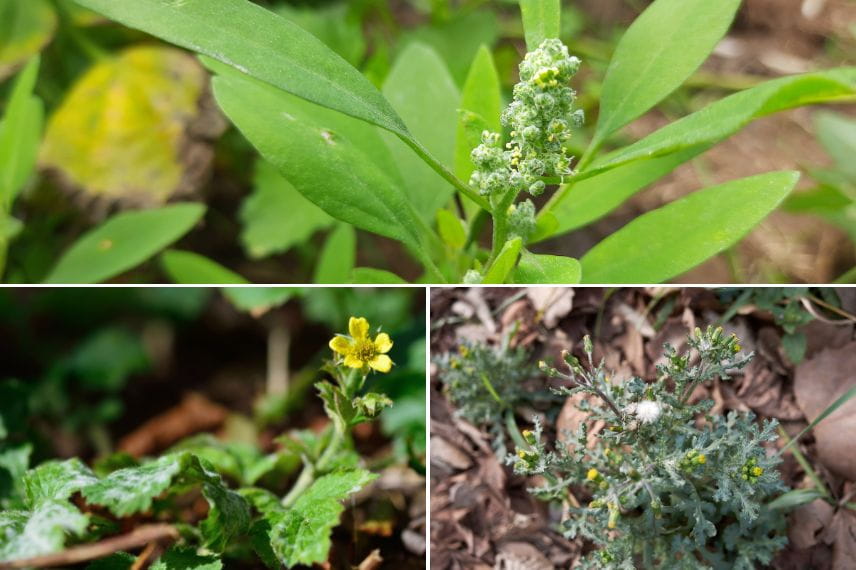
White goosefoot, common avens, and common senecio indicate that the soil is rich in nitrogen
- Common avens (Geum urbanum)
- White goosefoot (Chenopodium album)
- Field bindweed
- Bird’s foot trefoil
- Dioecious nettle
- Common senecio (Senecio vulgaris)
- Subscribe!
- Contents
Comments