





























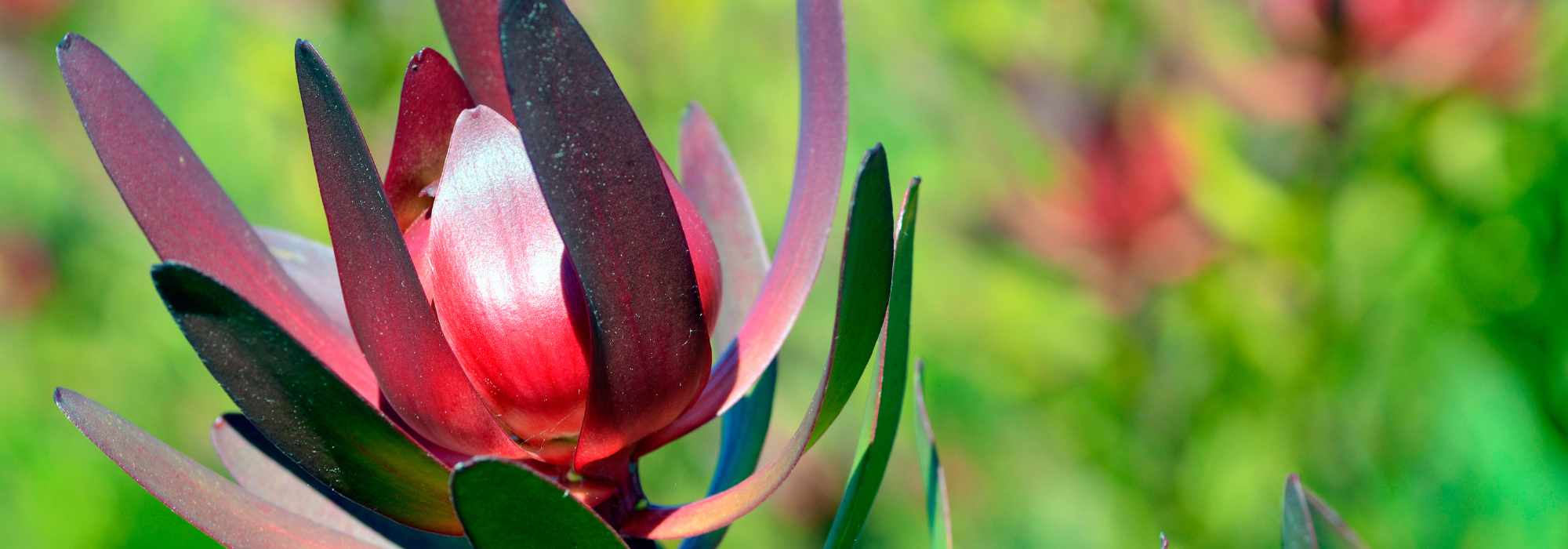
Leucadendron: the most beautiful varieties
Our selection
Contents
Leucadendron is a wildly exotic evergreen shrub with its eye-catching star-shaped pink or red bracts and elegant, colourful foliage. Compact in size, it forms a shrub that rarely exceeds 1.5 m at ripeness. This cousin of the Proteas is sensitive to cold and should be reserved for gardens in mild climates, such as those by the sea. Very little hardy (-4 to -5°C), it requires warmth, full sun, and light, poor, mineral, rather acidic soil to thrive. Most can only be grown in the ground in Zone 9b (-3.9°C to -1.1°C), which is why, in the harsher regions of our country, it is best cultivated in pots, allowing for control over the substrate composition and wintering of the shrub. With its exotic and graphic silhouette, it will look sensational as a standalone feature, on a dry slope, or in dry garden beds. It integrates beautifully into contemporary or Mediterranean-inspired gardens.
Discover our 7 favourite varieties to grow in the ground or in pots!

Leucadendron ‘Safari Sunset’
This hybrid variety of Leucadendron is one of the most popular, especially in floristry, for the very exotic look it brings to cut flower arrangements. ‘Safari Sunset’ forms a modest bush reaching 1.5 m in height. It rewards us with a long flowering period, when its floral bracts don warm and changing tones, blending purplish-red and yellow evoking an African sunset. Its red stems bear beautiful green foliage that turns purple during full flowering. The display will last from April to September, creating vibrant collars that will light up any sunny and open area of the garden or a south-facing terrace.
In an exotic or Mediterranean garden, it can be paired with ‘Euphorbia mellifera, whose flowers open in cut flower arrangements with subtle colours ranging from yellow-orange to brown-red.
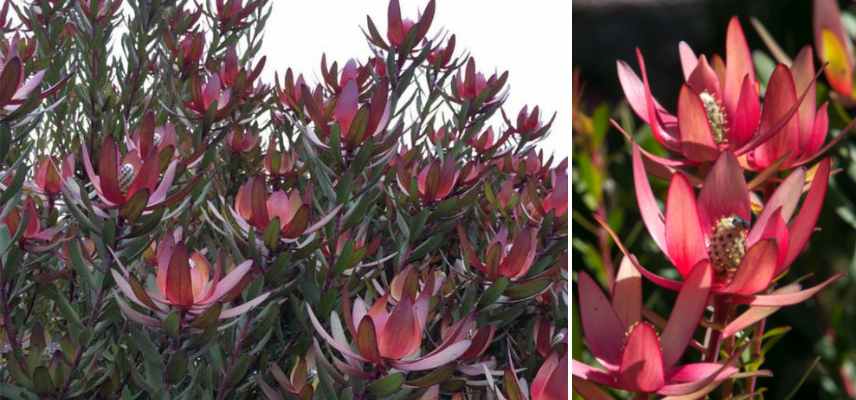
Leucadendron ‘Cheeky’
This variety of Leucadendron is one of the most compact! ‘Cheeky’ stands out from its relatives with a much more compact habit, not exceeding 60 cm in height and 1 m in diameter. It is particularly well-suited for pot cultivation and will make a stunning conservatory plant in our less clement regions. It is also remarkable when, from February to April, it displays its long bright red bracts surrounding a small golden-yellow cone. Its evergreen bluish-green foliage, tinged with red in winter before the appearance of the inflorescences, adds to its flamboyance.
Placed in a very large pot on the terrace or in a patio, you will create an exotic and wild decor, for example by placing it near the Agave americana, which is very graphic with its large grey-blue leaves as well.
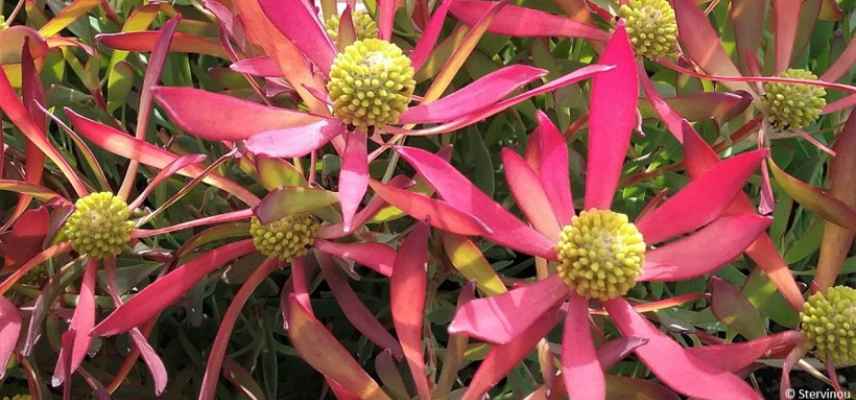
Leucadendron ‘Devil's Blush’
Another beautiful Leucadendron that stands out for its small size! The Leucadendron ‘Devil’s Blush’ quickly forms a compact bush measuring 1 m in all directions. It draws all eyes when it reveals, sometimes as early as February, its bracts in shades of purple to scarlet red. They emerge against a backdrop of foliage that is also coloured purple in winter and summer. This flamboyant specimen will look splendid at the heart of an exotic or Mediterranean border, surrounded by Grevilleas, such as the Grevillea gracilis ‘Clearview David’ with raspberry-red flowers for a burst of colour.
Read also
10 hardy plants for an exotic dry gardenLeucadendron ‘Fireglow’
It is certainly one of the most popular leucadendrons. From the beginning of spring, its collars of bracts bloom in vibrant and changing colours, shifting over time from yellow to orange, and from red to purple. This variety ‘Fireglow’ stands out for its beautiful and long flowering in flamboyant tones. Its collars of bracts, like small colourful flames, ignite the garden from February to April. They are remarkably highlighted by a backdrop of foliage tinged with green and purple. Its compact size, 1.5 m in height and 1.2 m in spread, allows for use at the back of exotic beds, in frost-free gardens, or in large pots to create a focal point that draws the eye. Enhance its colourful flowering by cultivating alongside it its cousin Protea magnifica, the Queen Protea, fascinating with its spring flowering in shades of cream and pink.
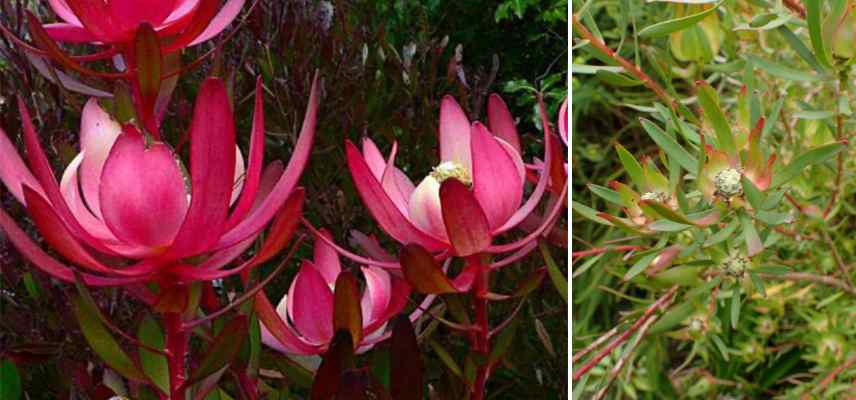
Leucadendron ‘Fireglow’. On the right, the plant in bud (© Wikimedia Commons)
Leucadendron ‘Sundance’
A must-have variety that owes its success to its colours that brighten the entire spring period. From March to May, ‘Sundance’ is covered in waxy stars of apple green turning to pale yellow tipped with orange-pink, centred around a large golden heart. Its changing collars, borne on red stems, are highlighted by light green juvenile foliage, showing a tip and margins touched with red. This beautiful bush, reaching 1.5 m in height and 1.2 m in spread, will be paired with Aloe ‘Safari Sunrise’ with its salmon-orange spikes. Together, they will form a perfect duo in a harmonious palette of shades, on a dry slope, perhaps adorned with a carpet of Delosperma ‘Wheels of Wonder Fire’ as groundcover.
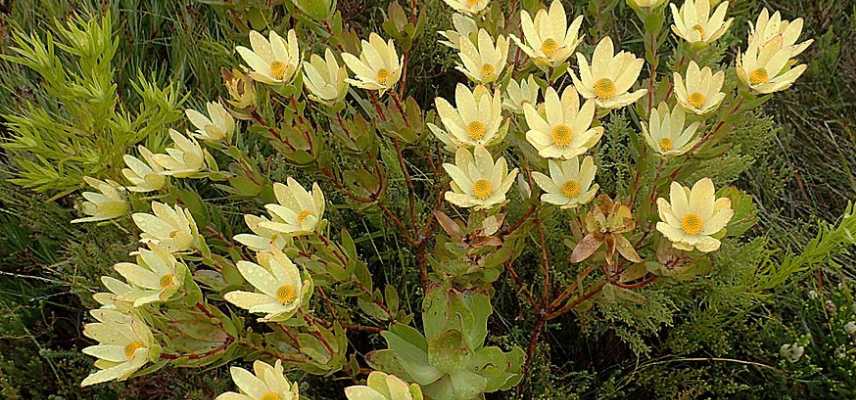
Leucadendron Sundance © Wikimedia Commons
Leucadendron ‘Jester’
Another Leucadendron with a texture and accent that won’t go unnoticed! Especially when it showcases its unique flowering and foliage from March-April to August. While the hybrid ‘Jester’ (or ‘Safari Sunshine’) is valued for its variegated bracts of fuchsia red and burgundy, it may be even more appreciated for its foliage that blends various colours. Its leaves display tender hues reminiscent of dawn as they unfold in cream-variegated green, turning pink at the end of winter when flowering begins. This small bush will benefit from being surrounded by a carpet of succulents such as Aptenia cordifolia ‘Variegata’, with its variegated foliage and carmine pink flowers, to create a dazzling, multicoloured display that blooms for a long time.
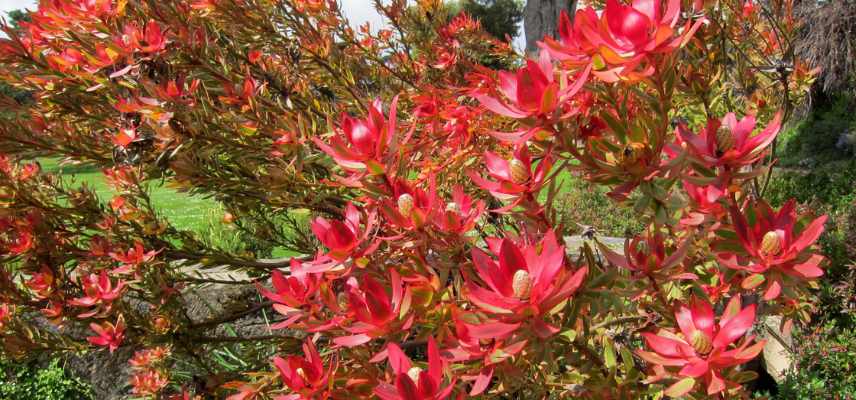
Leucadendron ‘Safari Sunshine’ (© cultivar 413)
Leucadendron ‘(x) Inca Gold’
A stunning new addition that delights us with its vibrant tones! ‘Inca Gold’ is a still rare hybrid in cultivation. In spring, from March to May, it is adorned with a multitude of star-shaped bracts in a particularly bright yellow set against soft green foliage. It has medium proportions, quickly reaching 1.50 m in height and nearly the same in width. In a large pot to be stored frost-free, or in the ground depending on your climate, it will be a good companion for the Madeira Bugloss, Echium candicans (syn. fastuosum), whose blue flowering from spring to summer will provide a complementary splash of colour.
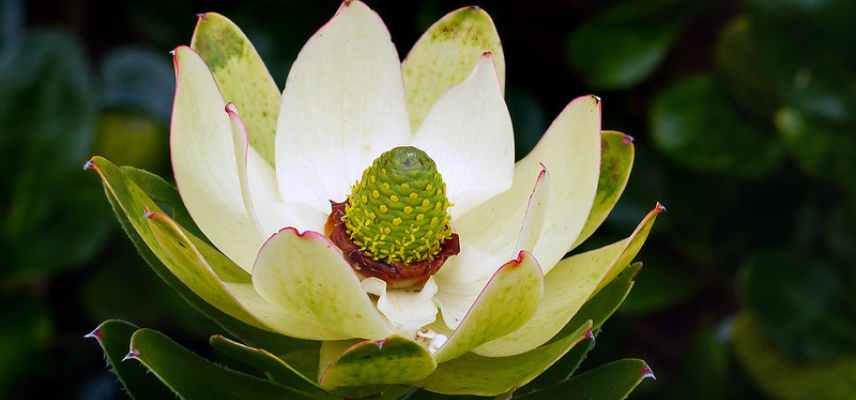
Leucadendron ‘Inca Gold’ (© Bernard Spragg.NZ)
Useful resources
- The most beautiful collection of Leucadendron is with us!
- Subscribe!
- Contents
Comments