





























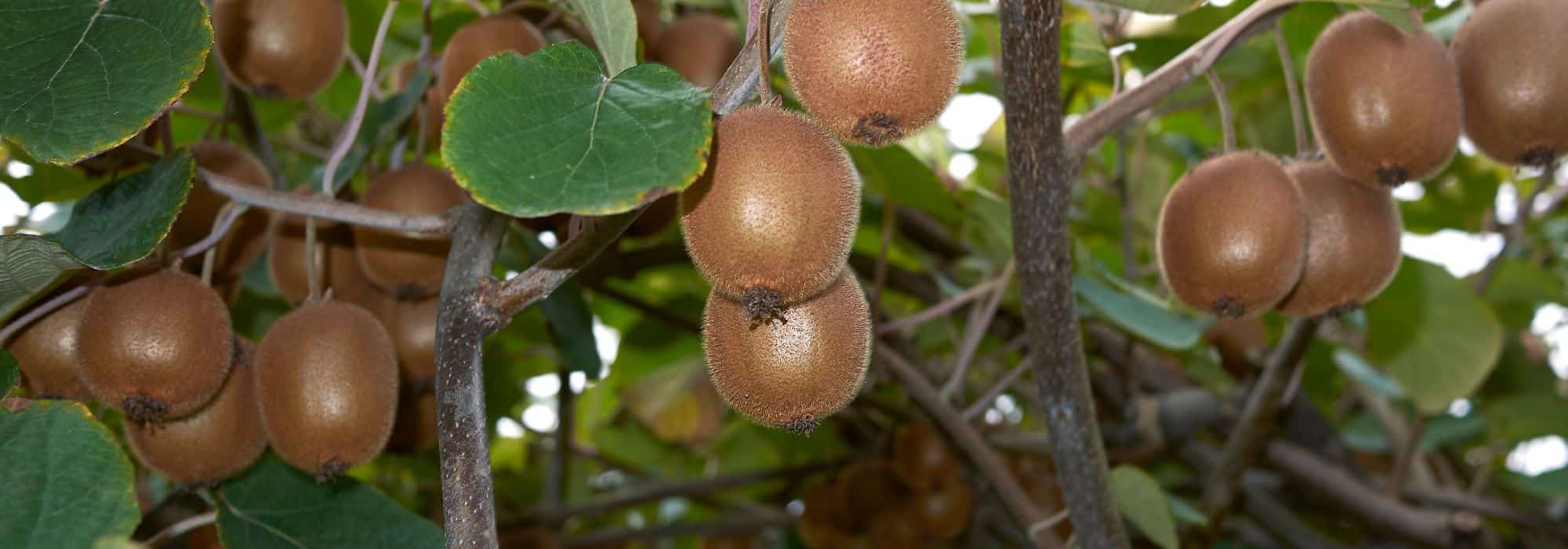
Kiwi fruit: how to choose the right variety?
Our kiwi fruit buying guide based on various criteria
Contents
Whether you call it a kiwi tree or kiwi fruit, the Actinidia chinensis or deliciosa is a woody climbing shrub of Chinese origin that will reward you with delicious kiwis, those velvety-skinned fruits renowned for their nutritional richness. Relatively easy to grow, kiwifruit nevertheless needs to be trellised, as its shoots can reach 6 m in height with a 4 m spread. Generally hardy to -15°C, kiwifruit can be susceptible to spring frosts. That’s why planting in a sunny position (not scorching) sheltered from cold winds in soil that stays cool is essential. Finally, like most fruit trees, kiwifruit needs pruning. Apart from these requirements, it’s an easy plant to grow.
If you want to produce beautiful, juicy kiwis, you’ll need to choose the right varieties according to criteria such as pollination, cold resistance and harvest period…
Discover our selection of the best kiwi varieties according to different criteria linked to pollination mode, as well as cultivation or climatic criteria.

According to pollination mode
Here is one of the most important criteria for choosing your kiwi variety. After all, it is not uncommon for gardeners to buy a kiwi plant without considering pollination. And years later, despite the plant’s good health, they have still not tasted a single kiwi!
Indeed, Actinidia is a dioecious genus of plants, meaning that to obtain fruit you need to plant a male and a female plant. Obviously, the female plant bears the fruit, but not the male plant, which is content with sterile flowers that provide the pollen needed for pollination. This pollination is mainly carried out by insects, particularly bumblebees. That’s why you must plant at least one male plant for every one to six female plants.
In recent years, self-fertile varieties that guarantee pollination on their own have been developed. These self-fertile kiwis are perfect for gardeners with limited space. But fruiting will always be better and more abundant with at least two plants.
Self-fertile varieties
A single plant is enough to obtain fruit since the flowers of these self-fertile varieties of Actinidia chinensis or deliciosa pollinate each other. Thus, the variety ‘Boskoop’ offers fruits weighing 30–40 g in October–November on a particularly vigorous liana. ‘Solissimo’, also available in an organic version, produces large fruits in November, while the kiwis of ‘Solo’ are of small calibre (20–30 g) but particularly sweet and juicy. The variety ‘Jenny’ bears fruit around November from the fourth or fifth year. Finally, ‘Herma’ is a variety developed in France that produces very large fruits.
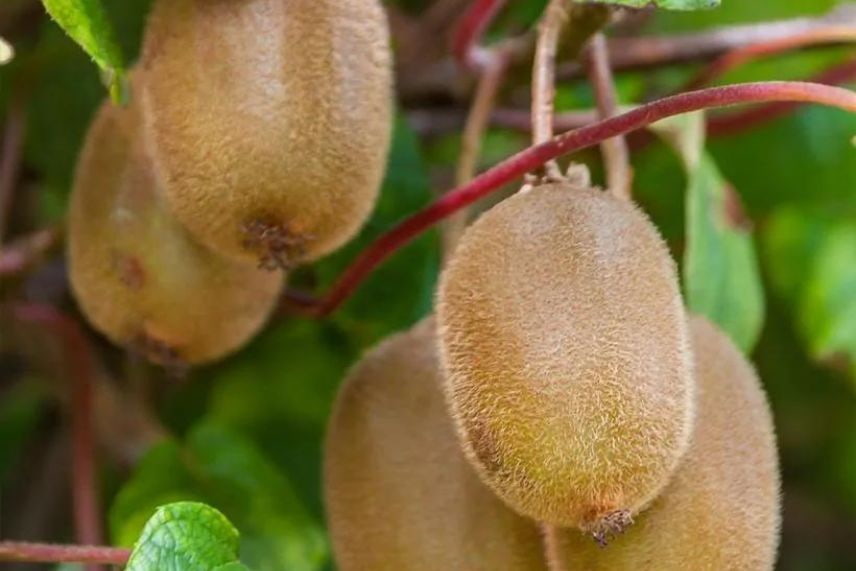
The self-fertile variety ‘Boskoop‘
Dioecious varieties
If you have space in your garden, opt for dioecious varieties. You will need to plant at least one female plant with a pollinating male plant. Thus, the Acinidio deliciosa ‘Tomuri’ is an excellent pollinator, among others for the female variety ‘Hayward’ because they flower at the same time. Just like the male plant ‘Atlas’. By contrast, the variety ‘Belen’ flowers a little earlier, which is why it is the ideal pollinator for ‘Sorelli®’. As for ‘Golden Delight’ (male), it’s the ideal counterpart to the female ‘Golden Delight’ that produces golden kiwis.
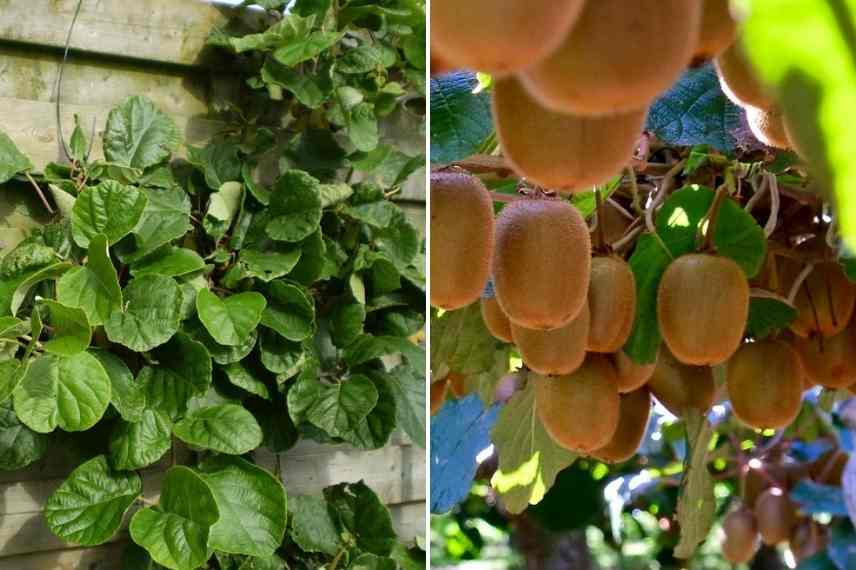
If you tend to get lost in these kiwi couples, opt for the easy solution with our duos consisting of a male plant and a female plant. And you’ll be sure to enjoy fine fruits after four or five years of cultivation.
Depending on the fruits
Admittedly, a kiwifruit remains a kiwifruit, sometimes called ‘Chinese gooseberry’ or ‘vegetable mouse’: oval-shaped, the kiwifruit offers green flesh, both sweet and tangy, covered by a pale brown, downy skin. However, kiwifruits vary in size, colour, shape and flavour.
Thus, if you want to harvest kiwifruits of good size, do not hesitate to choose varieties such as ‘Hayward’ which yield large-calibre fruits. It is, moreover, the most widely grown variety worldwide, making it a benchmark. Their fruits weigh between 70 and 120 g, up to 150 g, with a diameter of 6–7 cm. It is a late-maturing variety (from November to January), but kiwifruits continue to ripen after harvest. Monty is also known for its elongated kiwifruits weighing at least 70 g, with excellent flavour. Like ‘Hayward’, this variety benefits from late flowering. It is also very productive.
If you want to enjoy kiwifruits remarkable for their aroma and flavour, it’s ‘Bruno’ that you need! Their fruits, very elongated, are of medium calibre (around 40 g) but with a very fine flavour, and much more fragrant than those of Hayward. This variety is productive and early ripening.
Those seeking originality will turn to kiwifruits with golden-yellow flesh. ‘Kiwi Wonder‘ offers kiwifruits with yellow flesh and a red core, with very sweet flavour, and no acidity. Their yellow skin is thin and fuzz-free. This female variety thrives in the company of the male pollinator ‘Tomuri’. As for ‘Minkigold’, it also produces golden kiwifruits with yellow flesh, endowed with a light apple fragrance. This variety grows and fruits alongside its male counterpart, the variety ‘Minkimale’ with beautiful fragrant white flowers. These two varieties are French-bred selections by the breeder Marionnet. To simplify your choice, we offer the duo comprising the two golden kiwifruit varieties.
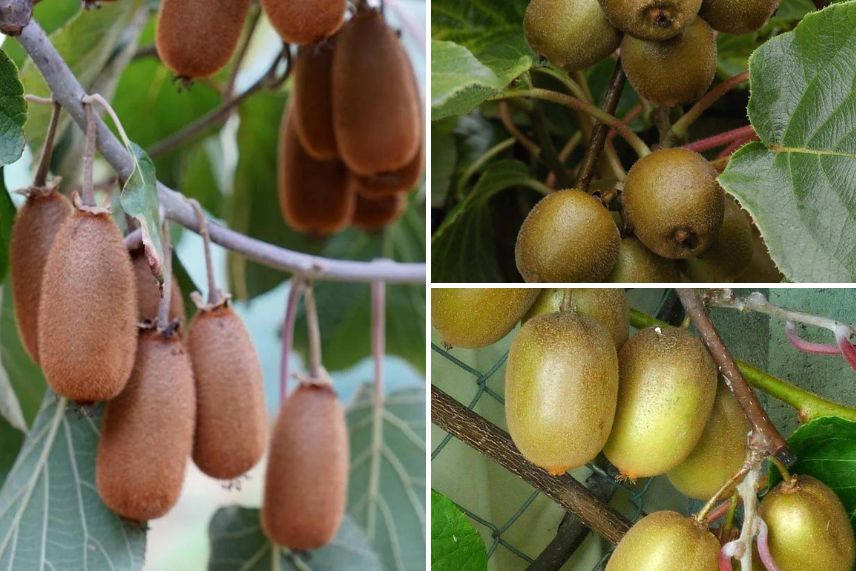
The varieties ‘Bruno’, ‘Hayward’ and ‘Minkigold’
Depending on frost tolerance
Overall, an Actinidia chinensis or deliciosa is hardy to -15°C, which allows kiwis to be grown fairly widely. Provided it is planted in a sunny spot sheltered from cold winds, for example against a south-facing wall. Indeed, kiwis fear late-spring frosts that can damage their flower buds, and thus jeopardise fruiting.
If you live in a region with harsh winters, it may be wise to choose hardier varieties :
- Actinidia kolomikta, also known as Arctic kiwi, can withstand temperatures down to -40°C. It is a self-sterile kiwi notable for its colourful foliage, variegated pink and white on a green background in spring. It flowers in June and yields small, dark-green fruits, striped with dark green, edible but not very fragrant; This fruiting is achieved by pairing Actinidia kolomita ‘Adam’ with Actinidia Kolomikta ‘Eve’
- Kiwai (Actinidia arguta), also known as ‘Siberian kiwi’, a vernacular name that says a lot about its hardiness, is a small kiwi that can be eaten with the skin and has a sweet, fragrant flesh. There are many varieties, all the more delicious than the next.
To know more on kiwai and its varieties:
- Kiwai, a tiny, bite-sized kiwifruit to nibble!
- How to differentiate between kiwi and kiwai?
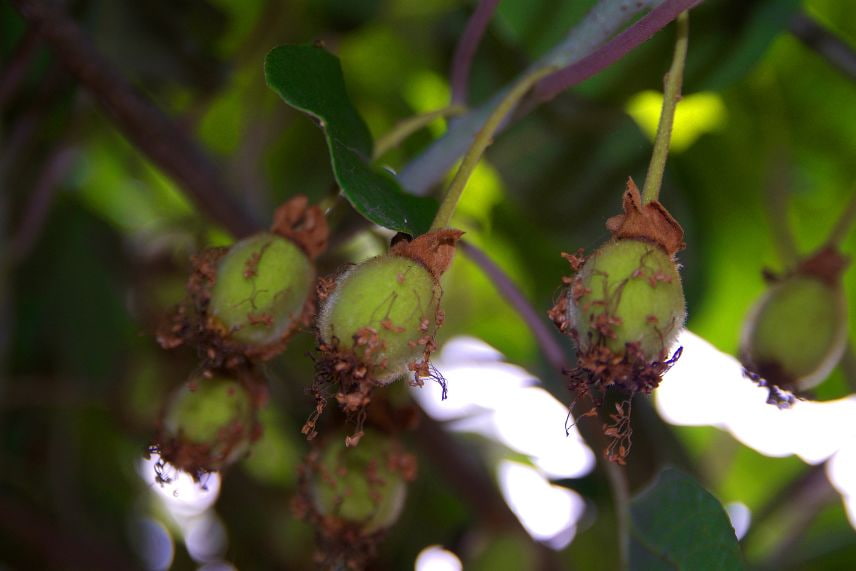
Kiwis from‘Actinidia kolomikta
According to productivity
Among the most productive varieties, you can cite ‘Hayward’, ‘Bruno’ or ‘Monty’, but the variety Kiwidoo is not to be outdone. This variety produces beautiful green-fleshed fruits with a sweet flavour, very fragrant and particularly rich in vitamins. These fruits are harvested in October.
Depending on the harvest period
Actinidia typically bears fruit after around four to five years. Patience is therefore required. With regard to the harvest, it generally takes place in October and November, before the frosts. Only kiwifruit (Actinidia arguta) are harvested from September.
Among kiwifruit varieties, some show early fruiting, such as ‘Hayward’ or ‘Montcap®’, a variety selected in France in Tarn-et-Garonne by the Montauban agricultural lycée. The fruits of ‘Montcap’ are sweeter and larger than those of ‘Hayward’ and reach ripeness about thirty days earlier. It is therefore an interesting variety in regions where autumn is earlier. The fruits also benefit from excellent keeping qualities. It is a self-sterile variety, so it requires a pollinator.
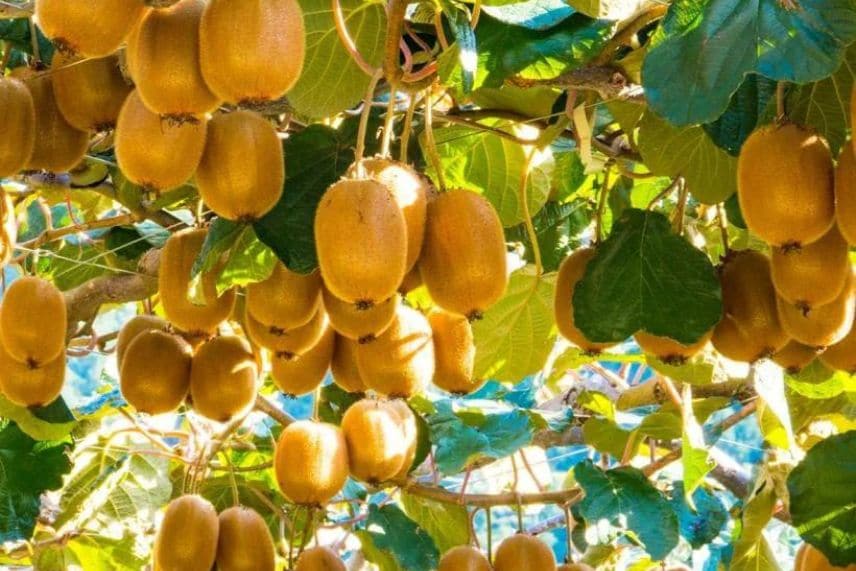
The Actinidia deliciosa variety ‘Montcap®’
As development progresses
Actinidia is a vigorous liana that grows rapidly. It can reach up to 6 m in height (and possibly more if growing conditions suit it) with a spread of 4 m. If you have limited space, opt for the Monty variety, which has a more compact growth habit of its woody climbing stems. It generally climbs to around 3 m with a width of 1.50 m, making it ideal for a garden arbour, a pergola or a trellis in a small garden. Harvesting will also be easier. It bears fruit as readily as the other varieties, with fairly late flowering.
- Subscribe!
- Contents
Comments