




























Irrigation solutions for a balcony or terrace
Effective and targeted irrigation for your potted plants
Contents
There are several automatic watering solutions for balconies and terraces, with or without a tap. Whether you want to use them just to simplify your daily tasks or to replace you in case of absence, autonomous watering systems allow you to supply water to your plants regularly and precisely: watering is done directly at the base of the plant, in just the right amount and without wetting the foliage. Watering cones, water-retaining pots, ollas, drip irrigation kits with water reservoirs, or connections to a water supply, these water-saving systems are very useful if you don’t have time to water your plants. Discover the different solutions available to meet the water needs of your flowering plants in containers, bush in pots, or your vegetable garden in a trough!
Watering cones
Irrigation system easy to set up and inexpensive, the watering cone is an effective solution for watering potted plants and planters during your absence, without any power source. Simply screw the cone onto a bottle filled with water and plant it in your pots. Thanks to this inverted water bottle, water then diffuses continuously at the base of your plants. There are different sizes of cones available in various materials: ceramic, terracotta, plastic, or glass. When purchasing, refer to the manufacturer’s recommendations to make your choice based on the size of the container, the plants to be watered (water needs specific to each plant), and the duration of your absence. Depending on the model chosen, the water diffusion system at the base of the plant may vary, and some cones do not necessarily require a bottle (for example, a glass watering globe).
Our tips for using the irrigation cone with a bottle:
- Plant the cone in well-moistened substrate.
- Make a hole in the bottom of the bottle to create an air vent. You can also choose to cut the bottom of the bottle. This makes future refills easier, but remember to cover the bottle with a bag secured by an elastic band to prevent water evaporation.
- Do not use this system for plants that are not water-hungry, such as cacti and succulents.
- Do not place the water reservoir cone near the edge of the pot, but close to the plant (maintaining a reasonable distance).
- If necessary, you can support the bottle with stakes placed around it.
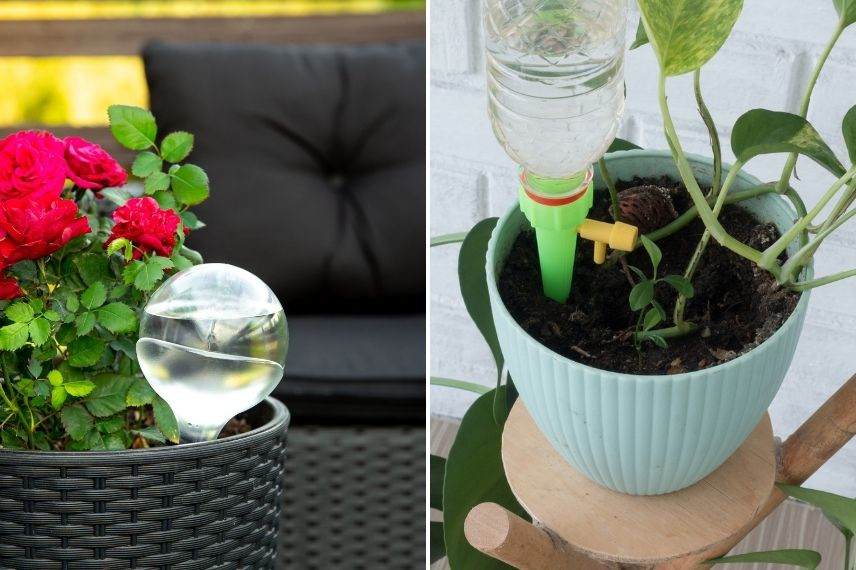
Glass watering globe on the left. On the right, the plastic watering cone diffuses water drip by drip through the small adjustable yellow dripper
Water-retaining pots
Available in various shapes and sizes, water-retaining containers are recommended for plants that prefer consistently moist soil (flowering plants and green plants). Often made from plastic, these pots, cache-pots, or planters feature a double base that allows for the storage of a quantity of water beneath the substrate. Sometimes, a gauge indicates the water level. A grid or perforated tray serves as a separator between the water reservoir and the soil. Water poured into the reservoir rises by capillarity and continuously moistens the soil. The main drawback of this watering system is that plants risk root asphyxiation during successive rains. On the positive side, larger reservoirs allow the plant to be self-sufficient in water for two to three months.
Our tips for using water-retaining containers:
- Do not use these pots for conifers, aromatic plants, cacti, and succulents, or even certain ornamental bushes that are sensitive to constant moisture.
- Ensure that the container is equipped with an overflow system to allow excess water to drain away.
- Prefer a lightweight substrate when planting to promote good diffusion to the plant’s roots.
- After planting and in the following months, water your plant from the top until the roots develop more deeply.
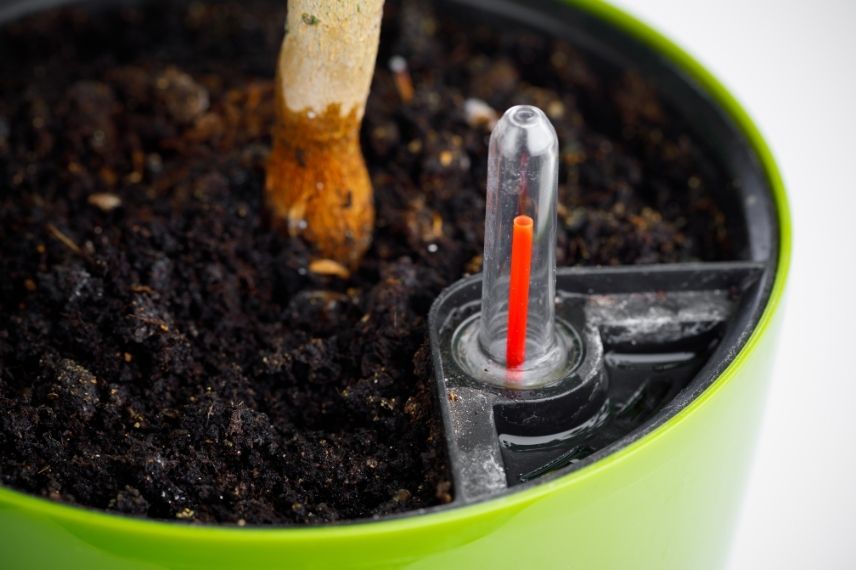
Pot with water reservoir and water level indicator
Discover other Patios
View all →
Available in 1 sizes

Available in 1 sizes
Available in 1 sizes
Available in 1 sizes
Available in 1 sizes
Available in 0 sizes
Available in 2 sizes

Available in 1 sizes

Available in 0 sizes
Available in 1 sizes
Ollas (or oyas)
Watering pots known as “ollas” (meaning “pot” or “cooking pot” in Spanish) have been used for thousands of years. This irrigation system involves burying or inserting a reservoir near the plants and then filling it with water. The microporous ceramic olla diffuses water gradually at the base of the plant due to its porosity. The plant can then draw the water it needs. A removable lid is placed on the olla to limit water evaporation and prevent foreign bodies from entering the water. Ollas come in various sizes. The larger ones are generally used in open ground, in the garden or vegetable patch. However, for a bush in a large container, you can use a large olla (1 to 2 litres) to bury at the time of planting. The mini-ollas for planting fit into small pots, containers, and window boxes on the terrace or balcony.
To learn all about this irrigation method, discover our advice sheet: Ollas or oyas: an efficient and economical watering system
Make your own olla with our tutorial: Make a homemade olla to water the garden
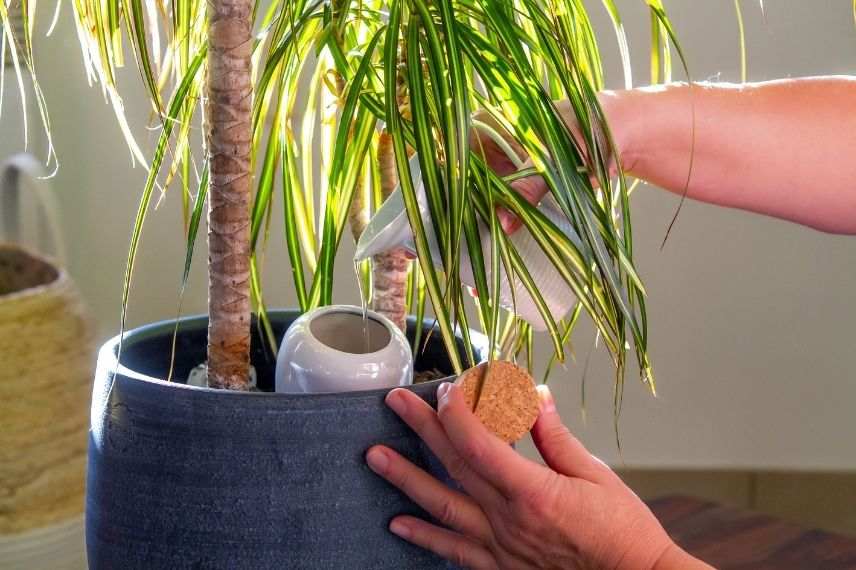
Small olla for potted plant
Read also
Watering with a porous hoseDrip irrigation
Drip irrigation allows water to be delivered directly to the base of plants in a precise, targeted manner, thus minimising water loss. It is very economical compared to traditional watering methods, and there are several micro-irrigation systems available for use on terraces and balconies, which can be connected to a water supply or a reservoir. While the initial investment may be significant, this solution is effective and cost-efficient in the long run. Take the time to assess your terrace or balcony to optimise the installation of your irrigation system and determine the length of hoses required. Don’t hesitate to make a plan to cover all aspects.
Drip systems with water reservoir
If you do not have a water supply on your balcony or terrace, be aware that there are also drip irrigation kits that do not need to be connected to a tap. Also known as “automatic watering systems,” these systems may or may not include an electric pump.
- Without pump: a water reservoir equipped with a siphon tube is placed at a height (approximately 80 cm above the potted plants). A flexible hose connected to the tube links the plastic drippers installed in the various pots, creating a network of hoses. The water drawn from the reservoir flows by gravity, from the reservoir to the plants. This system can be used for both indoor and outdoor potted plants or planters.
- With pump: this allows water supply from a large container, provided or not with the kit (bucket, can…). An automatic timer manages the watering independently. An electrical connection is required to operate the pump.
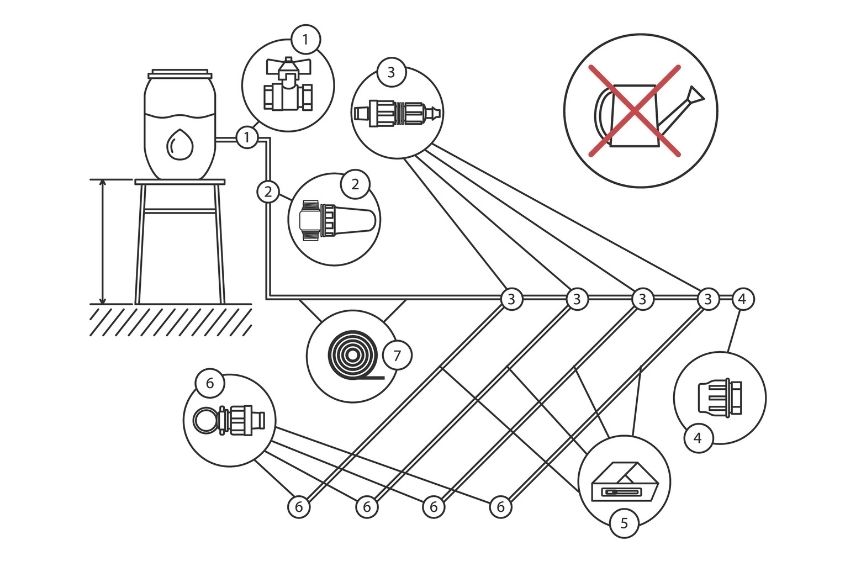
Installation diagram of a watering system with water reservoir: 1) water supply, 2) irrigation central unit, 3) connections on main hose, 4) end-of-line cap, 5) drippers, 6) removable caps for secondary network, 7) main supply hose
Drip kits to connect to a tap
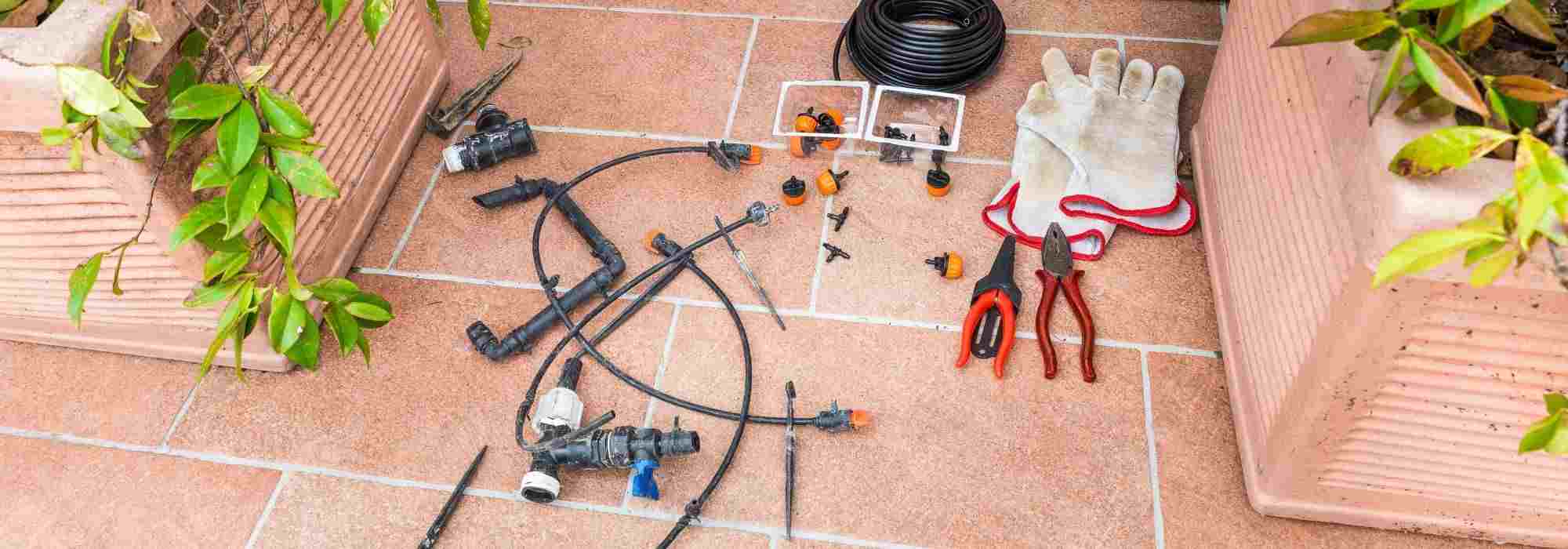
The water supply for these irrigation systems is achieved by connecting to a water source. Perfect for large terraces or balconies, these drip kits typically consist of:
- an irrigation central unit to manage pressure,
- connections: T-junctions, adapters, reducers, and caps,
- drippers or micro-sprayers,
- a central supply hose (generally 13 mm in diameter),
- a flexible and thinner irrigation hose that supplies the drippers or sprayers,
- and supports to hold the hoses in place on the substrate.
Some models include a pump for connection to a rainwater collector, while others feature a timer to allow watering based on schedule, duration, frequency, and desired quantity. Be aware that not all kits necessarily come with a timer.
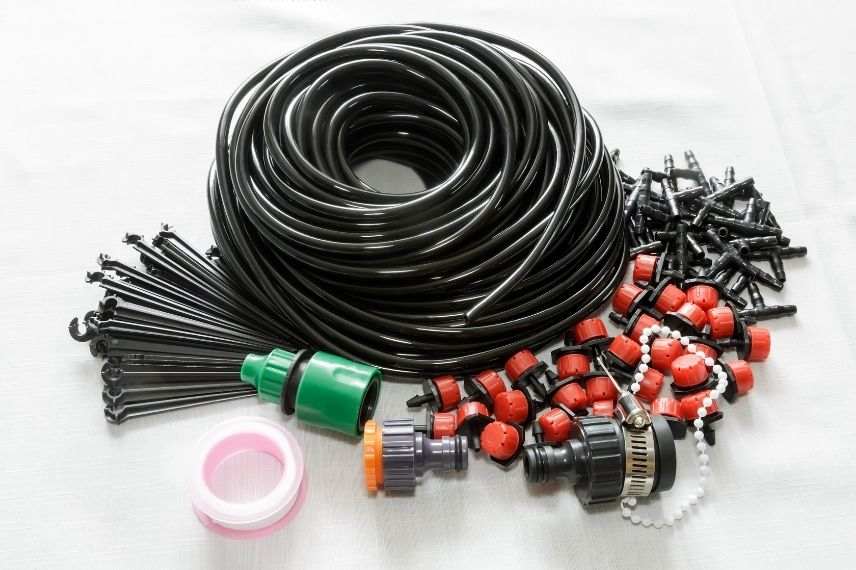
The advantage of this system lies in the ability to create one or more hose networks according to your needs, offering therefore more possibilities than a system with a water reservoir. Highly adaptable, different types of drippers can be used and placed on the hose towards the plants. Here are a few examples:
- the self-regulating dripper delivers the same flow rate along the entire length of the hose, whether at the beginning or the end,
- the adjustable dripper allows you to set the water flow according to the needs of each plant,
- the fixed-flow dripper, which cannot be adjusted, is to be used for plants with similar water needs or if you have few potted plants,
- the inline dripper, for watering several plants in the same container, such as a planter or rectangular box.
For further reading
To complement your watering, also check our advice sheet to learn all about water retainers.
- Subscribe!
- Contents

Comments