





























How to grow vegetables or fruits on a terrace?
All our installation and planting tips for a productive terrace vegetable garden
Contents
Growing your vegetable garden is very rewarding. But it’s also economical, ecological, good for your health, and stress-relieving… In short, the benefits of having a vegetable garden, no matter how small, are numerous. And you are convinced of this! However, you live in an urban environment and only have a terrace. Don’t despair, as it is entirely possible to grow vegetables and even fruits on a terrace. Admittedly, the profitability and productivity will not be the same as in a traditional garden, but you can still look forward to enjoying vegetables and fruits that you have sown, planted, watered, and cared for. And while setting up a terrace garden requires a bit of investment in time, effort, and money, afterwards, maintenance will be minimal. Follow our tips to set up your garden on a terrace.
The Importance of the Orientation of Your Vegetable Garden on a Terrace
To push and produce fruits and vegetables, a vegetable plant needs adequate light, and therefore sunlight. This is why it is essential that your terrace receives a minimum of 6 hours of sunlight per day so that you can grow a wide range of vegetables or fruits.
For a productive vegetable garden, a terrace facing south-east or south-west is ideal, as the rays of the sun will provide all the energy necessary for the plant to develop. However, remember to place the vegetable plants with the largest growth at the back to avoid creating artificial shading that could be detrimental to sun-loving vegetables. On the other hand, salads may appreciate a partially shaded position.
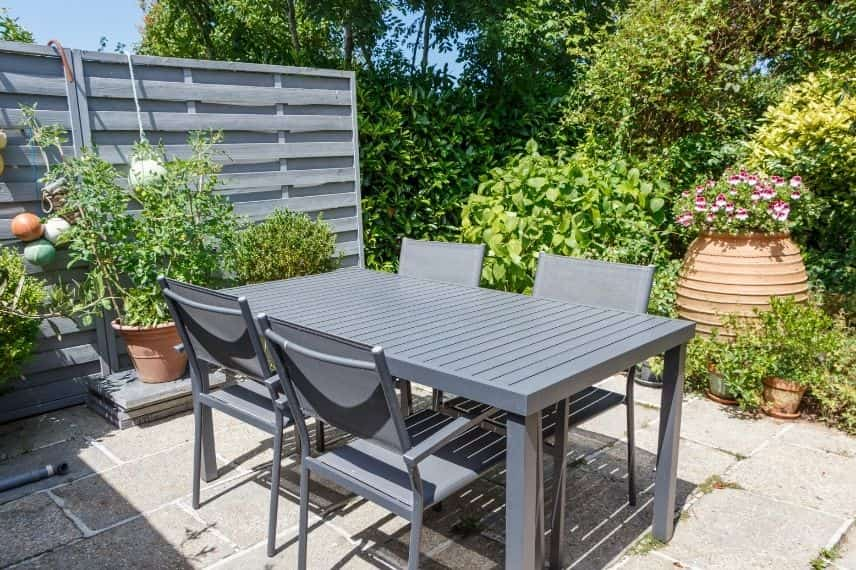
A terrace facing south-west or south-east is ideal for a vegetable garden
If your terrace is exposed to drafts or wind, don’t hesitate to install a windbreak. Reed screens are suitable as they promote ventilation while blocking the wind.
However, if your terrace is shaded or partially shaded, all is not lost. You may have to give up on sun-loving vegetables like tomatoes, aubergines, and peppers, but you can easily grow salads, cabbages, watercress, spinach, rocket, or even radishes. Similarly, some aromatic plants like parsley, tarragon, and mint… adapt easily to shade.
Some layout tips can also reflect sunlight: paint a wall a light colour, install mirrors, or use light-coloured mulch…
The most suitable containers for growing vegetables on a terrace
Inutile de rappeler que, sur une terrasse, votre potager sera cultivé hors-sol. Donc le choix des contenants est primordial.
Simple pots, planters and containers
The simplest solution lies in installing pots, planters or containers that you can choose in plastic, wood or terracotta. However, a few precautions are necessary:
- Don’t forget to place clay balls at the bottom of these containers to ensure substrate drainage and thus prevent root rot. If you wish, you can also cover the layer of clay balls with a geotextile felt to prevent soil from blocking the drainage hole.
- Check that the containers have drainage holes. If they don’t, drill them.
- Opt for containers that are deep enough (at least 30 cm) to allow vegetables and fruits to develop their roots properly. Moreover, the larger the pot, the less quickly the substrate dries out.
- Dare to recycle by repurposing or hunting for pots that you can paint in your colours.
- Remember to place a saucer under each container to prevent water leaks on the terrace. However, try not to let water stagnate in the saucers to avoid, among other things, the proliferation of mosquitoes.
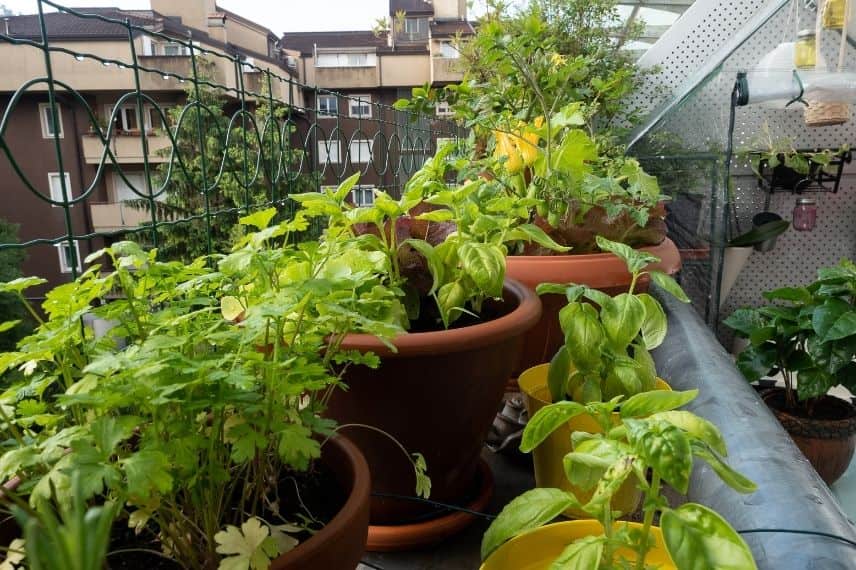 Vegetables can indeed be grown in pots
→ For further reading, discover Jean-Christophe’s article on the cultivation, maintenance and care of potted plants.
The wooden square vegetable garden
The square vegetable garden technique involves growing vegetables and small fruits in wooden squares of about 1.20 by 1.20 m, divided into 6 or 9 sections. Quite aesthetic, these square gardens allow for the cultivation of a large number of vegetables, provided you are rigorous about planning sowing or planting.
Widely available commercially, these square gardens are also very simple to make with untreated formwork boards or even pallets.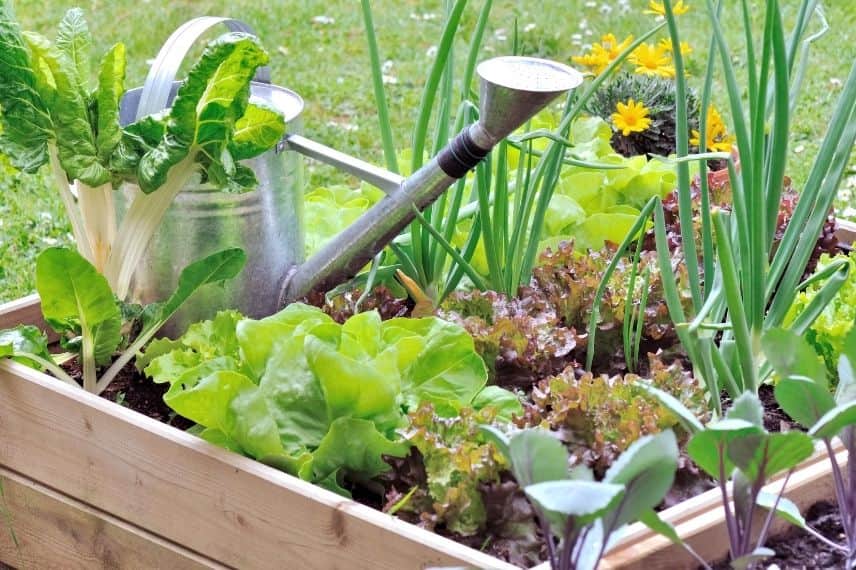
However, this solution can only be adopted on a terrace if you line the inner walls of the garden with a waterproof tarpaulin. This will prevent watering runoff on the terrace. And don’t forget the clay balls.
To understand everything, read Ingrid’s article on the square vegetable garden.
The raised vegetable garden
Similar to the square vegetable garden, the raised vegetable garden differs in that it has… legs! It is therefore an elevated garden that allows you to grow vegetables or fruits literally within reach. It is ideal for avoiding back pain.
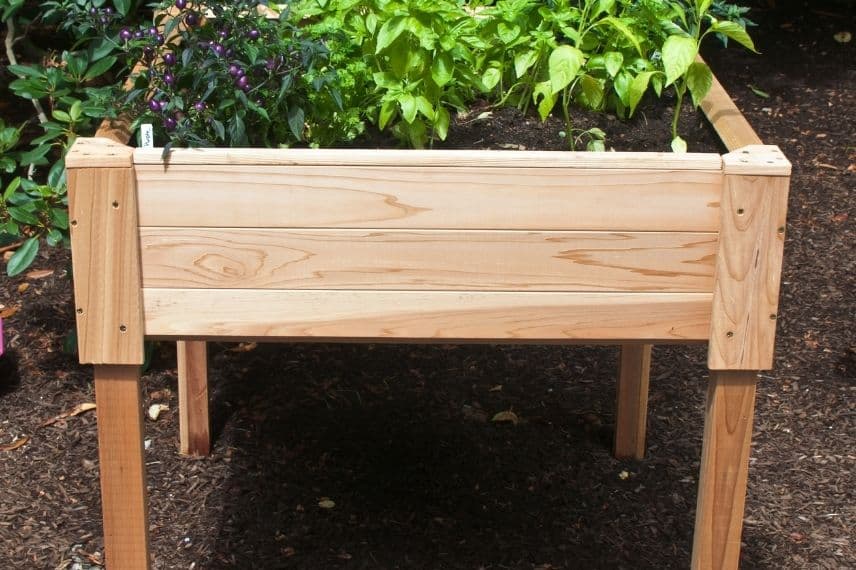 The raised vegetable garden is perfectly suited for the terrace
Generally, the standard height is around 80 to 100 cm. It is more often rectangular than square. It is easily found commercially, either in treated wood or plastic. However, you can just as easily make it with untreated boards or pallets. Just ensure you have sufficiently sturdy legs and a tarpaulin to ensure waterproofing.
Gardening bags or vegetable bags
These planting bags are perfectly suited for a terrace vegetable garden. Made from geotextile fabrics in various sizes, the growing bags ensure perfect ventilation of the root system while preventing roots from becoming root-bound. Lightweight and durable, they are also easy to install.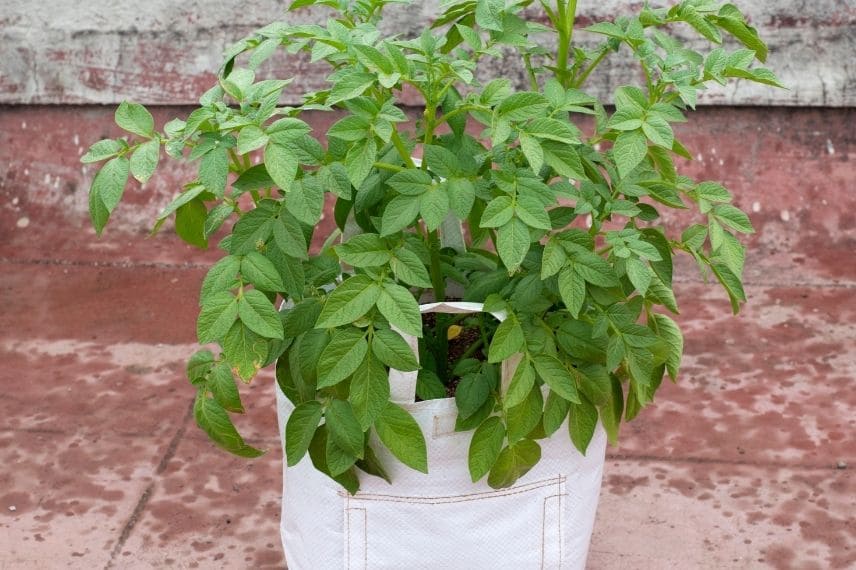
Often made from recycled materials, these planting bags are therefore eco-friendly while being very practical. Generally, watering needs are lower and the vegetable plant is better kept cool due to the composition of the container. Finally, these vegetable bags are biodegradable.
Today, it is even possible to find fabric square gardens that unfold and set up in less than 5 minutes.
→ Ingrid tells you more in her article Urban vegetable garden, the deal is in the bag!
The vertical vegetable garden
On a terrace, the available space can be limited. However, you can also gain space by growing vertically. Again, a bit of ingenuity is enough to create a 3D vegetable garden:
- Stacked pots on a nice shelving unit or a sturdy trellis
- Gardening bags in a hanging version
- Gutters inspired by planters to grow strawberries or salads
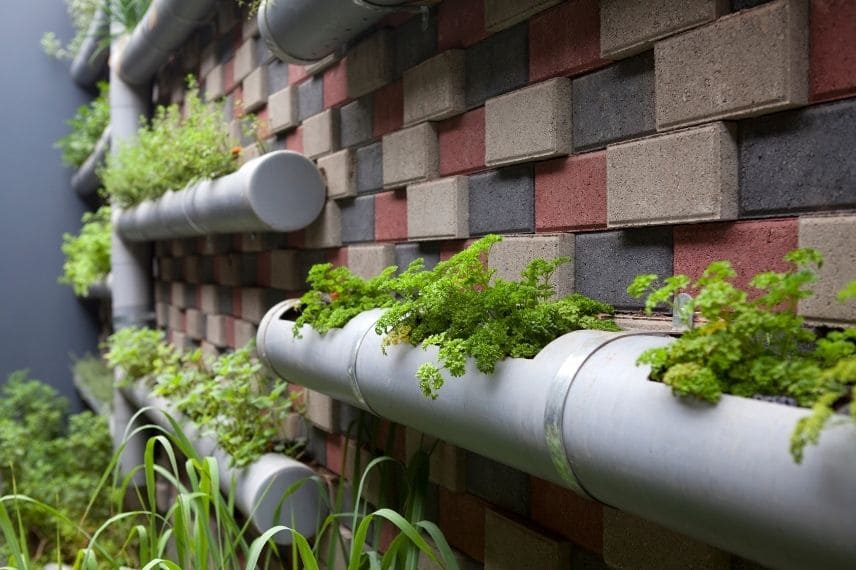
- Palettes lined with tarps and placed vertically
- Trellises to allow climbing vegetable plants like squashes
Discover other Patios
View all →
Available in 1 sizes

Available in 1 sizes
Available in 1 sizes
Available in 1 sizes
Available in 1 sizes

Available in 0 sizes
Available in 2 sizes

Available in 1 sizes

Available in 1 sizes
Available in 1 sizes
Essential Small Tools and Compost
Every good gardener needs good tools! Whether in a traditional vegetable garden or a raised bed on a terrace. Of course, if you’re growing your garden on a terrace, there’s no need to acquire a spade, rake, or hoe.
However, you will need to equip yourself with the essentials for an effective gardener, but in a mini version. The gardening kit should contain at least a small planting spade or dibber, a cultivator, a small pick, and a mini-rake to turn and aerate the soil. Opt for stainless steel to ensure they last long, and remember to clean them after each use. You can also add a pruning shear, which is always useful, and especially the essential watering can and a sprayer.
Finally, whatever containers you choose, they need to be filled with substrate. A mix of good potting soil and garden soil is ideal, but if you don’t have garden soil available, potting soil alone will suffice, provided you choose a very high-quality one. Indeed, this potting soil should be rich in nutrients and ensure good water retention. For example, choose a horticultural potting soil or, even better, a potting soil specially suited for raised beds.
Read also
Balcony vegetable gardenWhich vegetables to grow and harvest on a terrace?
At the outset, for a vegetable garden on a terrace, you will need to forgo certain vegetables that either take up a lot of space or require deep rooting. Therefore, forget about asparagus or even potatoes, which remain in the soil for a long time.
On the other hand, some vegetables adapt very well to cultivation in a limited space:
- Salads, particularly cut-and-come-again varieties like oak leaf, which can be harvested one to one and a half months after sowing.
- Radishes are easy and quick to grow. Foolproof, they just need to be watered regularly.
- Carrots, provided you choose early varieties or round-rooted types, such as Paris Market carrots. They require a deep container.
- Tomatoes are the queens of balcony or terrace gardens. Of course, cherry tomatoes are perfect, but all varieties can be easily grown in pots.
- Peppers and chillies are also perfectly suited for pot cultivation. However, they do require plenty of sunlight.
- Aubergines can also be easily grown on a terrace, with maximum sunlight and plenty of water.
- Cucumbers and courgettes, but you should choose varieties that can be easily trained and will grow vertically on a trellis.
- Climbing beans or Spanish beans can also be grown vertically.
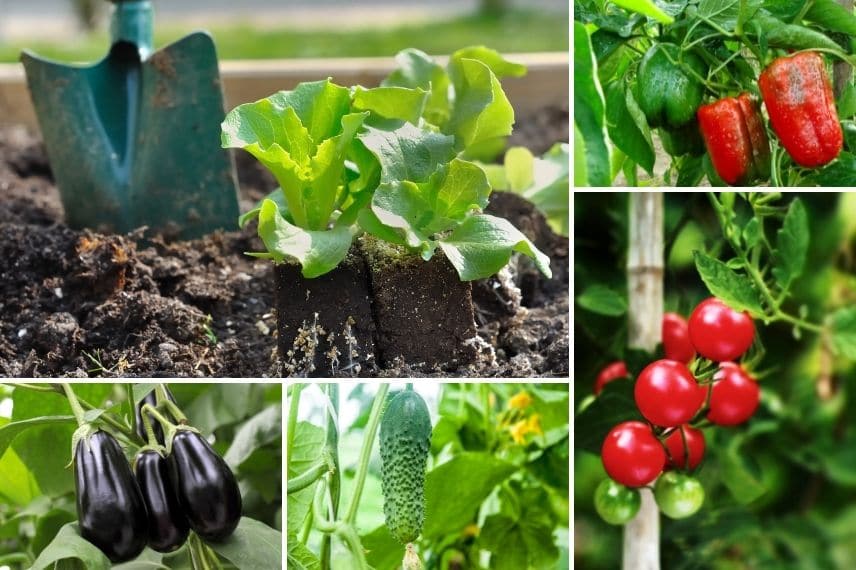
Of course, all these vegetables can be sown indoors or outdoors, but for terrace cultivation, it may be preferable to favour plug plants or pot plants. Easy to transplant, they will reach ripeness more quickly.
Discover with Ingrid the benefits of planting plug vegetable plants.
You can also try seed tapes, which are very practical for a terrace vegetable garden. Alexandra explains how to sow seeds on tape.
Indulge yourself with all the plants and herbs you desire. All can be grown in pots or containers. Moreover, they will be within reach to enhance your dishes.
Fruits on a terrace? It's possible too!
Do you fancy smoothies or delicious fruit-based desserts? Know that you can also grow fruit on a terrace. And, in this regard, almost anything is possible.
- Strawberries are the most suitable fruits for container growing as they thrive very well in pots or even in gutters or hanging baskets.
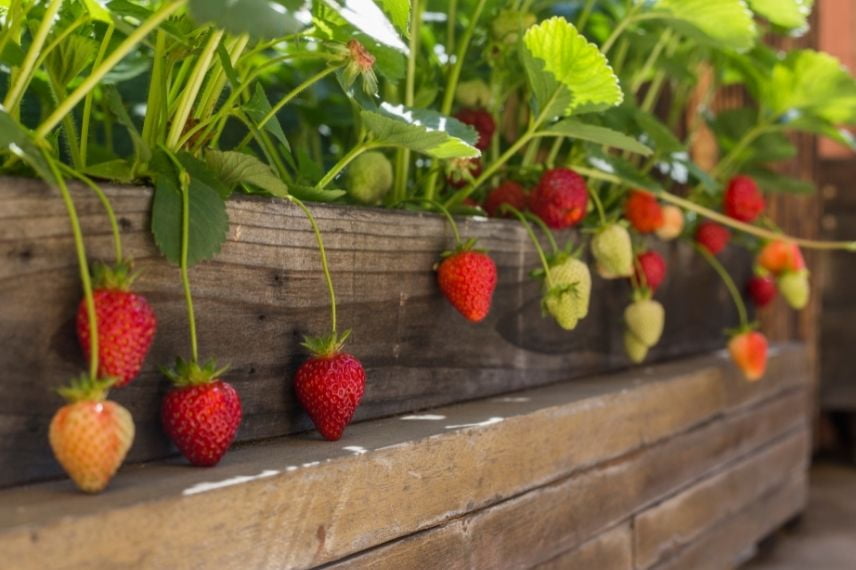
- Small fruits like raspberries, currants, blueberries… also grow quite easily on a terrace, as they benefit from good resilience.
- Citrus trees can be considered provided you have a well-lit room with a temperature between 8 and 12 °C to store them in winter.
- Apples, pears, peaches, cherries… but in mini versions. Indeed, dwarf fruit trees are perfect for enhancing a terrace with their spring flowering while providing juicy fruits. Discover how to plant and care for these dwarf fruit trees with Ingrid. As for Virginie, she presents a selection of 10 varieties of fruit trees perfect for a terrace.
- A vine is possible if you provide it with a sturdy trellis and plenty of sunlight.
What care do pot plants need on a terrace?
Cultivated in soilless conditions, vegetables have less soil than in a family garden. The medium dries out more quickly. This is why than in open ground. In the height of summer, you will need to water every day, preferably in the morning or evening. Mulching is therefore even more recommended, as it helps retain a certain level of moisture. To avoid constant trips to the sink, consider investing in a small water collector if you have access to a downspout.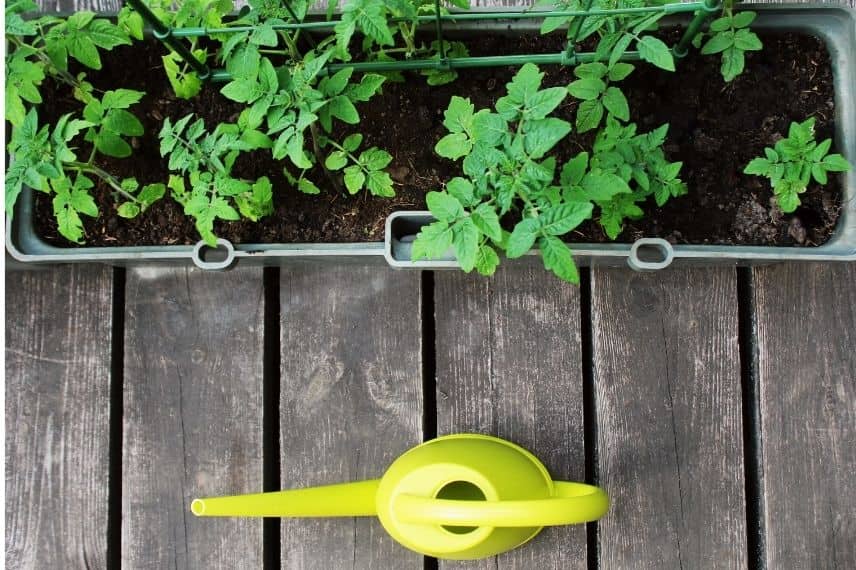
As for pests, they are often more numerous than in open ground. So don’t hesitate to plant repellent flowering plants or companion plants such as lavender, mint, nasturtiums, and marigolds… which will look stunning among the vegetables. Virginie presents 8 repellent plants. And Ingrid explains how companion plants work.
Finally, these vegetables will need to be fed and fertilised. While you can use commercial fertilisers, why not invest in a worm composter? You will obtain rich fertilisers while recycling your organic kitchen waste. For further reading, check out Patricia’s article: worm composting, the practical side.
- Subscribe!
- Contents
Comments