






























How to create a low-maintenance slope?
Our ideas and tips for greening an unattractive mound of soil.
Contents
Are you tired of contorting yourself to maintain the mound of earth that stretches in front of your house? Are you fed up with running a strimmer or a lawn mower over your slope for an unattractive finish? In short, You have a slope in your garden and you’re fed up with the maintenance constraints. Yet this mound can be a real asset to your garden, provided you make the most of it. Not always easy, you may think, given that this slope brings a number of drawbacks: poor soil, sometimes rocky, drainage that varies between the top and bottom of the mound, rainwater runoff and soil leaching, access difficulties that make maintenance hard, or even impossible…
Discover our tips, ideas and tricks to transform this sloped area into an attractive green space that requires only minimal maintenance. From soil preparation to plant selection, we reveal all the keys to successful slope landscaping.

How to prepare the soil on your slope?
Whether your sloped mound is lawned or left to its own devices, The first step of the job is to prepare the soil. This, too, is a crucial step in shaping your slope, because good soil preparation will determine how little maintenance is required.
Before you begin shaping your earth mound, the essential thing is perhaps to mark out its boundaries.
Thus you will probably need to install a small edging that not only holds back the soil but also helps define aesthetically pleasing curves. Depending on the slope, several options are possible, from dry-stone walls to gabions, via logs, boards or timber stakes, concrete in a range of colours, plastic or metal, to corten steel or aluminium for a more contemporary look.

Once these edgings are in place, the soil preparation work can begin. And this is certainly the longest and most tedious step, but one that must be carried out with care. You should start with meticulous, deep weeding to remove all adventive roots. Notably those of the toughest weeds, such as bindweed and couch grass. This weeding can be done by hand, with a digging fork, aiming to reach the rootstocks without breaking them too much. Another technique is to cover your slope with cardboard to smother the weeds. But this technique takes a little more time. Also remember to remove stones.
At this stage of the work, if you wish, you may integrate a few stones or rocks into your mound. They will help stabilise it.
Next, you need to enrich the soil of your slope. Indeed, the soil of a sloped mound, subject to erosion and runoff, is often poor in nutrients and dry. Especially if your slope faces south. That’s why it’s essential to loosen the soil with a digging fork to a depth of about ten centimetres, without altering the slope of your slope. Then you can incorporate well-rotted compost or well-decomposed manure, across the entire surface of the mound, at a rate of one bucket per m². The use of a garden fork is well suited for this step.
Ideally, this soil preparation for the slope should take place about a month before planting. So either in spring, in April, or in early autumn, between September and October.
→ For further reading
Which mulch should you choose for a low-maintenance slope?
If you’re an experienced gardener, there’s no need to remind you of the benefits of mulching. However, it may be helpful to note for beginner gardeners that mulching makes maintenance of a green space such as a flower bed or border easier, and also of a slope, which is harder to access. Indeed, mulching has the merit of limiting weed regrowth and proliferation, spacing out the watering while maintaining some humidity, insulating the soil from cold and heat, reducing runoff from rainwater, and preventing the formation of a crust… Needless to say, mulching is indispensable on a slope with poor soil that presents all the drawbacks mentioned.
Of course, you could opt for plastic sheeting as a mulch fabric. But acknowledge that it is neither aesthetically pleasing, nor environmentally friendly, nor biodegradable… Moreover, it literally smothers any life in the soil. Other alternatives prove just as effective, eco-friendly, and not necessarily more expensive.
If your slope is very steep, the most interesting solution is biodegradable mulch fabric in natural fibres. These mulch fabrics have the advantages of being 100% plant-based, thick and strong, and above all, of decomposing in a few months, the time it takes for the plants to establish themselves. This decomposition stimulates the development of microorganisms and insects, beneficial to soil health. These fabrics do not impede air circulation or the penetration of rainwater, do not compact the soil, and suppress weed growth. These mulch fabrics made from flax, from hemp, from wool, from hemp-linen or from jute are also very attractive. They are laid before planting the plants, using clips or nails specially designed.
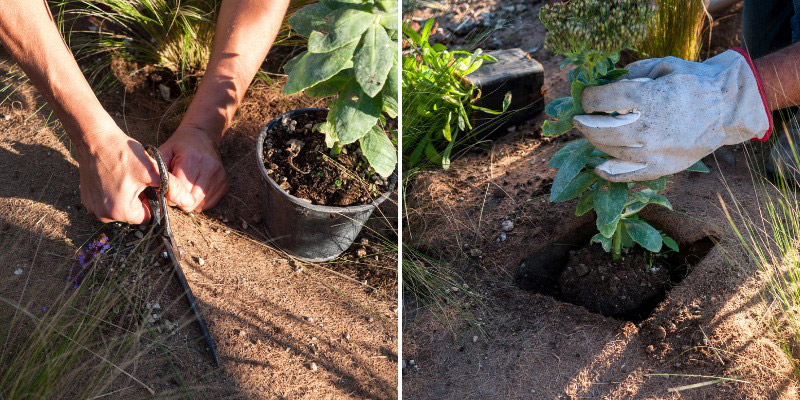
Biodegradable mulch fabric is ideal for slopes
For less steep slopes, a simple mulch will suffice. Just choose fine mulches such as flax flakes, hemp or miscanthus which have the advantage of binding together when wet. Or indeed those mulches based on bark and wood chips. Natural mulches are laid after planting.
Our tips for planting
Before offering you a selection of plants particularly suited to a vegetated slope, here are a few practical tips:
- For an aesthetically pleasing and harmonious slope, it is advisable to plant in groups several individuals of the same species that, as they grow, will form coloured patches or spreading swathes of vegetation. Prefer an odd number of plants of the same species or variety, and plant them in a random pattern, not in a straight line.
- When planting your plants, consider their mature spread. Do not hesitate to plant a little closer to fill the area more quickly. Some fast-growing plants will fill in after a year; others will need a little more time. But, in general, within three years the slope will be filled.
- Before planting them in the ground, arrange them all on your slope and step back a little. You will then be able to judge the final effect you are aiming for.
- Organise your plantings according to the slope of the bank. Thus, at the top, you can plant grasses or low-growing, compact bushes. At the bottom of the slope, where the soil is moister and more fertile, install groundcover plants that form pretty flowering cushions. In the middle of the slope, carpet-forming plants benefit from root systems that stabilise the slope and hold the soil.
- Prefer evergreen plants to dress your slope year-round.
Read also
How to plant on a slope?Our plant ideas for an attractive, low-maintenance slope.
We have reached the essential stage in laying out your slope: selecting the plants. And the choice is particularly wide. Bear in mind that these plants will need to be creeping and ground-covering to cover the mound, robust and vigorous, suited to poor and unforgiving soils, drought-tolerant, and above all easy to live with and low-maintenance.
Here are some suggestions of plants, perennials, grasses or creeping groundcovers for a slope that requires no special maintenance. The selection will depend on exposure.
For a slope in full sun
Among the perennials, you can plant: Alchemilla, the Aubrieta, the Stachys, the Helianthemum, the Lavender, the Thyme, the Creeping rosemary, the Nepeta, the Oregano, the Mountain sandwort, the Phlox, the Mouse-ear (Cerastium), the Spanish thrift (Armeria), the Houseleek (Sempervivum), the Saxifraga, the Iberis sempervirens (Iberis sempervirens), the Sedums, the Dianthus, the Anthemis, the Artemisia…

Perennials for maintenance-free slopes: Aubrieta, Spanish thrift, Nepeta, Iberis sempervirens and Saxifraga
Among the grasses, you can highlight Stipa tenuifolia, the blue fescue, and the various Carex varieties.
Some shrubs can also be planted on a slope: the ground-cover cotoneaster, the creeping cotoneaster, the creeping St John’s wort (Hypericum calycinum), santoline, the rockrose…
For a mound in partial shade
Among perennials, include the Fragrant violet, the Sweet Woodruff, the Bergenia, the Moneywort (Lysimachia nummularia) (Lysimachia nummularia), the small periwinkle (Vinca minor), the Liriope muscari, the creeping bugle, the Pulmonaria, the Erigeron…
Among shrubs, one can select Potentilla, the evergreen euonymus (Euonymus fortunei), the bushy honeysuckle (Lonicera nitida), the prostrate Ceanothus (Ceanothus prostratus), the summer heathers (Calluna) and winter heathers (Erica), the shrubby Veronica (Hebe), and ‘Halimiocistus…
For a fully shaded slope
The hellebores, the Helxine, the Sagina subulata, the Siberian bugloss, the Heuchera… they will also have their place on a shaded slope.
Some plants adapt to all exposures. Among them, you can cite the Ophiopogon, the hardy geranium (and in particular the Geranium macrorrhizum), the Epimedium, the Campanula, the Symphoricarpos…

The hardy geranium Macrorrhizum, Ophiopogon, Epimedium and Campanula adapt to all exposures on a slope
We can also use creeping plants (often regarded as climbers) to cover a slope, such as ivy (and particularly Bellecour ivy), Virginia creeper, Muehlenbeckia complexa…
And don’t forget to plant spring-flowering bulbs all over your slope. Year after year they will naturalise and return more beautiful and floriferous. Or rock garden conifers such as creeping juniper, creeping cypress, mountain pine…
For more information:
- Subscribe!
- Contents
Comments