





























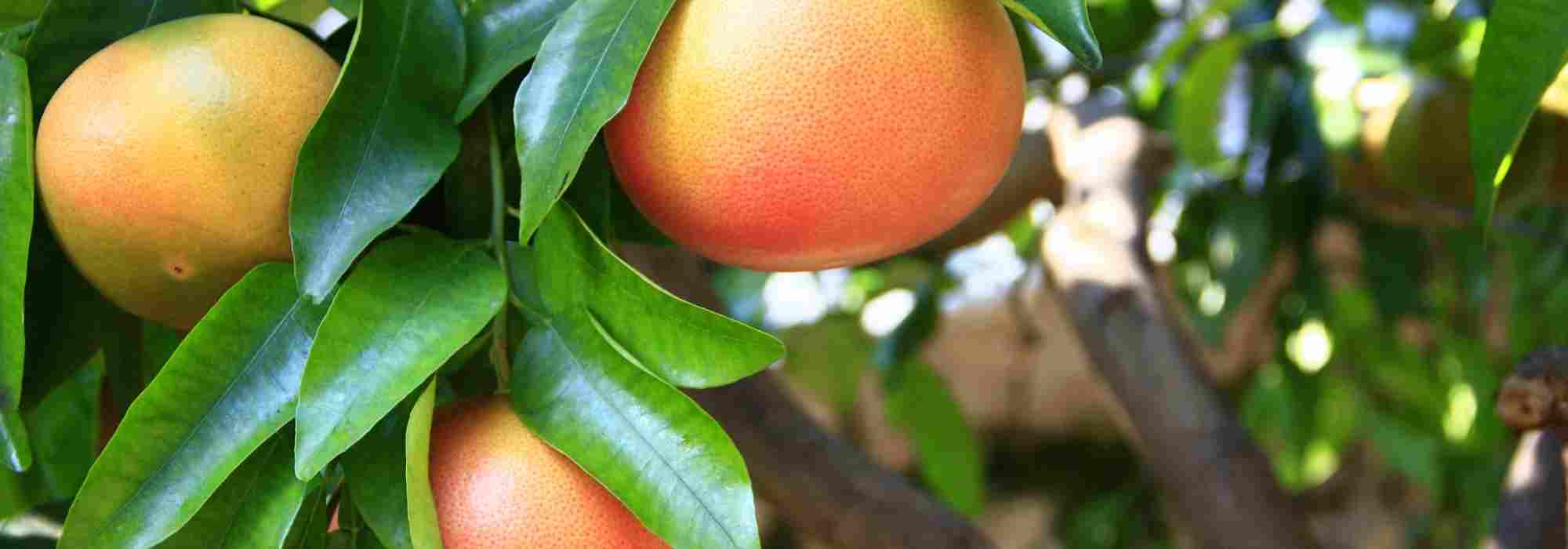
Grapefruit tree: what are the common diseases and parasitic pests?
Identify them, treat them naturally, and prevent their appearance.
Contents
Whether it’s the common grapefruit (Citrus maxima) or the Pomelo (Citrus x paradisi), this citrus fruit is prized for its juicy flesh, with varying degrees of acidity.
Discover the main parasitic pests and diseases that affect the grapefruit tree, and above all the treatment options and preventive measures.

Most common grapefruit tree diseases
Different diseases can affect the growth and yield of the grapefruit tree, and can even cause its death. Often, poor cultivation conditions favour these diseases.
Gummosis
This disease that manifests as gum exudations is caused by the fungus Phytophthora which develops in injuries and pruning wounds that are not well treated. Humidity or excess water promote infections.
Symptoms
- Gum exudation on the bark: brown to black exudates on trunks or branches, sometimes accompanied by cankers. The gum darkens as it dries. Necrotic patches are also observed.
- Chronic decline of the grapefruit tree.
What to do?
Act quickly by removing the affected branches. The smallest ones should be neatly pruned with a disinfected pruning shear. On larger branches, you may sometimes need to curette the wound before applying Bordeaux mixture and a wound-healing putty.
As a preventive measure, it is essential to prune the grapefruit tree with disinfected tools, and to seal the cuts with a wound-healing putty. The application of limewater is also recommended.
Anthracnose
The anthracnose is a fungal disease, caused by the fungus Colletotrichum gloeosporioides. This disease often develops in spring and summer when humidity is high. The spores are dispersed by rain.
Symptoms
- Appearance of brown-pink spots on young shoots
- Development of cankers on the twigs
- Shoots deform, fruits blemish or crack, may even split and drop.
What to do?
Remove damaged foliage, prune lightly to aerate the crown and water well at the base. As a preventive measure, treat with Bordeaux mixture or a horsetail decoction.
Sooty mould
La sooty mould is not a disease proper, but a secondary symptom linked to honeydew produced mainly by aphids or scale insects.
Symptoms
A black, soot-like secretion covers the leaves, fruits and new shoots.
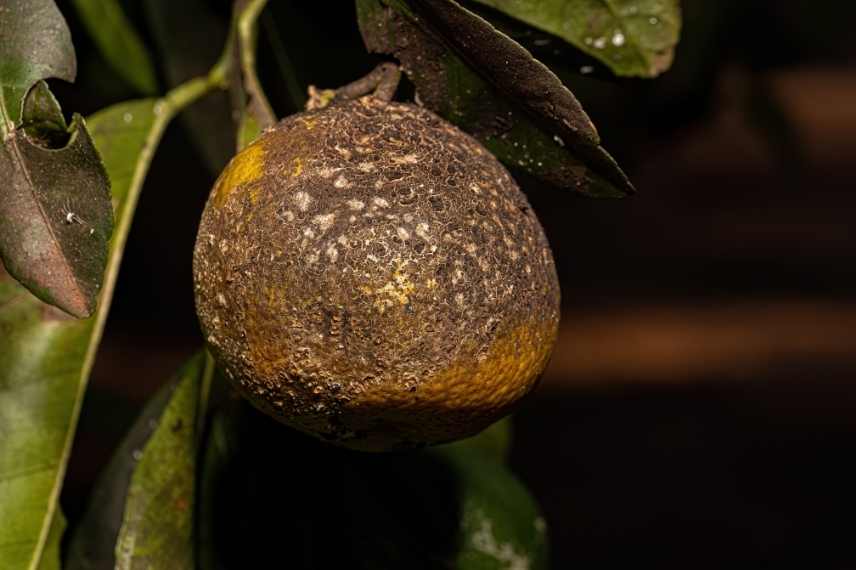
Severe sooty mould attack on a citrus tree
What to do?
You must control the vector insects of sooty mould (aphids, scale insects…), by cleaning the grapefruit tree with soapy water to restore photosynthesis.
Chlorosis
It is not a disease, but a deficiency, common in grapefruit trees. This chlorosis is often linked to an excess of lime or to an iron deficiency (iron chlorosis). It is sometimes induced by poorly structured soil or a high pH (>7.5).
Symptoms
- Yellowing between the leaf veins
- Leaf drop
- Weak, slender shoots
What to do?
Apply a foliar or root treatment with iron chelate. Adding compost helps improve the substrate or soil. Watering should be properly adjusted.
Citrus canker
Citrus canker is a devastating disease caused by the bacterium Xanthomonas citri subsp. citri. It attacks leaves, twigs, and especially fruits, severely compromising their commercial appearance. Spread occurs by rain, wind, tools and contaminated equipment. Storms and hail particularly promote infections by creating micro-wounds.
Symptoms
- Appearance of light brown lesions with a necrotic center, surrounded by a yellow halo
- Perforation and premature leaf drop
- Development of cankers on the fruits causing corky scars and deformities.
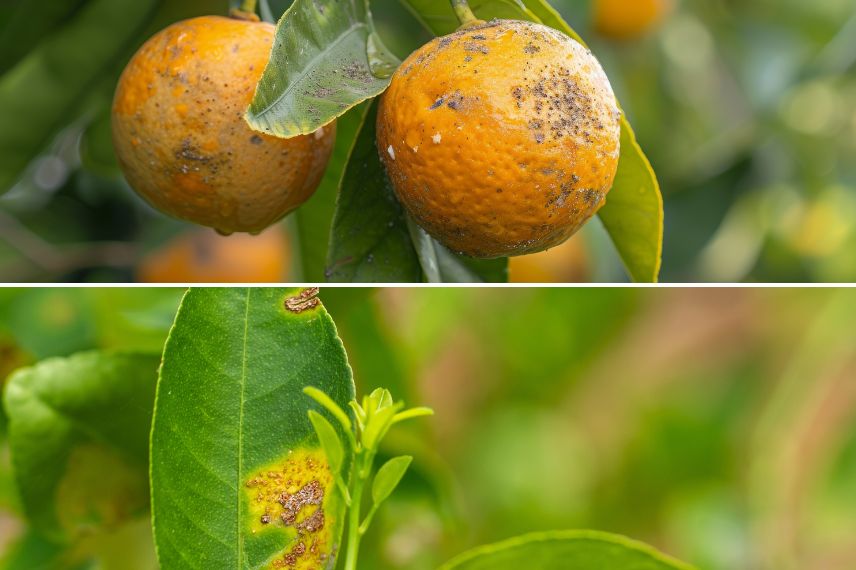
Symptoms of citrus canker on an orange tree
What to do?
Unfortunately, there is no curative treatment. Control relies on strict prevention: disinfection of tools, removal of infected organs, and limiting pruning during damp periods. Preventive applications of Bordeaux mixture during active growth are effective.
Mal secco (the disease)
It is a serious disease affecting citrus trees, particularly the lemon tree, and to a lesser extent the grapefruit tree. It is caused by the fungus Plenodomus tracheiphilus (formerly Phoma tracheiphila) which spreads via injuries and blocks the movement of sap in the wood vessels. It affects leaves and twigs, then the whole tree.
Symptoms
- Leaf chlorosis
- Leaf drop
- Red-orange discoloration of the wood
- Twigs wilting
- Progressive death of the tree
What to do?
There is no curative treatment. Control relies on removing diseased parts, or even uprooting the tree in the most severe cases. As a preventive measure, disinfect pruning tools, apply a wound-healing putty to wounds and limit injuries.
Tristeza
Also called “Tristeza virus” or “CTV”, this virus disease is one of the most serious on citrus. It is spread by the brown citrus aphid (Toxoptera citricida). A single feeding is often enough to inoculate this virus.
Symptoms
- Rapid or progressive decline of the grapefruit tree
- Sparse crown
- Leaf chlorosis, veining accentuated, and formation of root suckers
- Wrinkled bark phenomena are common.
What to do?
There is no curative treatment. It is essential to control aphids and prevent them from establishing themselves.
Read also
How to prune a grapefruit tree?The most common parasitic pests on grapefruit trees
Among piercing and sucking insects, mealybugs or armored scales and aphids are common on grapefruit trees. They cause sticky honeydew residues and leaf distortions, or even a weakening of the tree in case of a heavy infestation. They are mainly vectors of sooty mould, and tristeza for brown aphids. The most effective control is spraying a soap-based mixture or releasing beneficial insects, such as ladybird larvae, hoverflies or lacewings. For more information: Aphids: identification and treatment and Mealybugs: identification and treatment.
Red spider mites are also common on grapefruit trees. They cause discoloration on the undersides of leaves. The best treatment is to spray water onto the foliage, as they dislike humidity. For more information: Red spider mites: identification and treatment.
Two other pests are formidable:
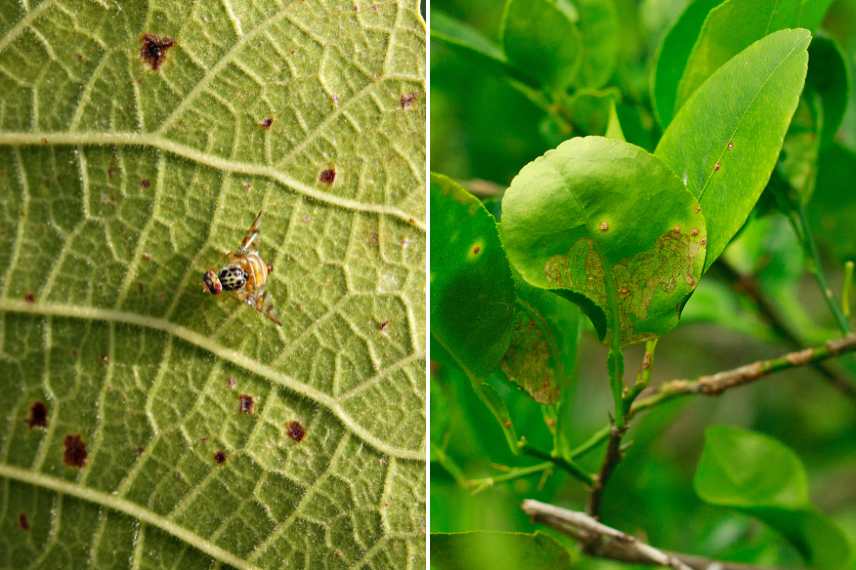
Mediterranean fruit fly and damage from the citrus leaf miner
The importance of optimal growing conditions
A few simple rules help prevent the development of diseases and pest invasion:
- A sunny exposure well sheltered from cold winds, with excellent light
- Soil or substrate drainage to avoid heavy or waterlogged soils
- A very regular but moderate watering, especially in spring and summer, with soft water. In autumn and winter, watering is reduced but continues.
- An organic mulch to keep the soil cool
- Regular fertilisation with mature compost for grapefruit trees planted in the ground, and a citrus fertiliser for grapefruit trees in pots
- Pruning, with tools perfectly disinfected, in dry periods to remove diseased shoots, followed by a preventive spray of Bordeaux mixture
- Active monitoring of the foliage to detect the slightest signs
- Subscribe!
- Contents
Comments