





























Garlic diseases and pests: identification and solutions
Recognising symptoms, treating naturally and preventing
Contents
Garlic (Allium sativum) is a perennial bulbous plant in the Alliaceae family, relatively easy to grow in the vegetable garden.
In cooking, we love its pungent flavour, indispensable for elevating a leg of lamb, a simple salad or a purée. Not to mention its medicinal properties: garlic is reputed to be useful against circulatory disorders or as a vermifuge. So, no reason to go without garlic, which comes in three colours: white garlic and purple garlic are planted in autumn, pink garlic in spring. It thrives in all soils, provided they are light, well-drained, and free from organic fertiliser such as compost or manure.
If these growing conditions are met, garlic yields good bulb harvests. By contrast, this perennial bulbous plant in the Liliaceae family can sometimes develop diseases or be infested with parasitic pests.
Discover how to identify garlic pests and diseases, how to treat them naturally and, above all, prevent their occurrence

Common Garlic Diseases
Overall, garlic is not often affected by diseases, and growing it proves relatively easy. However, if your vegetable patch is prone to a few diseases, if climatic conditions are not favourable, if soil preparation has been poorly carried out, some diseases can develop. Some are fairly harmless and do not affect production. Others can be more difficult to treat.
Here is an overview of the different affections that can affect garlic cultivation.
Downy mildew
The different species of fungi responsible for downy mildew are host-specific. In garlic, and more generally Alliums, they are Phytophthora porri and Peronospora destructor. These fungi overwinter as mycelium on living parts of the plants. They then develop in damp weather, with ambient temperatures between 15 and 22 °C. In dry years, downy mildew causes no damage.
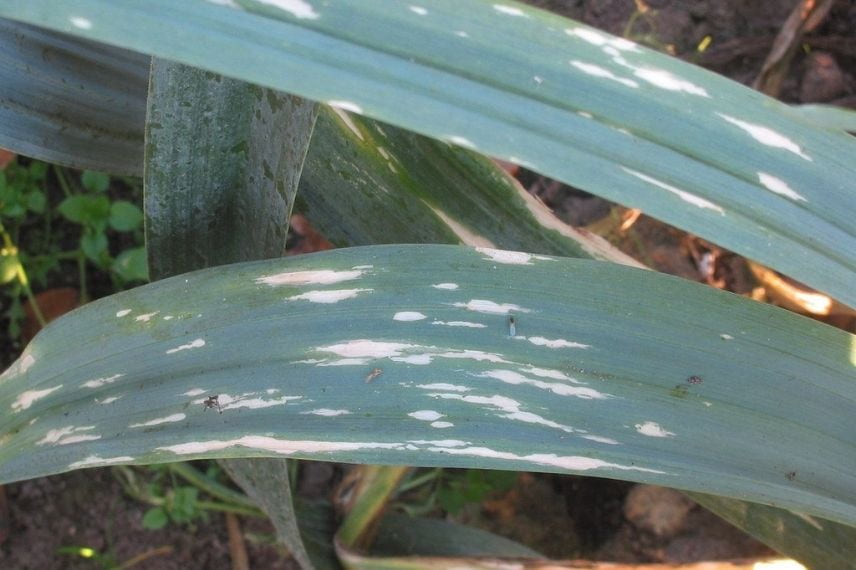
In garlic as in leek (our illustration) downy mildew is caused by the fungus Phytophthora porri
Concretely, white to yellowish, rather elongated spots appear on the upper surface of the leaves, and on the reverse there is a felt-like white to gray-violet. Later, the ends of the leaves die, and the growth of the foliage slows markedly.
Rust
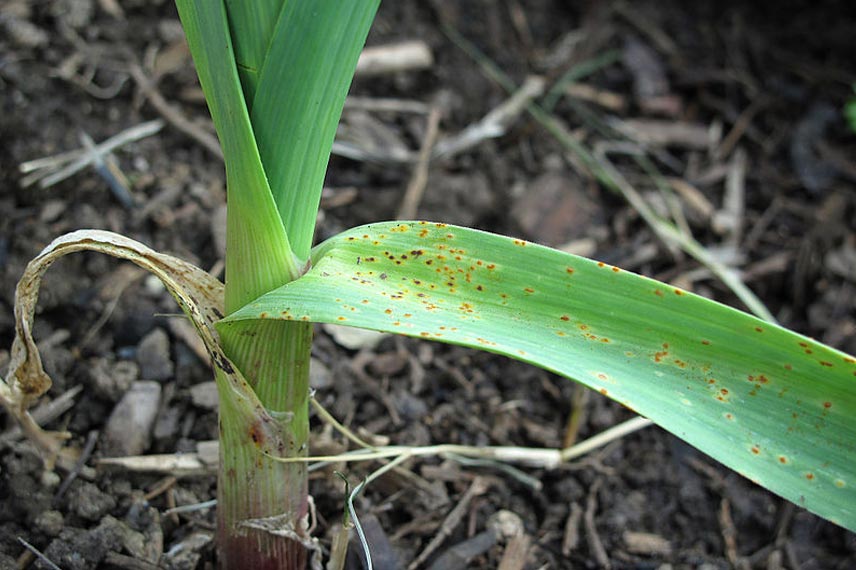
Rust symptoms on leek foliage
Rust, caused by the fungus Puccinia allii, also develops in humid years, at ambient temperatures of at least 18 °C. Depending on the region, it may appear from early summer, in June, through to August–September. The fungus overwinters on infected plants, which do not die. Indeed, with autumn and cooler temperatures, the disease stops developing. And new healthy leaves appear.
Rust appears as spots, round or elongated, strongly orange-coloured. The leaves crack on the surface and the foliage takes a light green colour. It eventually dries out and dies. The development of bulbils may be affected.
The grey, green and white rots
Several rots can affect garlic, both on the foliage and on the garlic heads during storage.
Green rot : at the surface of the bulbils, brownish patches are slightly visible on the skins of the bulbs, on which a greenish-blue down develops. As for the bulbils, they are also affected since irregular spots develop before they completely degrade. Green rot is due to a fungus of the genus Penicillium, often on bruised or damaged bulbs, in warm and humid conditions.
White rot : this disease is caused by the fungus Sclerotium cepivorum. Specifically, the plants wither very quickly from the base, the roots rot. The white mycelium is clearly visible around the root plate, it climbs up the bulb and invades the interior. The bulb rots completely. This disease develops mainly in spring in cool conditions. It is often the bought bulbs that are contaminated.
Neck rot : It is due to the fungus Botrytis porri or Botrytis allii and only manifests during storage. The fungus penetrates garlic in late summer, in damp weather, starting from the foliage, aided by mechanical injuries. Then, the upper part of the bulb softens and colours internally. Later, a grey mycelial felt with black spots develops.
Bacteriosis (coffee-colour disease)
This bacteriosis is a fairly common ailment in garlic, caused by the bacterium Pseudimonas salomonii which develops in spring, on damp soils that do not dry. The first symptom is an oval lesion on the foliar sheath that extends into a yellow-brown stripe up the leaf. Rapidly, the plant may rot completely, slump and emit a strong, quite characteristic odour.
Fusarium wilt
Fusarium wilt is a cryptogamic disease caused by the fungus Fusarium oxysporum. The plants decline from the lower leaves, a pale brown to red rot begins on the root plate and progresses upward through the bulbil. The latter eventually rots completely. The spores of the fungus overwinter in the soil or in crop debris. They thrive in warm, moist soil.
Read also
Garlic: the best varietiesOur solutions for healthy garlic
Most of these diseases appear under fairly humid climatic conditions. Unfortunately, it is difficult to influence those factors. Nevertheless, poor cultivation or storage conditions can also explain the development of these fungal or bacterial diseases. With a few simple general tips, these conditions can be made considerably more favourable and the risk of diseases thereby reduced. Some of these precautions are essential, others more routine but nonetheless important.
- Crop rotation is essential for garlic, but also for the other Alliums such as onion, the shallot, the spring onion and the leek. Specifically, in moderately healthy soil, you must absolutely avoid planting garlic in a spot that has previously hosted it. You can even go further by waiting 4 or 5 years before growing garlic again on a plot.
- Avoid nitrogen-rich fertilisers (manure and compost) in soils intended for garlic crops. Indeed, these fertilisers tend to promote the development of various rots.
- Be vigilant about crop debris that should not be left in place from one season to the next. Indeed, it is not uncommon for some fungi to overwinter in these crop residues. Likewise, at the slightest suspicion of disease or the slightest sign of rot, diseased plants must be pulled up and destroyed outside the vegetable plot.
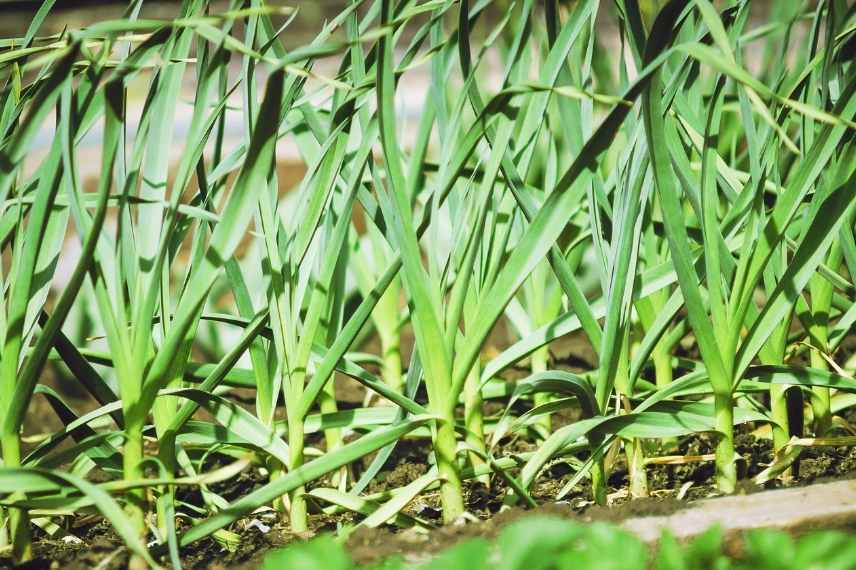
Good cultural practices are essential to prevent the onset of diseases in garlic
- Garlic loves light, well-drained soils. The slightest excess of moisture, especially in winter, can be fatal and lead to root rot. Therefore, it is essential to plant garlic in soil that drains freely or on a raised bed. Moreover, in heavy soils, watering should be kept to the bare minimum.
- If your garlic has been planted in soil that holds little water, you will still need to water a little. In such cases, it is preferable to do so in the morning, avoid wetting the foliage and stop any irrigation three weeks before harvest.
- To reduce fungal attacks, bulbils should not be planted too closely. The rows should be well spaced.
- During handling of the bulbils, at planting or harvest, avoid any injury or bruising.
- Choosing healthy seed stock is essential!
- We can proactively treat soils and plants with horsetail decoction.
Finally, precautions can also be taken during harvest and storage. Harvesting takes place on a dry day and the bulbils should be allowed to dry for two to three days on the soil in the vegetable plot. Then, they should be dried for about a month in a well-ventilated place, away from moisture. During this drying period, garlic will lose about 20 to 30% of its weight. The heads are then stored in a dry and airy room, with a temperature between 15 and 18 °C, such as a garage, a pantry, a kitchen… You can also keep the dried foliage to make braids to hang in a well-ventilated attic.
Which pests attack garlic?
When it isn’t diseases that attack garlic plots, pests can also appear, and they can be just as damaging to the crops and to the harvest. These pests that attack garlic are also commonly found on onions or leeks.
Onion fly
This fly (Delia antiqua), pale grey-yellow in colour, resembles a common housefly. The mating flight of the first generation takes place from mid-April to the end of May; the female lays eggs in the young shoots or on the soil. The white larvae penetrate the plants and the bulbs, and move about. The larvae pupate in the soil. It is mainly the first generation that is to be feared.
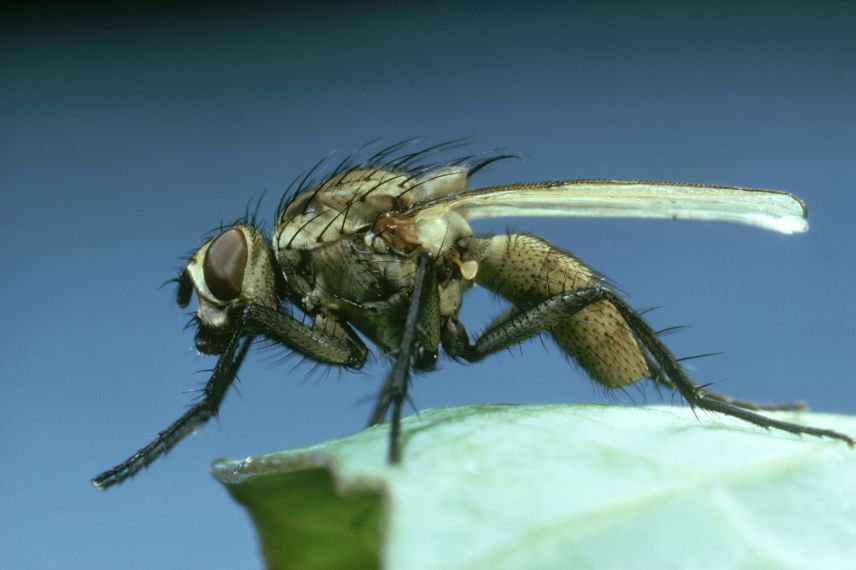
Onion fly
If infestation occurs, the foliage turns pale grey-yellow, withers and dies; plants can be pulled out very easily.
To prevent onion fly, one should:
- Rotate crops on a four-year cycle.
- Do not use fresh manure.
- Sow or plant late.
- Intercrop garlic with carrots.
- Water garlic with a tansy infusion.
- Cover plots with a fine-mesh insect net.
Leek moth
This time, it is a moth, Acrolepiopsis assectella, with brown wings speckled with white. The first flight occurs in April–May; the female lays eggs in the evening on the foliage. The caterpillars that hatch are brownish-yellow, dotted with black spots and pale bands. They bore furrows inside the leaves and infest the heart of the plant. The leaves yellow at their tips, wither and rot.
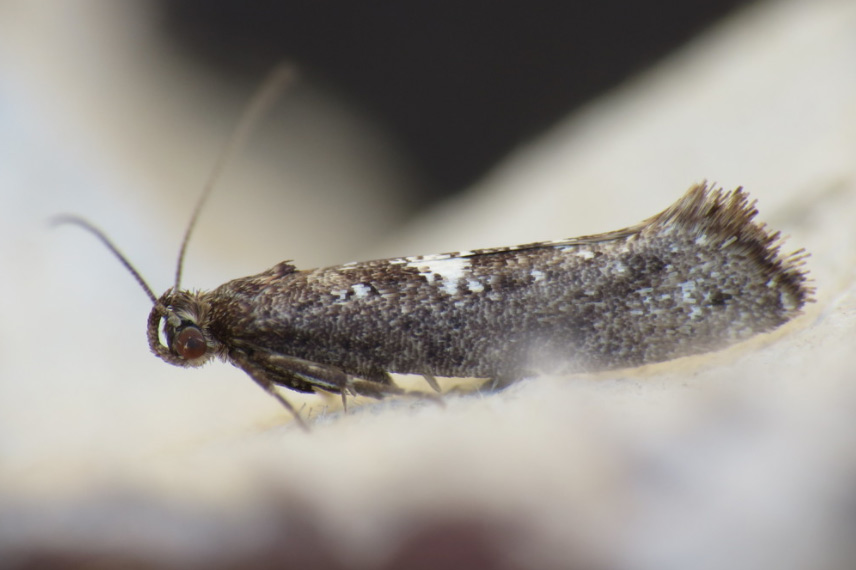
Acrolepiopsis assectella or leek moth © Donald Hobern
The most effective control measures:
- Plant garlic near carrots or celery.
- Water with horsetail manure.
- Cover garlic with an insect net.
- Use pheromone traps dedicated to leek moth.
Thrips
Thrips are piercing-sucking insects about 2 mm long, yellow-brown or black, which develop mainly in hot, dry weather. There can be up to three generations in a summer. Adults overwinter on plant residues. As for the larvae, they are pale in colour, and live on the foliage, like the adults. During a thrips attack, the foliage becomes speckled with small white to silvery spots, often striped.
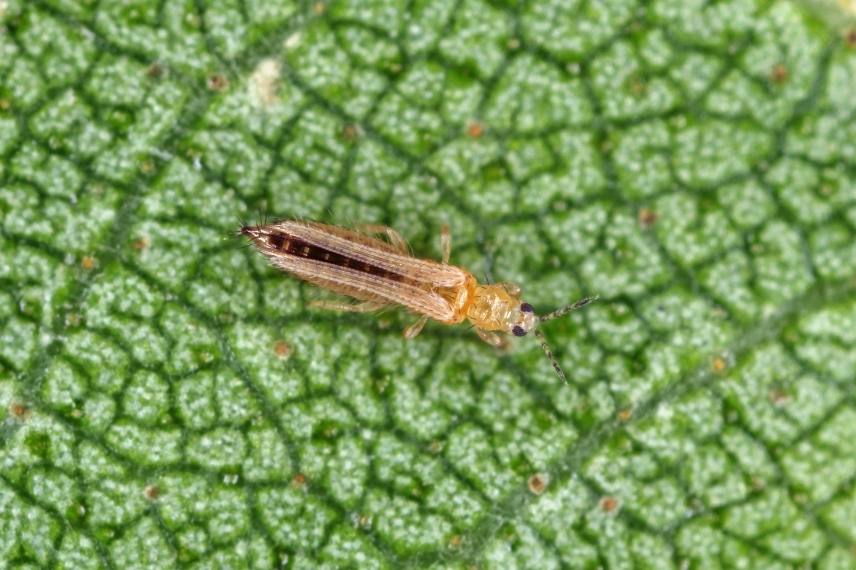
Thrips are a real pest for the foliage.
To prevent and control:
- Spray the garlic leaves with a jet of cold water on the upper and lower surfaces to remove adults and larvae.
- Cut away infested stems.
- Place blue sticky chromatic plates to detect their presence.
- Dispose of plant debris.
- Spray with fern manure or elder manure.
Mites
Invisible to the naked eye, the mites (Aceria tulipae) particularly favour garlic. When an infestation is confirmed, oily then yellow waxy spots appear on the foliage along the folds. Mites are dispersed by leaf contact, by insects, wind and seeds. There is no means of control. It is essential to choose healthy seed.
- Subscribe!
- Contents
Comments