





























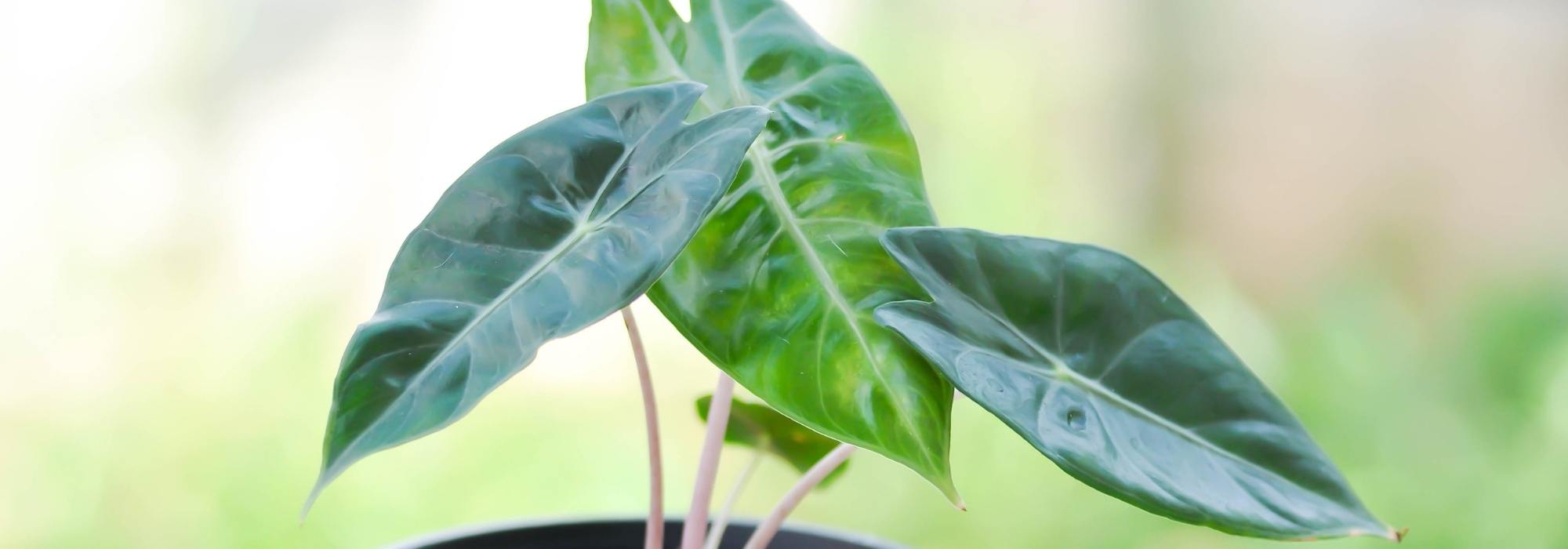
Diseases and pests of Alocasia and Colocasia
Identification, natural treatments and prevention
Contents
Between Alocasia and Colocasia, confusion often reigns. Indeed, these two rhizomatous plants of tropical and subtropical origin, in the Araceae family, share their enormous hydrophobic leaves, with varied hues, and their often outsized size. Due to their frost sensitivity, they are also two plants that are grown in the ground in mild-climate regions, or as indoor plants elsewhere. Despite their similarity, these two plants are essentially distinguished by the petiole: it is attached to the leaf at the edge of the lamina in Alocasia and underneath for Colocasia. More precisely, the foliage of Alocasia tends to stand upright, whereas Colocasia foliage tends to droop.
Nevertheless, these two plants thrive under similar growing conditions, indoors as outdoors. They are also susceptible to the same pests and diseases.
Discover the various pests and diseases that affect Alocasia and Colocasia, and, above all, how to treat them naturally and prevent their occurrence.
Further reading:Colocasia: planting, growing and care.
A quick reminder of growing conditions for Alocasias and Colocasias
Because The main pests or cultivation mishaps affecting plants occur when growing conditions aren’t optimal, perhaps it’s worth a quick reminder for Alocasia and Colocasia, two tropical plants with exceptional foliage in terms of size, colour and shape… Lush, these two Araceae family plants have similar care needs.
Watering
Alocasias or Colocasias, otherwise known as elephant ears, prefer humid and warm environments. That is why, whether grown in the ground or in pots, watering should be regular in spring and summer, more spaced in autumn and winter. The substrate must be kept consistently moist. It is preferable to use rainwater or demineralised water at room temperature. However, residual water in the saucer or cache-pot must be avoided. It is perfectly possible to place the pot on a bed of constantly damp clay pellets.
Throughout the year, misting the foliage with rainwater is recommended, as is dusting the foliage with a damp cloth. These plants require a relatively high humidity level, around 70%, not always easy to achieve.
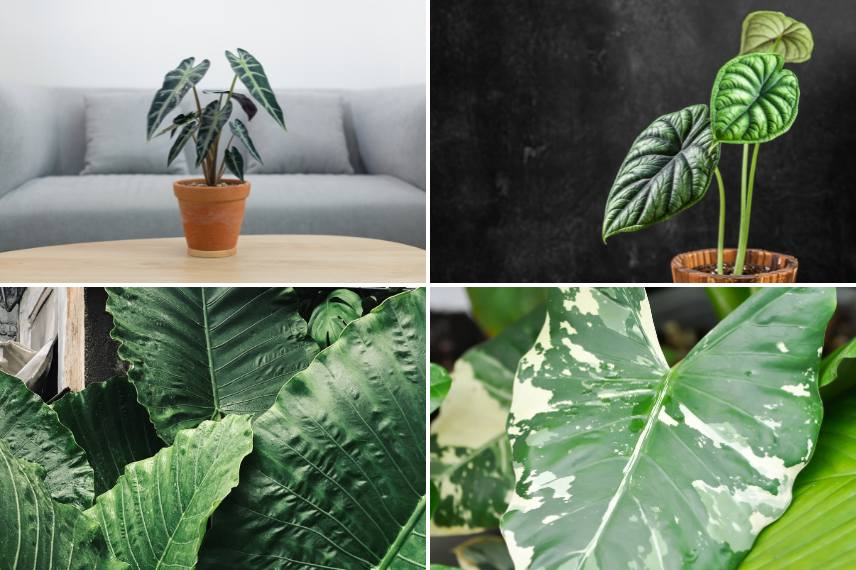
The diversity of Alocasia foliage
Fertilisation
Alocasia and Colocasia are fairly heavy feeders that will benefit from regular fertilisation, especially if grown in pots. Therefore, provide them with a green plant fertiliser, rich in nitrogen, every three weeks.
Exposure
Outside, elephant ears thrive in partial shade, illuminated by the soft morning sun. Inside, give them plenty of light but not direct sun. So place them in a bright room, away from the sun’s scorching rays, at an ideal temperature between 16 and 25 °C. In winter, these plants will appreciate moving to a conservatory or greenhouse with a maximum temperature of 16 °C, allowing them to enter a semi-dormancy.
Your Colocasia and Alocasia, grown in pots indoors, can easily spend the summer outdoors in the garden, provided they are placed in partial shade.
If all these cultivation conditions are met, Alocasia and Colocasia show good resistance to pest attacks. These two plants are also relatively resistant to diseases.
Read also
Misting indoor plantsWhat are the main pests of elephant ears?
If the atmosphere in the room where your Alocasia or Colocasia is kept does not meet its needs, it can be prone to infestations by several pests. Likewise, in the ground, if the growing medium is not moist enough. However, the outlook is not bleak, as these plants prove fairly hardy.
Mealybugs
Mealybugs present themselves as waxy, sticky pustules, white to brownish, often located on the undersides of leaves and then on the stems. They are insects enclosed in a waxy shell that suck sap, exhausting the plant and promoting the appearance of fumagine, a fungus that appears as a sooty dust.
Symptoms
Mealybugs or shield scale are fairly easy to detect with the naked eye: you can see small white masses or shell-like coverings along the stems or gathered on the foliage, usually on the underside. Infected leaves tend to become deformed, yellow and drop.
The plant weakens and may die if the infestation progresses too far.
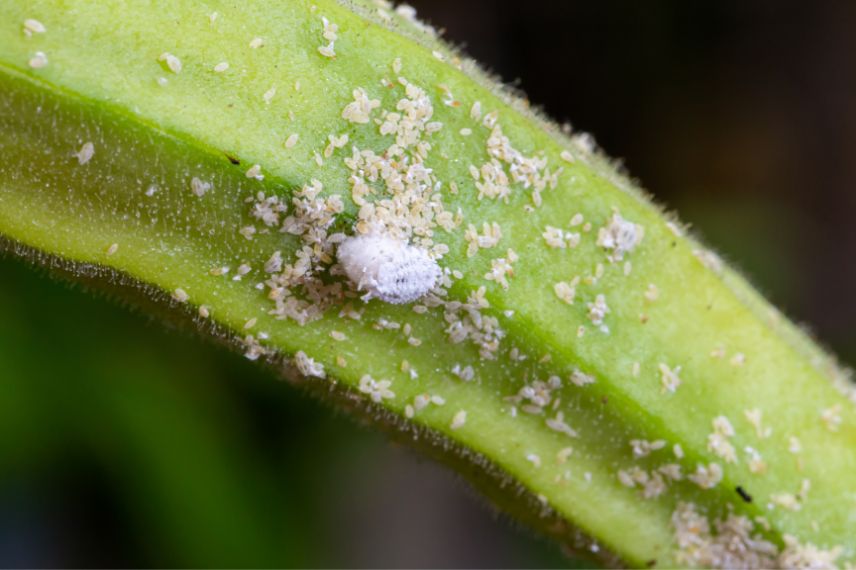
Mealybugs often proliferate on the underside of the foliage and on the stems
The curative treatment
Before anything else, it is essential to quarantine your Alocasia or Colocasia at the slightest suspicion of a mealybug attack, as they can very quickly infest all your houseplants.
In the first instance, it is advised to rub off the white or brownish masses with a toothpick, a brush or a soft-bristled toothbrush, or simply with a nail, to remove as many mealybugs as possible. Next comes the natural treatment. The best solution remains a spray based on black soap. Dissolve a teaspoon of black soap in a litre of water and spray on the upper and lower surfaces of the foliage. For greater effectiveness, you can add a little 90% alcohol to this mixture.
The spraying should be repeated several times, at one- to two-week intervals, in case of heavy infestation. Knowing that the mealybug can be very tenacious and difficult to eradicate. Not to mention that eggs and larvae are even harder to see.
It is preferable to perform this treatment outdoors.
Prevention
As mealybugs can be tenacious, it is best to prevent their appearance. The best preventive measure is to adhere strictly to cultivation conditions, because a healthy Alocasia or Colocasia is less fragile. Note, however, that mealybugs particularly favour confined, humid and warm atmospheres. Conditions that our plants also enjoy!
That is why a few tips are in order:
- Ventilate the room where your plant is kept very regularly
- Leave enough space for your Alocasia or Colocasia, whether grown in a pot or outdoors
- Take plants outside in summer, as mealybugs do not thrive in a dry, warm atmosphere
- Keep your Alocasia or Colocasia at around 16°C in winter.
And most importantly, regularly inspect the underside of the leaves to act at the first sign of mealybugs.
Red spider mites
Red spider mites, also known as spider mites, get their name from their tendency to weave fine webs on the leaves of plants. However, they are not true spiders, but mites that puncture leaf tissues to suck sap. Tiny, they are very difficult to distinguish with the naked eye. On the other hand, they multiply very quickly and move from one plant to another.
Red spider mites thrive in warm and dry atmospheres. This is evidence that your Alocasia or Colocasia does not have optimal growing conditions, as they require a high level of humidity.
Symptoms
Often, presence is detected by the fine webs they spin, especially when you mist the foliage with water. Otherwise, the leaves may be speckled with tiny white and then yellow dots, a warning sign. Infested foliage eventually grays, dries and drops.
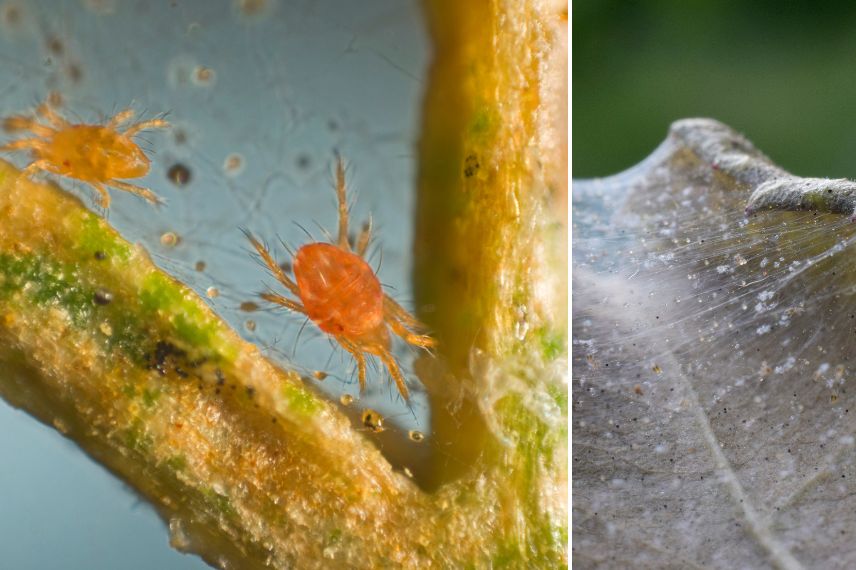
Red spider mites weave webs and sip the sap from the leaves
The curative control
Simply spraying the foliage regularly will help eradicate red spider mites, which hate humidity. In case of a severe attack, you should shower your plant with a jet of water either outdoors or in the shower.
After this treatment, feel free to leave your Alocasia or Colocasia alone to prevent infestation of neighbouring plants.
Prevention
The most effective preventive measure to avoid a red spider mite infestation is regular misting of the foliage. And that’s handy, because Alocasia and Colocasia love this sprayed water boost. A well-ventilated room also helps prevent this problem.
Thrips
Thrips are tiny insects that puncture leaves to suck sap. They can also jump from one plant to another. These insects, difficult to see, mainly thrive in a warm and dry atmosphere. They are very common in conservatories.
Symptoms
On the underside of the leaves, where they are usually punctured, spots appear, sometimes slightly shiny. You may also notice black frass. The spots enlarge, the foliage loses colour, then turns yellow, dries and drops.
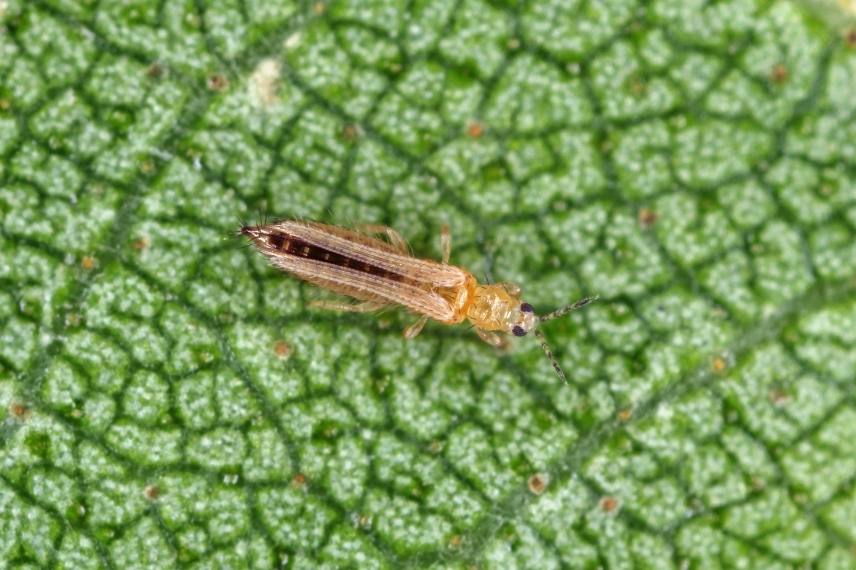
Thrips are a real pest for the foliage
The curative control and prevention
The treatment and prevention are the same as for eliminating red spider mites. If your Alocasia or Colocasia has enough humidity, it will not be attacked by thrips. Therefore, spray the foliage regularly.
Growing problems encountered by Alocasia or Colocasia
Sometimes an Alocasia or Colocasia may show signs of distress that are most often manifested through its foliage. If no pests are detected, look elsewhere.
- A yellowing foliage is often the sign that your plant is overwatered. In this case, simply space out the watering a little, while keeping the substrate moist between waterings.
- Conversely, foliage that yellows and then dries can be a sign of a lack of water. To confirm this, simply inspect the root ball. If it is dry, it’s almost certainly due to insufficient or irregular watering.
- Yellowing and drying leaves are also a sign that your water is too hard. If possible, collect rainwater to water your Alocasia or Colocasia. Otherwise, leave tap water in a watering can for several hours so the limescale settles.
- A browning foliage is a sign of scorch. Your plant is too close to the window and exposed to direct sunlight. Simply move it elsewhere while still giving it sufficient light.
- A drooping foliage usually results from poorly drained substrate, hence too damp. Simply repot the plant, ensuring a good layer of clay balls or gravel at the bottom of the pot to ensure excellent drainage.
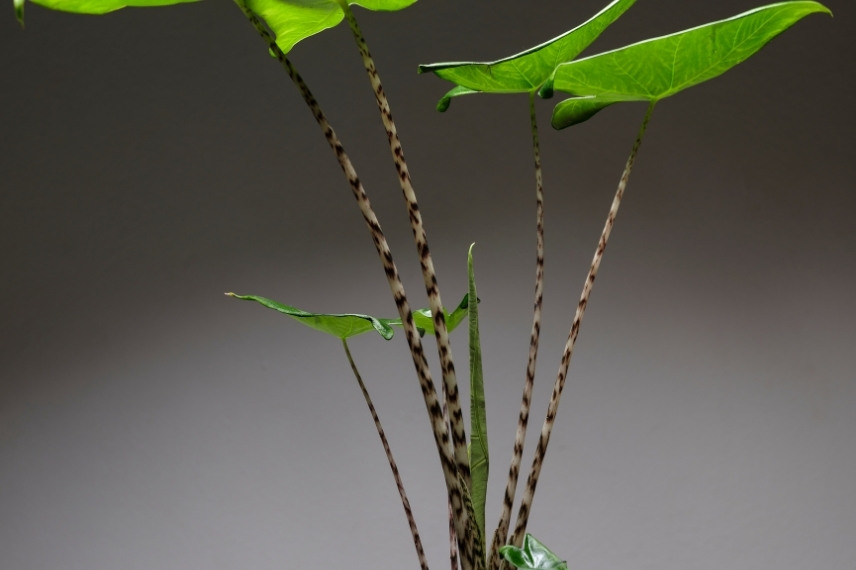
The magnificent Alocasia ‘Zebrina’
Foliage that falls away without any other signs is the result of a normal process. New growth appears, the oldest giving way to them.
Diseases of Alocasia and Colocasia
Alocasia and Colocasia are extremely resistant to disease. Only rot can affect the foliage or the rootstocks. They are generally caused by excess humidity and, above all, a lack of ventilation. It is therefore essential to ventilate the room regularly to create a gentle draught. Except in winter, as this draught could be fatal to your plants.
Water that remains in saucers or cachepots should also be avoided for Alocasia and Colocasia, as well as for all indoor plants.
- Subscribe!
- Contents
Comments