





























Deutzia: the most beautiful varieties
Beautiful flowers on an elegant shrub
Contents
The Deutzia is a deciduous shrub, of modest dimensions, with a compact habit, yet very generous in spring flowering. It is valued for its ease of cultivation, tolerant of soil and exposure conditions. It prefers ordinary soil, ideally quite cool, and enjoys full sun or partial shade, but can tolerate occasionally dry soils. It reliably returns each year and generally flowers between April and June in airy panicles of numerous small flowers in shades of pink or white.
This flowering shrub, a reliable choice, is suitable for the most novice gardeners as well as for small gardens or containers on the terrace or balcony. Among the different varieties, there are differences in size, shape, and flower colours. Discover the most ornamental ones in our opinion to help you choose your Deutzia.

Deutzia compacta 'Lavender Time'
The Deutzia compacta ‘Lavender Time’ is a rare variety that forms a small, rounded, compact and highly floriferous shrub. In late spring and early summer, its unique flowering is quite charming. It produces small cup-shaped flowers with 5 round petals, measuring 1.5 cm in diameter, numerous and gathered in panicles, creating delightful bouquets. They are white-pink in colour, gradually tinged with lavender over time. The particularly compact and rounded shape of this variety is also marked by trailing branches at the tips. Its average growth allows it to reach 1 m to 1.5 m in height and 1 m in width at maturity. In June and July, it is covered with these miniature bouquets of soft, romantic colours. The flower buds, reminiscent of lilacs, appear like a delicate cloud against a spring green foliage. Upon opening, the round cup-shaped flowers, melliferous, reveal the golden shimmer of the stamens. The strongly veined foliage turns bronze and purple-violet at the end of the season.
The hybrid Deutzia ‘Lavender Time’ is a wild variety derived from the Himalayan species compacta. Easy to cultivate in the sun in not too dry soil, it establishes itself in plant beds alongside numerous perennials. Elegant, the late flowering of this Deutzia harmonises beautifully with that of roses such as the old ground-cover rose ‘Gloire des Polyanthas’. Mixed with grasses with fine, blonde spikes like those of Stipa tenuissima ‘Pony Tails’, it also pairs well with other medium-sized grasses, their upright stems responding to each other for a blurred yet graphic effect.
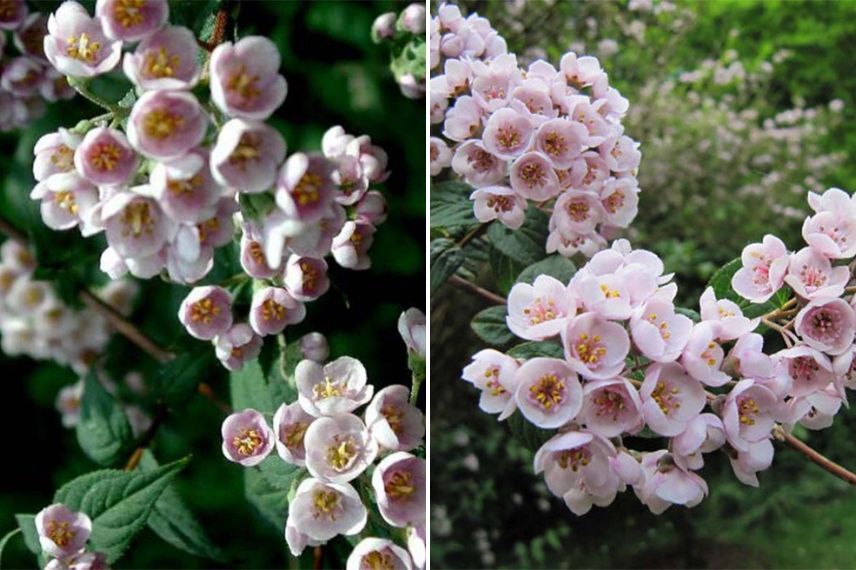
Deutzia compacta ‘Lavender Time’
Read also
Deutzia: planting, pruning, careDeutzia magnifica
The Deutzia x magnifica is a hybrid species obtained in the early 20th century by cross-breeding two species native to China and Japan. It quickly forms a large shrub reaching 2.5 m in height and 2 m in spread, standing upright in its early years and becoming more spreading with age. In spring, it is covered with clusters of fairly large, double bell-shaped flowers, pure white with prominent yellow stamens. These appear in May and last well into June, almost obscuring the foliage beneath the panicles of trailing flowers. They are sometimes tinged with pink.
In the back of a border or as a hedge, this flowering shrub creates beautiful combinations with evergreen foliage such as that of conifers like Chamaecyparis, Picea, or Cryptomeria, for example. Plant the Osmanthus x burkwoodii with its fragrant flowers, or evergreen viburnums such as Viburnum tinus with winter blooms, V. odoratissimum, V. davidii, Viburnum ‘Le Bois Joli’, or Viburnum ‘Pragense’ with spring blooms. Also consider Mexican oranges like Choisya ‘Aztec Pearl’.
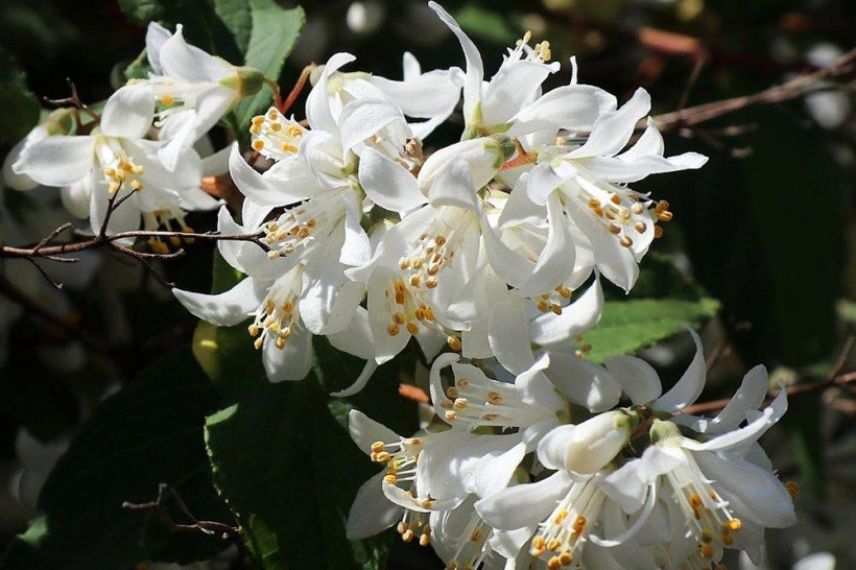
Deutzia magnifica
Deutzia setchuenensis 'Corymbiflora'
The Deutzia setchuenensis ‘Corymbiflora’ is a rare variety to discover! It flowers extensively, tirelessly, from June to October, occasionally taking a break in the heart of summer. Its multitude of pure white flowers are star-shaped, with 5 petals, gathered in light, rounded corymbs. Delicately scented, they attract pollinating insects and contrast beautifully against the rather dark foliage, a matte dark green with bluish reflections. In autumn, it takes on reddish-purple hues before shedding its leaves.
This Deutzia is a horticultural selection with a compact habit and particularly floriferous nature of Deutzia setchuenensis, sometimes referred to as Sichuan Deutzia. Small in stature, it does not exceed 1 m in height and 90 cm in spread at maturity, but grows quite quickly. It tolerates partial shade well, even full shade in warm climates, where it can brighten up a somewhat dark spot with its very bright flowering. Pair it with woodland geraniums such as Geranium nodosum or Geranium phaeum for example, and Saxifraga stolonifera ‘Cuscutiformis. Given its small size, it can also be planted in a pot on the terrace or balcony.
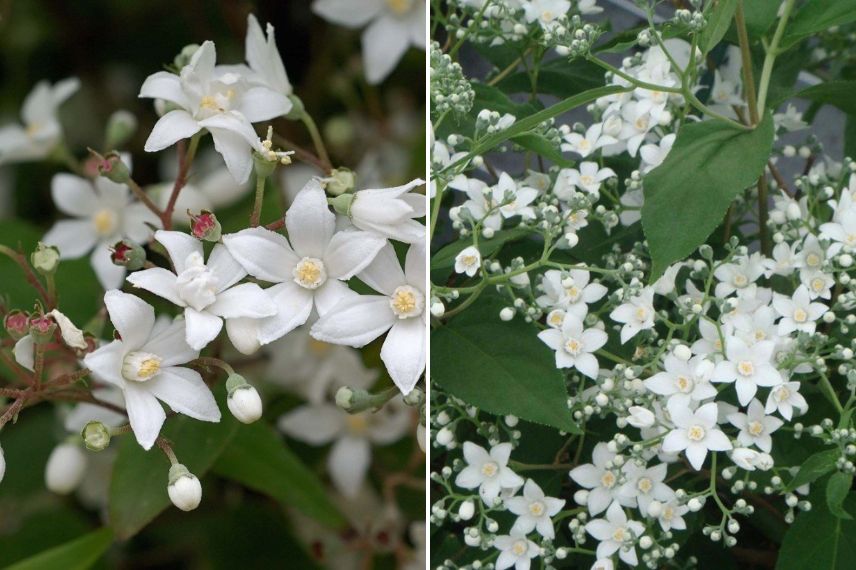
Deutzia setchuenensis ‘Corymbiflora’
Read also
Deutzia: 5 lovely pairing ideasDeutzia scabra 'Plena'
With significant growth, the Deutzia scabra ‘Plena’ grows rapidly and reaches 2.50 m in height and 2 m in spread at maturity. It displays an upright habit in its early years, which then becomes more spreading. In June and July, its double flowers, lightly fragrant, overwhelm the shrub in clusters that start as soft pink and gradually fade to white. At the time of blooming, its trailing flowers in panicles, with their striated pink backs, give the whole a pink hue. However, as the flower opens, the pure white interior of the petals appears, giving the overall effect a white tone. Its flexible branches arch slightly at their tips, and the bark, cinnamon in colour, exfoliates as it matures.
The Deutzia scabra ‘Plena’, sometimes referred to as ‘Flore Pleno’, is a horticultural variety dating back to 1863, derived from Deutzia scabra, which is native to China and Japan. It is sensitive to drought and shallow soils. It requires a sheltered and dappled exposure to protect its flowering from scorching sun and strong winds. It can be planted as a specimen in the garden or in a flowering hedge, alongside other shrubs such as Lilac, Mock Orange, and Ornamental Crab Apple, ensuring four months of flowering from April to July.
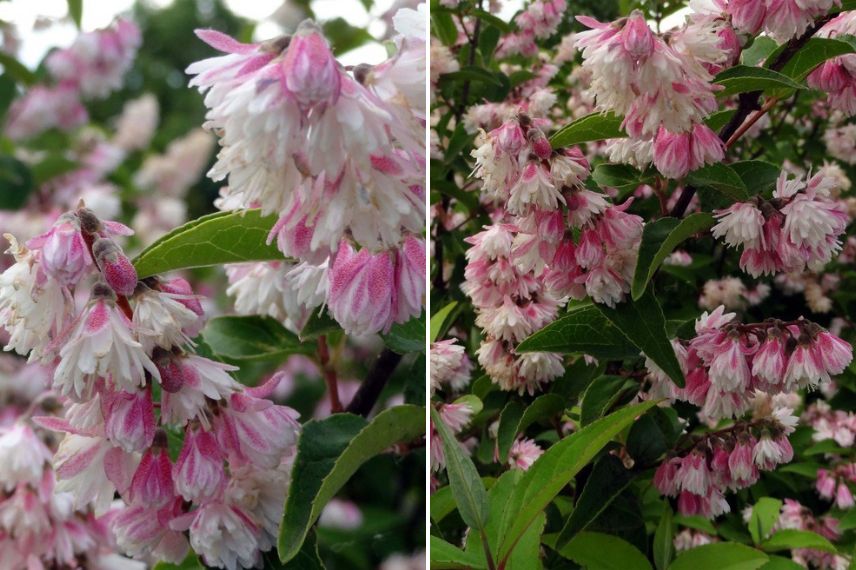
Deutzia scabra ‘Plena’
Deutzia hybrida 'Raspberry Sundae®'
The Deutzia hybrida ‘Raspberry Sundae®’ is a recent English cultivar. It is covered in spring with simple star-shaped bicoloured flowers with 5 petals. The centre of the flower is white, with a heart of yellow stamens, and the tips of the petals are a purplish pink. They are larger than average, slightly fragrant, and grouped in dense bouquets along the curved and trailing branches down to the ground. Remarkably abundant, they almost obscure the foliage between April and June. The foliage is a very dark green with strong veins, turning bronze and purple in late season.
This rather compact Deutzia hybrid reaches 1.20 m in all directions with a rounded and noticeably upright habit. Within a shrub border or on a sunny bank, it enjoys calcareous soils, and will be perfect to accompany small-growing Lilacs such as the Syringa patula ‘Miss Kim’ and Elder trees with pink and white flowers. Perennials like Aquilegias or Campanulas enliven this spring-flowering border, along with bulbs of tulips. They then join lovely bouquets in vases in the home.
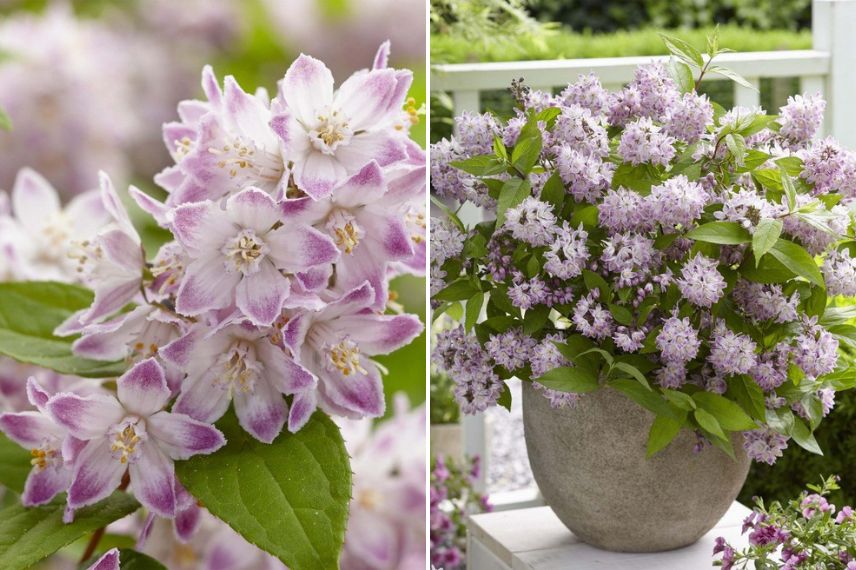
Deutzia hybrida ‘Raspberry Sundae®’
Deutzia gracilis 'Nikko'
Very small, the Deutzia gracilis ‘Nikko’ forms a compact, ramified dwarf shrub of 50 cm in all directions. This floriferous cultivar is robust and valued for its ornamental qualities. In May-June, it produces erect clusters, measuring up to 15 cm long, consisting of multiple pure white bell-shaped flowers. Its deciduous foliage is silver-green and turns burgundy-red in autumn. Ultimately, it can still reach 1 m in height.
The Deutzia gracilis ‘Nikko’ is a horticultural variety derived from the species Deutzia gracilis, native to Japan. It grows quite slowly. It prefers cool, deep soils in partial shade or full sun, but adapts to drier gardens with good mulching. Its flowering is not damaged by rain. It is an almost indestructible shrub, very generous in flowering, and its foliage takes on a beautiful autumn colour. Plant it in pots or at the edge of perennial plant beds, as groundcover, with equally indestructible hardy geraniums like ‘Rozanne’, in front of contrasting ornamental shrubs like the Physocarpus opulifolius ‘Diabolo’, with purple leaves, and the Cornus alba ‘Ivory Halo’, with cream variegated leaves. Add evergreen shrubs like small conifers with green, blue, or golden foliage.
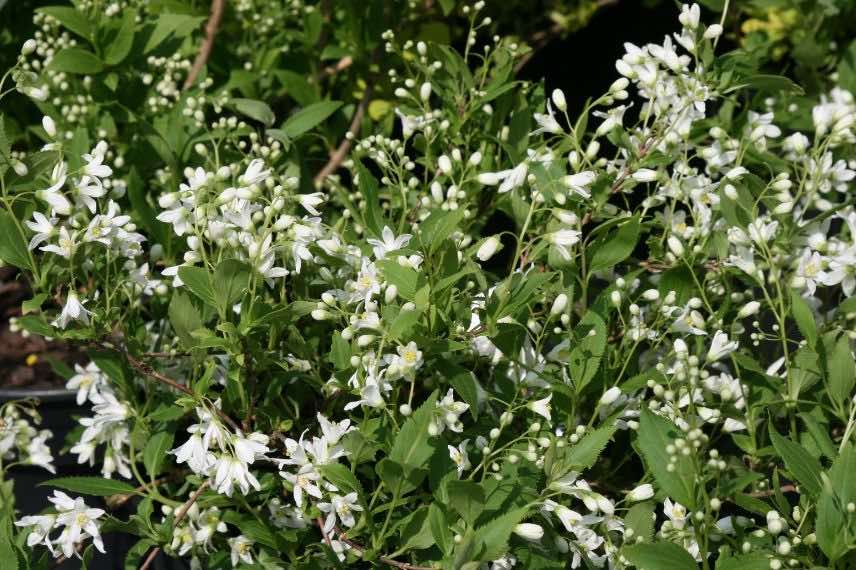
Deutzia gracilis ‘Nikko’
- Subscribe!
- Contents
Comments