





























Cycas: 9 pairing ideas
Associate Cycas in all settings
Contents
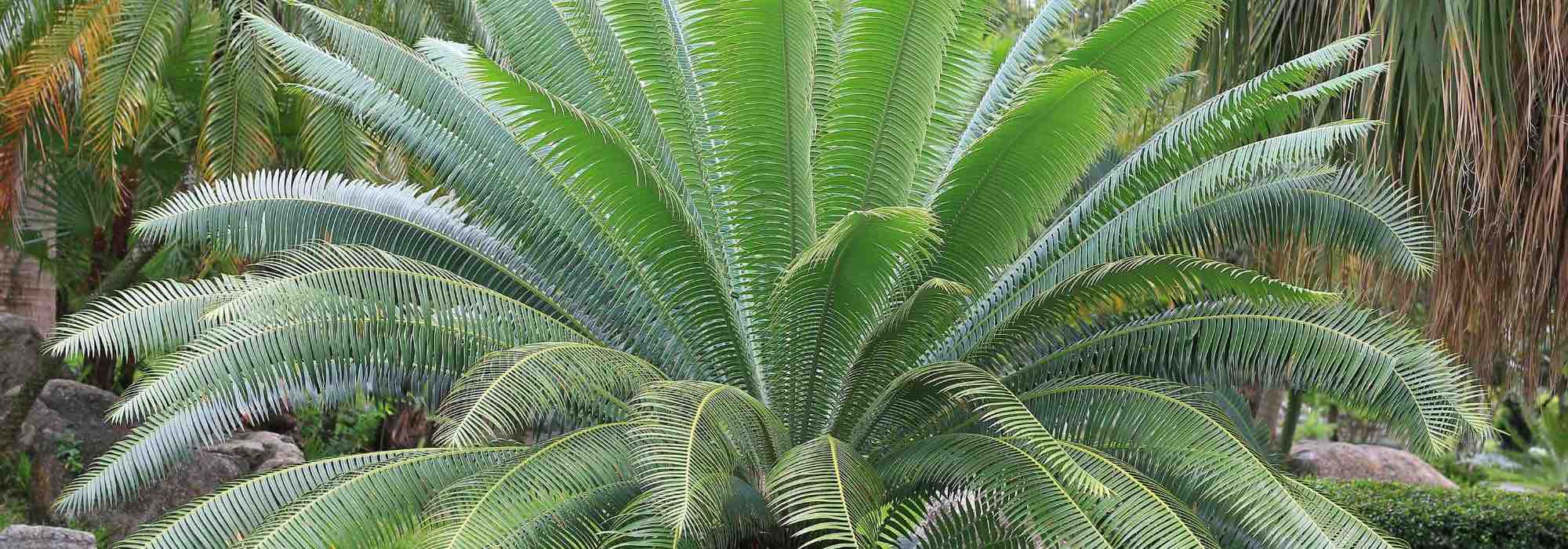
Cycas is a prehistoric plant with an archaic appearance, reminiscent of both a fern and a palm, two different families from which it borrows botanical characteristics. The most commonly cultivated is the Cycas revoluta, or Japanese Cycas, which is quite frost-sensitive but the least frost-sensitive, tolerating frosts of around -6 to -8 °C once well-rooted, in a sheltered position, in well-drained soil. There is also, more rarely, the Macrozamia Moorei, also known as Moore’s Cycas, which is related to the Cycas.
The Cycas is grown in the ground in France, only in the Mediterranean region or in the mildest coastal areas. It also tolerates sea spray well. It enjoys a sunny exposure, well-drained and fairly rich soil. It withstands drought once well established. A very graphic, imposing plant with a strong presence, the Cycas is not easy to pair and stands alone. However, it enjoys the company of many plants of different styles and conditions, and can be integrated into numerous gardens, in pots on the terrace, and even indoors, alongside various plants.
Discover our 9 pairing ideas for this extraordinary plant!

In an exotic scene
The Cycas has a strikingly exotic appearance, encouraging its combination with lush plants from tropical regions. Its low hardiness and specific growing conditions allow for this; the Cycas requires well-drained and fairly rich soil. Its strong personality can be challenging to pair, so it is wise to plant alongside foliage of the same green colour, but with different shapes, to provide contrast while remaining quite understated and light. Plants with foliage suited to mild climates, like banana plants, Yuccas, and Tetrapanax, offer this contrast in form with a certain elegance. By adding an orange-flowered Strelitzia, which combines very exotic foliage and flowering, one can then introduce some vibrant flowers from Crocosmias and Kniphofias, while still keeping to the same flower colour to avoid overwhelming the scene and create overall cohesion.
Plant a Cycas revoluta in a sunny position alongside a Bird of Paradise or Strelitzia reginae, Kniphofia, an Yucca rostrata, a Banana Plant Musa acuminata Dwarf Cavendish, Crocosmia ‘Zambesi’, and a Tetrapanax papyfera ‘Rex’.
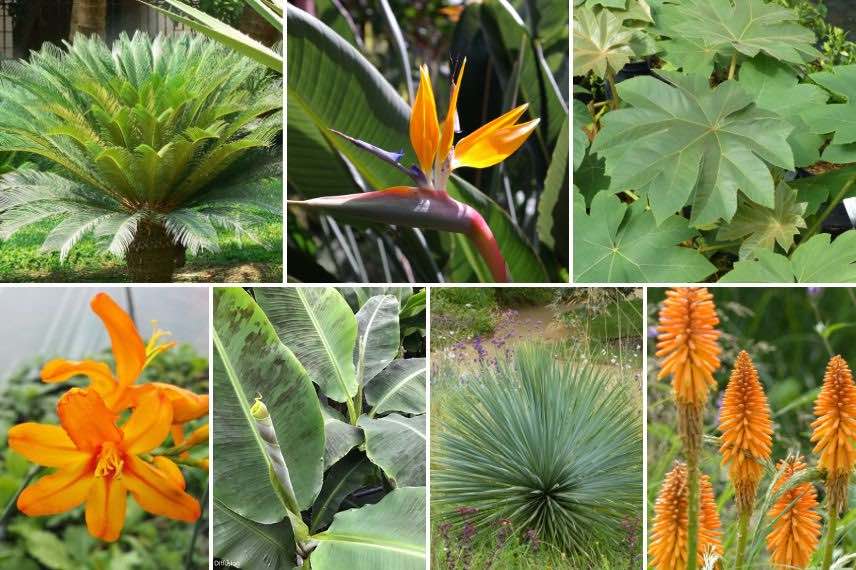
Clockwise from top: Cycas revoluta, Strelitzia reginae, Tetrapanax papyrifera ‘Rex’, Kniphofia, Yucca rostrata, Musa acuminata Dwarf Cavendish, Crocosmia ‘Zambesi’
Read also
Cycas: planting and careIn a Mediterranean garden
Well suited to the Mediterranean climate, which is mild enough with low frost, Cycas readily associates with the bushes and perennials that thrive there. Macrozamia moorei, also known as Moore’s Cycas, is related to Cycas. Its hardiness is slightly lower than that of Cycas revoluta. An older, well-established specimen does not tolerate frosts below -6°C. Its foliage is damaged at -3°C, but the stump is likely to sprout again in spring if it has received good winter protection (thick mulching and well-drained soil).
In a sunny Mediterranean garden where, for example, an Olive and a Citrus (citrus trees) grow, plant a Macrozamia moorei alongside Polygala myrtifolia, lavenders, and agapanthuses. Here, a Macrozamia moorei, with an Olive Olea europaea, lavender, a Polygala myrtifolia, and a Citrus.
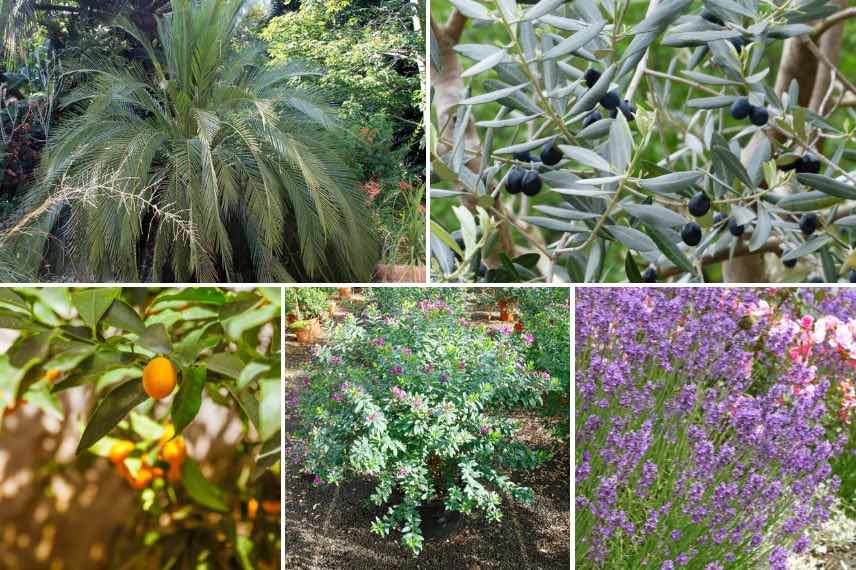
Macrozamia moorei, Olea europaea, lavender, Polygala myrtifolia, Citrus
In a contemporary atmosphere
Very graphic, the Cycas impresses with its large, fern-like fronds that are highly divided and quite stiff. Planted in a contemporary and minimalist setting, it serves as a majestic focal point. In a fairly large modern garden, for example, it can be planted in groups of three specimens.
Here, the Macrozamia moorei has a slightly softer appearance than the Cycas revoluta. At its feet, a plant that also has its place in a contemporary garden, with beautiful grey foliage: the Stachys byzantina. It provides a perfect dense groundcover and can replace a mineral choice of pebbles, for example (which is also an option). The two plants are compatible in growing conditions.
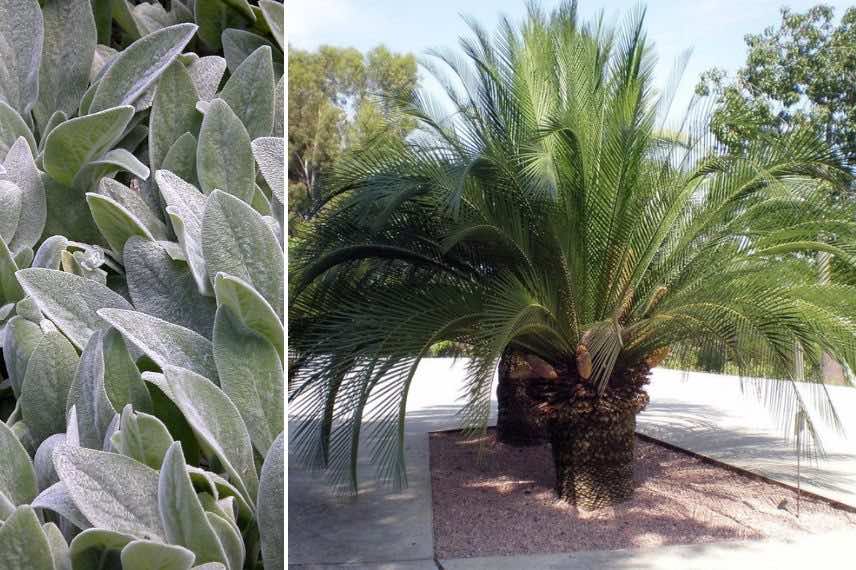
Imagine several Macrozamia moorei on a bed of Stachys byzantina
Read also
How to protect Cycas in winter?In isolation
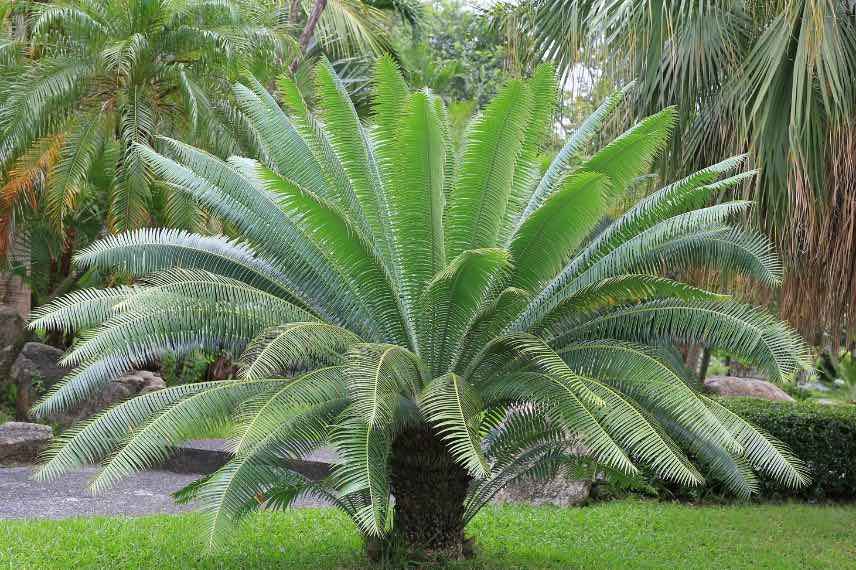
Of course, given its size and silhouette, its graphic quality, architectural strength, and presence, the Cycas is perfect when planted alone, in isolation, standing proudly in the middle of a lawn or on a bank, suitable for both exotic and contemporary gardens, Mediterranean settings, or those without a pronounced style. Ensure you have the right growing conditions and make it a centrepiece. A timeless focal point, as modern as it is archaic, it stands on its own.
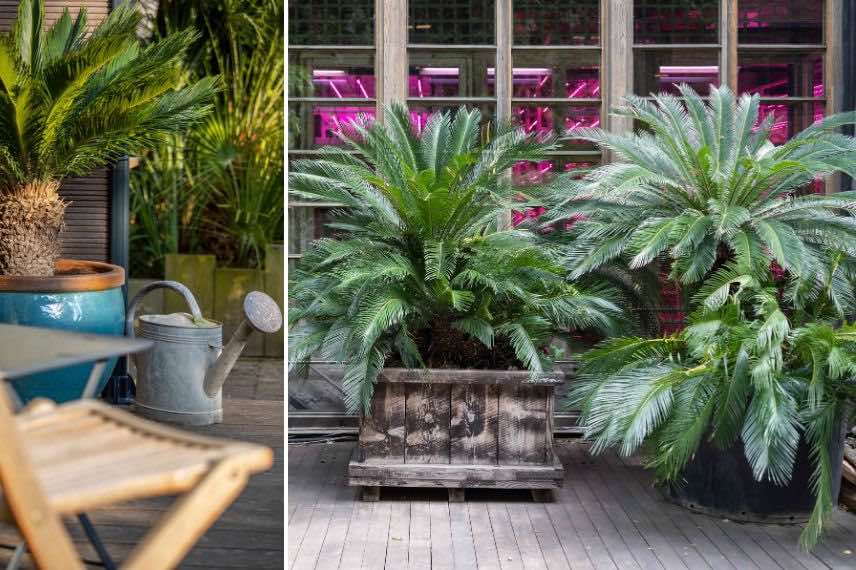
In a pot on a terrace, alone or accompanied
Always solitary or accompanied, the Cycas is very beautiful in a pot where it grows very well. This allows it to be wintered in regions where winter temperatures do not permit leaving it outside. It should be brought indoors in autumn to a bright, unheated room or a conservatory and taken out again in spring. Round pots suit its silhouette very well, but large square containers also showcase it nicely. Choose a large pot so it can develop comfortably, but surely.
Give it the spotlight or surround it with cacti, succulents, or, inspired by the first paragraph, surround it with exotic plants like Strelitzia, Banana plants, or Kniphofia. Leave it alone in its pot or add a low perennial, with flowers or contrasting foliage, such as a small grass like Fescue.
In a lush garden of foliage and dappled shade
The Cycas is an astonishing plant, exhibiting botanical characteristics that lie between ferns and palms. Given this observation and the Japanese origin of Cycas revoluta, imagine it in a semi-shaded garden, filled with lush foliage, ferns, and bamboos. As long as it is in a protected position, shielded from frost and cold winds, and in a bright location, it can also be cultivated with less sunlight, in partial shade.
Pair it with a large tree fern, Dicksonia antarctica, which also features a stipe and a crown of arching, divided leaves. Plant curtains of tall bamboos or Fargesia in the background. For a completely green scene, add Angelica, and for groundcover, a low evergreen fern like Polystichum makinoi.
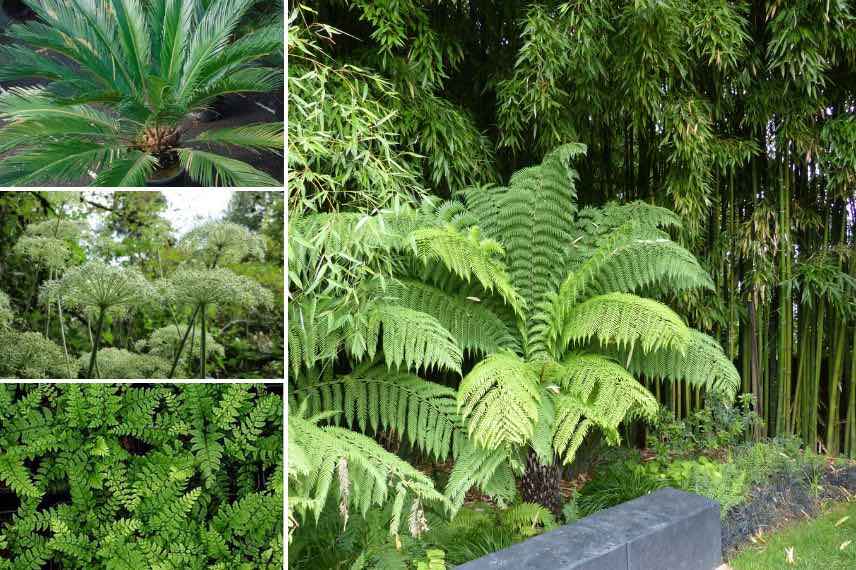
Dicksonia antarctica and Bamboos, Cycas revoluta, Angelica heads, Polystichum makinoi fern
On a slope, in a scree garden, in a succulent garden
The other appearance of Cycas, the palm, evokes drier gardens, alongside Cacti and succulents. It can indeed be planted in drier conditions, on a slope, in a rock garden with succulents. It is drought-resistant once established.
In full sun, on a slope surrounded by stones, plant a Cycas revoluta with fairly thick fronds reminiscent of palms, alongside an Aloe arborescens, an Agave americana, a Cereus forbesi ‘Spiralis’, and an Aloe polyphylla with very graphic spiralled leaves. Also consider the Opuntia ‘Alta’ and all the cacti of different shapes and sizes, round, cushion-like, or upright like candles…
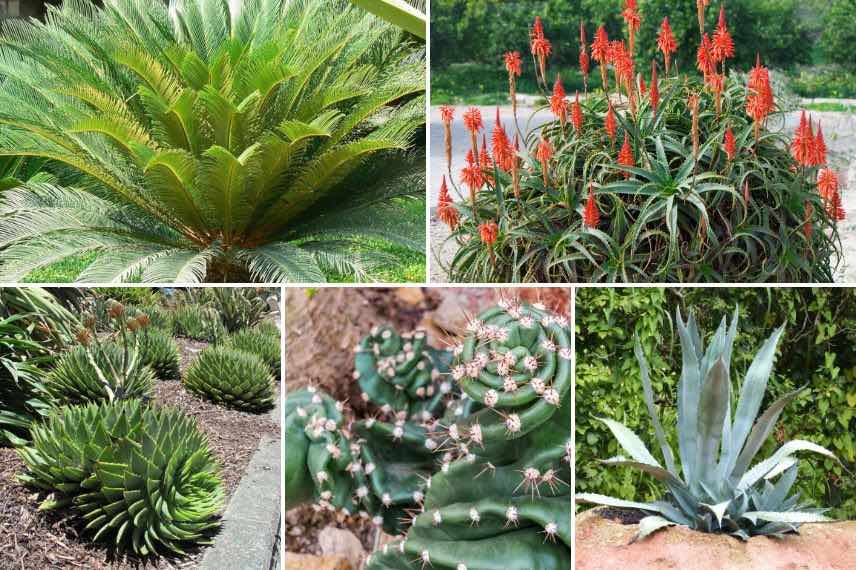
Cycas revoluta, Aloe arborescens, Agave americana, Cereus forbesi ‘Spiralis’, Aloe polyphylla
Indoor
The Cycas can be grown all year round as an indoor plant. It requires the following conditions: always very bright, even with some direct sunlight. In winter, a cool or unheated room is preferred. It can also be grown all year round in a conservatory.
Indoors, in very bright conditions, even in direct sunlight, it joins succulent plants, which are the only indoor plants that tolerate and appreciate the sun behind a window, providing very warm conditions where many plants suffer. Many sedums and sempervivums thrive in these conditions. Check that each of them can be grown all year round indoors.
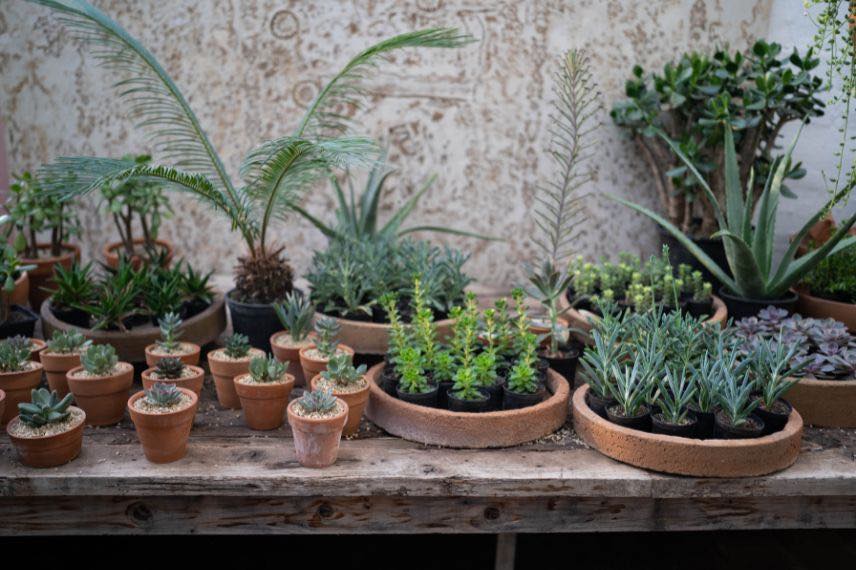
A display of indoor plants at a nursery, where the Cycas finds itself in good company with many succulent plants.
In shades of grey
The green foliage of Macrozamia moorei is adorned with grey hues. Reveal them by pairing it with plants that have grey, blue-grey, or grey-white foliage. Add some blue flowering plants for a stunning effect in these cool shades, in a gradient of green, grey, and blue.
Plant a Macrozamia moorei with a Puya harmsii that has almost white grey foliage. Include the beautiful upright tufted foliage of Dianella. Here, a Dianella tasmanica ‘Variegata’, with variegated white foliage and lovely small blue ball-like flowers. Echo the blue with the stunning blues from the range of Agapanthus.
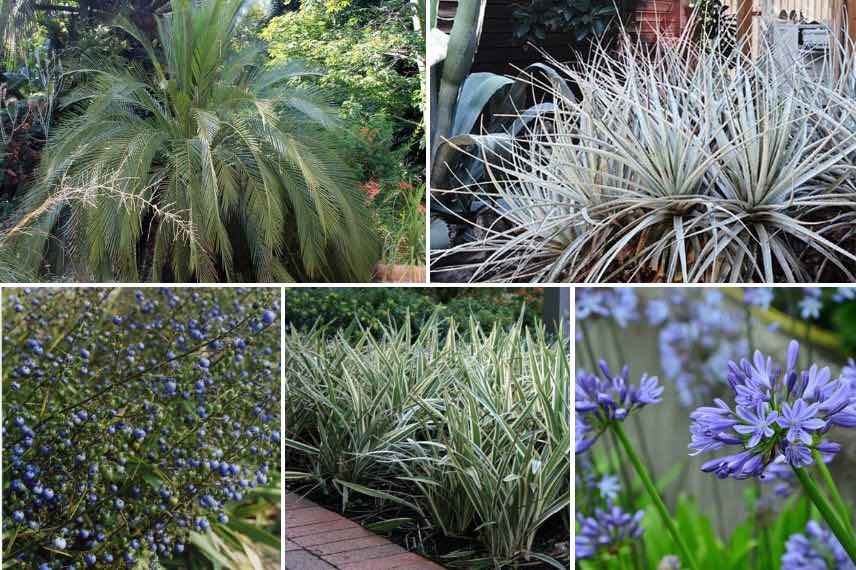
Macrozamia moorei, Puya harmsii, blue Agapanthus, Dianella tasmanica ‘Variegata’ and its flowering
- Subscribe!
- Contents
Comments