





























Creeping Grevillea: 5 varieties to discover
Carpet varieties ideal as groundcovers
Contents
Grevillea are evergreen shrubs that showcase a beautiful diversity in terms of sizes and habits. While, like Grevillea robusta, some are true trees reaching several metres in height, others barely exceed thirty centimetres.
Less known than the popular Grevillea rosmarinifolia, they are nonetheless interesting. Their prostrate and spreading silhouette is indeed capable of forming beautiful flowering plant cushions, perfect for dressing slopes, rockeries, borders, or the foreground of flower beds and hedges. They help stabilise the soil, prevent the development of adventive plants (“weeds”), and facilitate the maintenance of sometimes challenging areas. However, these bushes can also be grown in pots to brighten up small spaces, terraces, or balconies.
Here is our selection of 5 Grevillea with a spreading habit, which will make perfect groundcovers.

Grevillea lanigera ‘Mount Tamboritha’: a very floriferous dwarf shrub
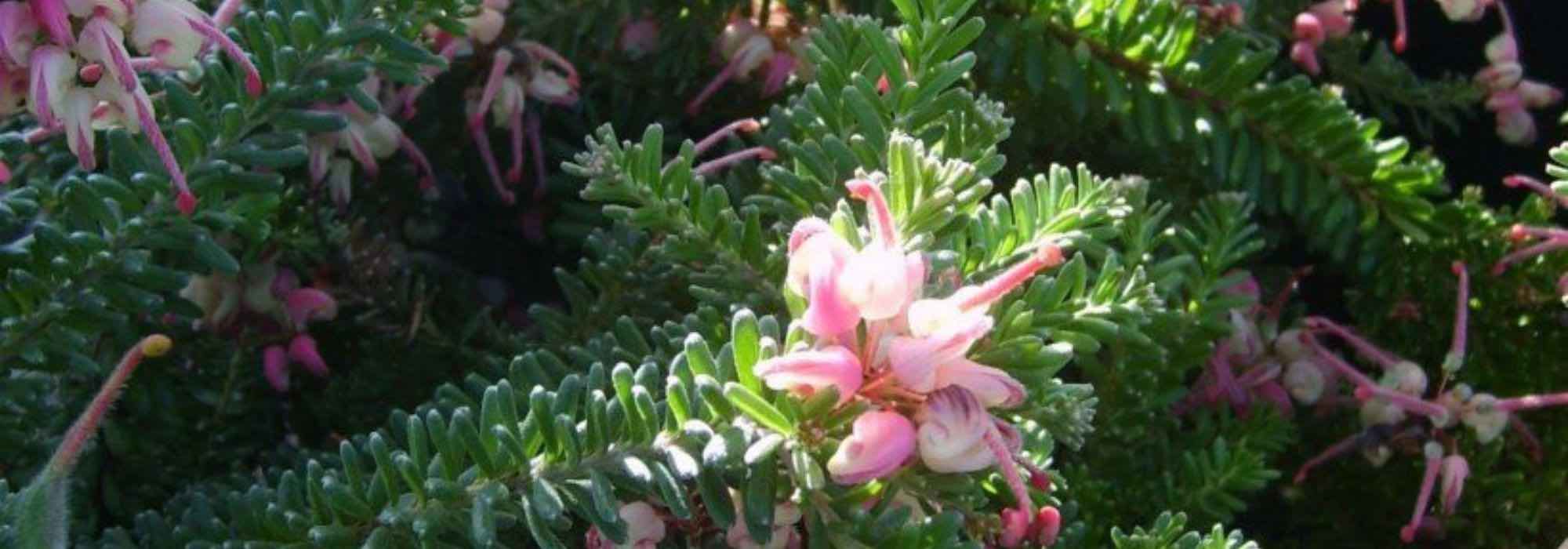
The Grevillea lanigera ‘Mount Tamboritha’ is a creeping form that possesses the same qualities as the shrub varieties, namely evergreen foliage and a beautiful exotic-looking flowering display. It reaches only about twenty centimetres in height with a spread of 1.5 metres.
This groundcover produces leaves that are fleshier than its relatives, almost globular in shape. They display a grey-green hue and have a somewhat wooly and pilous appearance, ornamental in all seasons.
But it is at the end of winter that the real spectacle begins: our shrub then produces a profusion of flowers combining bright pink and pale cream-washed pink. They consist of petaloid styles, curled in on themselves like snail shells, and long, curved stamens. These flowers continue to renew until the end of spring.
Just as easy to grow as other Grevillea, ‘Mount Tamboritha’ will thrive in full sun, in light, well-drained soil, without stagnant moisture or lime. This maintenance-free shrub can go without watering once well established. Its hardiness can reach -9°C in a sheltered position and suitable soil.
To dress the base of a wall or a slope, pair it for example with a creeping ceanothus, such as the prostrate ceanothus, which will accompany the spring flowering with a vivid lavender blue. In rockeries, sedums or creeping rosemaries (Rosmarinus officinalis ‘Prostratus’) will also make good companions.
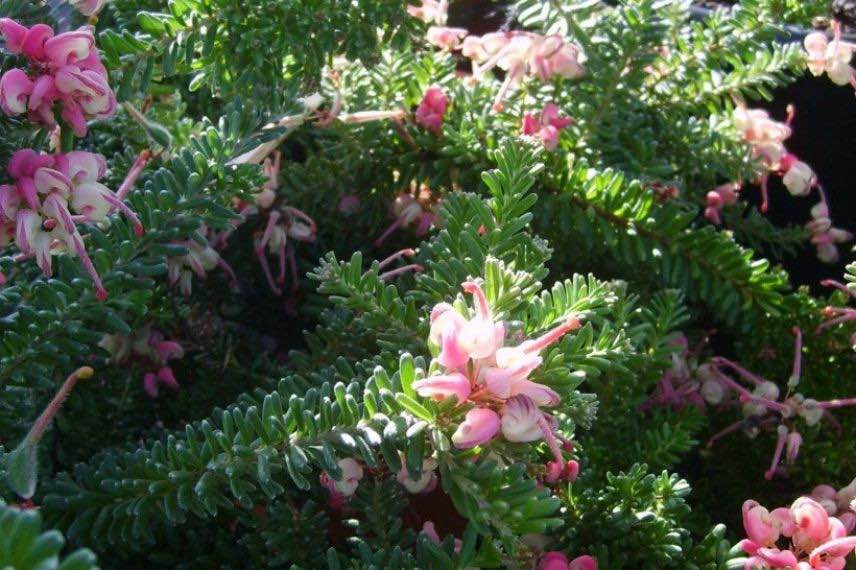
Grevillea lanigera ‘Mount Tamboritha’
Read also
Grevillea: planting, pruning and careGrevillea hybrid 'Bronze Rambler': an original and ornamental dissected foliage
‘Bronze Rambler’ is a hybrid variety of Grevillea, resulting from the cross-breeding of two species (rivularis x ‘Poorinda Peter’). It is distinguished by its quite impressive creeping silhouette (30 cm in height and 3 metres in spread) and the aesthetic appeal of its foliage. The leaves are indeed cut into large lobes, and the young shoots are delicately coloured in coppery bronze.
In spring, this foliage comes to life with the appearance of beautiful red or purplish-pink flowers, which follow one another for many weeks. They are grouped in clusters resembling toothbrushes.
This shrub forms a dense and very graphic groundcover, but can only be grown in open ground in the mildest and sunniest regions, where frosts do not exceed -6°C. In a Mediterranean garden, it will thrive beautifully in a raised bed or a large rockery. Plant it next to Leptospermum, cistus and creeping junipers.
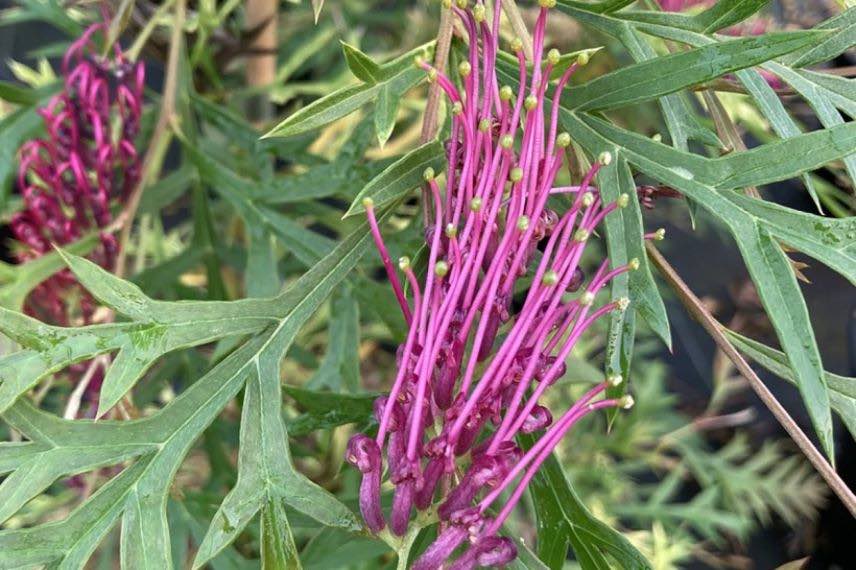
Hybrid Grevillea ‘Bronze Rambler’
Grevillea juniperina ‘New Blood’: a spreading habit and endless flowering
If the type species of Grevillea juniperina is very popular, the creeping variety ‘New Blood’ deserves to be more widely known.
Its evergreen needle-like foliage displays a beautiful bright green and is quite dense. It serves as a backdrop to the magnificent and tireless flowering of a bright pink almost red, which lasts almost all year round in a mild climate without frosts. In less clement regions, it will bloom in summer and still last for several weeks.
‘New Blood’ has a small spreading silhouette, reaching 35 cm in height and just over 1 metre in spread. These modest dimensions allow it to be grown in the ground or in pots, especially in areas with severe frosts. Its hardiness, rather commendable for the genus, reaches -10 to -12°C in optimal conditions (protected location and perfectly drained soil).
Pair it with an Escallonia ‘Red Carpet’ with its summer pink flowers. Add the delicate white flowers of the candytuft Iberis sempervirens and the bright cup-shaped flowers of a Callirhoe involucrata.
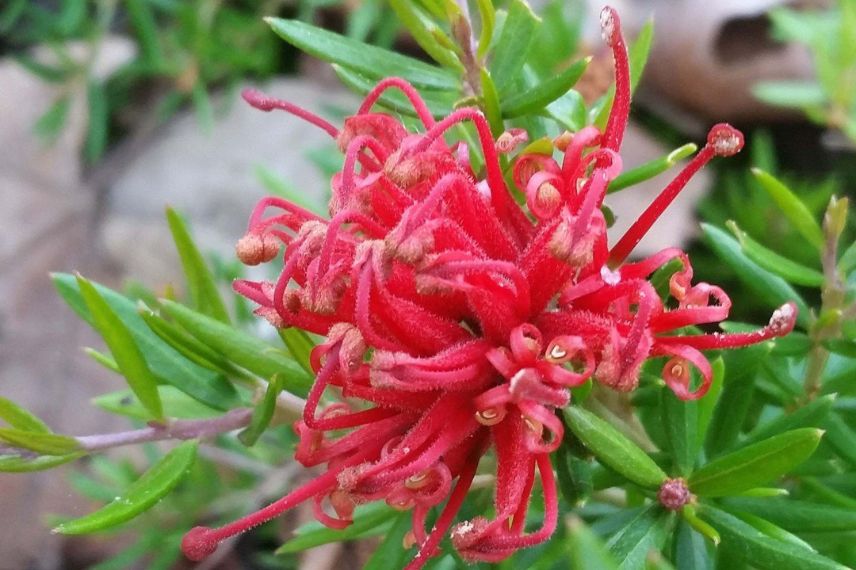
Grevillea juniperina ‘New Blood’
Read also
9 creeping shrubsGrevillea prostata ‘Aurea’: a sunny groundcover with yellow flowering
This Grevillea is notable for its sulphur-yellow flowering, which is less common among these shrubs. It occurs in spring, renewing itself generously for several weeks. The spider-like flowers lack petals but have petaloid styles and long, prominent stamens. With a tousled appearance, they possess a true natural charm. Its evergreen foliage consists of fine, needle-like leaves in a lovely light green.
‘Aurea’ has a prostrate, spreading silhouette, reaching 50 cm in height and 1.20 metres in width. Fast-growing, it will easily spread to form a dense, bright cushion.
Like most Grevilleas, this shrub native to Australia does not tolerate harsh winters and severe frosts. Its hardiness is limited to around -5°C. In unsuitable regions, this variety can, however, be grown in pots, planters, or hanging baskets, allowing it to be brought indoors during the cold season.
It enjoys perfectly drained soils where water does not stagnate. Provide it with a sunny exposure on a rockery to green the base of a wall or dress a slope.
Pair this Grevillea with creeping brooms that appreciate the same growing conditions, such as Cytisus decumbens, winged broom (Genista sagittalis), or Lydia broom (Genista lydia). They also flower in yellow at the end of spring. You can also choose the creeping broom Cytisus kewensis, which offers a rather cream-yellow flowering. To create a lovely contrast, pair them with blue-flowering plants, such as lavenders or Nepetas in the northern Loire regions.
Grevillea gracilis ‘Alba’: a compact variety with bright white flowers
The Grevillea gracilis ‘Alba’ is not one of the wider varieties typically used as groundcover. However, its small size allows for it to be used to dress slopes, rockeries, borders, or the front of flower beds. It reaches 60 cm in height and 40 cm in spread. Its bushy foliage consists of evergreen needle-like leaves, displaying a vibrant green.
From the end of winter, it offers an abundant cream-white spider-like flowering, particularly bright. The flowers appear on the shrub almost continuously until the end of spring.
Not tolerating frosts above approximately -6°C, ‘Alba’ will only be grown in open ground in coastal regions with a mild climate. Elsewhere, pot cultivation is entirely possible on terraces, balconies, or in small gardens. Like its relatives, this Grevillea will require full sun and a light, poor substrate that drains well, with a neutral or acidic pH.
Also appreciating acidic soils, winter heathers with a spreading habit will pair very well with our shrub. They will precede its flowering by brightening cold days with their lovely pink (‘Spring Surprise’, ‘Ghost Hills’, ‘Kramer’s Rote’) or white (‘White Perfection’) bells.
For an exotic-looking flower bed in a mild climate, you can also pair it with a Callistemon citrinus ‘Albus’ with a spreading habit (1 metre in height and 3 metres in spread).
- Subscribe!
- Contents

Comments