





























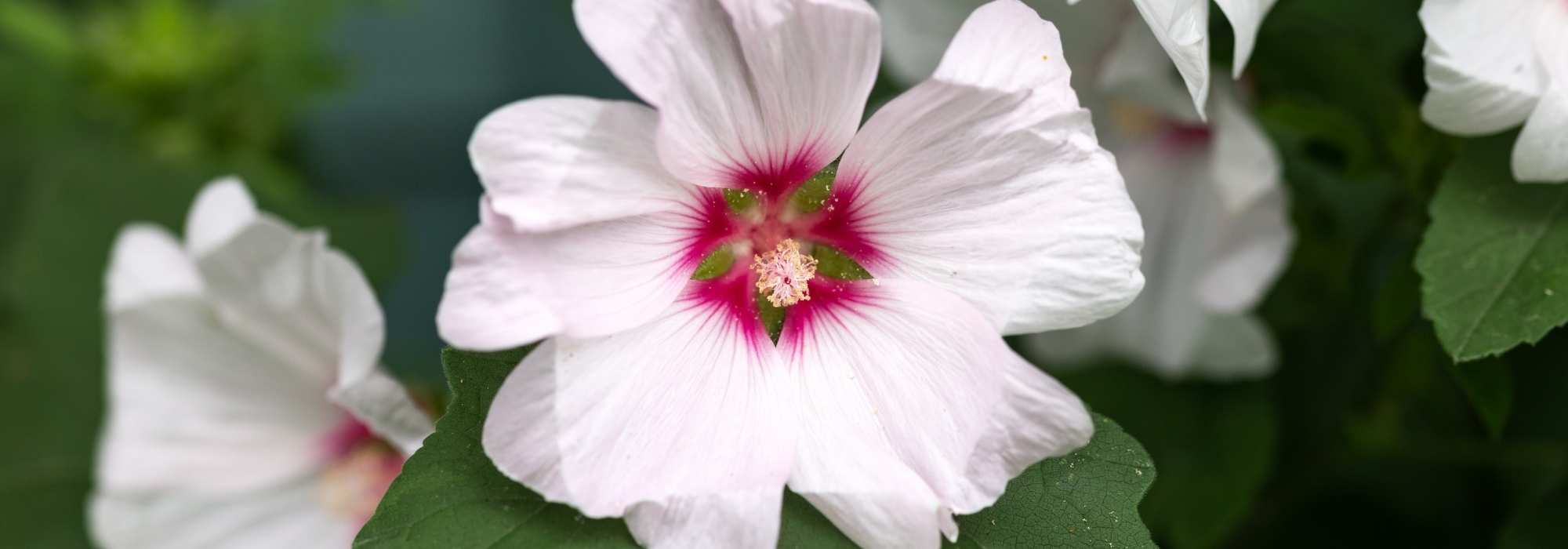
Lovely pairing ideas with hollyhocks
6 ideas for a successful pairing
Contents
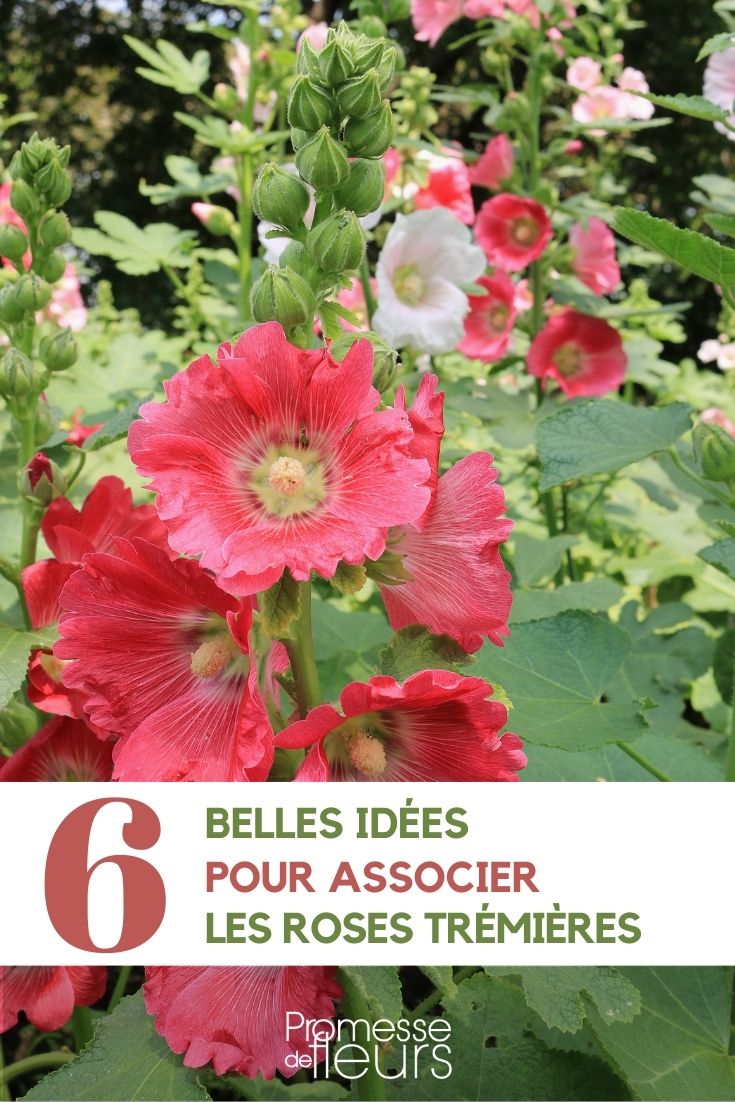
Hollyhock is one of the perennials, often grown as a biennial, offering immense spikes of flowers that bring verticality to the garden. Preferring a sunny position and shelter from the wind, it provides a long flowering period throughout the summer. Its flowers can be single or very double, in shades ranging from white to dark brown, including soft pink, purple, or yellow. Iconic in English gardens, it also blends beautifully into a cottage, contemporary, or romantic garden.
Discover our 6 ideas for pairing hollyhocks in the garden.
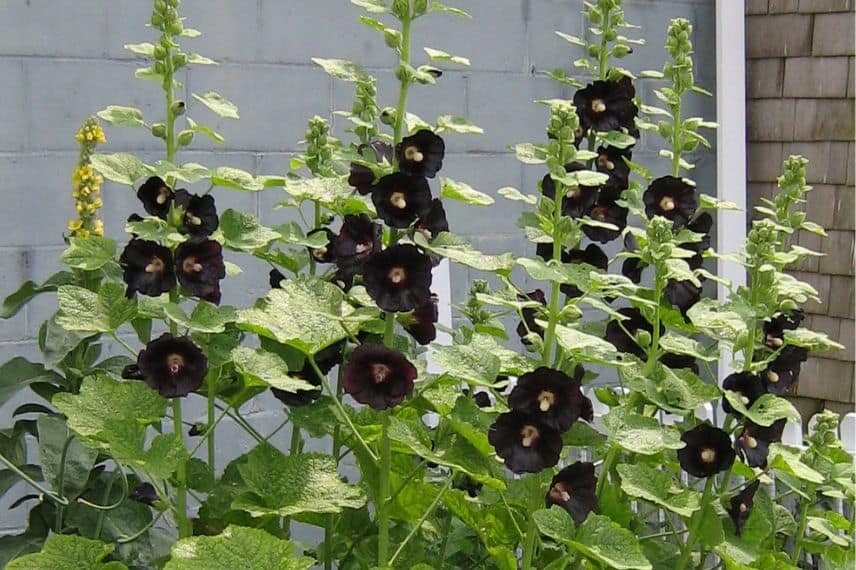
Black hollyhock (Alcea rosea Nigra)

In a romantic garden
With its tall silhouette and long summer flowering, the hollyhock will beautifully enhance a romantic garden. Opt for varieties with very double flowers, shaped like pom-poms. Choose white flowering varieties such as Alcea rosea ‘Chater’s Double White’ or salmon pink, both soft and warm, like Alcea rosea ‘Chater’s Double Salmon’, as well as medium pink for Alcea rosea ‘Chater’s Double Rose’. You can enhance the display by adding other cultivars with deeper colours, such as the delicate blend of soft pink and blackcurrant mauve in Hollyhock ‘Crème de Cassis’.
For a successful combination, plant them at the back of the border, near the iconic climbing rose, a Clematis, or sweet peas. Alongside them, also plant Foxgloves ‘purpurea’, which are also biennial, for their long floral spikes adorned with poetic bell-shaped flowers. In front of the hollyhocks, you can place a beautiful Peony for its delicate rounded flowers. Add a touch of lightness by wisely placing perennials with airy flowers, such as a Gypsophila or a Gaura.
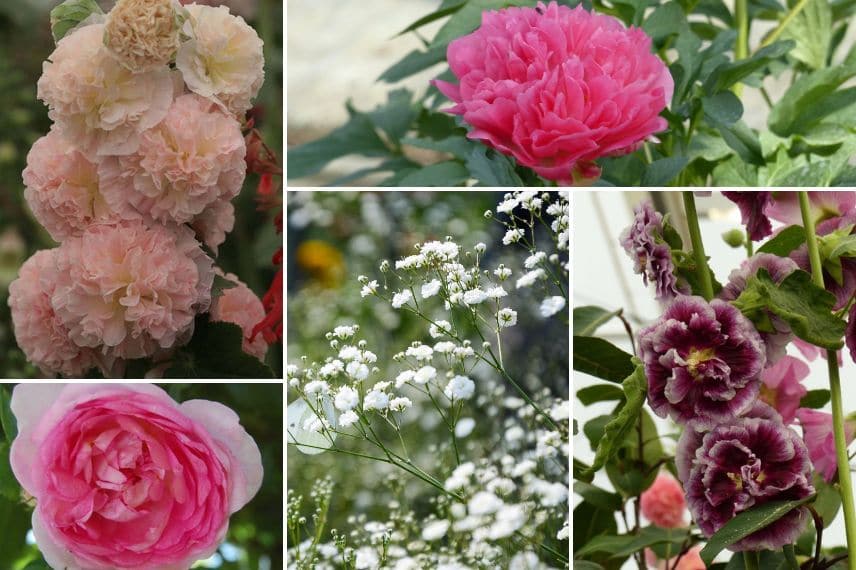
Alcea rosea ‘Chater’s Double Salmon’, Peony ‘Coral Sunset’, Climbing rose ‘Jasmina’, white gypsophila, Hollyhock ‘Crème de Cassis’
Read also
English garden: 10 emblematic plantsIn an English garden
With their natural charm, hollyhocks are among the iconic plants of English gardens. They are often found at the back of famous mixed borders, in a clever blend of blue, pink, and white. Therefore, we will select tall varieties of hollyhocks with white flowers, such as ‘Alcea rosea ‘Chater’s Double White’ or with pink flowers like Alcea rosea ‘Chater’s Double Rose’.
With heights of 2 metres, hollyhocks should be placed at the back of the border, alongside a Delphinium ‘Pacific Blue Bird’ for its long, intense blue flower spikes or a Digitalis purpurea. In the middle of the border, we will install traditional English roses, Phlox paniculata for their flowers gathered in bouquets, and don’t forget hostas for their beautiful decorative foliage. Here too, we can plant smaller hollyhocks, such as the lovely Alcea rosea ‘Fiesta Time’. At the front of the border, we must remember to install groundcover perennials with white, blue, and pink flowers, for example, a hardy geranium or a campanula for its delicate bell-shaped flowers.
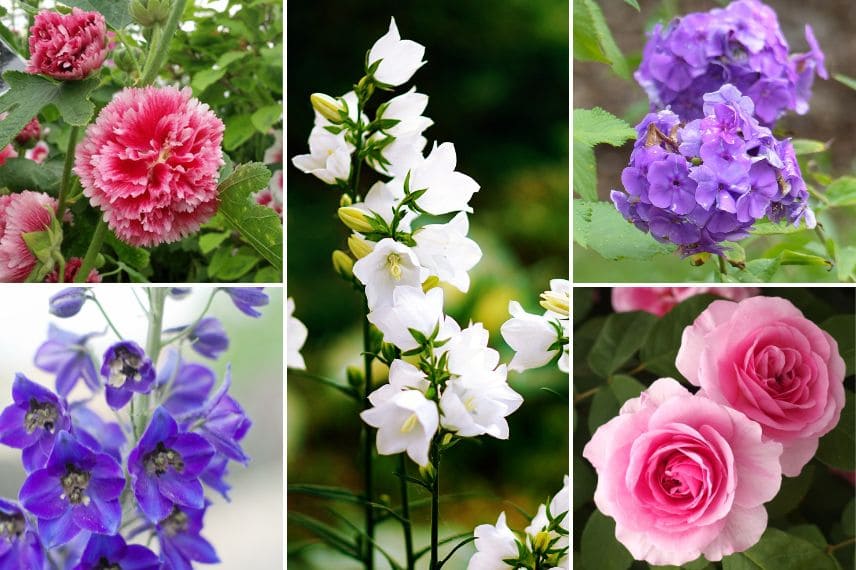
Alcea rosea ‘Fiesta Time’, Delphinium ‘Pacific Blue Bird’, Peach-leaved Campanula, Phlox paniculata ‘Blue Paradise’, and David Austin Rose ‘Gertrude Jekyll’
In a cottage garden
With their tall silhouettes, Hollyhocks structure the herbaceous borders of informal and cottage gardens. Requiring almost no maintenance, they will appeal to the less hands-on gardener. Choose Hollyhocks with white or pale yellow flowers, such as Alcea rosea ‘Sunshine’. If your garden is exposed to winds, opt for smaller varieties, such as Alcea rosea ‘Spring Celebrities White’, which reaches barely 80 cm in height.
White and yellow will pair beautifully with the azure blue of a Wood Sage or a Perovskia. You can also incorporate other perennials that require almost no maintenance, such as a Campanula ‘Lactiflora Loddon Anna’, a Nepeta ‘Racemosa Grog’, and Phlox. An Eryngium ‘Sapphire Blue’, which is nothing more than a lovely blue ornamental Thistle, will add a touch of originality while enhancing the rustic spirit of your garden. Incorporate some grasses, such as Pennisetums or Stipas to bring lightness and movement to the borders.
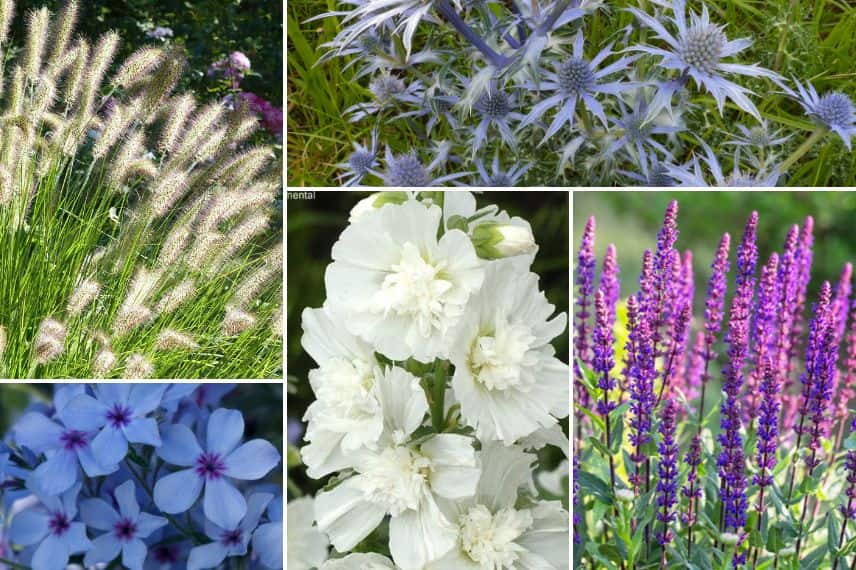
Pennisetum ‘Hameln’, Phlox divaricata ‘Chattahoochee’, Eryngium ‘Sapphire Blue’, Alcea rosea ‘Spring Celebrities White’, Salvia nemorosa ‘Caradonna’
Read also
How to landscape an English garden?In a contemporary garden
With their tall, vertical silhouettes, hollyhocks will find a prominent place in a contemporary garden. Moreover, the delicately crumpled flowering will soften the strict lines of box balls or the round flowers of ornamental allium bulbs. To create a modern atmosphere, it is advisable to favour the harmony of two opposite colours, such as white and black, or white and purple. Thus, one might choose hollyhocks with white flowers, like the beautiful variety ‘Chater’s Double White’, and those with simple black flowers from Alcea rosea ‘Nigra’. If you prefer purple tones, Alcea rosea ‘Chater’s Double Purple’ will surely charm you.
For a combination in purplish black tones, the large Iris germanica ‘Black Suited’ will be particularly vigorous and floriferous. To perfect the scene, a few beautiful grasses will be added, such as the small black Ophiopogon, contrasting with the light green foliage of a Hakonechloa ‘macra’.
On the white side, a Hydrangea arborescens ‘Annabelle’ will bring softness with its magnificent panicles of round flowers. A white Arum will attract attention with the shape of its pure, conical flower. A bit of movement can be introduced by incorporating some steppe lilies or silver candles that will sway with the slightest breeze.
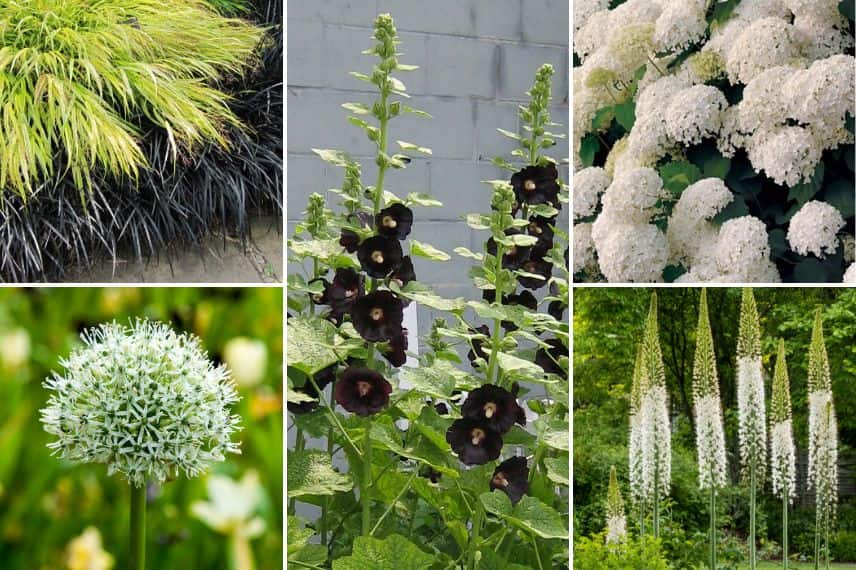
Hakonechloa ‘macra’ and black Ophiopogon, allium ‘mount everest’, Alcea rosea ‘Nigra’, Hydrangea arborescens ‘Annabelle’, steppe lily
In a red and black flowerbed
Very trendy, original, and warm, red and black combine in the garden to bring a touch of exoticism. The hollyhocks with their crimson colour and long flowering period will naturally find their place in this vibrant setting. Among them, the Alcea rosea ‘Pleniflora Rouge’ offers very double pompom flowers in a rich carmine red. The Alcea rosea ‘Mars Magic’ adds exoticism with its single, well-opened flowers in a very pure light red, reminiscent of Hibiscus.
To enhance this tropical atmosphere, install a Crocosmia ‘Lucifer’ and a Lobelia fulgens ‘Queen Victoria’ for their flamboyant red flower spikes. Add a Dahlia ‘Bishop of Llandaff’ for its bright red flowers and copper-bronze foliage, along with Echinaceas ‘Eccentric’ with lovely purple-red pompons, slightly orange.
In this bed, plant the surprising Cosmos ‘Chocolate’, whose young black flowers evolve into dark red at ripeness, with an intoxicating cocoa scent. Add a few touches of black-purple to enhance the red, for example by installing a black Ophiopogon and even a black hollyhock. A Eucomis vandermerwei ‘Octopus’ will bring a sense of adventure with its quirky dark pineapple-shaped flowers and green foliage speckled with black dots.
If you have plenty of space in the garden, don’t hesitate to plant a Cordyline australis ‘Red Star’ for its long, narrow, arching leaves in bronze-red, which are very decorative. The black elder will also be interesting for its finely cut foliage, almost black-purple, and its beautiful pink flowering in June.
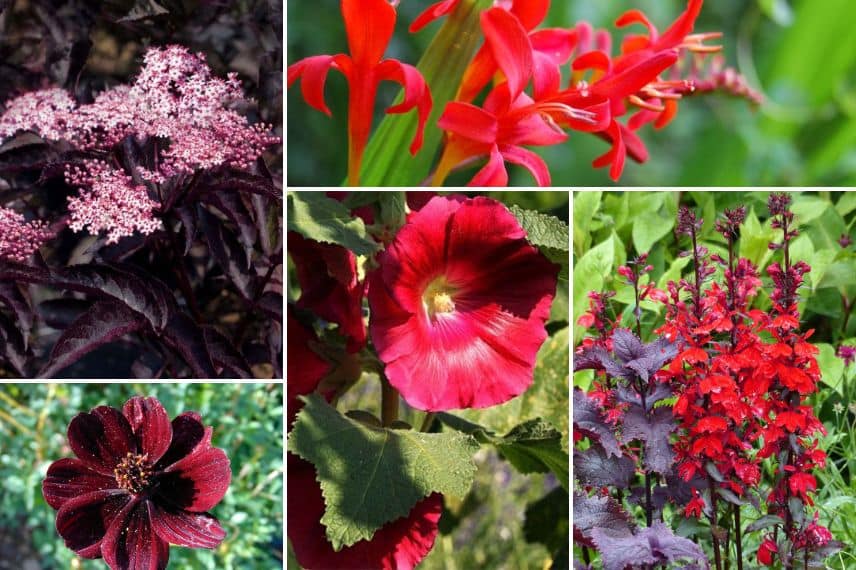
Black elder, Crocosmia ‘Lucifer’, Cosmos ‘Chocolate’, Alcea rosea ‘Mars Magic’, Lobelia fulgens ‘Queen Victoria’
In a bush bed
Hollyhocks will bring splashes of colour throughout the summer to a bed of summer-flowering shrubs or spring-flowering shrubs. It is advisable to choose tall varieties, such as Alcea rosea ‘Simplex’ with single flowers, randomly appearing in shades of white, pink, or purple.
They can be placed alongside a Ceanothus for its generous flowering in dense spikes of blue or light pink. The beautiful exotic flowers of Hibiscus will echo those of the hollyhocks and will renew daily from July to October. We can play with shapes by installing, for example, a Hydrangea ‘Annabelle’ for its rounded flower panicles or a Buddleia davidii ‘Berries and Cream’ for its long arching flower stems.
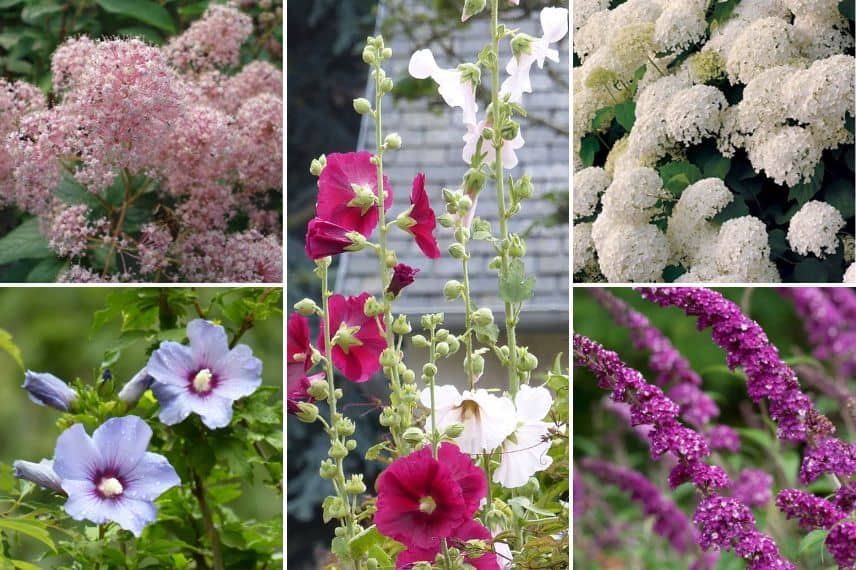
Ceanothus pallidus ‘Marie Rose’, Hibiscus ‘Blue Bird’, hollyhocks, Hydrangea arborescens ‘Annabelle’, Buddleia davidii ‘Berries and Cream’
For further reading
- Find all our varieties of potted hollyhocks and hollyhock seeds
- To learn everything, browse our complete guide on hollyhocks: sowing, planting, caring for
- Subscribe!
- Contents
Comments