





























Associating Hedychiums
To add a beautiful exotic touch to the garden!
Contents
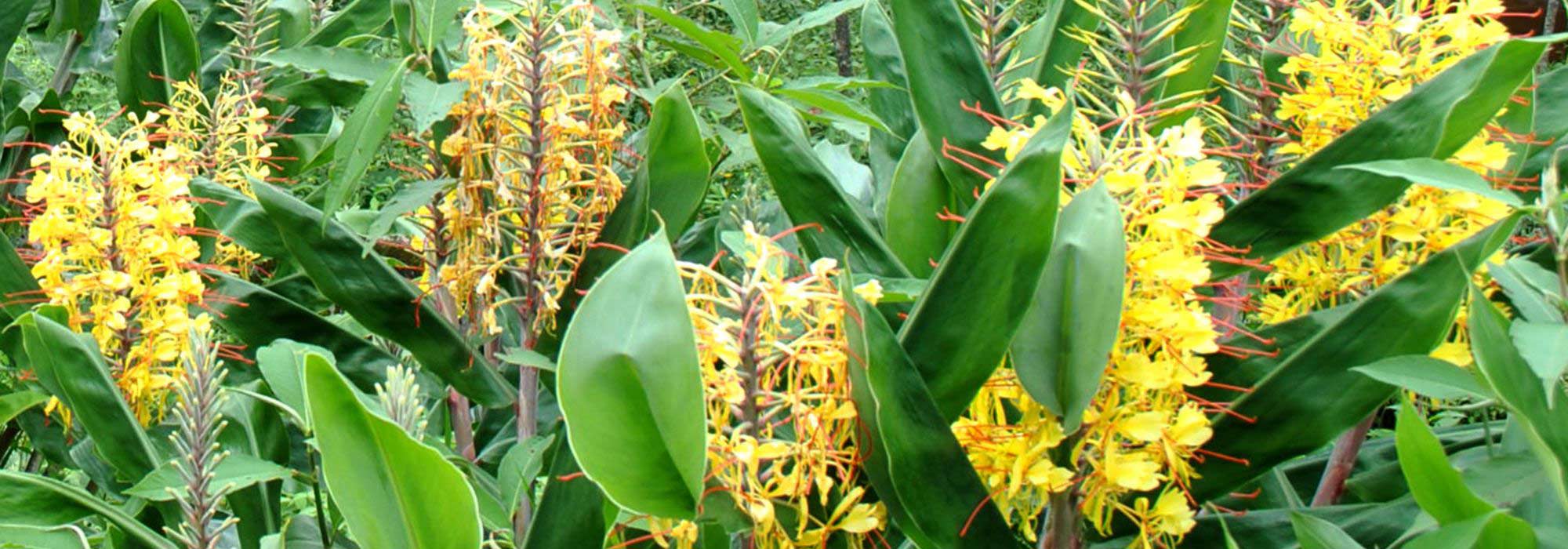
Recognisable by its lush foliage, the Hedychium or Wild Ginger is native to the forests of Southeast Asia and India. Belonging to the same family as Ginger and Turmeric – the Zingiberaceae – it is a rather tender rhizomatous plant that adds a lovely exotic touch when planted in our latitudes. Also known as “Longose”, these generous perennials produce spikes up to 20 cm long, adorned with magnificent fragrant flowers.
Preferring a warm, sunny location, sheltered from strong winds, Hedychiums can indeed be planted in the ground in regions that are not too cold, provided they are protected with a thick layer of mulch. Otherwise, they can easily be placed in pots, allowing for easy shelter during frost.
If you wish to try cultivating these unique plants and bring a breath of exoticism to your garden or terrace, discover our 5 ideas for pairing with Hedychiums!

Among exotic-looking foliage
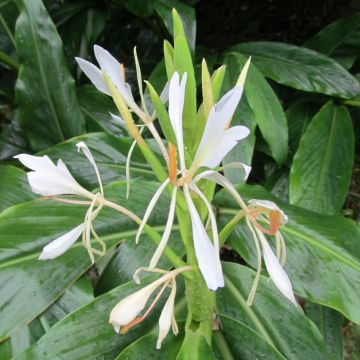
Large rhizomatous plant, highly ornamental with its beautiful leaves reminiscent of those of the banana plant, the Hedychium ellipticum can be happily inserted into a border that highlights foliage. However, it also adds a lovely splash of colour with its spider-like white flowers and orange stamens, emitting a spicy fragrance. Native to the Himalayan mountains, this fairly hardy species can withstand winters down to -10 °C in dry soil and requires water during the growing season.
To keep it company, plant a Colocasia: one can only admire their enormous leaves, which are also remarkably ornamental and completely infused with exoticism. The Colocasia ‘Blue Hawaii’, for example, is a modest-sized variety (1.20 m in height) that develops large heart-shaped leaves, heavily veined and edged in blue-violet to purple against a green background, supported by stunning almost black petioles. Not very hardy, it is best suited for regions with the privileged climate of the Mediterranean coast, in rich, moist soil, with sun only in the morning. With winter protection, it can withstand temperatures down to -5 °C.
The Tetrapanax papyrifera ‘Rex’, or rice paper plant, half shrub – half perennial, will form a small tree with a very exotic appearance in mild climates, ideal for planting in the background, thanks to its large, beautifully cut grey-green leaves. The Phormiums, always interesting in this style of landscaping, will remain attractive throughout the seasons, their slender leaves either standing tall towards the sky or cascading in generous tufts. Some, like the Phormium ‘Jester’, offer shades of pink, copper, red, and bronze or chocolate brown edged with mint green like the New Zealand flax ‘Chocomint’. If you are tempted to adopt a banana plant, plant the classic Musa basjoo, which is easy to grow, particularly due to its excellent resistance to cold, wet winters. The tree fern Dicksonia fibrosa, which matures to form a black stipe, bearing a wide tuft of lush emerald green leaves giving it a strong exotic character, will complete and perfect this desired exotic tableau!
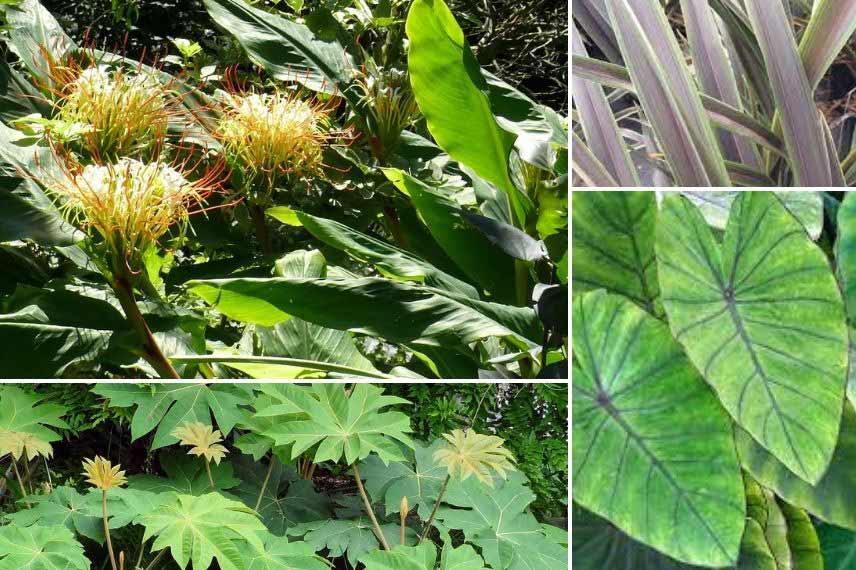
Hedychium ellipticum, Phormium ‘Chocomint’, Colocasia ‘Blue Hawaii’ and Tetrapanax papyrifera ‘Rex’
In a flowerbed of vibrant hues
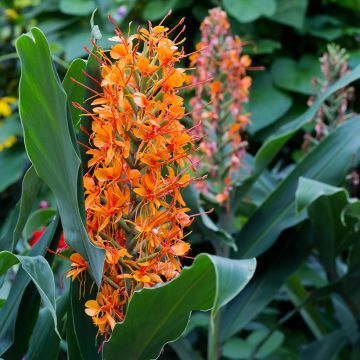
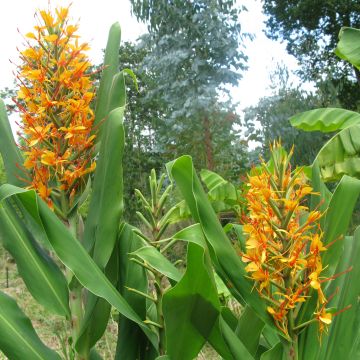
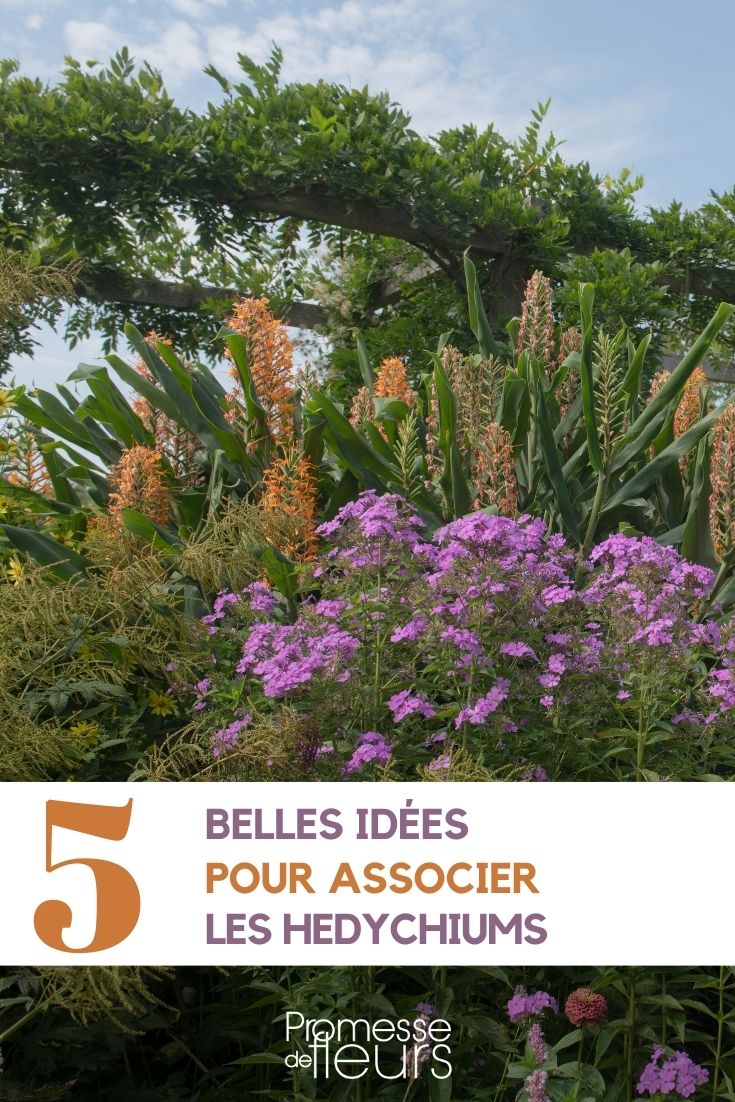
Forming stems adorned with long, glossy green leaves, Hedychium coccineum ‘Tara’ bears large spikes of flowers in August that are light as butterflies, in a yellow-orange hue. This ornamental ginger has the advantage of being hardy down to -15 °C, and it regrows from its stump in spring. ‘Tara’ will eventually form an impressive clump, 70 to 90 cm wide, made up of leafy stems that can reach up to 1.20 m in height. Its inflorescences can measure up to 30 cm and attract numerous bees. In a bed of yellow, orange, and red tones, plant alongside Crocosmias, bulbous plants with flamboyant spikes that are very floriferous from July to October.
The Blood Castor Ricinus communis ‘Impala’ will also bring colour with its large, purple, palmate leaves borne on red stems. The fruits it produces are very decorative and bright red. The impressive size of this large annual herbaceous plant (up to 1.2 m tall) allows it to be placed at the back of a border, and its ramified habit resembles that of a small bush. At the back of the border, you can also install a Cotinus. Known as the Smoke Tree for its spectacular flowering, with pink, fluffy panicles standing out against purple foliage, as seen in ‘Royal Purple’, golden like ‘Golden Lady’, or green like ‘Smokey Joe’.
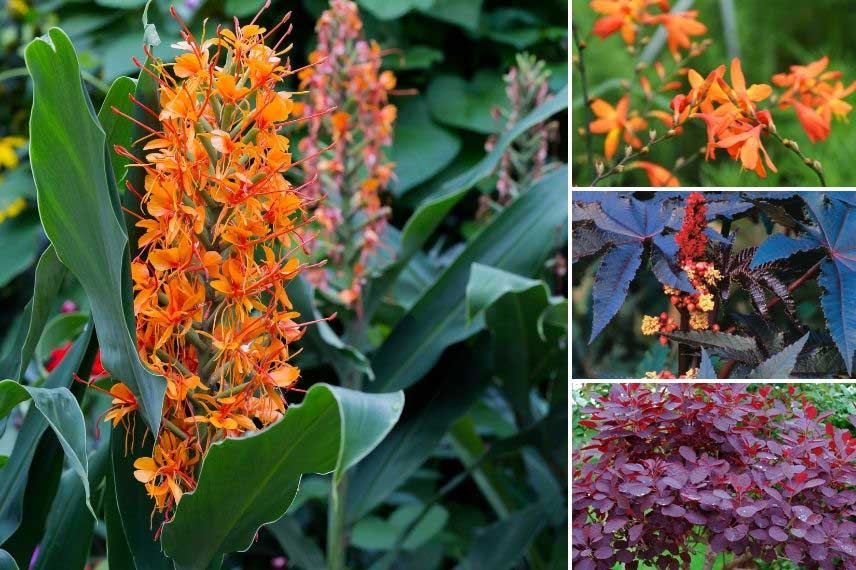
Hedychium coccineum ‘Tara’, Crocosmias, Ricinus communis ‘Impala’ and Cotinus ‘Royal Purple’
Discover other Hedychium
View all →
Available in 0 sizes
Available in 1 sizes
Available in 2 sizes
Available in 1 sizes
Available in 1 sizes
Available in 1 sizes
Available in 1 sizes
Available in 1 sizes
Available in 1 sizes
Available in 1 sizes
In a layout with an Asian fragrance
Himalayan botanical species that withstands cold down to -10/-12 °C, Hedychium densiflorum develops slender pseudo-trunks in spring, bearing long, sword-shaped dark green leaves. Its dense clump is adorned in late summer with yellow-orange flowers, gathered in upright spikes. Grown in partial shade, in fertile, cool, and well-drained soil, it will adapt very well to many regions along the Atlantic coast of our country, for example. For an Asian atmosphere, plant it alongside a Japanese Maple such as Acer palmatum ‘Summer Gold’, a small tree reaching 3 m in height and 2.5 m in spread, elegantly ramified. Particularly bright in spring with its yellow foliage, it will turn light green in summer, taking on sumptuous orange hues in autumn. In the foreground, clumps of Hakonechloa macra ‘Albostriata’, a semi-evergreen grass with beautifully finely striated green foliage, will enliven the scene. Their bamboo-like appearance will fit perfectly in this Asian-inspired garden.
Speaking of bamboo, consider a Chimonobambusa quadrangularis with its stunning cascading evergreen foliage, keeping in mind to give it space due to its running character. You may also install a rhizome barrier to prevent it from spreading uncontrollably.
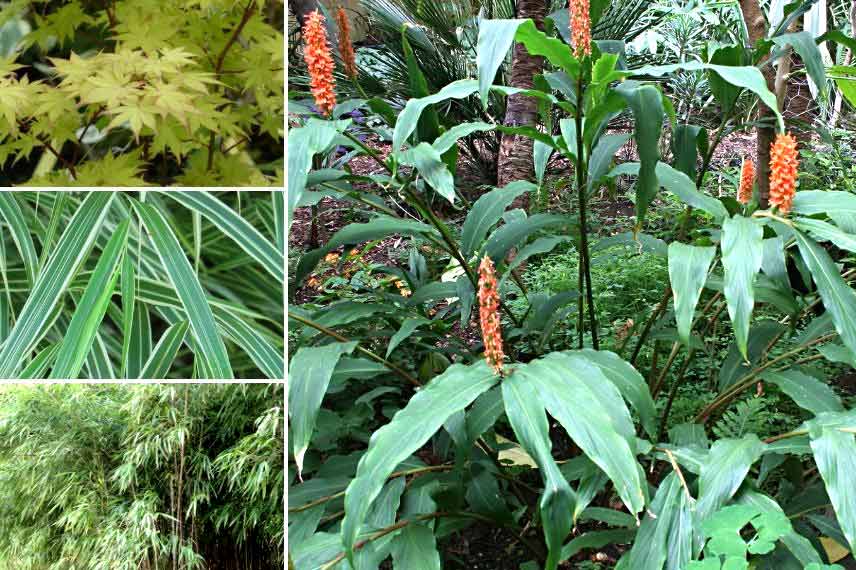
Acer palmatum ‘Summer Gold’, Hakonechloa macra ‘Albostriata’, Chimonobambusa quadrangularis and Hedychium densiflorum
In a contrasting harmony of yellow and blue
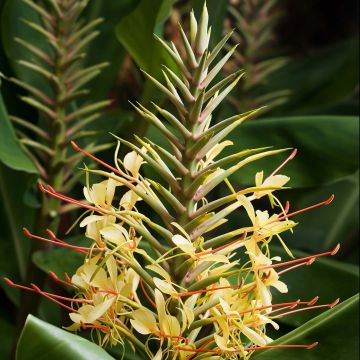
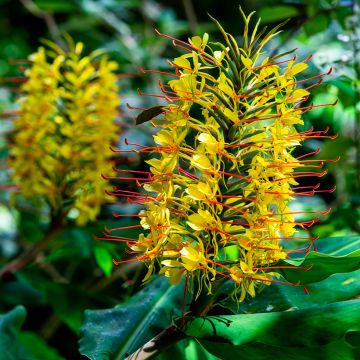
Adorned with stunning yellow flower spikes enhanced by red stamens, Hedychium gardnerianum will elegantly take its place in a composition that always succeeds in the garden, combining yellow and blue. Plant alongside the vibrant Arum ‘Black Magic’, a prized hybrid for its green foliage marbled with white and its sumptuous lemon-yellow summer flowering.
Tropical-origin bushes that require warmth, dappled sunlight, and fertile, light soil, the Tibouchina urvilleana and Tibouchina ‘Groovy Baby’ will literally disappear under a multitude of large purple flowers throughout the beautiful season. The former will form a lovely bush of 2.5m in height, while the latter, with a more compact habit, will maintain the appearance of a small, bushy, rounded shrub of less than 1m throughout its life. Complete the ensemble with generous masses of blue Hostas with mauve flowers like ‘Blue Cadet‘.
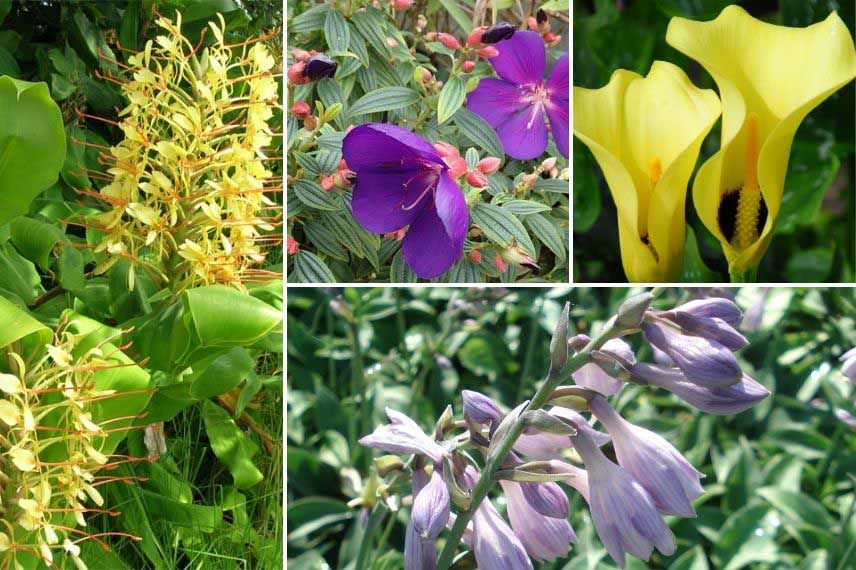
Hedychium gardnerianum, Tibouchina urvilleana, Arum ‘Black Magic’ and Hosta ‘Blue Cadet’
In a pot on the terrace
The cultivation of ornamental Ginger is not exclusively reserved for gardeners in regions with a privileged climate. If you don’t want to resist the temptation of its wonderful flowering and generous foliage, plant it in a pot. Just ensure you have a container large enough to guarantee its development and to be able to winter it sheltered from frost.
You can thus combine Hedychiums with other tender plants that will be placed out of the frost with it in winter. For a decidedly exotic look, plant a mini-palm Cycas revoluta in a beautiful terracotta pot, placing it in full sun, and consider the Papyrus Cyperus alternifolius, generous and fast-growing. You can cultivate it indoors during the cold season. For this, place it in a pot without drainage holes at the bottom and ensure that its root ball is always kept moist. And to add a flourish, place pots filled with white Agapanthes. Brighter than the blue-umbelled varieties, they will add a touch of real elegance near your garden seating area!
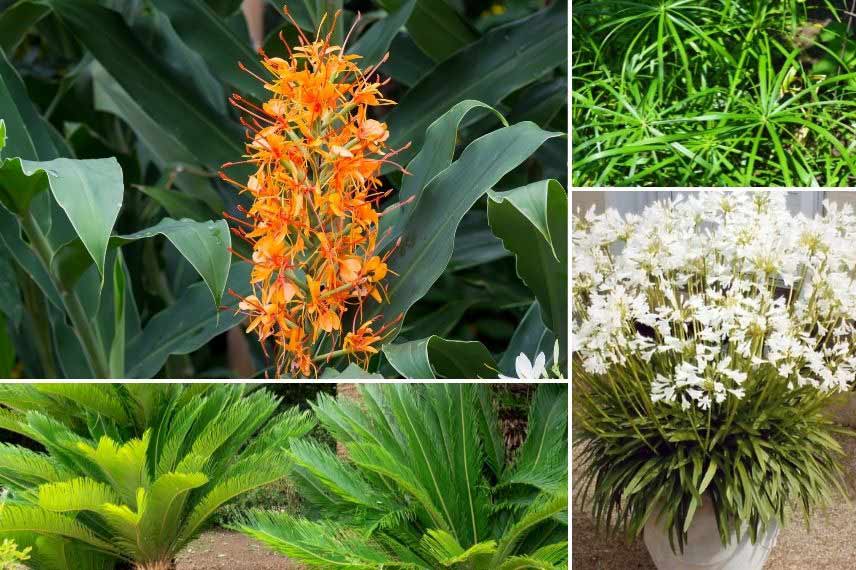
Hedychium, Cyperus alternifolius, white Agapanthes in pot and Cycas revoluta

- Subscribe!
- Contents
Comments