





























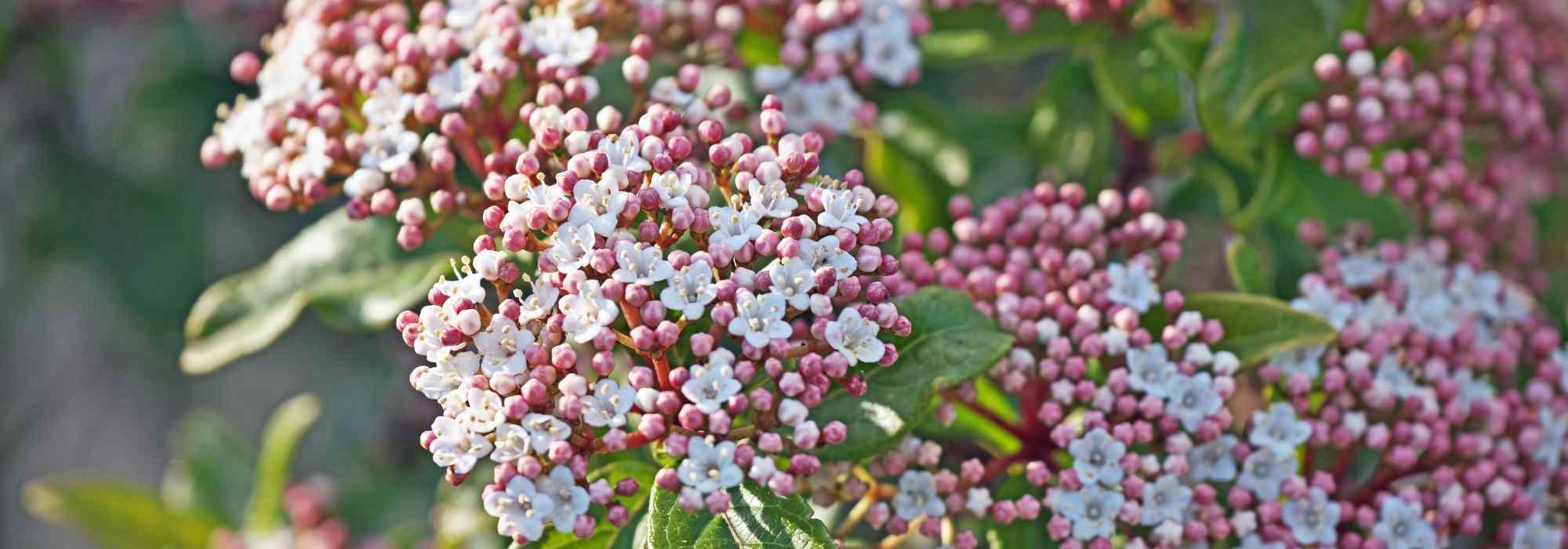
Pairing ideas with Laurustinus
6 ideas for pairing Laurustinus, in the garden or on the terrace
Contents
Laurustinus is a shrub that has been established in many gardens for generations, valued for its evergreen appearance and winter flowering, which is white and bright. Sometimes considered outdated, it remains a reliable choice due to its ease of establishment in various exposures and soil types, as well as its robustness. Beneath its unassuming exterior, Viburnum tinus can fit into many scenes in the garden, whether with the typical species featuring dark leaves or with the numerous ornamental varieties, boasting more pink flowers or variegated leaves.
We offer several associations with laurel tin, whether it is already in place in the garden or if you wish to install it in a bush display, a hedge, or as part of a composition on the terrace.

In a winter garden
The dark, evergreen foliage of laurustinus brings a valuable backdrop when creating winter beds, where colours can be played with. It can be used like a conifer to provide the right texture to the bed, highlighting other more architectural or colourful plants. The plants placed in front, chosen for their colourful bark or soft flowering, will stand out particularly well.
One or two Viburnum tinus types should be placed at the back of the bed, ideally pruned into a round or oblong shape, alongside, for example, a Thuja occidentalis, and a Euonymous fortunei ‘Emerald Gaiety’ lower down, in the centre of the bed. These evergreen shrubs complement each other well with their distinct shapes and foliage: dark green for the laurel, light green for the Thuja, and cream-variegated for the spindle tree. Several winter beauties will rhythmically enhance the overall lightness and colour: some Cornus alba for a blaze in the heart of winter (‘Sibirica’ or ‘Winter Flame’, for example), other woods of immaculate white like Rubus cockburnianus, and why not a Miscanthus sinensis for the grace of its parchment-like spikes.
A lower stratum, composed of Ophiopogon planiscapus ‘Nigrescens’, Snowdrops, and Bergenias, as well as some winter heathers (Erica carnea and x darleyensis), will look splendid while also serving as groundcover. Finally, another viburnum, this one delightfully fragrant, like the Viburnum bodnantense ‘Dawn’ which covers itself with small pink flowers in January or February, will add delicacy to this bed in the heart of winter.
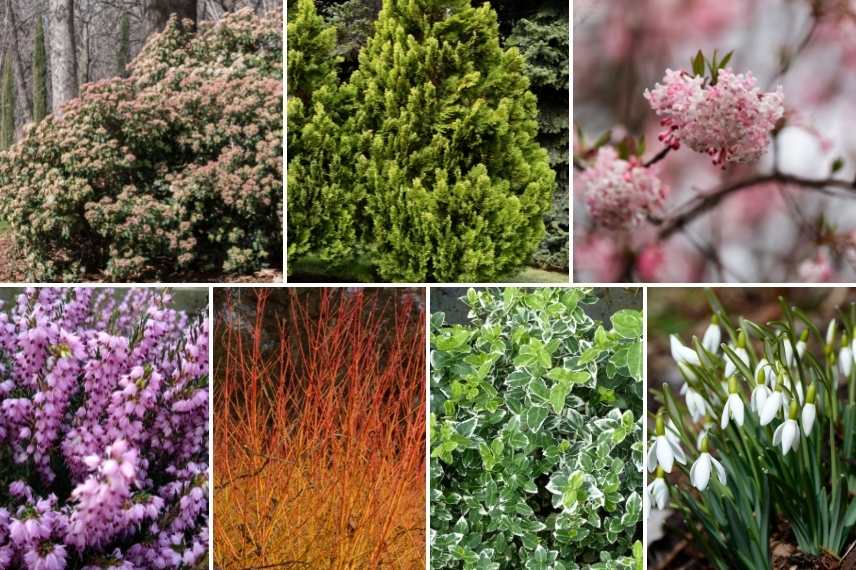
Viburnum tinus, Thuja occidentalis, Viburnum bodnantense, Erica carnea, Cornus alba ‘Winter Flame’, Euonymous fortunei ‘Emerald Gaiety’ and snowdrop
Structured, in a Mediterranean garden
Well-suited to very sunny locations and tolerant of drought, the laurustinus is an ideal candidate for creating some permanent structures in a Mediterranean garden. For this use, it is advisable to prune it to give it a nice rounded shape, for example, or to shape it into semi-low borders.
It will integrate wonderfully into a structured Provençal garden where the harmony of shapes—erect, rounded, or conical—will provide the essential volume, the beauty of the local flora with its colourful and fragrant bases, and the persistence of numerous trees and bushes will be an additional asset to enliven the garden throughout the year.
For this structured southern garden, opt for timeless, reliable, and very effective choices, along with a fairly limited plant palette to better highlight it: lavenders in abundance, Provence cypress, an olive tree for its remarkable silhouette, creeping and bushy rosemaries, Helichrysum orientale or Helichrysum italicum for their grey foliage and beautiful yellow flowering. A few terraces can be inserted here and there in the case of a medium or large-sized garden.
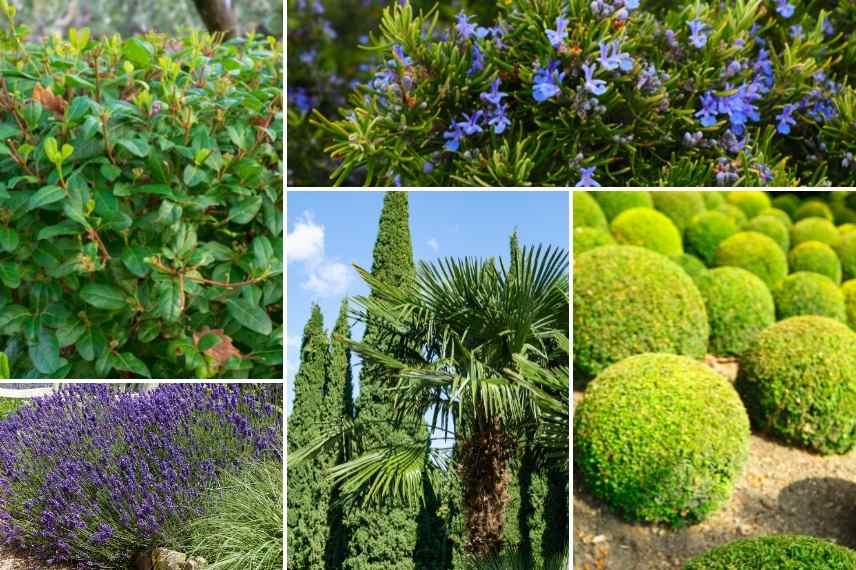
Viburnum tinus pruned, rosemary, lavender angustifolia ‘Hidcote’, Provence cypress, and Trachycarpus fortunei with box in balls
Discover other Shrubs A to Z
View all →
Available in 1 sizes
Available in 1 sizes
Available in 1 sizes
Available in 1 sizes
Available in 0 sizes
Available in 1 sizes
Available in 1 sizes
Available in 1 sizes
Available in 1 sizes
Available in 1 sizes
In a free-standing hedge
Very much at home in garden hedges, whether for separation or delineation, laurustinus is a bush that pairs well with other flowering bushes, often outpacing its companions in the border with its long flowering period from January to April, sometimes even starting as early as December. For a free-standing hedge that is easy to maintain, many cultivars of Laurustinus are suitable, such as Viburnum tinus ‘Purpureum’ with its purple foliage emerging in spring, or the species type, adaptable to all situations, or even the variety ‘Lisarose’ with particularly rosy flowers.
The ideal is to alternate evergreen and deciduous bushes, and to stagger the flowering periods: Weigela, Syringa, and Abelia grandiflora or Abelia chinensis create a beautiful combination of soft, spring-like flower hues that continue well into autumn with Abelia. For the evergreen stratum in a tall hedge, consider a Prunus lusitanica ‘Angustifolia’ with its beautiful glossy leaves, and a Eleagnus ebbingei with its silvery reflections. An Abeliophyllum distichum, the white cousin of forsythia, can also be included in a slightly lower hedge, flowering concurrently in winter. A Ceanothus or evergreen Laurustinus will add substance and colour in milder regions, and an Osmanthus fragrans aurantiacus will also bring an interesting orange and fragrant note late in the season.
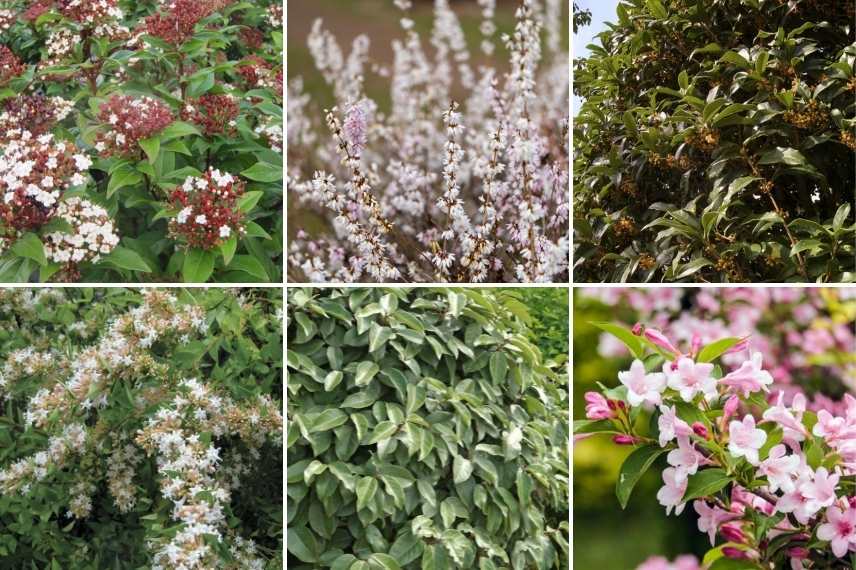
Viburnum tinus ‘Lisarose’, Abeliophyllum distichum in winter bloom, Osmanthus fragrans ‘Aurantiacus’, Abelia chinensis, Eleagnus ebbingei and Weigela florida ‘Rosea’
Read also
Viburnum: 8 successful pairing ideasIn a classic garden
Laurustinus has the versatile quality of being able to thrive in radically different types of gardens. It can perfectly fit into a formal garden, of classic design, known as a French garden: this is a garden where the flowerbeds are organised in a very defined manner, arranged in rectangles bordered by low edges (often boxwood), with rather narrow, linear paths, which can also be the case in a vicar’s garden or in a rose garden, for example.
As Laurustinus responds well to pruning, it can accompany other plants with very varied habits, always ensuring to maintain a neat shape, regardless of the chosen form (ball or on a stem). For instance, it can create a structured duo in perfect symmetry at the end of a path, defining it. The flowerbeds will be planted with soft and structural perennials, such as a combination of lupins, steppe lilies, and roses that bring a sense of classicism and great elegance. A few topiaries will be wisely positioned throughout. Other contrasting evergreens, such as purple Berberis, also blend well into this classic atmosphere.
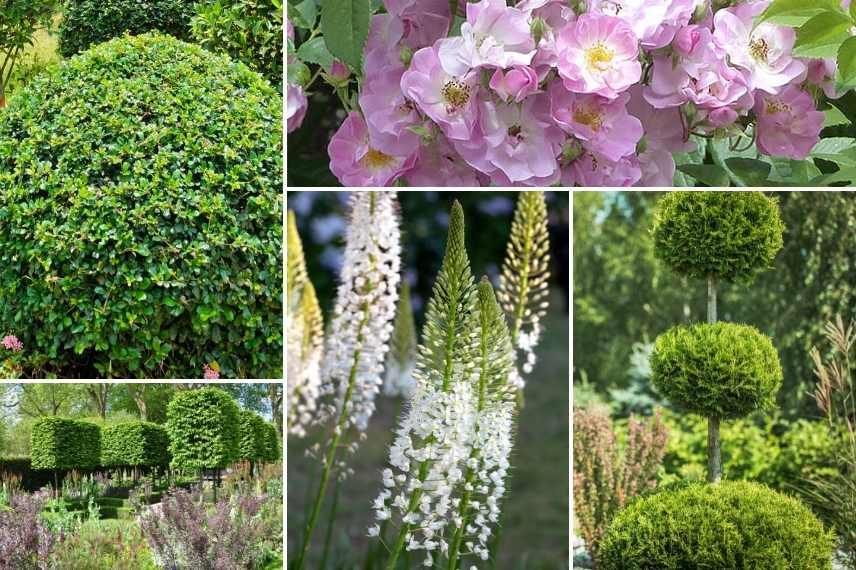
Viburnum tinus pruned into a ball, old rose, mix of perennials, Eremurus himalaiacus, and Thuja shaped into topiary
In a large pot on the terrace or balcony
You can also train a Laurustinus on a stem on a terrace or balcony to form a charming little bush, whose round, fully flowered head in the coldest months will bring a lot of elegance. This type of silhouette will suit a balcony, even a narrow one or a long one. It will be perfectly complemented by Oriental Hellebores at its base, which will bloom for a long time in winter.
Around a Viburnum tinus ‘Eve Price’, with its pale pink flowers and small foliage perfect for this use, you can also install, depending on your available space, a few other large evergreen pots, as well as deciduous shrubs that will enliven the scene in spring or summer: a good idea is to complement our laurustinus on a stem with another subject, evergreen like a Trachelospermum jasminoides, also trained on a stem, which will bloom later in June, filling the terrace with fragrance, or a privet (Ligustrum), a dwarf ornamental apple like Malus Toringo ‘Tina’, or even invite a standard rose to bring a bit of colour all summer long.
Evergreen viburnums blooming a little later in May or June, taking over, like Viburnum cinnamomifolium or Viburnum davidii, have a lovely rounded habit and glossy, veined foliage. Finally, for contrast with smaller leaves, a Pittosporum tenufolium, also evergreen, will be perfect, chosen in a variegated version, and of varying sizes (‘Green Elf’, ‘Silver Ball’).
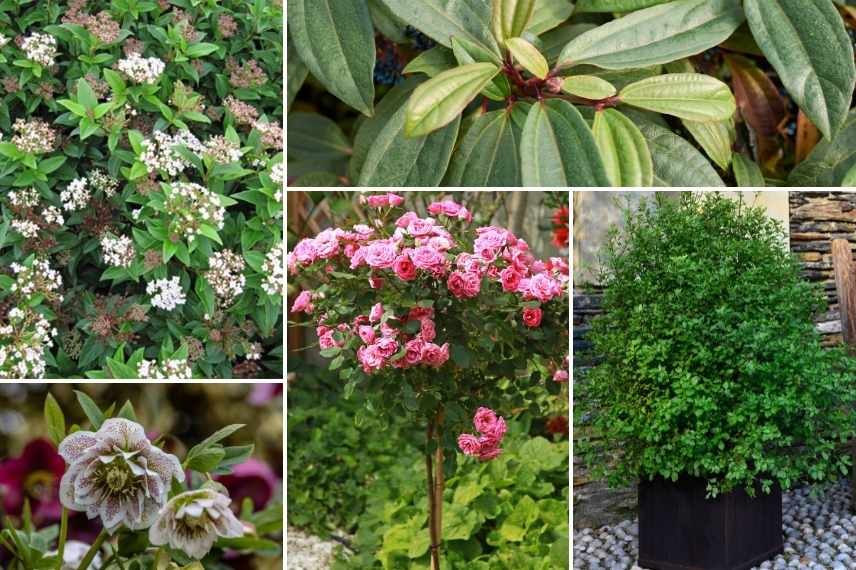
Viburnum tinus ‘Eve Price’, Viburnum davidii, Helleborus ‘Cinderella’, standard rose, and Pittosporum tenuifolium
In a courtyard, a patio, or a small shaded garden
Small spaces with limited light deserve some evergreen and variegated foliage to brighten the area. Viburnum tinus has the advantage of thriving in so-called difficult conditions, often found in shaded courtyards, patios, and small urban gardens: lower light levels, poor-quality soil, and urban pollution. As long as the soil is adequately drained in such spaces, a variegated variety of laurel, Viburnum tinus ‘Variegatum’, will enhance a flowerbed with its leaves of a beautiful green edged with cream yellow, although it may flower a bit less than in sunnier situations.
In a sufficiently large pot (with a minimum diameter of 60 cm) or in the ground, pair your variegated laurustinus with shrubs that perform well in pots, are low-maintenance, and have ornamental foliage: an Aucuba japonica Crotonifolia for its cream and yellow variegation, a Pieris with pink flowers like ‘Katsura’, a Choisya for its graceful, white, repeat-flowering in autumn, and one or two hostas that thrive in shade, such as the elegant Hosta ‘Stiletto’ with its fine cream-edged leaves. In the case of a garden, install some groundcovers that will flower in white and pink tones to accompany the laurustinus: Anemones blanda ‘White Splendor’ and long-flowering Ipheion, or a carpet of pink lily of the valley, for example. For summer, a compact hydrangea like ‘Cap Sizun’ will provide the necessary splash of colour.
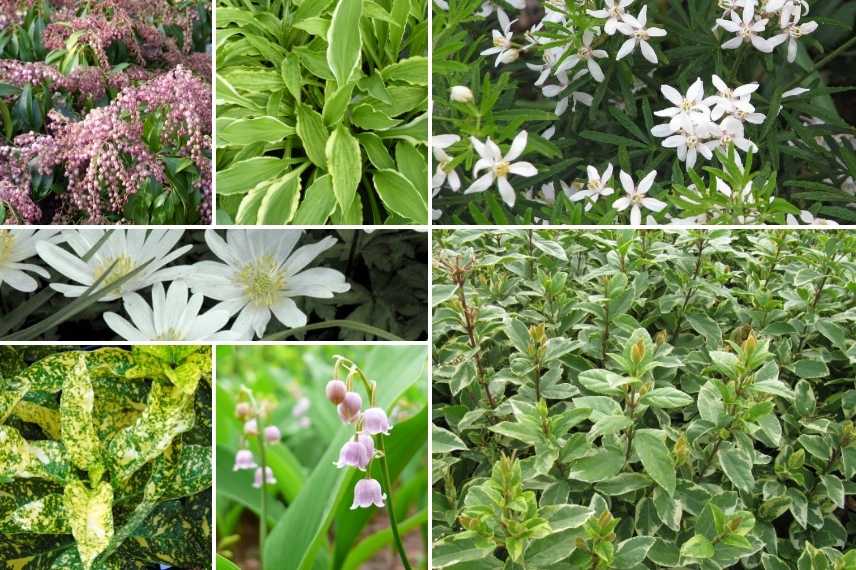
Pieris japonica ‘Katsura’, Hosta ‘Stiletto’, Choisya ternata ‘White Dazzler’, Anemone blanda ‘White Splendor’, Aucuba japonica ‘Crotonifolia’, Convallaria majalis ‘Rosea’, and Viburnum tinus ‘Variegatum’
- Subscribe!
- Contents
![[naked] associations viburnum tinus in garden and on terrace](https://www.promessedefleurs.ie/blogwp/wp-content/uploads/2022/11/Associer-le-laurier-tin.jpg "Associate the bay laurel")
Comments