






























Alternative to lawn: planting creeping dichondra
A low-maintenance groundcover plant to replace the lawn.
Contents
To achieve a clean and uniform expanse of greenery in the garden, lawn is not the only option. It requires care, time, and does not adapt to all growing conditions (drought, shade, sea spray, etc.). The creeping dichondra (Dichondra repens) is one of those groundcover plants that offers a good alternative to lawn.
Let’s see how to easily achieve a beautiful lawn with this plant with minimal maintenance.

The advantages of creeping dichondra as a lawn replacement
The Dichondra repens has many advantages that allow it to easily replace lawn. It is a perennial plant that belongs to the same family as bindweeds or morning glories, plants well-known for their ability to spread and colonise space effortlessly.
- It has a spreading habit reaching about 50 cm in width and 10 cm in height. Its small, round, bright green leaves are very elegant; they form a true well-maintained and regular green cushion. This foliage persists if winter frosts are not too severe (below about -8°C). The villous stems quickly create new roots at each node, promoting the plant’s expansion.
- The dichondra tolerates all exposures. It will even thrive in dense, dry shade, where few plants can flourish. It also tolerates salty soils, sea spray, pollution, and slightly calcareous soils.
- The plant can withstand occasional foot traffic, meaning a few passes without intensive use.
- It does not require mowing and needs very little maintenance.
- It is hardy down to about -10°C and has good longevity.
- It can be mixed with other lawn alternatives (see dedicated paragraph).
As a bonus, it offers a small white and green flowering at the end of spring, between May and June.
The creeping dichondra is therefore the perfect lawn alternative for dressing areas with light foot traffic, in shaded exposure and mild climates. Grow it to decorate the edges of slabs or stepping stones, at the foot of flower beds or hedges, in rockeries or on slopes. It is best used on small areas, not exceeding 50 to 100 m² maximum.

The Dichondra repens develops into a low carpet
Where to plant creeping dichondra?
Dichondra repens can tolerate all exposures, but it thrives in shaded conditions and in fairly cool (moist without excess) soil. The stems will be more vigorous and the leaves larger than in sunny exposure or in dry soil.
Our groundcover will flourish in fairly light and draining soil (which does not retain excess water), but humus-bearing (rich in organic matter).
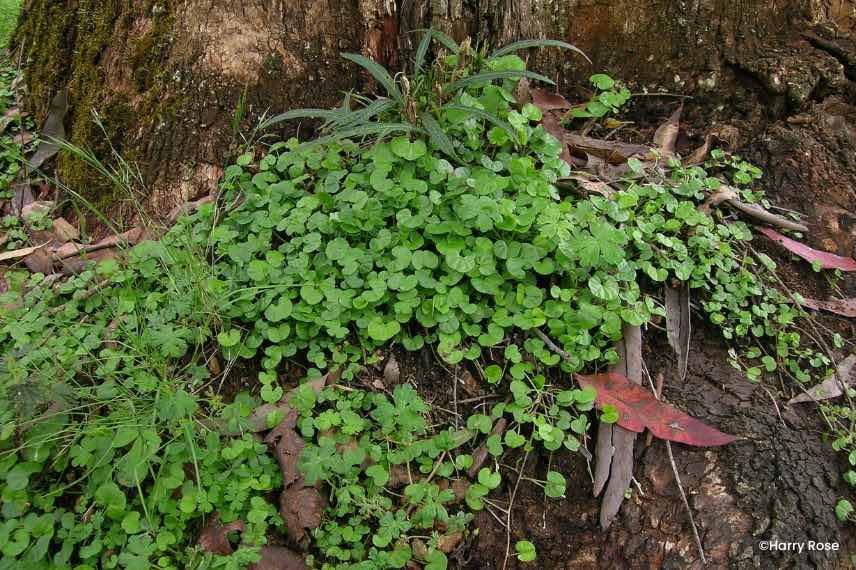
Dichondra repens prefers cool, shaded soil, here under a tree
Discover other Alternatives to lawn
View all →
Available in 2 sizes

Available in 0 sizes

Available in 2 sizes

Available in 2 sizes

Available in 1 sizes

Available in 1 sizes

Available in 1 sizes

Available in 2 sizes

Available in 2 sizes

Available in 1 sizes
How to plant creeping dichondra?
Ideal Planting or Sowing Period
The ideal planting period occurs in early spring, between March and May depending on the regions. Just wait until the last risks of frost have passed.
It is also possible to sow Dichondra repens seeds directly in place in March-April.
Soil Preparation
To ensure that creeping dichondra can develop without competing with other plants, it is essential to thoroughly clean and prepare the soil before planting or sowing.
To do this:
- use a hoe or a weeder to remove all existing herbs and plants;
- loosen the soil to a depth of at least 30 cm using a spade and remove large stones;
- if your soil is heavy and clayey, mix it with river sand or horticultural compost; work the mixture well to make it homogeneous;
- use a rake to smooth and level the surface.
Planting Density
To create a beautiful dense and homogeneous alternative lawn, count about 4 to 6 plants (pots) per m². Maintain a distance of about 40 cm between each.
When sowing, a 500-gram box covers approximately 50 m², at a rate of 10 g per m².
Sowing Steps
- Sow by scattering, that is, by evenly spreading the seeds by hand over the entire area to be filled.
- Lightly rake to cover the seeds with soil.
- If you have a lawn roller, roll it over the entire surface to ensure the seeds adhere well to the soil.
- Water gently to avoid pushing the seeds too deep.
- Keep moist (in the absence of rain) until germination.
Planting Steps
- Using a shovel, dig planting holes slightly larger than the size of your plants.
- Place a layer of well-worked soil at the bottom of the hole so that the plant’s roots can easily develop.
- Position your clumps in the centre of the holes and cover with soil.
- Firm down with your fingers.
- Water generously.
Read also
Lawn replacement: ideas and solutionsMaintenance after installation
To ensure it can settle in without difficulty, our dichondra should not be subjected to competition: therefore weed frequently and carefully during the first year. After that, regular weeding 2 to 3 times a year will be sufficient.
Our groundcover can withstand temporary drought. Conversely, it fears stagnant moisture. However, regular watering will be necessary in the southern Midi or southern Atlantic regions (about once or twice a week), especially during the first year of establishment.
To promote the growth of your carpet of plants, you can apply lawn fertiliser in spring. It will release nutrients slowly over several weeks.
Dichondra repens does not need to be mown. But if you wish, you can carry out a maintenance mowing or pruning with shears in autumn.

A careful and weeded carpet of Dichondra repens between slabs
Pairing creeping dichondra with other alternatives to lawn
The Dichondra repens can easily be grown alongside other alternatives to lawn, which thrive under the same growing conditions.
In full sun or partial shade, for example, plant it next to Roman chamomile Chamaemelum nobile ‘Treneague’, Pratia pedunculata, and creeping vervain Lippia nodiflora.
In shade, try lesser periwinkle Vinca minor or creeping bugle Ajuga reptans.

Here, the Dichondra repens is mixed with ivy, Hedera helix, and clover, Trifolium pratense
- Subscribe!
- Contents

Comments