





























Almond tree: how to choose the right variety?
Our Buying Guide
Contents
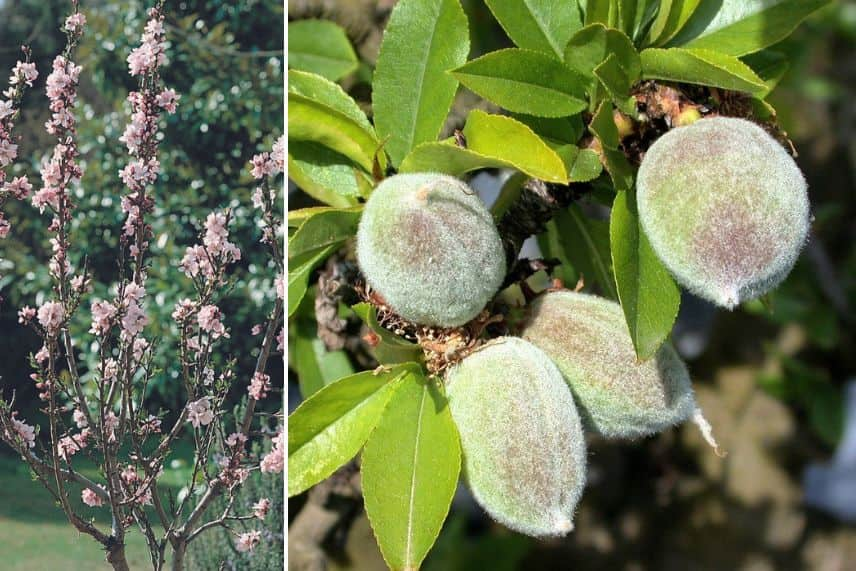
How can one not succumb to the charm of almond trees in bloom, with delicate pale pink-tinged white blossoms that, from February, perfume the surroundings? The first fruit tree of the year to flower, the almond tree (Prunus dulcis syn. Prunus amygdalus) is blessed by pollinating insects which emerge from their winter dormancy. Insects are still relatively few in number, but they nonetheless ensure pollination of almond trees (although today self-fertile varieties have been developed).
Belonging to the Rosaceae family, the almond tree forms a handsome fast-growing tree, obviously much appreciated for its sumptuous flowering which blooms on bare shoots. This flowering is all the more interesting as it yields drupes that split open to reveal the famous almonds. Provided that late frosts have not compromised this harvest! A harvest that takes place in two phases, June–July for fresh almonds, from late August to October for dried almonds.
Fully hardy (down to -25 °C), the almond tree can potentially be cultivated anywhere in France. That said, to obtain an almond harvest, a few criteria are essential, largely related to pollination or climate.
Discover our selection of almond tree varieties best suited to different criteria.
According to tree size
The almond tree is a fruit tree highly sought after for its aesthetic value. Its flowering, white with a pinkish tinge, is utterly divine. Perhaps because it occurs on leafless branches at a time when winter is still very much present. Once fertilised, these flowers will bear almonds ready for harvest in early autumn. One can therefore grow the almond tree as much for its flowering as for its fruiting.
The almond tree can reach 8 to 12 metres in the wild, but the varieties most commonly grown in orchards display a height of 5 to 7 m with a spread of 4 to 6 m. Therefore, a garden needs to be sufficiently large to plant an almond tree as a standalone specimen where its flowering will bring a real touch of refinement in late winter.
However, it is perfectly possible to grow an almond tree in a smaller space, in a pocket garden, or even on a balcony or terrace. In a small garden, simply favour trees trained to a half-standard. For the balcony or terrace, pot culture is essential. Some almond varieties have been developed to stay dwarf. Thus, the variety ‘Garden Prince’ reaches only 1 m in height and a width of 50 cm at maturity. Originating in North America, this self-fertile variety with an erect habit particularly enjoys the shelter of a wall. Bearing fruit 2–3 years after planting, it produces thin-shelled almonds, even north of the Loire.
The almond tree ‘Garden Prince’ is grown in a pot on a balcony or terrace
In the ‘Fruit Me’ series, the self-fertile ‘Almond me’ also shows limited growth (3.5 m by 3 m in open ground, considerably less in a pot) which allows it to be grown in a small garden, or on a balcony or terrace. It actually adapts its growth to the space available to it. This almond tree has the peculiarity of producing thin-shelled almonds from the very first year.
Depending on the type of almonds and their flavour.
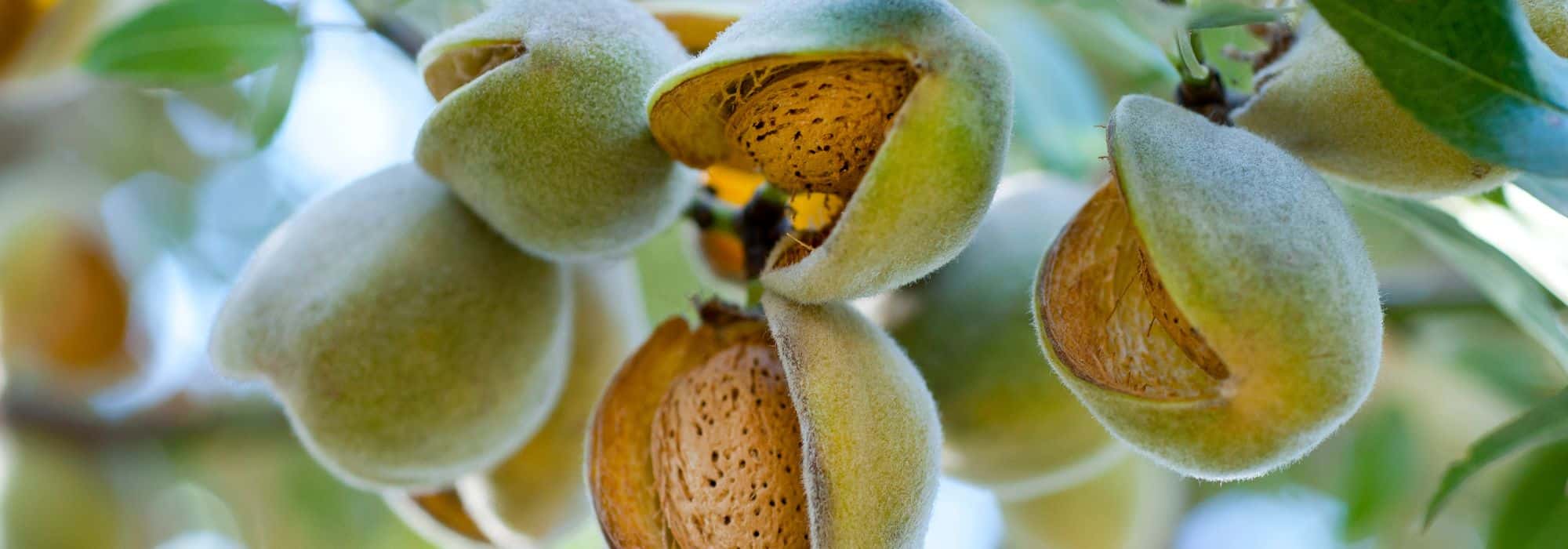
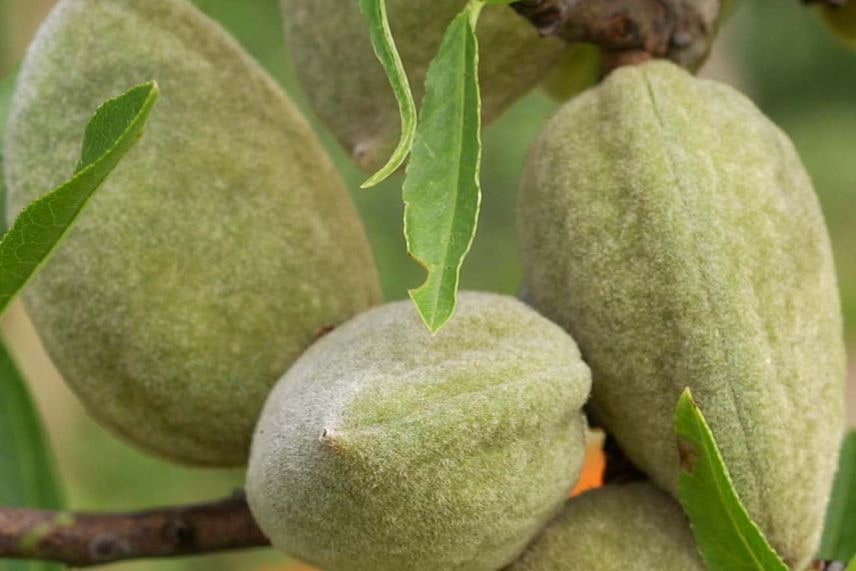
The different varieties of almond trees also differ in the texture of their oblong, velvety shell—the drupe—which encloses a stone that is more or less porous and contains one or two seeds, the almonds we eat. On wild almond trees, the almond is relatively bitter and toxic if consumed in too large quantities due to its amygdalin content. Nevertheless, it is used in pharmacy and in the agrifood sector. By contrast, on selected or horticultural varieties, almonds are sweet and suitable for pastry, confectionery or cooking. But let’s return to the shell…
The almond shells are fine, soft, semi-hard or hard. This aspect may seem trivial but it matters in a garden. Indeed, varieties with a fine or soft shell will be more readily attacked by birds such as the magpie or the jay. But, in turn, they crack much more easily, making their consumption simpler. Among almonds with a soft shell, one can cite the variety ‘Aï’ which yields brown, broad almonds with a pronounced flavour. The variety ‘Ferragnès’ also produces large almonds with a soft shell, a light colour and a sweet flavour.
But the champion of tenderness remains the variety ‘Princesse’. It is said that this variety bears that name because the delicate hands of a princess could even crack the shell, so tender is it! As for the almonds of this variety, they are white and sweet, with a flavour reminiscent of pistachios. These are the almonds most often used for making calissons from Aix-en-Provence. The variety Texas offers almonds with a shell that is tender to semi-hard and with a delicate flavour.
The variety Princesse produces almonds with a soft shell
By contrast, ‘Ferraduel’ produces fairly large and flat almonds, of high flavour quality with a sweet flavour, but with a hard shell.
According to the flowering period
Overall, common almond trees flower over a period from late January to the end of March, depending on the varieties, but also on the climate of the region where they are planted. However, during this period, the flowers are particularly sensitive to cold, and more specifically to late frosts that can occur up to the end of March, or even beyond. That is why flowering time is essential information to know, especially if you live north of the Loire. Indeed, the later the flowering, the more likely it is to withstand late frosts. Thus, your almond tree will be more likely to bear fruit.
If you live in southern France, you can potentially plant all varieties of almond trees, all of which are likely to bear fruit thanks to the mild climate. Elsewhere, you will need to choose varieties known for later flowering. Thus, the variety, developed by INRA, ‘Ferragnès’ flowers mainly in March, which gives it better frost resistance. The almonds reach ripeness from mid-September to early October. Another INRA creation, the variety ‘Ferraduel’, flowers even later in March for a harvest in the second half of September. These two varieties are therefore perfectly suited to planting north of the Loire, in a well-sunlit location and, above all, well sheltered along a south-facing wall.
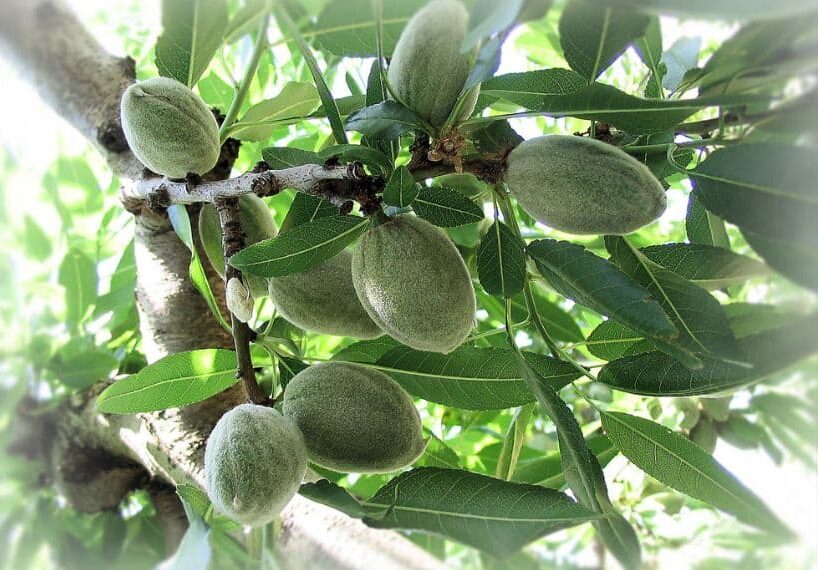
‘Ferraduel’ offers late flowering, therefore less susceptible to late frosts
‘Aï’ also benefits from late flowering, in March, for almond ripeness around September. The almond trees of this variety display good vigour and an open habit, and yield almonds with tender shells.
Conversely, the variety ‘Princesse’ is known for early flowering, while ‘Supernova’ or ‘Texas’ have mid-late flowering.
Read also
Diseases and Pests of the Almond TreeAccording to pollination
To bear fruit, fertilisation must occur between female flowers and male flowers. And among almond trees, most older or popular varieties are self-sterile, pollination is cross-pollination. This means pollination occurs between compatible varieties via bees and, incidentally, by wind. Bees do not miss and swarm the first almond blossoms as soon as milder temperatures wake them from their winter dormancy.
That is why, for certain self-sterile almond varieties, it is essential to grow within a perimeter near other perfectly compatible almond varieties:
- ‘Aï’ should be planted near ‘Texas’, ‘Ferraduel’ or ‘Ferragnès’
- ‘Ferragnès’ should be planted beside ‘Aï’, ‘Texas’ or ‘Ferraduel’
- ‘Ferraduel’ grows alongside ‘Ferragnès’
- ‘Princesse’, partially self-fertile, can be pollinated by ‘Aï’ or ‘Ardéchoise’, a French-origin variety with good vigour
- ‘Texas’ can be pollinated by ‘Aï’
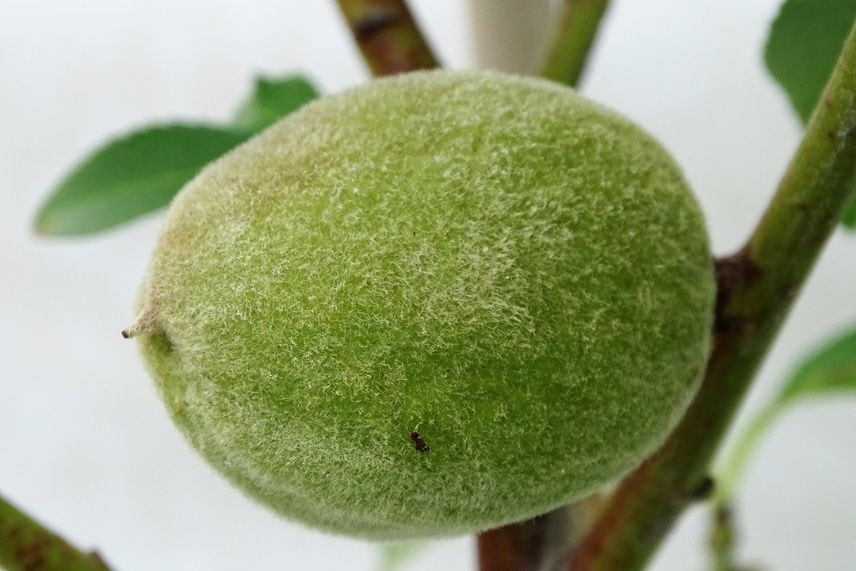
The variety ‘Texas is one of the most effective pollinators
If you have limited space and want to maximise your chances of enjoying almonds, the best option is to choose self-fertile varieties. They do not require a pollinator tree to bear fruit. Thus, the variety ‘Supernova’ is a self-fertile almond tree with mid-to-late flowering that produces almonds with shells ranging from semi-hard to hard. It also shows good natural disease resistance.
‘All in One’ is also a self-fertile almond variety with soft-shell almonds. Flowering occurs in March, harvest from late August through September.
Dwarf almond trees are also self-fertile.
Based on disease resistance
The almond tree is fairly hardy in the face of demanding growing conditions. Similarly, it is low-maintenance, requiring little upkeep or watering. For this reason, it can be susceptible to certain fungal diseases such as moniliosis. To learn more, please read Sophie’s article: Almond diseases and pests: detecting and treating them naturally.
Some varieties can sometimes be very resistant to these diseases. That is indeed the main asset of ‘Ardéchoise’, an old variety with medium productivity that is only lightly affected by fungal diseases. It is, in fact, exceptionally resistant to moniliosis, coryneum blight or scab. ‘Texas’ also displays considerable resilience against these diseases, including moniliosis.
The INRA Ferraduel selection also proves fairly vigorous and resistant to diseases.
According to productivity
Some varieties will be more productive than others. ‘Lauranne’, a self-fertile variety created by INRA, is certainly the variety that offers the best productivity. The productivity of ‘Ferragnès’ and ‘Ferraduel’ is lower, but interesting. As with ‘Aï’, ‘Princesse’ has medium-level productivity, as does ‘Texas’.
- Subscribe!
- Contents

Comments