





























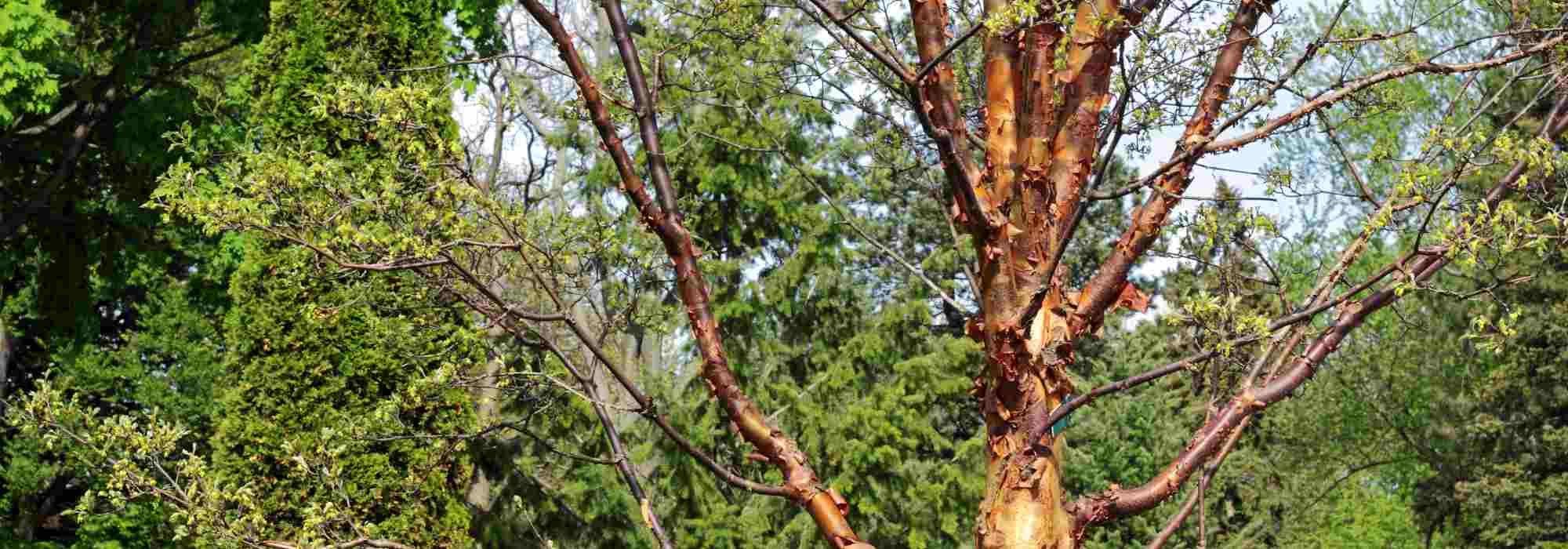
A beautiful garden even in winter
Focus on decorative barks!
Contents
When planting trees and bushes in the garden, one tends to choose them for their flowering, their foliage (sometimes stunning in autumn), or perhaps for their decorative fruits. But do we really think about beautiful barks? Yet, the bark of trees will be there all year round. Especially during a time when the flowering will have finished for a while (except in rare cases), when the deciduous foliage has fallen, and when the fruits have disappeared: winter.
→ Let’s discover in this video some beautiful examples of trees with remarkable barks.

Decorative barks to brighten up the garden in winter
Acer davidii or Snake Bark Maple
The Acer davidii is known as the Snake Skin Maple* due to its bark resembling… a snake’s skin. This maple thrives in partial shade in rich, humus-bearing soil that is cool but well-drained. In short, it prefers a somewhat woodland atmosphere. It is a small tree that is easy to grow, reaching a height of no more than 5 m. Its greatest fear is heavy, overly wet soil in winter.
*Note: Other maples may also be referred to as “snake skin maple,” such as Acer capillipes and Acer rufinerve.
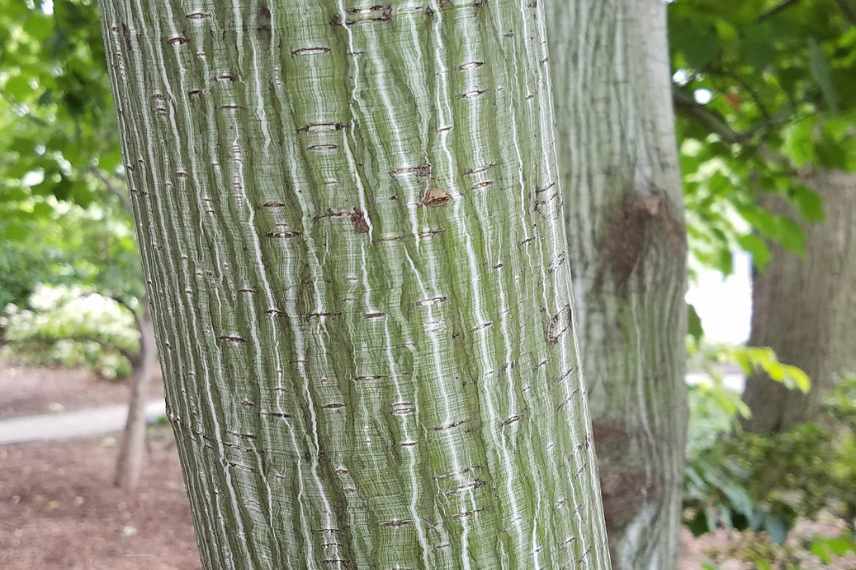
Acer davidii (© Dan Keck)
Acer griseum or Paperbark Maple
The Acer griseum is known in French as the cinnamon maple due to its bark that peels over the years like cinnamon. The tree is stunning all year round, but without the foliage, the bark becomes even more prominent and adds real interest to the garden in winter. Like the Acer davidii, the Acer griseum prefers partial shade and humus-bearing, cool, but well-drained soils. Do not plant it in the south of France, as this small tree (6 m tall) will suffer too much from the heat and drought.
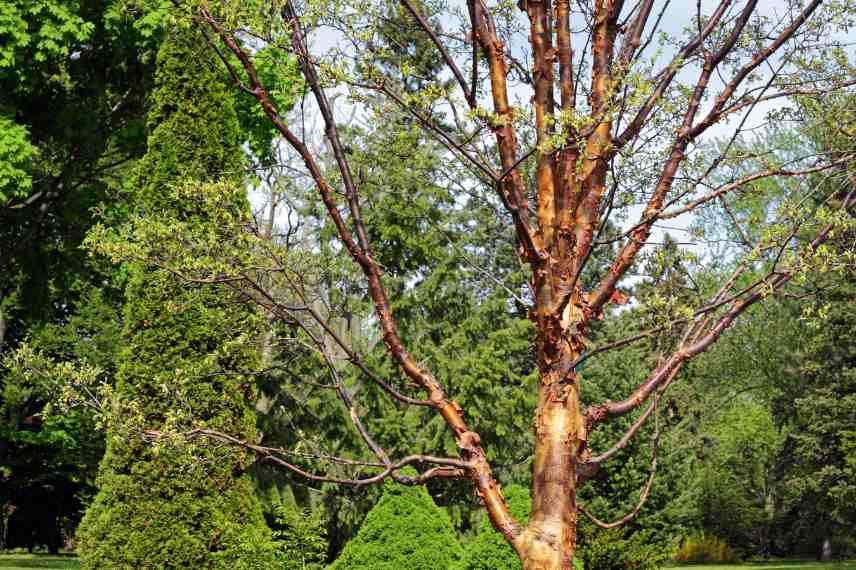
Acer griseum
Read also
Birches: the most beautiful barksPrunus serrula 'Jaro'
Another very beautiful specimen whose bark peels away, revealing a very smooth bark with almost metallic bronze reflections. This tree is part of the ornamental Prunus, known as Prunus serrula ‘Jaro’. In addition to its bark, this tree showcases a lovely white flowering in spring. To grow it well, this Prunus prefers sun or partial shade and fertile, cool, but well-drained soil.
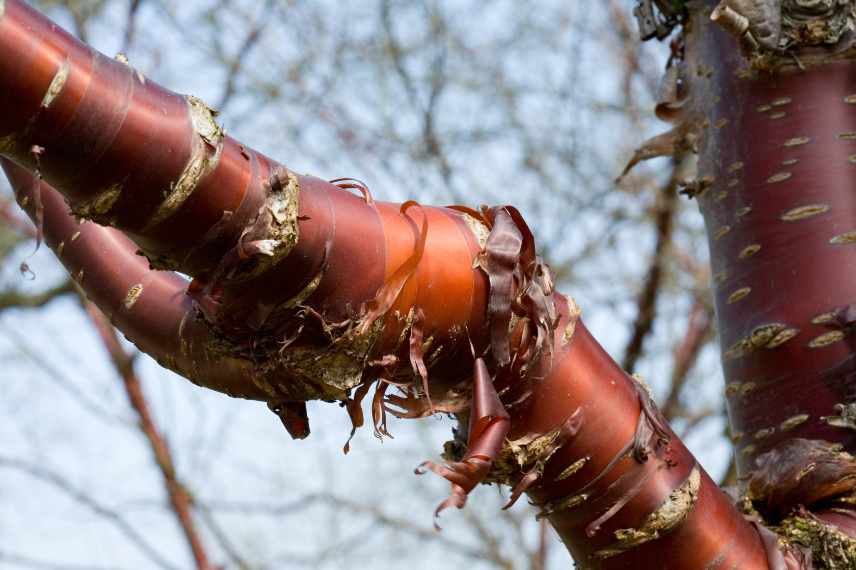
Prunus serrula
Betula nigra and Betula utilis
Birches in general, even the simplest ones, have a beautiful bark that is revealed in winter. Some, less well-known, deserve a prominent place in the garden. This is the case of the Betula utilis or Himalayan Birch with its extremely white bark. Nearby, we note the presence of a Betula nigra or Black Birch, with very dark (almost black) and deeply fissured bark, giving it a very mature appearance quickly.
To grow birches, it’s quite simple: full sun or partial shade and a neutral, acidic, or calcareous soil, it doesn’t matter, as long as it is well-drained.
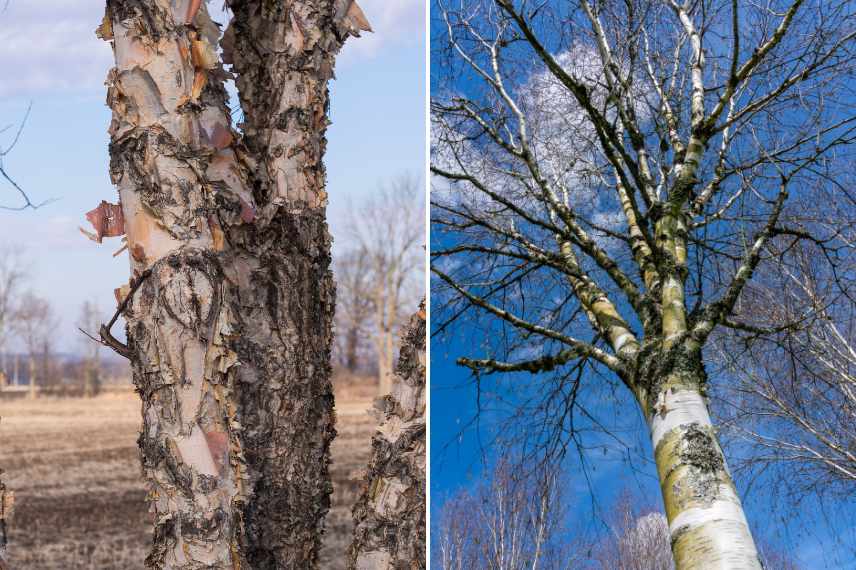
Betula nigra and Betula utilis
Acer triflorum or Three-flowered Maple
We started with two maples, and we will end our garden stroll with… another maple. Here, it’s a lesser-known Acer: the Acer triflorum or Three-flowered Maple. Its bark peels a little, but more importantly, it quickly takes on an aged, antique appearance, even in relatively young specimens. In terms of cultivation, it’s the same as the other two maples presented at the beginning: partial shade and humus-bearing soil that remains cool but well-drained.
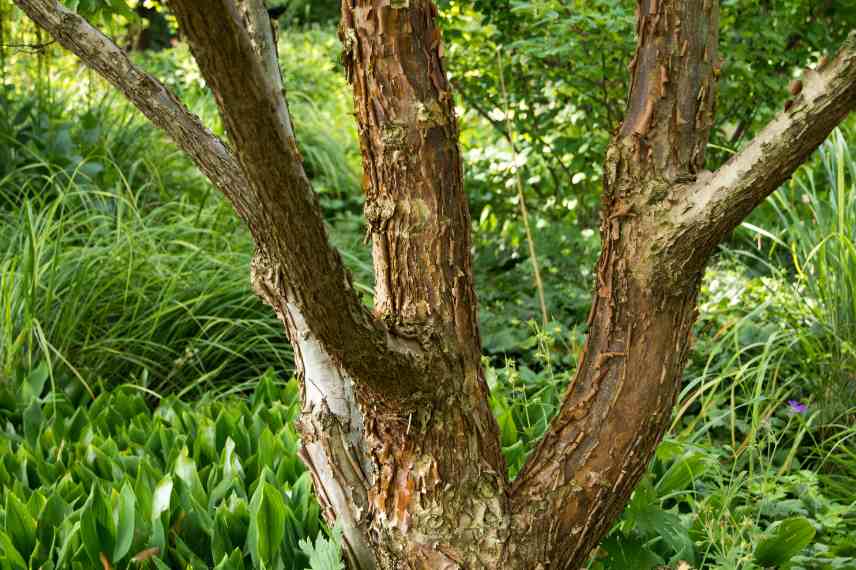
Acer triflorum
For further reading...
Here, only a brief selection of trees with remarkable bark has been presented: Prunus, Acer griseum, Birches… But there are many more! Consider the Strawberry Tree – Arbutus x andrachnoides, the decorative wood dogwoods (Cornus alba, Cornus sericea, Cornus sanguinea…), and certain Rubus, such as Rubus thibetanus ‘Silver Fern’…
In short, you can “colour” or dress your garden in winter, even without evergreen foliage. You just need to think a little more about remarkable barks.
- Subscribe!
- Contents
Comments