





























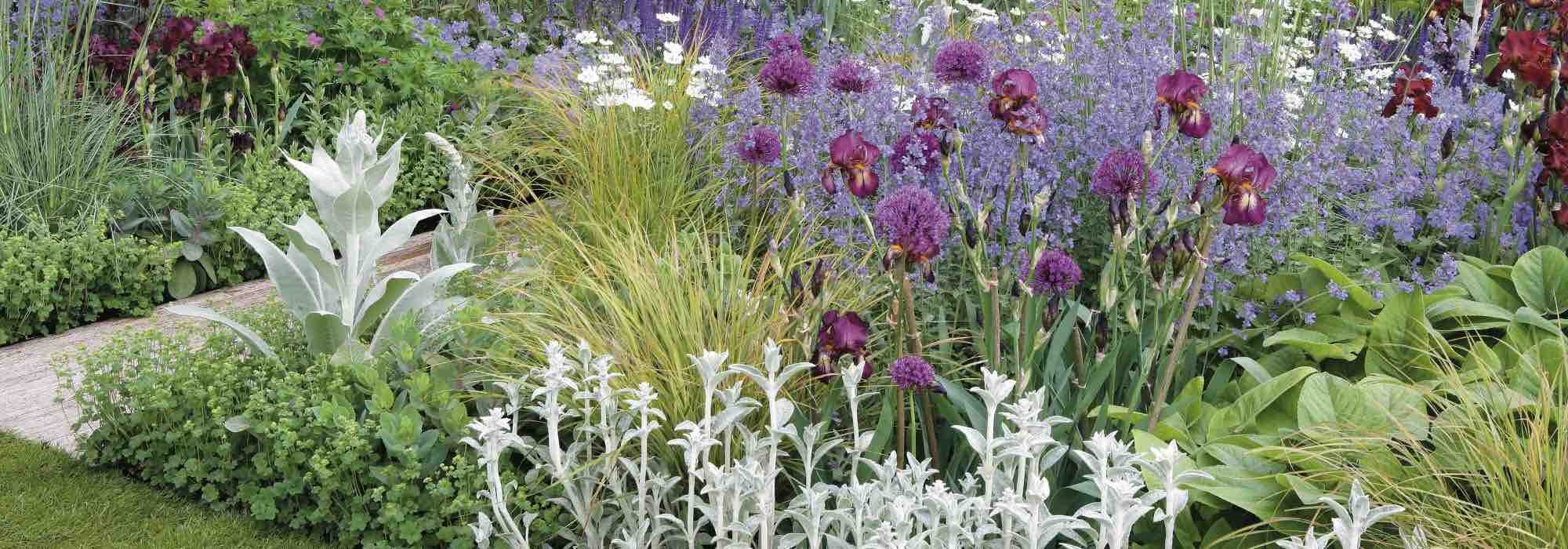
7 ideas for pairing Stachys
In a dry garden, but also in a cool and shaded garden
Contents
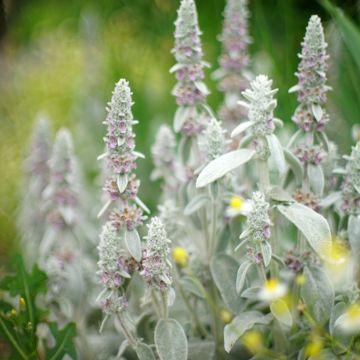
There are several species of Stachys, each with different appearances and growing conditions. What unites them is a summer flowering with violet spikes, except for a few varieties that stand out for their flower colour. The Stachys byzantina is by far the best known, and it must be said that its silvery, woolly leaves, soft as a hug, aptly named “lamb’s ears,” do not go unnoticed. It lends itself to numerous uses, not all explored here; for instance, in mineral rockeries and white gardens, or in pot cultivation, as it is valued for its undemanding nature. Also discover other Stachys, with their beautiful foliage, green certainly, but still ornamental, and their vibrant flowering, particularly in Stachys grandiflora and officinalis. You will be surprised to learn that there are Stachys for moist or cool soils and partial shade.

In a sunlit naturalist garden
The Stachys byzantina and Stachys monierii are both species of Stachys that thrive in sunny, well-drained, poor soil, requiring very little maintenance. The former is known for its silvery, wooly foliage, which is very soft to the touch, shining and varying from grey-green to an almost white colour in very dry beds. The latter features attractive bright green, glossy, crinkled, lanceolate leaves and forms a rounded clump. It prefers less dry soil and partial shade in hot situations, but both are low-maintenance plants if given the right conditions at planting. They bloom in summer with violet spikes.
They are excellent choices for naturalistic gardens. In combination with grasses, perennials of varied structures, and self-seeding plants that wander, create lovely scenes that appear very natural, both free and composed, for your garden. For example, pair Stachys monieri ‘Hummelo’ with golden, flowing clumps of Stipa tenuifolia ‘Pony Tails’ and Stipa arundinacea, bulbs of Allium sphaerocephalon with small purple heads, and Heleniums like ‘Short’n’Sassy’.
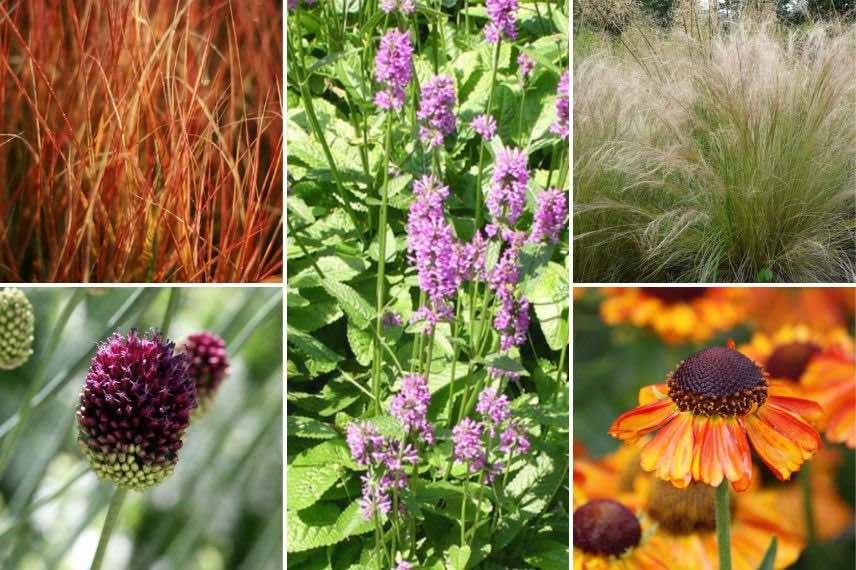
Clockwise: Stipa arundinacea, Stachys monieri ‘Hummelo’, Stipa tenuifolia ‘Pony Tails’, Helenium ‘Short’n Sassy’, Allium sphaerocephalon
In a contemporary and graphic atmosphere
The Stachys byzantina or Stachys lanata with its grey foliage has everything to please in a contemporary garden. This is even truer for the cultivar ‘Silver Carpet’, which rarely flowers. Thus, it maintains a tidy appearance all year round, and its minimalist look suits graphic settings. Like the species type, it forms a dense carpet of thick, evergreen, elliptical, and woolly leaves that are silver-green to white-silver, measuring up to 10 cm long. When planted in masses, it is even more striking and catches the eye from afar.
In a modern and contemporary garden, plant it in numbers alongside graphic-looking plants such as Eryngiums or Thistles, Spurge, Verbascums, large-headed Alliums, or blue or white Agapanthus in front of a backdrop of Black Elder, for example. Also consider blue grasses. Here, with a Black Elder, Sambucus nigra ‘Black Lace’, the Stachys byzantina is surrounded by an Eryngium yuccifolium, Allium ‘Mount Everest’, and Euphorbia characias ‘Glacier Blue’.
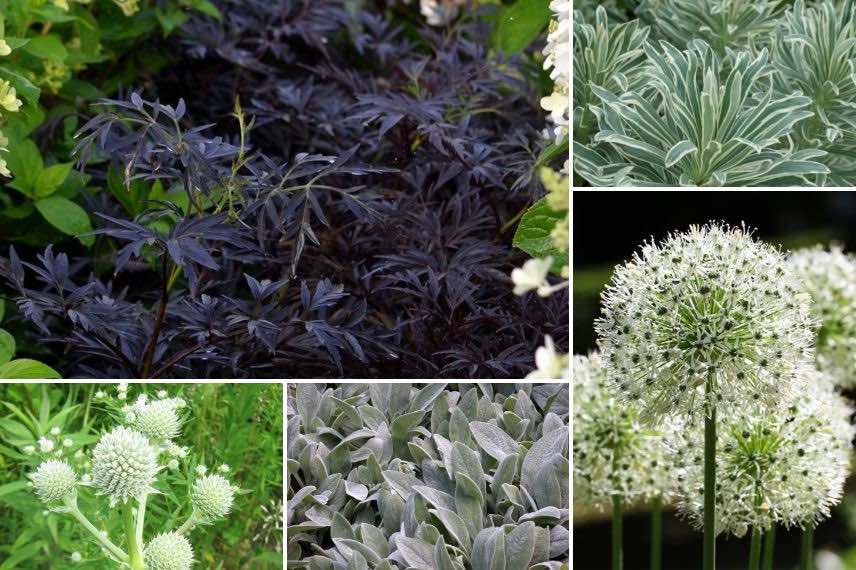
Against a backdrop of Black Elder, Sambucus nigra ‘Black Lace’, the Stachys byzantina is surrounded by Eryngium yuccifolium, Allium ‘Mount Everest’, and Euphorbia characias ‘Glacier Blue’
Discover other Stachys
View all →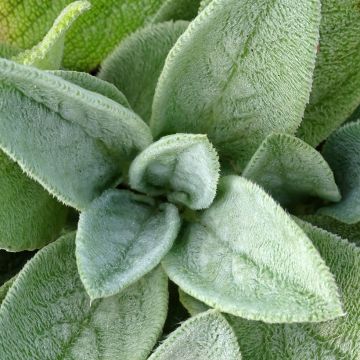
Available in 2 sizes

Available in 2 sizes
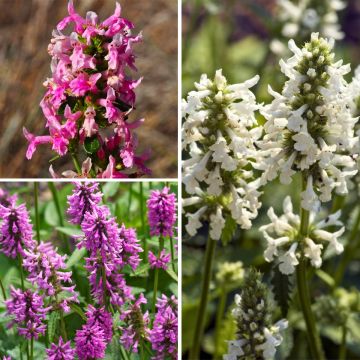
Available in 0 sizes
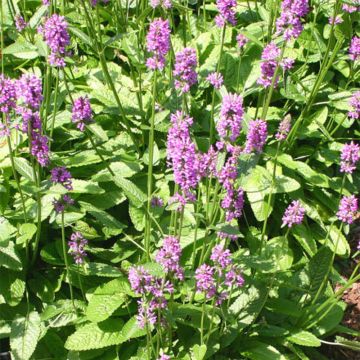
Available in 3 sizes
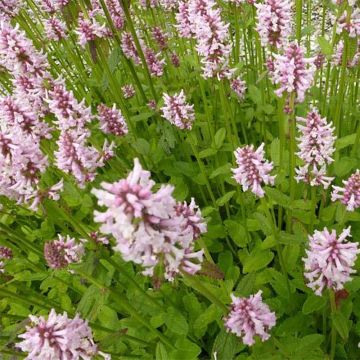
Available in 1 sizes
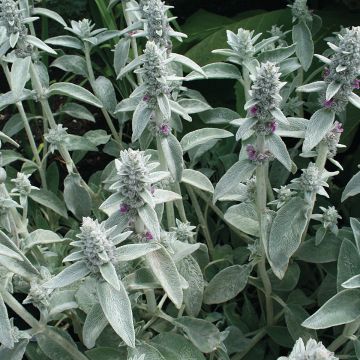
Available in 1 sizes
Available in 1 sizes
Available in 1 sizes
Available in 1 sizes
Available in 1 sizes
In a romantic garden
For the softness of its grey foliage, beautifully complementing the pink, blue, and mauve flowers for a lovely romantic ensemble, use Stachys byzantina as a border for a tender, flowering bed. Its summer flowering, pink-violet in wooly spikes, harmonises gently with pastel-flowering perennials while adding character to the whole, thanks to its unusual foliage. Flowering plants generally appreciate sunlight, and so does Stachys. Choose plants for fresh or dry soil, but always very well-drained; otherwise, Stachys will not survive the winter in good condition.
For example, plant the typical species of Stachys byzantina alongside a Rose ‘Louis Blériot’ with medium pink to lavender flowers, or a Rose ‘Minerva’ with very violet flowers, for a lovely match with the grey of Stachys. Add clumps of Salvia nemorosa ‘Caradonna’ with fine spikes of intense blue-violet, and a Campanula persicifolia ‘Hidcote Amethyst’ with mauve bell-shaped flowers. Dot with Oriental poppies ‘Princess Victoria Louise’ with large crumpled salmon-pink flowers and clumps of Allium rosenbachianum.
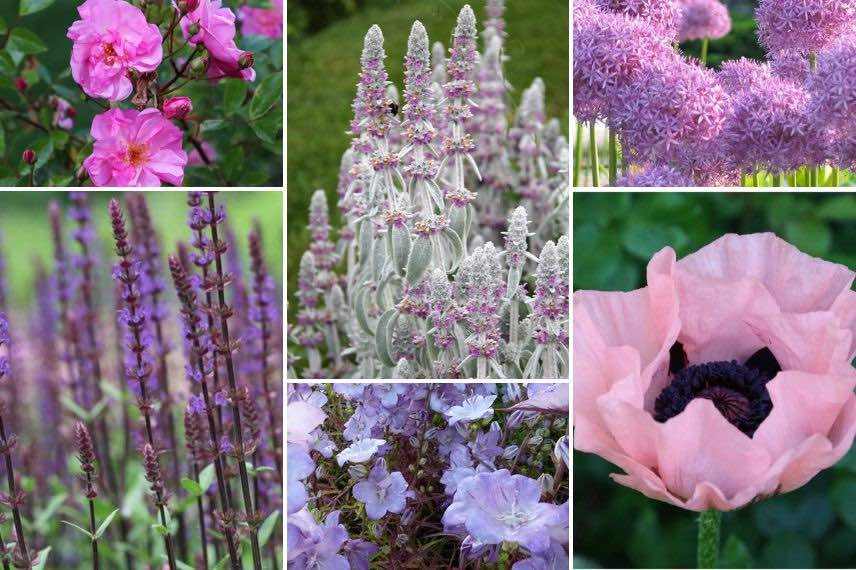
Rose ‘Louis Blériot’, Stachys byzantina, Allium rosenbachianum, Oriental poppy ‘Princess Victoria Louise’, Campanula persicifolia ‘Hidcote Amethyst’, Salvia nemorosa ‘Caradonna’
In a Mediterranean garden
The Stachys byzantina is a very hardy perennial that thrives in full sun, in dry, poor, filtering soil, much like Mediterranean plants. Like them, it particularly enjoys limestone. It also tolerates sea spray perfectly. Like them, it dislikes winter moisture and requires well-drained soil to get through this season in good condition. Therefore, it is an ideal companion for all Mediterranean-origin plants. It is also suitable for seaside borders for intermittent gardeners, given its autonomy once properly established.
Plant it in full sun, alongside other silver-leaved perennials such as Wormwoods, Helichrysum italicum or Immortelle, and the lovely Santolines. Add the bright, light, and fragrant blooms of carnations and Agastaches, for example, along with the structure of euphorbias. Here, the Stachys byzantina ‘Big Ears’ is surrounded by a Helichrysum italicum, with its curry scent, a Santolina virens, an Agastache ‘Kudos Ambrosia’, the beautiful graphic form of Euphorbia pithyusa or Balearic Spurge (hardy down to -11° C), and a Dianthus deltoides ‘Rosea’.
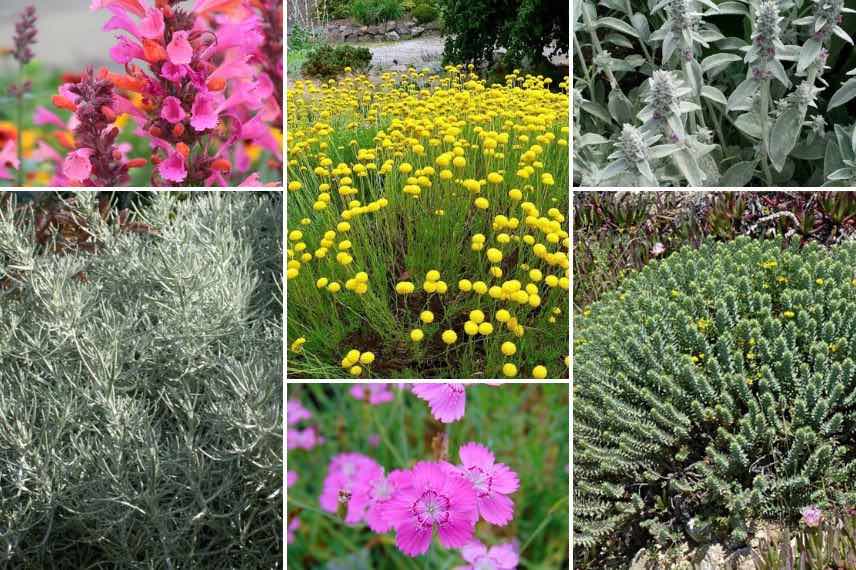
Agastache ‘Kudos Ambrosia’, Santolina virens, Stachys byzantina ‘Big Ears’, Euphorbia pithyusa, Dianthus deltoides ‘Rosea’, Helichrysum italicum
In cool soil
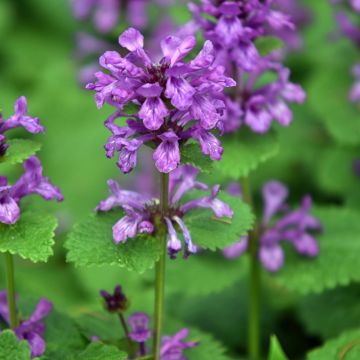
The Stachys grandiflora is adorned with dark green, glossy, ovate, plicate, dentate deciduous foliage. It blooms in summer with spikes of very bright purple-pink flowers. In the variety ‘Superba’, the flowers are particularly large and vibrant. Highly floriferous, it is a vertical perennial that looks striking in borders with fresh to moist soil. This Stachys prefers heavy, rich, and cool soils, and even thrives on damp banks, in full sun or partial shade. It can also grow in lighter soils as long as they are not too dry.
Plant the Stachys grandiflora ‘Superba’ alongside beautiful and opulent perennials for fresh soil. In full sun, add Lythrum salicaria with a lovely fresh soil grass such as Deschampsia cespitosa. In partial shade, opt for Astilbes like Astilbe arendsii ‘Amethyst’ and some Hostas and ferns to add roundness to these vertical plants. Here, Dryopteris filix-mas and Hosta ‘Canadian Blue’. Accent with lovely Japanese primroses ‘Millers Crimson’.
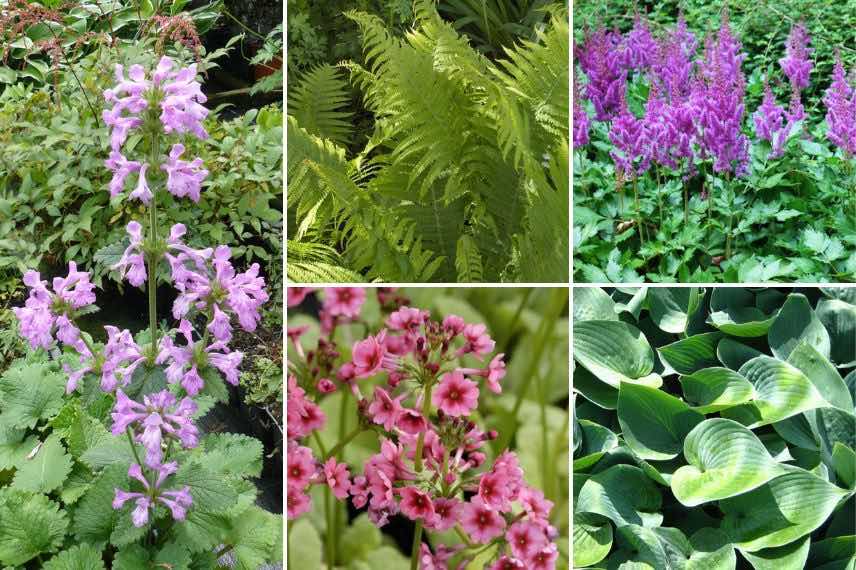
Stachys grandiflora ‘Superba’, Dryopteris filix-mas, Astilbe arendsii ‘Amethyst’, Hosta Canadian Blue, Primula japonica ‘Millers Crimson’
In an aromatic or wild garden
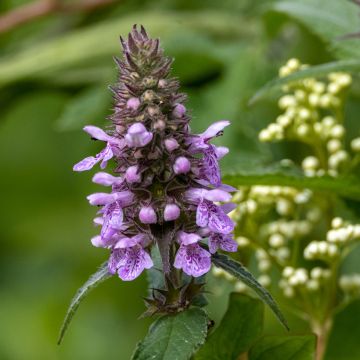
The Stachys officinalis, also known as betony or medicinal woundwort, is formed of large, grey-green, glossy, rough, and dentate deciduous leaves, in a basal tuft. It also flowers in summer, producing spikes of purple-pink flowers. It can be found in meadows, along paths, or in the undergrowth of our territory. Not very demanding, plant it in both not too dry and light soil as well as in fresh to moist, rich, heavy, but well-drained soil. It enjoys full sun and prefers partial shade in hot climates. Edible and medicinal, you can plant it in a physic garden, alongside thyme, sage, savory, hyssop, and lavender, for example.
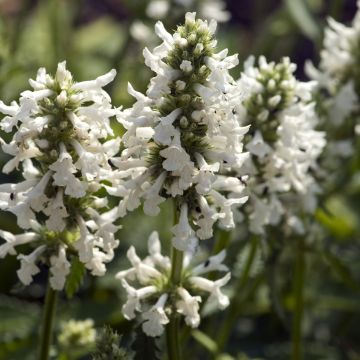
It also thrives in wildflower beds, alongside plants with a wild appearance such as comfrey, here Symphytum azureum, Centaurea montana, Nepeta subsessilis, and Aster cordifolius ‘Little Carlow’, for example. However, it adapts to a wide range of situations. Discover the white variety, ‘Alba’, and the candy pink variety, ‘Pink Cotton Candy’.
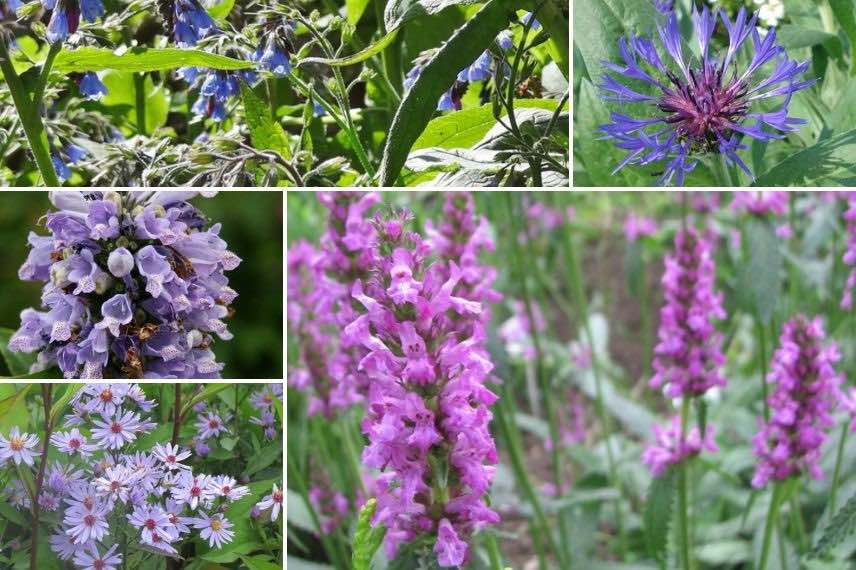
Symphytum azureum, Centaurea montana, Stachys officinalis, Aster cordifolius ‘Little Carlow’, Nepeta subsessilis
To create a pond
Finally, Stachys palustris or Marsh Woundwort proves useful for the balance of water bodies. Its creeping stump works to purify and stabilise the banks, while its upright spikes laden with pink flowers nourish pollinating insects.It is also edible and has medicinal uses. It is widely represented in our territory. Its root system naturally filters water by absorbing nutrients such as nitrates from the decomposition of organic matter.
Ornamental and easy to grow, Stachys palustris thrives at the edges of water bodies, on damp, sunny banks prone to flooding. Quite tall, around 75 cm, it enjoys the company of Purple Loosestrife, Caltha palustris ‘Polypetala’, Butomus umbellatus or flowering rush, and Phalaris arundinacea.
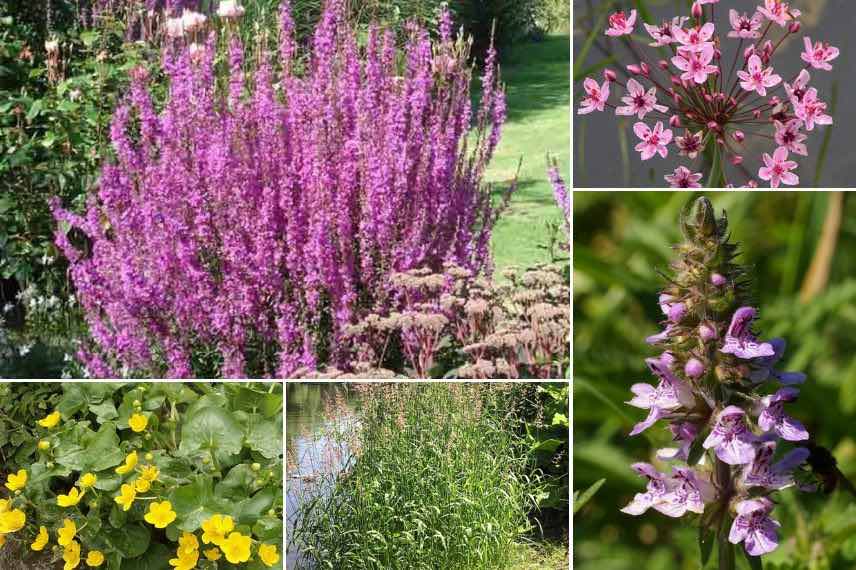
Lythrum salicaria, Butomus umbellatus, Stachys palustris, Phalaris arundinacea, Caltha palustris ‘Polypetala’
- Subscribe!
- Contents
Comments