





























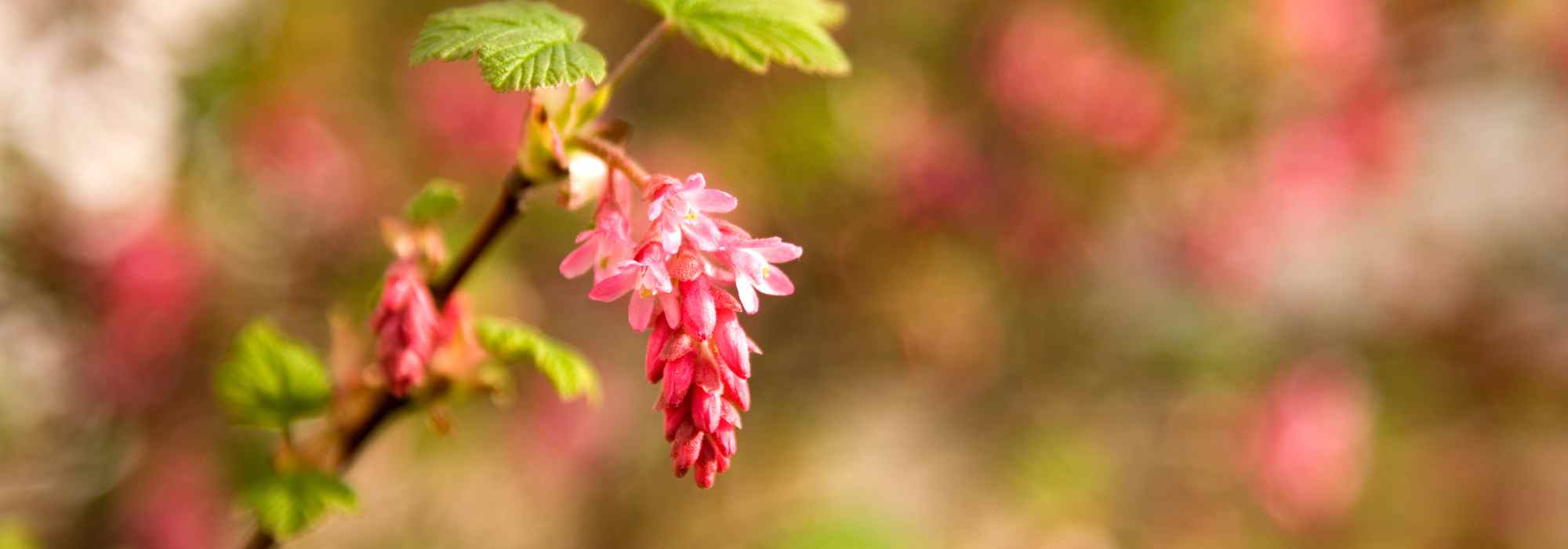
5 ideas for pairing Flowering Currant
In the garden or in pots!
Contents
The flowering currant, also known as False Blackcurrant, is a small ornamental bush appreciated for its early spring flowering with a light fruity blackcurrant scent, much like the Ribes sanguineum, which brightens the first beautiful days. With its graceful habit and rustic appearance, it can be used in various ways in all natural and wild gardens, in bright, spring-like, or romantic scenes. It pairs easily with many perennial plants, spring bulbs, and other early-flowering bushes. Compact in size, it adapts to all gardens. The ornamental currant works wonderfully in a flowering hedge or bocage, in a shrub thicket, or even in a container on the terrace.
Discover our best ideas for combining the flowering currant in the garden and extending its appeal!
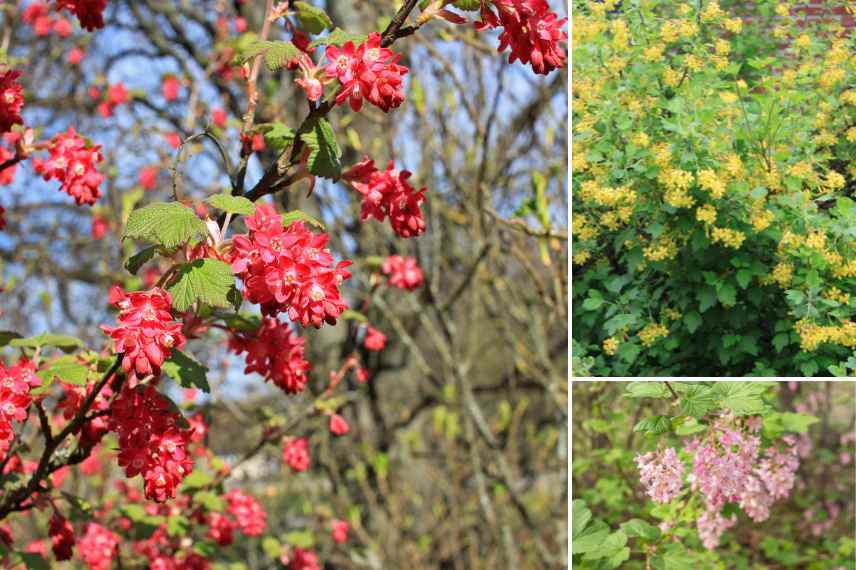
The old-world charm of the flowering currant

In a flowering hedge
Planted in groups of three or four, the Flowering Currant thrives in a free or bocage hedge. Its spring flowering in March-April, with a blackcurrant fragrance, followed by bluish-black fruit from summer to autumn, makes it ideal for a hedge that evolves through the seasons. With rapid growth, it quickly forms a beautiful, rounded bushy clump. As its foliage is deciduous, consider incorporating evergreen bushes, such as laurustinus (Viburnum tinus), and Abelias, for example, to maintain an attractive hedge even in winter.
It easily associates with other flowering hedge shrubs with either deciduous or evergreen foliage that, like it, bloom in the early days of spring. For instance, plant a Ribes sanguineum ‘King Edward VII’ that flowers in bright pink to red. To accompany it, choose shrubs like Spiraea prunifolia ‘Plena’, attractive for the earliness and refinement of its white flowers, the Prunus triloba multiplex, with very early spring flowering in small soft pink pom-poms, a Prunus persica ‘Taoflora Pink’ (Flowering Peach), and Cytisus x praecox (the early brooms) in white or pink. The pink flowering of the ribes will also accompany that of the Japanese Quince, whose flowers in shades of white and pink appear early in spring on the naked wood.
Somewhat insignificant by late spring, be sure to surround it with companions that will take over its flowering. To extend the decorative interest of your hedge, integrate shrubs with later flowering such as Syringa microphylla ‘Superba’ or Buddleia davidii ‘Pink Delight’, Viburnum sargentii ‘Onondaga’, and Deutzias, for a flowering spread from February to September.
You will create a magnificent purple and peach hedge by subtly mixing the foliage of Ribes gordonianum with that of Cotinus coggygria ‘Royal Purple’ and Physocarpus opulifolius ‘Lady in Red’ with its coppery-red to purple dress.
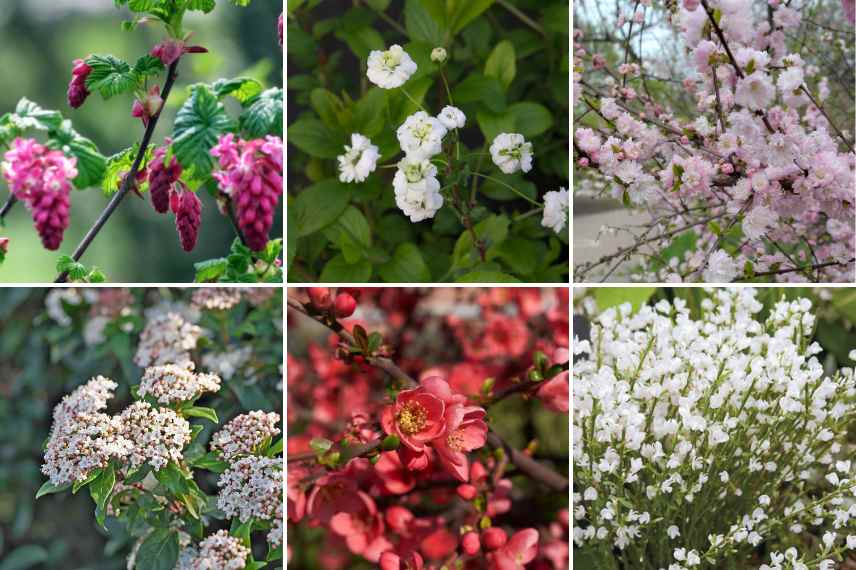
Ribes sanguineum, Spiraea prunifolia ‘Plena’ (© je_wyer), Prunus triloba, Viburnum tinus, Chaenomeles, and Cytisus praecox
In a vibrant and spring-like scene
The Flowering Currant pairs beautifully with perennial plants, bulbs, and bushes, whether with white flowers for a green/white atmosphere in a white garden, or with yellow and blue flowers for vibrant contrasting scenes, or even with pink flowers for a romantic display. Of modest dimensions, it complements all sizes of borders and nearly all garden styles. It will punctuate a medium or back border with its delicate flowering. It allows for many combinations. Around a golden currant (Ribes odoratum) with yellow flowers, install some clumps of Caucasian Forget-me-nots, and Anemone blanda ‘Blue Shades’ for a refreshing and contrasting effect.
Early in spring, Hellebores are other good companion perennials. Complete the scene with a carpet of spring bulbs; Daffodils and other enchanting bulbous plants.
The Bleeding Hearts, hardy geraniums, and peonies will continue the enchantment a little later in the season. Highlight everything with a Hosta ‘August Moon’’, with its very bright acid green foliage. The highly decorative foliage of these perennials will ensure a spectacle once the flowering has passed.
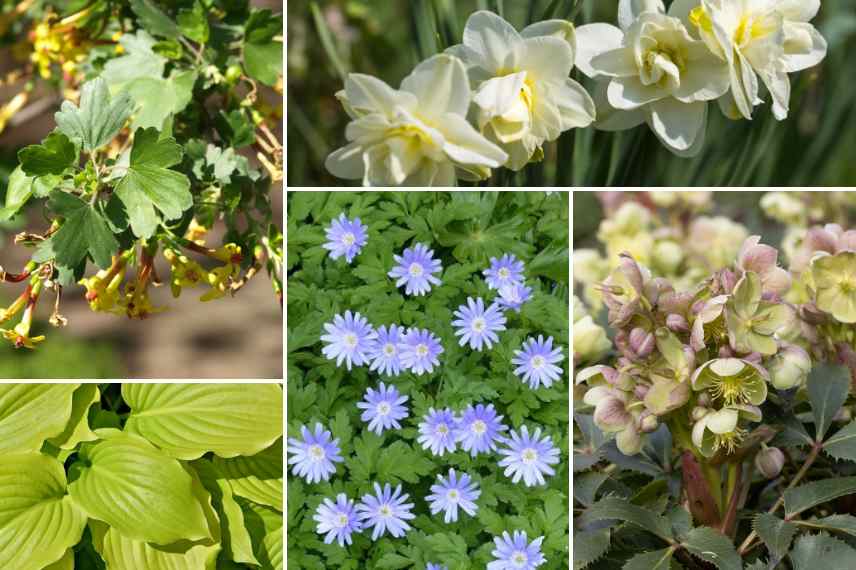
Ribes odoratum (© Juan Carlos Lopez Almansa), daffodils, Hosta ‘August Moon’, Anemone blanda ‘Blue Shades’, and Helleborus sternii
In a flower bush bed
The Flowering Currant showcases its graceful silhouette, which can reach up to 3 m in height. In a natural or wild garden, it is best positioned in the background of a bed, made up of taller deciduous or evergreen bushes, with staggered flowering or decorative foliage. To accompany it, choose spring-flowering bushes such as Lilacs, Forsythia, Spiraea prunifolia or Spiraea thunbergii that bloom in spring. The Abeliophyllum distichum or White Forsythia will echo the immaculate flowering of a Ribes ‘White Icicle’. You can also place it in a spring scene with Mexican Orange Blossoms with their citrus scent, and with Exochorda macrantha ‘The Bride’, which is delightful when covered in semi-double snow-white flowers in April-May.
In a charming bed dressed in pink, you can place the Ribes sanguineum close to the Purple Broom Chamaecytisus purpureus, which blooms in pale pink to violet-pink shades, or the Abeliophyllum distichum ‘Roseum’. A Prunus cerasifera ‘Nigra’, a Hydrangea aspera ‘Rosemary Foster’, and a Viburnum opulus will enhance the colourful effect. Buddleias, oceanias, and old roses will take over the flowering. Meanwhile, Eleagnus and Photinias with their evergreen and changing foliage will provide a green backdrop throughout the seasons.
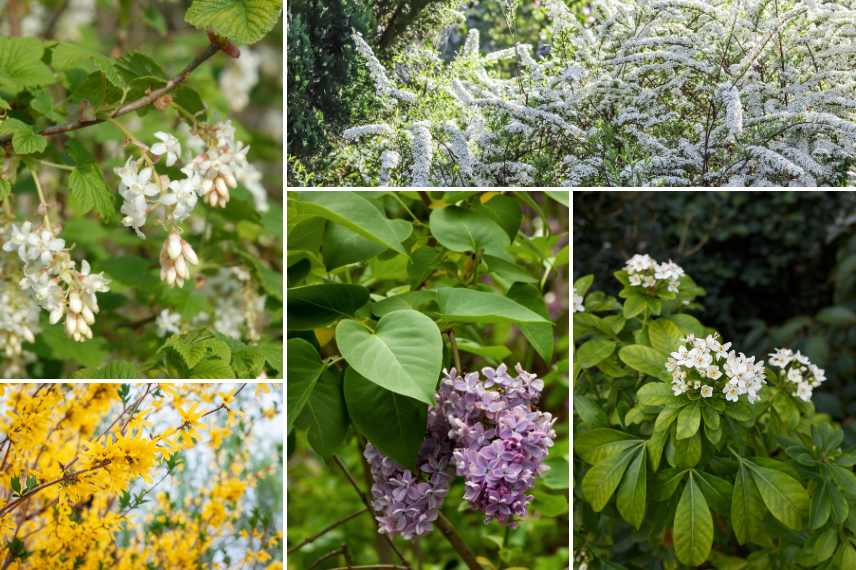
Ribes ‘White Icicle’, Spiraea thunbergii, Forsythia, Syringa, and Choisya ternata
Read also
6 pretty spring-flowering flowersWith spring bulbs
Spring bulbs are excellent companions for underplanting deciduous trees. They bring cheer and colour to the garden, as well as a very natural touch. As winter fades, a joyful carpet of bulbs beneath the fragrant and abundant flowering of a Flowering Currant will provide a delightful spectacle, symbolising the renewal of the season. These small bulbs will thrive at its base without suffering from overly dense shade that could hinder their flowering. Choose bulbs that echo the hue of the bush for scenes of great delicacy. Plant at its base early-flowering bulbs, such as Muscari (pink ‘Pink Sunrise’), Hyacinths (Multiflorous Hyacinth ‘Rouge’ for example). A few clumps of Narcissus ‘Rosy Cloud’ in a very soft, light salmon pink will awaken its base by adding bright touches. With their graceful flowering, Tulips are also good companions.
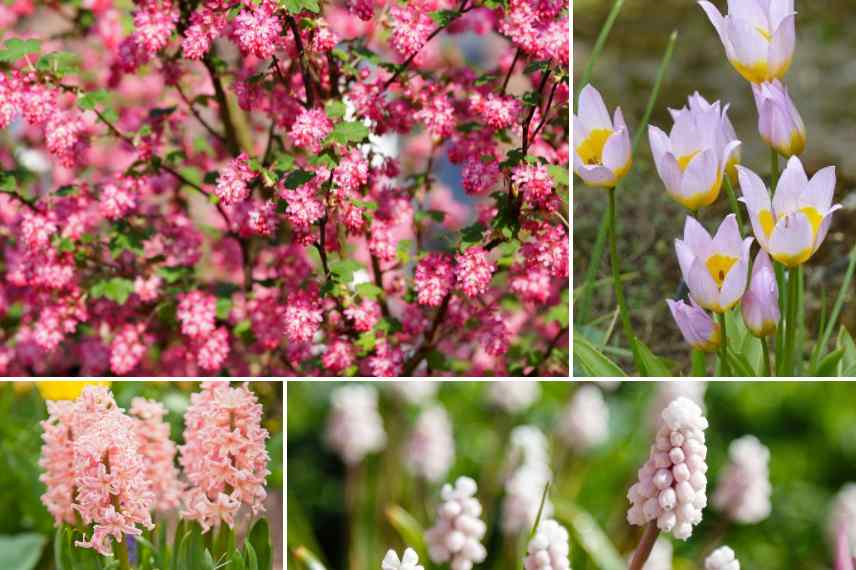
Ribes sanguineum, Tulip ‘Lilac Wonder’, hyacinths and Muscari ‘Pink Sunrise’
In a pot or container on the terrace
You will fully enjoy its flowers and fragrance! Growing a Flowering Currant in a pot is possible as long as you use a container with a diameter of at least 50 cm and keep the substrate moist, but not excessively throughout the beautiful season to ensure its proper development. It will make a striking impact when planted in a container on a terrace or balcony, providing freshness and brightness while maintaining modest dimensions. Keeping it close to the house will delight you with its generous flowering in clusters of fragrant flowers with a sweet scent reminiscent of carnation or blackcurrant. Yellow varieties will present a lovely contrast when paired with the blue flowers of forget-me-nots or will be enhanced in gold/white displays alongside small muscaris (‘White Magic’ Muscaris) or white daffodils. All Flowering Currants pair well with perennials featuring purple foliage, such as bugle and borage. Also, try the lovely botanical tulips like ‘Lady Jane’.
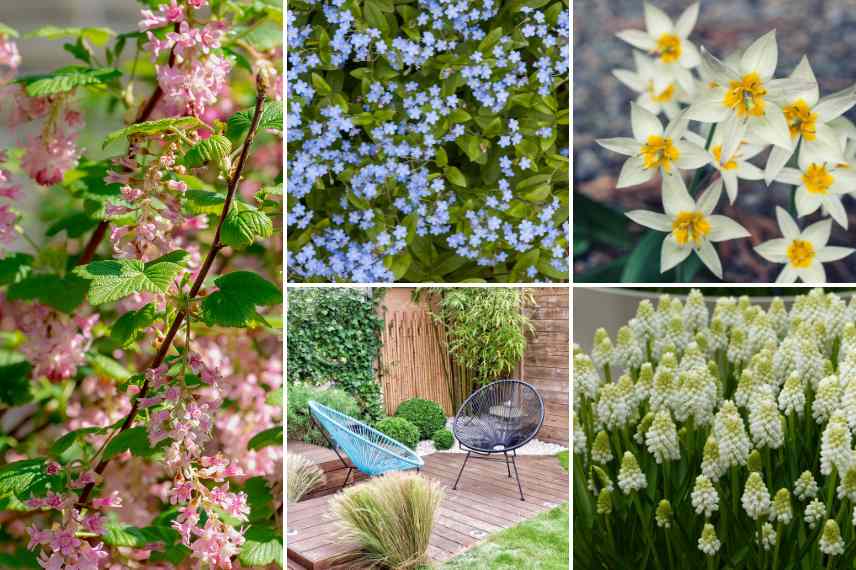
Ribes sanguineum, forget-me-not, Tulip ‘Turkestanica’ and Muscari ‘White Magic’
- Subscribe!
- Contents
Comments