





























Permaculture is on trend! It’s talked about almost everywhere: in gardening magazines, at plant fairs, on television… and many gardeners claim to practise permaculture.
Perhaps you yourself are tempted by a course on the subject... Good news: I have tested a permaculture course for you and here is my opinion!
1) Why I undertook a permaculture course?
When I decided to undertake a permaculture course, I was already convinced that it would constitute a personal and professional enrichment that would also benefit my everyday life. By choosing it well, I knew I could value it with my colleagues or future employers. I saw it as a real professional edge because I knew I could leverage it within the scope of my job as a landscape engineer.
From a personal perspective, I also hoped that this permaculture course would open up new avenues of reflection about myself, my way of thinking, consuming and living. I saw it as a unique opportunity to question myself and to focus on my life projects. I looked forward to asking all my questions and, above all, meeting people who, like me, want to learn more and take action.
And I was not disappointed! This course went beyond my expectations. I was pleasantly surprised by everything I could learn from the trainer or from the other participants. It was possible because I found a course that matched my expectations.
2) How I chose the theme of my permaculture course?
It is essential to research the course you choose. Indeed, the term permaculture is very broad. It can apply as well to a private garden as to a professional’s market gardens, to a house or even a business.
For my course, I chose a permaculture course dedicated to permaculture design. My aim was to create permaculture designs—whether gardens, projects or a house. As a landscape engineer, I value this additional asset in my professional activity: garden design. Permaculture design simply resonates with it.
There are other permaculture topics you can choose from depending on your profile and your projects:
- The professional market gardening in permaculture,
- Urban permaculture,
- Bioclimatic housing,
- Social permaculture: such as non-violent communication…
- Transition towns.
The chosen theme must suit your projects, your questions and your professional and/or personal circumstances.
When choosing your course, price is also an important criterion as few courses can be funded. I also advise you to beware of commercial sites or other scams that ride the permaculture wave. Many people take advantage of the enthusiasm to call themselves "permaculturist" and offer training when they are not at all qualified. Permaculture cannot be learned only from books; it is practised in the field and not on your own in a corner: it’s an open approach with others.
I can recommend two training sites that offer introductory courses, on-site workshops or certified permaculture courses: the Permaculture People's University and Brin de paille.
For my part, I chose the site of the Permaculture People's University, which lists numerous courses by date across France. Since my training could not be funded, I weighed the time involved, the money invested and the professional and personal return it offered me. Today, I am perfectly satisfied with the investment I made by undertaking this training.
3) How I chose the duration of my permaculture course?
There are several types of training according to their duration. I was able to start with talks or sessions of 2 or 3 hours that present the basics of permaculture. They are introductory and allow you to begin to explore this theme. You can ask questions of the speakers, usually well informed, and confirm that the topic interests you. I can recommend two sources for some of their permaculture talks and workshops in Paris: the Recyclerie and Acteurs du Paris Durable.
Then, it is possible to deepen the subject a little further for a weekend of on-site training. This very formative period—generally on the ground—is ideal for personal projects and the initiation of future professionals. In general, these weekends feature theoretical and practical parts. The on-site, hands-on approach is important, as are the exchanges with other participants.
Next, once the basics are well learned and your projects confirm your interest in permaculture, you can continue as I did with certified permaculture courses. This is a 10-day training. I would recommend it for future professionals in the field. In my case, my training was split into two five-day periods scheduled during school holidays: one in October and one in February. It was ideal for me since I work less during school holidays. This training was a gold mine for my own projects and my network. The permaculture topics could be explored in depth rather than skimmed. And what a pleasure to exchange with other participants who are on the same wavelength as you!
I would not hesitate to recommend these certified courses to people looking to orient themselves professionally in permaculture (future market gardener, designer in permaculture, facilitator in permaculture…). It is also possible for highly passionate individuals to follow this training who want to learn a great deal more.
Finally, there is the Applied Permaculture Diploma. This training is designed for future trainers. Very advanced, long in duration (minimum 2 years) and technical (preparing a substantial dossier), this diploma allows you to validate your field experiences and knowledge by a board of graduates. I would only recommend this course for those who also want to train permaculturists in certified permaculture courses.
4) How I chose my course: the importance of the trainer and the training setting
When you have chosen the duration of the course and its main theme, pay attention to the trainers!
Ensure that they have themselves completed a certified or diploma-bearing training, or that their experience or reputation attest to their professionalism. For example, certified permaculture courses are taught only by graduates (APD: Applied Permaculture Diploma) whereas introductory weekends may be taught by certified individuals (Certificate in Permaculture Design).
Moreover, each trainer always brings a different flavour according to their own background, affinities and desires. It’s up to you to study their profile to know if they will suit you.
During my certified permaculture course, I had the luck of having Sacha Guégan as trainer. I was drawn to his rigorous and Cartesian profile as a former automotive engineer. I learned that he had gained experience through a Professional Certificate in Agricultural Enterprise Management (BPREA) and 10 years of experience in applied permaculture, notably at the Bec Hellouin Farm, a French reference in permaculture. Finally, I verified that he earned his Applied Permaculture Diploma in 2015.
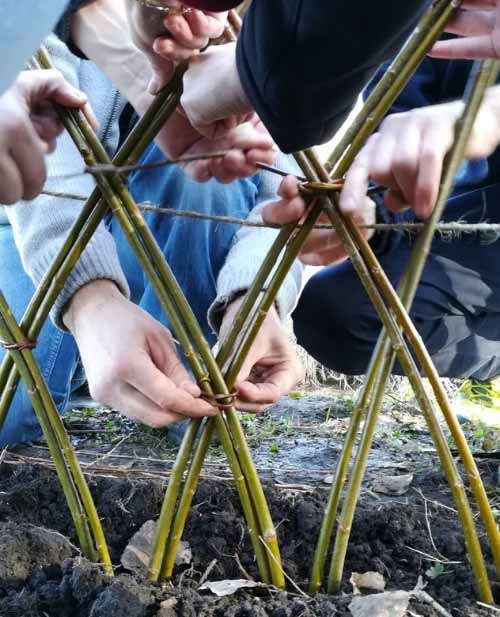
I completed my training on two sites: in the community gardens of Orry-la-Ville and at Pontarmé Castle. The training venue spoke to me immediately. The presence of a community garden was very appealing since I often work in that kind of context. I saw there the opportunity to go outdoors for field studies. And that is what we did, including weaving a living willow hedge, revisiting sowing techniques, and a wild-plant excursion… Even in the cold, we all enjoyed it. And what a pleasure to share moments when everyone’s smiles are on display!
5) How I made the most of my permaculture course?
I chose to value my training in all these ways: to enjoy it, to learn, to network, to receive feedback and external opinions on my projects. Even though I already knew some permaculture techniques, it was interesting to learn others’ approaches and their little personal tips.
I had the pleasure of meeting people who share my interest in societal topics such as climate warming, pollution, overconsumption… It was a real breath of fresh air to share and exchange with them. I loved this unique opportunity to meet these people. They were a source of inspiration for my own projects and gave me the drive to go even further.
Friendly, my training at the Clearing of the Sources was a real shared pleasure, filled with smiles, joie de vivre, deep reflections and learning. I would recommend it without hesitation!

6) And after my training?
Because the training was long, I was able to keep in touch with the other participants via Facebook and WhatsApp. Thanks to this, I extended my learning: I glimpse the others’ photos, their bibliographic resources and, above all, I love seeing everyone’s project progress. I’m delighted!
Even though I’ve finished my training, there’s still a lot to do: re-reading my notes, watching the documentaries that were recommended, and delving further into topics such as non-violent communication. My training remains a genuine gold mine that I still need to explore. For example, I still have many books to devour:
- "The Permaculture Guide to the Garden" by Carine Mayo from Terre Vivante Editions.
- "Permaculture – Healing the Earth, Nourishing People" by Perrine and Charles Hervé-Gruyer from Actes Sud Editions.
- "Permaculture in Practice" by Jessi Bloom and David Boehnlein from Ulmer.
- "The Forest Garden" by Martin Crawford from Ulmer editions
So don’t hesitate to take the plunge and train yourself!

Comments