





























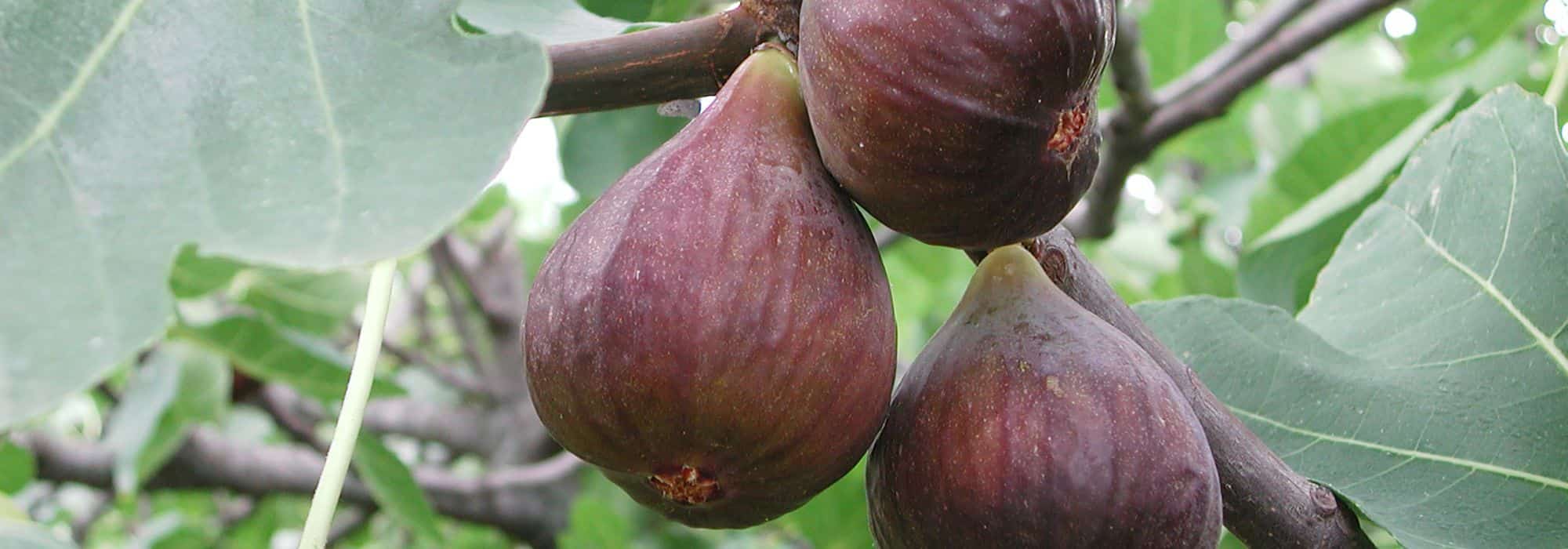
Why isn’t my fig tree bearing fruit?
Let's see the reasons why your fig tree isn't bearing figs... and, of course, the solutions!
Contents
As you know, the fig tree (Ficus carica) is a fairly hardy fruit tree that can adapt to many regions, so you have planted one in your garden. You were not entirely wrong, since the fig tree is hardy to -15°C (provided it is in full sun and sheltered from cold winds) and relatively undemanding in terms of soil. Planting in poor, dry soil may suit it. However, the fig tree you installed in your garden has yet to bear a single fruit, despite all the good care you give it!
This lack of fruiting may be due to multiple reasons related to cultural or climatic conditions, the choice of variety, or the maintenance practices you provide. Let us examine together the obstacles to fig production and, above all, what solutions to consider for making good fig jams.

Because your fig tree is still a baby
In this paragraph we will discuss fig fruiting, i.e., the onset of its first fruiting. For the fig tree, this fruiting is fairly quick compared with other fruit trees. Indeed, often as early as the second year after planting, the first fig can appear if cultural and climate conditions are ideal (we’ll come back to that a little later!).
However, to achieve real fruit production, you must wait for the tree to be well established. That is, a period of 4 to 7 years depending on varieties, regions where it is planted, soil or exposure…
So, if your fig tree isn’t fruiting yet, it may be because you’re in too much of a hurry. Let it settle in, and it should give you some fine figs if you show a little patience!
Because you haven't chosen the right variety
That is certainly the most common explanation for the lack of fruiting! Thus, if you have bought or taken cuttings of a fig tree without really considering its variety, you may have made the wrong choice! Indeed, there are hundreds of varieties, not all of which are suited to your region.
Thus, the fig tree is divided into two clearly distinct varieties: single-fruiting varieties and two-harvest varieties.
- A single-fruiting fig tree bears only one harvest per year, generally from late August to October depending on the varieties.
- And a two-harvest fig tree offers two harvests, the first occurring between June and July, and the second between September and October/November, depending on the region.
Depending on the region where you live, the choice of variety differs:
- Indeed, in southern France, you can grow either a single-fruiting fig tree or a two-harvest fig tree.
- However, in the colder regions, to simplify north of the Loire, only single-fruiting fig trees have any chance of bearing fruit. Why? Simply, because with a two-harvest fig tree, the first fruits risk being damaged by late spring frosts. If it frosts at around -4°C in March, April or May, the first harvest is compromised. As for the fruits of the second harvest (which takes place up to October or November), it is the cold that can prevent them from ripening.
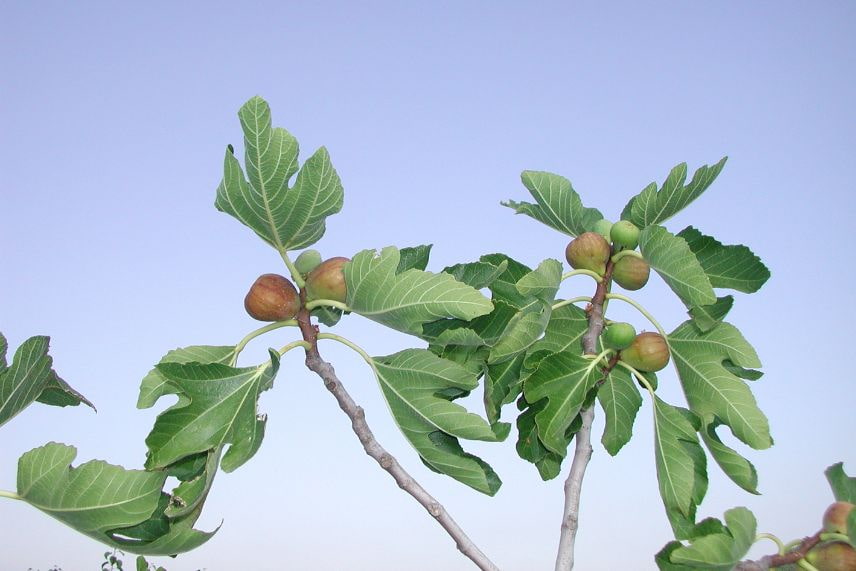
Fig trees are divided into single-fruiting or two-harvest varieties
So, if you live north of the Loire in France and have planted a two-harvest fig tree, the chances of having good figs are more variable. Nevertheless, with climate warming…
Alternatively, you can plant a single-fruiting fig tree, among which the varieties include ‘Nazareth’, ‘Panachée’, ‘Sucre vert’, ‘Ronde de Bordeaux’…
For some, however, certain two-harvest varieties can also be planted in less temperate climates, provided they have a sunny, wind-sheltered position: ‘Violette d’Argenteuil’, ‘Madeleine des 2 saisons’ or ‘Précoce de Dalmatie’.
Because pollination is not taking place properly
If you bought your fig tree from our site, no problem, because we only offer self-fertile fig trees. That is, these trees manage to bear fruit on their own, without the need for another fig tree nearby or the intervention of the blastophage, a small insect that ensures pollination of the female flowers.
However, if you have taken cuttings from a fig tree, perhaps you have come across a male fig tree? Indeed, the figs of the male fig tree do not ripen and are used solely to shelter the mating of the blastophage. Mr Blastophage dies there (and stays inside the fig) while the female leaves, bearing the precious pollen that will enable pollination of the female flowers. The blastophage is rather frost-sensitive and only survives in the south of France. Therefore, pollination of self-sterile fig trees is only possible in regions with a mild climate. Likewise, despite all your efforts, a male fig tree will never bear fruit…
All about pollination of the fig tree at: Fig wasp: the tiny insect essential to figs.
Because you didn't plant your fig tree in the right conditions
Not the easiest fruit tree to grow, the fig tree nevertheless needs some attention when planting. If these rules are not followed, fruiting will inevitably be compromised.
Fig trees can be planted in all soil types, even unforgiving, poor, rocky soils… However, the fig tree will realise its full potential in fertile, light and deep soil, preferably calcareous, cool in the first summers after planting, and above all well-drained. Thus, a fig tree grows very poorly (and does not fruit) in waterlogged soil where drainage is not adequately provided. Similarly, very poor soil does not necessarily hinder the tree’s growth, but it does not facilitate fruiting. If you want fruit, you need rich soil.
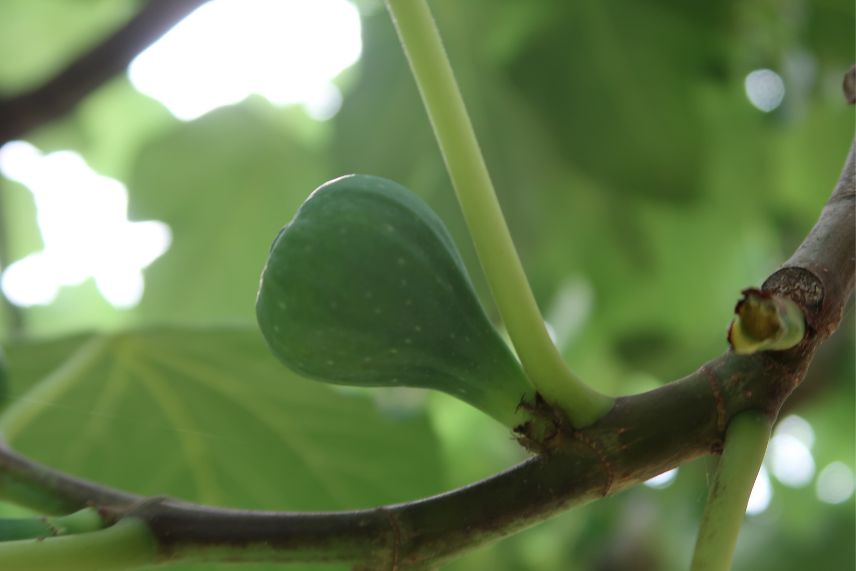
To bear fruit, a fig tree needs sun, rich, well-drained soil.
Because you’re not giving it the proper care
Once again, you’re doing the right thing by regularly watering your fig tree and giving it fertiliser inputs… In short, you’re giving it all the care you can! However, there are few, if any, figs on the horizon…
Let’s review the care to give your fig tree, in terms of watering or fertilising:
- Although drought-tolerant and not uncommon for trees planted in very poor soils with little maintenance to bear fruit, the fig tree needs water, at least in its first years. Thus, a young fig tree needs regular waterings in spring and especially in summer. During hot weather, two to three waterings a week are recommended for the first three years after planting. Otherwise, in spring, one watering a week suffices. Afterwards, the fig tree will be able to find the resources it needs for its survival on its own. The fig tree can be mulched to keep the soil cool
- Each year, in spring, it is advised to fertilise with an organic fertiliser, richer in potassium than in nitrogen. Indeed, nitrogen will promote leaf growth at the expense of the fruit. Over-fertilisation is therefore detrimental to the fig tree. An organic fertiliser for fig trees, or a special citrus fertiliser is ideal, as is the comfrey manure
- Mulching with fallen leaves or straw and a winter fleece cover are recommended to help young fig trees over-winter without trouble, at least in regions with a less temperate climate
Because you're not pruning it
Even though pruning is optional, it helps limit the growth of the fig tree, which can be rather vigorous, and also improve fruiting. Here too, fig trees are pruned differently depending on whether they are uniferous or biferous varieties. Christine explains it all in her tutorial: How to prune a fig tree?
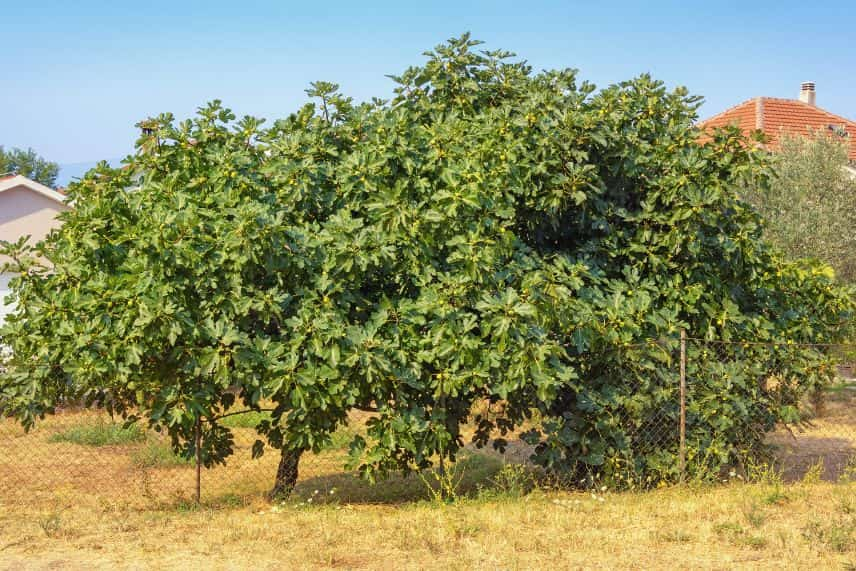
A fig tree can be vigorous
Because it is ill or attacked by a parasite
Like all fruit trees, the fig tree can be subject to various diseases or attacks by pests. And, of course, a tree in distress is a tree that produces less fruit, or none at all. Christine explains how to identify, treat and prevent the fig tree’s diseases and parasitic pests.
- Subscribe!
- Contents

Comments