





























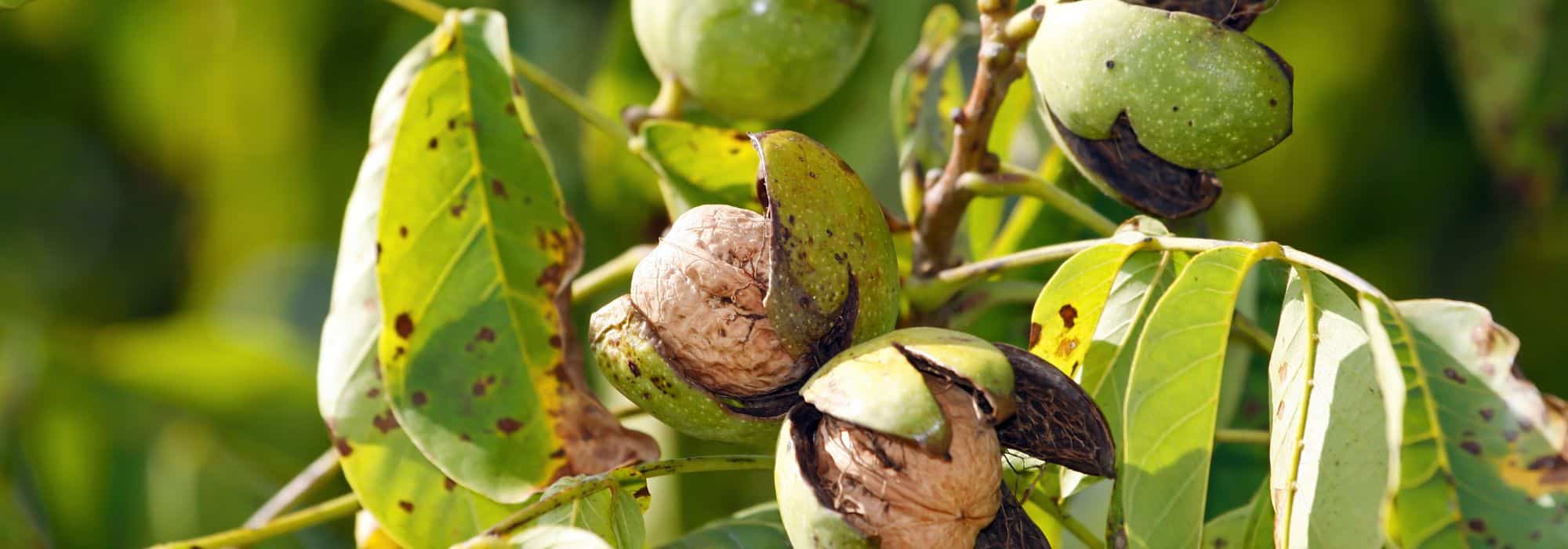
Why isn't my walnut tree bearing fruit?
Our tips for achieving beautiful, abundant walnut harvests
Contents
Walnut trees were formerly widespread in orchards, and Juglans regia is becoming rarer in private gardens. It is, in fact, a tree that requires a lot of space. That is why an isolated planting in a meadow is ideal. Although fairly easy to grow, the walnut tree is nonetheless a full-sun species that forms a tree 15 to 30 m tall, with a rounded, broad and rather open crown. Growing relatively slowly, it has a deep root system, between 3 and 5 m. Very decorative, it is grown for its large, compound leaves that turn yellow in autumn. When rubbed, a strong tannic odour is released. It is also valued for its silvery bark, long and smooth, which cracks lengthwise. As for its spring flowering, it is just as aesthetically pleasing: the male flowers, the aments, hang from the twigs while the female flowers are much more discreet. But it is mainly grown for its fruit, the walnuts, initially enclosed in a green husk that disintegrates once the fruit ripens from September.
Yet, despite all the care given to it, sometimes a walnut tree yields no walnuts. This lack of fruiting can have many reasons related to its cultural conditions as well as climatic conditions. Often solutions can be found.
Let’s explore together how to ensure the fruiting of your walnut tree.

Key facts about the walnut tree
Genus within the Juglandaceae family, the walnut is a robust tree that excels in deep, light, well-drained, and well-aerated soil, with an adequate water reserve. It will not tolerate acidic soils, overly compacted or waterlogged soils. And it is relatively demanding regarding space: it needs a large growing space. That is why it is rarely found in forests.
It also needs warmth, but fears drought. It requires an average of 10 °C for at least six months. It cannot tolerate winters that are too harsh, nor summers that are too dry and hot. And it needs at least 700 to 1000 mm of rainfall per year.
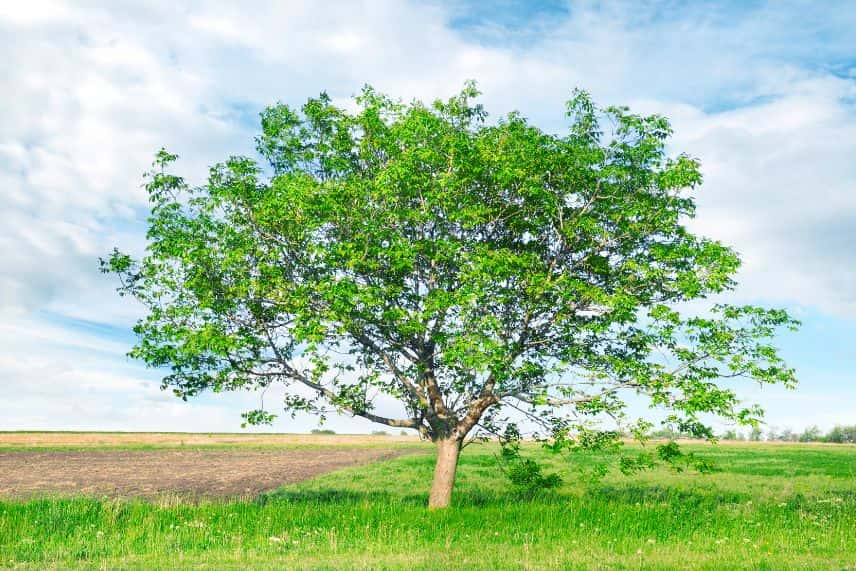
Walnut begins fruiting at around 10 years of age, although some varieties fruit earlier
That is to say, its planting must be carefully considered and well thought out to ensure proper fruiting. Any lapse will jeopardise fruiting.
Ensure optimal growing conditions for walnut trees
Not overly fussy, the walnut tree still requires a few essential cultivation conditions for its well-being, and therefore for its fruiting. If these cultivation conditions are not met, it may not provide you with as many walnuts as it should.
In terms of soil, walnut trees favour deep, well-drained soils, fairly loose. They adapt to neutral to calcareous soils, but never acidic. They also thrive quite well in clay-calcareous soils. This soil should be cool and not too compact so that the walnut tree can spread its roots deeply. It dislikes overly wet soils where water stagnates.
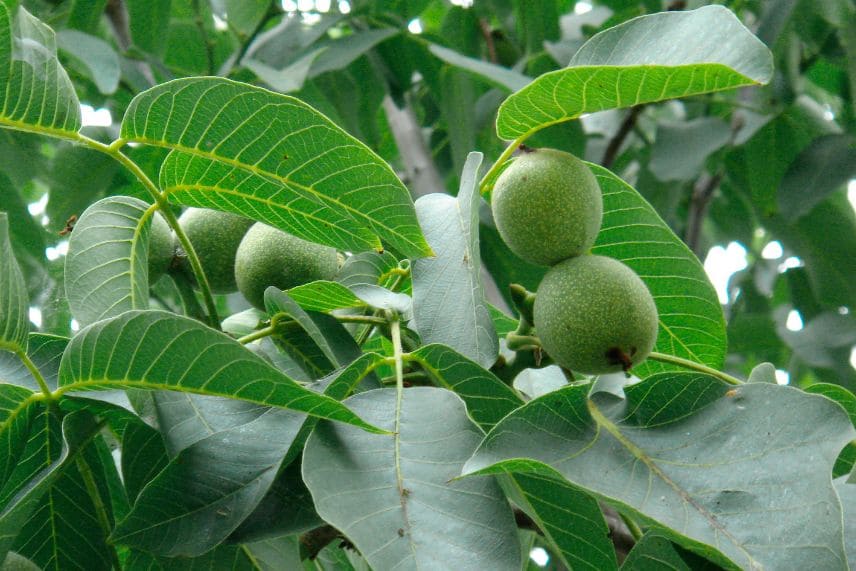
Walnut fruiting requires certain conditions
In terms of exposure, the walnut tree needs sun and plenty of light. It also dislikes cold, damp autumn winds, which is why it should be planted in a well-sheltered area. It particularly favour valleys sheltered from winds, or slopes at altitudes below 500 m.
The walnut tree also thrives in temperate-climate regions which have an annual rainfall of at least 700 mm. Hot, dry summers and prolonged droughts are not particularly favourable. It will also require a cold period of at least 700 to 1000 hours per year.
Finally, remember that the walnut tree is rather solitary and does not care for the company of other trees (unless the opposite is true, because it produces a toxic substance, juglone!). In short, you should allow at least 8 to 10 m of distance between the walnut and another tree or another walnut (we will see later that this is also essential for walnut production!).
Also note that a walnut tree is pruned little, or not at all, only to remove dead, weak or diseased shoots. It is also possible to remove branches that cross in the centre.
Reasons why a walnut tree won't bear fruit
You’ve just planted a walnut tree and you’re keen to see the first drupes develop? You’ve planted a walnut tree for a few years now and you’ll be despairing at not having harvested a single walnut? Several reasons can explain this absence of fruiting.
Fruit set
To begin with, fruit set. Indeed, the walnut is a tree with relatively slow growth. And fruit set follows the same pace! Expect around 10 years to achieve a reasonably decent harvest, even if some varieties such as ‘Franquette’, Fernor® or ‘Lara®’ offer earlier fruiting of about 5 to 6 years. ‘Weinsberg 1’ and ‘Esterhazy II’ fruit 3 to 5 years after fruiting. So these are walnut trees for those in a hurry!
By contrast, others take even longer to establish properly and produce their first nuts after around fifteen years of cultivation. Needless to say, with the walnut, patience is essential!
Climate conditions
Other climate-related reasons can jeopardise fruiting. Starting with the cold, and more particularly frosts. Indeed, the walnut is a tree with excellent hardiness. It can withstand temperatures well beyond -20°C. However, its flowers are very frost-prone. The slightest frost of -1.5 to -2°C and the flowers are irreparably damaged. Walnuts flower from April, at the moment when the leaves begin to appear. In some regions, spring frosts are not uncommon at this time. If the male flowers, the aments, which hang from the tips of the previous year’s shoots, and the female flowers that open on the current year’s growth, freeze, the harvest is permanently compromised.
The site
Another reason can be the site. Indeed, a walnut tree subjected to winds that are too strong or too cold will have difficulty fruiting. And it is especially the cold autumn winds laden with humidity that are most dreaded by the walnut.
Pollination
The lack of fruit can also be explained by the absence of pollination, which requires a few conditions. The walnut is indeed a monoecious species: it bears on the same tree both male flowers and female flowers, which usually bloom at different times. Male flowers appear before the female flowers. The numerous small flowers that make up the aments release pollen that is carried far by the wind, particularly onto the female flowers that open later. The pollen can thus land on the stigmas of the female flowers on the same tree or on another tree. Regardless, these flowers are not melliferous at all, as fertilisation does not occur by insects.
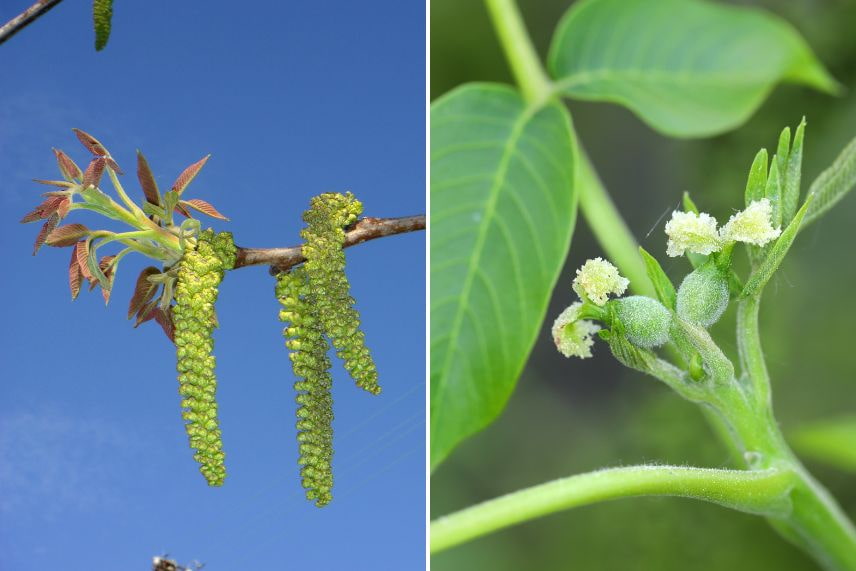
Male flowers and female flowers of the walnut
Other problems
Finally, a walnut tree that does not bear nuts may simply be suffering. Suffering due to a disease or pest that weakens it. I invite you to read the following article to spot signs of diseases, and implement the treatments: What are the diseases and pests of the walnut?
Poor cultural conditions can also explain a lack of fruit, both in terms of soil and site. And of course, if your tree is already sizeable, it will be harder to act and change things. Perhaps you’re not giving it the best possible care? Therefore, your walnut shows the consequences and warns you by not bearing fruit.
Solutions for obtaining generous walnut harvests
With every problem comes a solution. Or almost. Indeed, it is quite possible to act on certain levers to allow your walnut tree to bear fruit, but other problems will be more difficult to solve. Thus, if your tree does not benefit from good growing conditions in terms of soil or sunlight, it will be difficult to plant it elsewhere. Unless it is still young enough to be transplanted… Since transplanting a tree requires some precautions, do not hesitate to read Jean-Christophe’s article: Transplanting trees, shrubs, roses and perennials: when and how?
Review maintenance
If the absence of fruiting is explained by inadequate maintenance, perhaps it is reasonable to follow these care tips. Indeed, a walnut tree needs, in the years following planting, regular watering (especially if your soil is not sufficiently moist) and fertilisation. Thus, in the four or five years following planting, the young walnut tree should be watered regularly to preserve soil moisture, particularly during periods of high heat and droughts. A watering once a week is advised in summer, a little less at other times. In autumn and in winter, rainfall suffices. A good mulch is also essential to maintain a certain degree of moisture. Similarly, in the first three years, fertilisation based on compost or an organic fertiliser is necessary in autumn or spring.
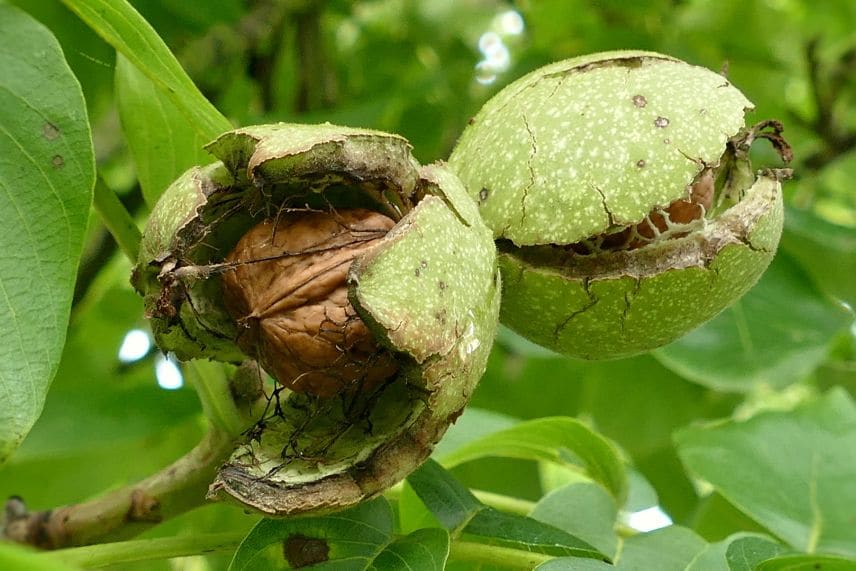 The harvest is near…
Plant another variety
Difficult to avoid spring frosts… If you live in a region where these late frosts are regular, the best is to plant a walnut with late flowering. The variety ‘Franquette’ is certainly the most recommended, as the bud burst is very late. Originating from Isère, this variety is probably the most widely grown. It is a vigorous variety with late maturity, the first fortnight of October. The Fernor variety, a variety created in 1978 by INRA from the cross of ‘Franquette’ with ‘Lara’, also exhibits late bud burst and late male flowering. However, it can be susceptible to early autumn frosts. As for ‘Corne du Périgord’, it flowers toward the end of April, which limits damage from late frosts. The ‘Parisienne’ variety is also relatively late. By contrast, the ‘Mayette’ variety is rather susceptible to late frosts and should be planted south of the Loire.
Finally, fruiting is often compromised by a lack of pollination due to the temporal gap between the appearance of male and female flowers. If in theory walnut trees are self-fertile since they bear flowers of both sexes, it is nevertheless advisable to plant two varieties with close flowering times. Two varieties stand out for their pollination qualities: ‘Franquette’ and ‘Parisienne’, just as ‘Maylanaise’ and ‘Ronde de Montignac’, two old varieties.
- Subscribe!
- Contents
Comments