





























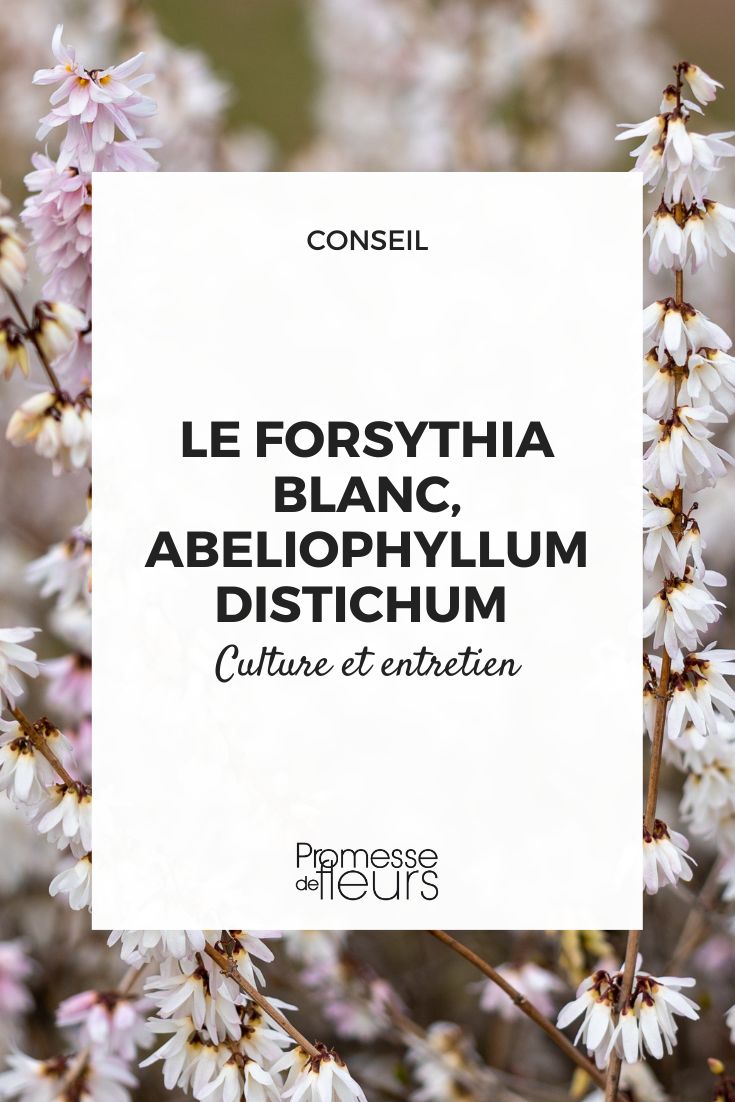
White Forsythia, Abeliophyllum distichum: Growing and care
A little-known and easy-to-cultivate species
Contents
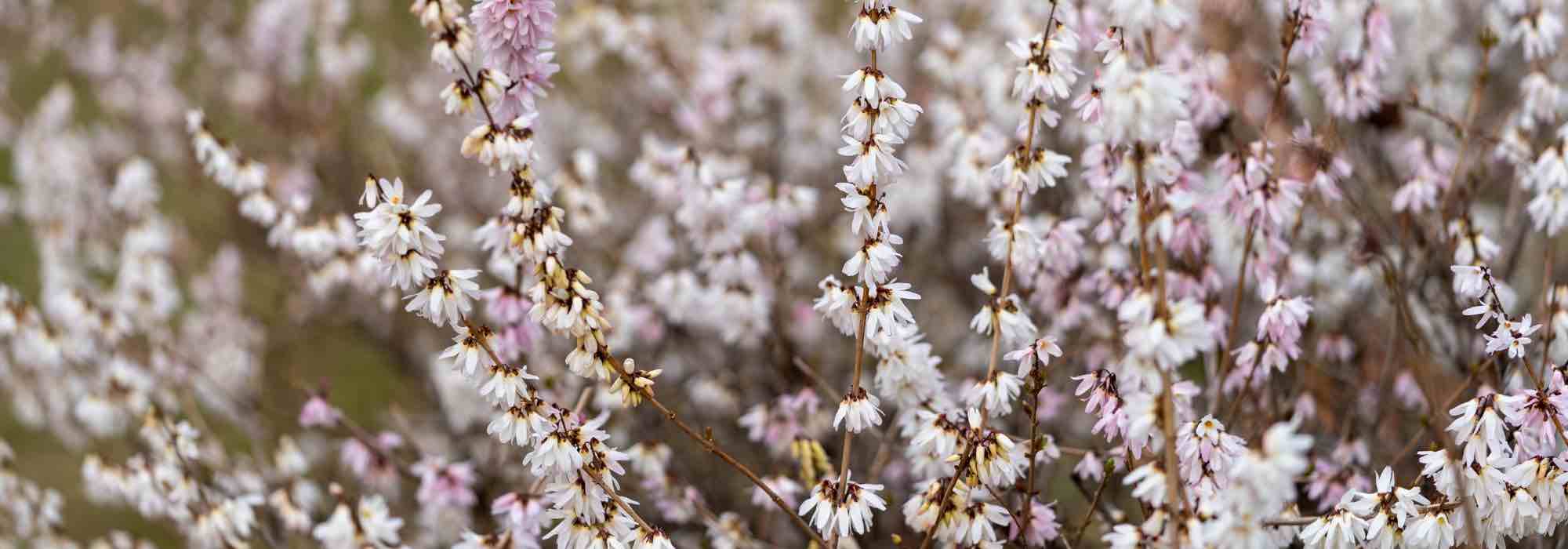
The White Forsythia or Korean White Forsythia is not part of the Forsythia species; it is named so due to its resemblance to it, but it is actually known as Abeliophyllum distichum. It is easy to see why it has inherited this name, as it is quite close to Forsythia: its appearance, behaviour, and growing conditions are similar. However, this bush blooms in white instead of the well-known yellow of Forsythia that heralds the end of winter. Its soft, bright white flowering is accompanied by a delicate almond fragrance. The Abeliophyllum distichum has another ornamental quality: its foliage turns purple-red in autumn.
Like Forsythia, it is a deciduous bush, hardy and easy to care for, thriving in full sun or partial shade, in fresh to drier, ordinary, or even poor, well-drained soil. Learn more about this species native to Korea, as well as our growing and maintenance tips, both in the ground and in pots!
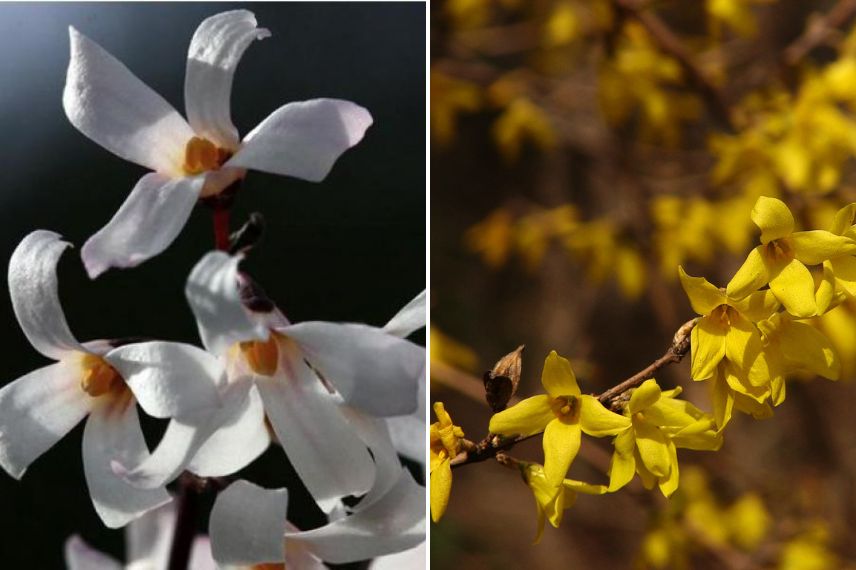
The flowers of Abeliophyllum distichum and those of Forsythia

What is white Forsythia?
Known as White Forsythia or Korean White Forsythia, the Abeliophyllum distichum is actually a shrub of a completely different species than forsythia. However, its appearance and behaviour are similar to that of Forsythia, which it could be confused with, were it not for the colour of its flowering, as the iconic yellow of Forsythia is not present. Instead, it boasts a bright and gentle white flowering that adorns the Abeliophyllum distichum at the end of winter. This shrub, native to Korea, also has a soft pink variant: the Abeliophyllum distichum ‘Roseum’, also known as Korean Pink Forsythia.
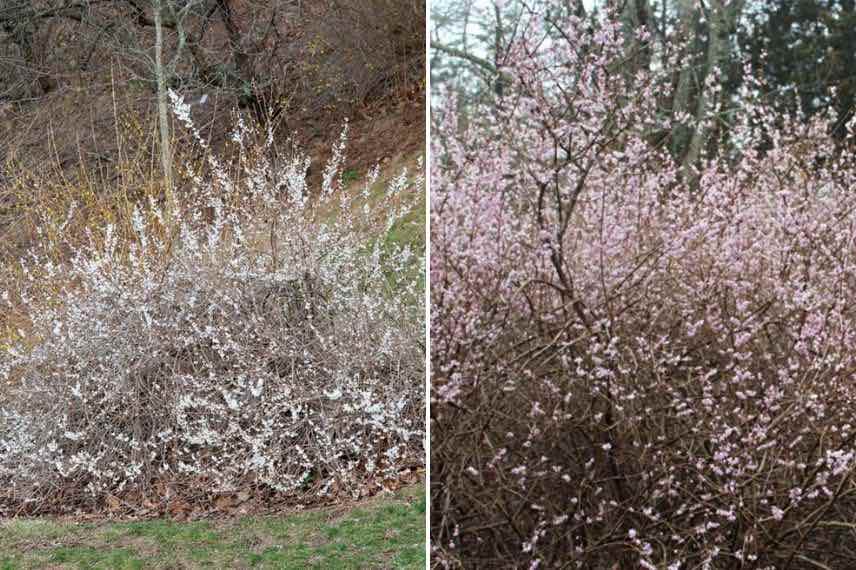
The Abeliophyllum distichum on the left and the ‘Roseum’ form on the right
Its similarities with Forsythia include belonging to the same family, the Oleaceae, although they are not of the same species. It features an early flowering, emerging at the end of winter, on the bare branches of the previous year, before the foliage appears, as both are deciduous. They share small flowers with four similar petals and comparable vegetation. They also require similar growing conditions and exhibit good hardiness in both cases.
It distinguishes itself from Forsythia by the colour of its flowers, the almond fragrance that emanates from them, and the autumnal colouring of its leaves, which turn a purplish red before falling. It reaches 1.5 to 2 metres in all directions, while some species of Forsythia are creeping and others can reach heights of 3 metres. It is also significantly less famous than its cousin!
Note that its lovely delicately scented flowers are adorned with an orange-yellow centre. While they bloom white, slightly tinged with pink, they turn light brown at the end of their cycle.
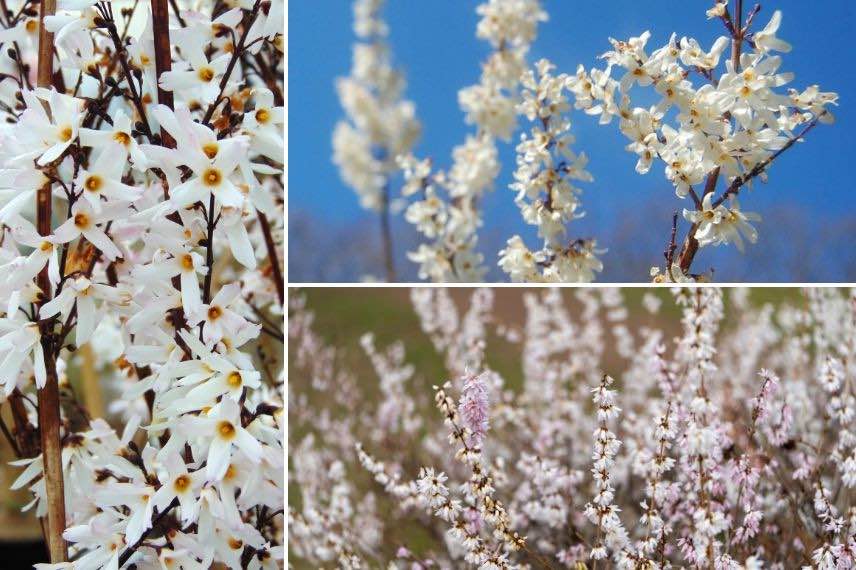
The flowers of the Abeliophyllum distichum are white with an orange-yellow centre, featuring hints of pale pink and brown
Read also
Choosing a forsythiaWhen and where to plant?
Korean white Forsythia, being hardy and low-maintenance, can be planted both in early spring, between February and April, and in autumn, between September and November.
It can be grown in the ground or in pots. It is beneficial to place it near the house, so it can be seen from indoors when one is still hesitant to go outside, but it is already in bloom. It can be trained against a wall, a position it appreciates and that suits its structure. It can also be planted as a low hedge.
It prefers a sheltered position from cold winds, in full sun or partial shade. It does not like excess moisture: its soil or planting substrate must be well-drained. This soil can be dry to moist, poor or rich.
Planting White Forsythia in the ground
Abeliophyllum distichum is not fussy about the soil it grows in as long as you ensure proper drainage. Therefore, in addition to providing drainage at the bottom of the planting hole, consider lightening your soil with river sand, around 20% of the amount of soil. This is a guideline; if your soil is already well-draining, there is no need to add sand. Conversely, if your soil is heavy and sticky, add more, up to 50%. If your soil dries out quickly, you can also add potting compost to help retain moisture. Finally, if you have well-decomposed compost, it can also lighten the planting soil while enriching it.
- Soak the root ball in a bucket of water for about ten minutes to allow it to rehydrate properly;
- Dig a planting hole approximately 2 to 3 times the size of the root ball;
- Mix your soil with river sand, and possibly some potting compost;
- Install a layer of drainage at the bottom of the planting hole (gravel, pumice, clay balls);
- Add a portion of your soil mix;
- Place the root ball in the centre of the hole, adding your mix until the root ball is covered;
- Firm down;
- Create a wide rim around the base of your Abeliophyllum to retain watering water effectively;
- Water generously;
- Mulch thoroughly to limit water evaporation and space out watering.
Planting White Forsythia in Pots
Choose a container 2 to 3 times larger than the size of the root ball, such as a terracotta pot or a wooden trough, which must be drained or one that you can drill yourself, to prevent the roots from stagnating in water.
Equip yourself with a special potting compost or create a substrate based on compost or garden soil mixed with about 20% sand to improve drainage.
- Soak the root ball in a bucket of water for about ten minutes to allow it to rehydrate and facilitate the removal from the nursery pot;
- Place a layer of drainage at the bottom of the pot using clay balls or gravel a few centimetres thick (pumice is heavier and should be avoided in pots);
- Pour the compost or mixed substrate until it is about half full;
- Remove the nursery pot and loosen the roots at the bottom of the root ball;
- Place your Abeliophyllum in the pot;
- Fill in with your substrate;
- Firm down;
- Water generously;
- Mulch carefully to a depth of several centimetres.
In a pot, position your Abeliophyllum preferably in partial shade during the hottest seasons, in spring or summer, to limit evaporation of water from the planting substrate. This also helps to prevent the shrub from suffering potential burns or sunscald during the hottest or sunniest moments of summer. Otherwise, generally, it enjoys the sun and grows well in partial shade. Place the pot in a sheltered position from cold winds.
Caring for White Forsythia
Chétif when young, it requires greater attention while it settles in, ensuring enough space and checking on it from time to time: a few waterings during establishment and verify that it is growing properly.
While it adapts easily to all types of soil, the white Forsythia will also have better growth in cool or not too dry soil. In summer, water once or twice a week, especially during heatwaves, after having carefully mulched in spring.
Once established, it requires little maintenance. Even though it is content with poor soil, to improve its growth and flowering, you can provide it with compost or organic fertiliser each spring.
Pruning the white Forsythia is straightforward and should be done in April or May, after flowering, by shortening all branches to ¼ of their length to encourage the plant to branch out and produce new shoots at the base.
- Subscribe!
- Contents
Comments