





























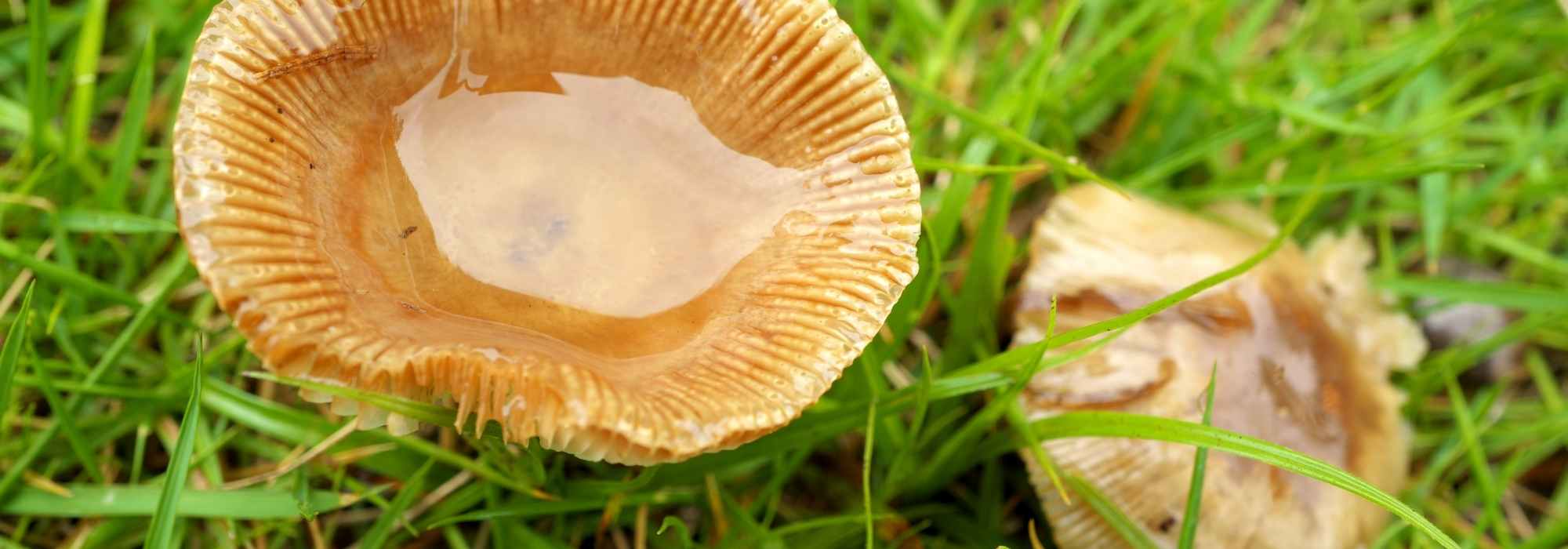
Which mushrooms can you harvest and eat?
Our lawns can hide a few edible mushrooms
Contents
From the outset, before discussing these edible mushrooms that can grow in our gardens, it may be necessary to remind you that caution is essential when it comes to mushrooms. You must absolutely be certain of their identification before harvesting and consuming any mushroom. And, if in doubt, a visit to a pharmacist, normally trained in mycology as part of their university studies, is advised.
That aside, let’s focus on these mushrooms that are not found in the woods, but rather in meadows, and therefore potentially in the lawns of our private gardens. Some are absolutely delicious and deserve to be harvested, cooked fresh or dried. They can be harvested in spring or autumn.
Discover the main edible mushrooms to harvest at home, in your garden

Mushrooms in the garden: beware!
A mushroom is a living organism, neither animal nor plant. They typically grow in humid and shaded environments such as woods, while others develop in grassy areas, such as lawns! These mushrooms that we encounter in our garden can be of different types, and are therefore far from being edible:
- Parasitic fungi: they are pests, as they carry cryptogamic diseases, very harmful to garden plants. The best known and most feared is Armillaria or honey fungus, which attacks trees through their root system and, in the longer term, causes their death. To learn all about this fungus, see our advice sheet: Armillaria or honey fungus: recognise and combat this tree fungus
- Saprophytic fungi feed on dead organic matter that they decompose, such as dead leaves, dead leaves, mulch, dead wood, plant residues, sometimes the carcasses of small animals… These saprophytic fungi are generally a sign of healthy soil, sufficiently fertile.
- Symbiotic fungi that live in association with a plant : they feed on its glucose and, in exchange, supply it with water or minerals. Some fungi therefore live in symbiosis with plants, such as the fly agaric, a toxic mushroom that generally grows near birch trees.
Among these different types of mushrooms, some are edible, some harmless, some completely toxic. If you have young children or pets, the best course is to remove and dispose of mushrooms growing in your garden, unless you can positively identify them as edible mushrooms.
Read also
Mushrooms in the lawn: what to do?Edible mushrooms that grow in gardens
If you love wandering through the woods as autumn arrives, you’ll surely be struck by these mushrooms that sometimes emerge from the ground in the garden, in the middle of the lawn, or even under the foliage of your trees, especially if you live not far from a forest or from pastures used for grazing cattle. Among these mushrooms that appear in your garden somewhat unexpectedly, some prove perfectly edible and, above all, very tasty.
Discover with us the various mushrooms you can harvest at home.
The meadow mushroom (or meadow rose)
The meadow mushroom, also called the meadow agaric (Agaricus campestris), is a mushroom very common in meadows frequented by cattle. Because it likes rich soils, it can perfectly appear, usually in groups, in the middle of your lawn, from mid-September to mid-October.
This mushroom, a cousin of the cultivated mushroom, is of excellent flavour and easy to identify.
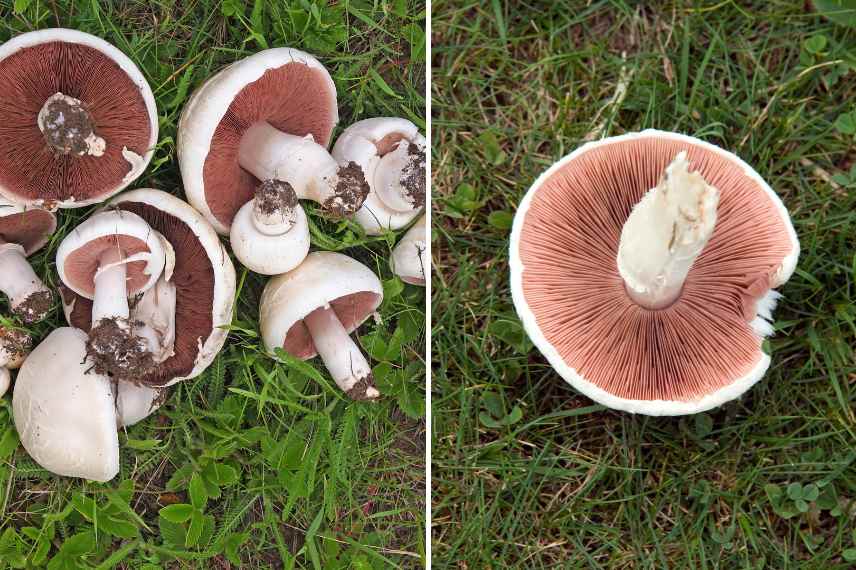
The meadow mushroom (Agaricus campestris)
How to recognise it?
- A white, silky-looking, hemispherical cap, slightly flattened on the surface, up to 10 cm in diameter
- Fine gills a pink to rose colour, turning brown with maturity
- A relatively short stem, narrower at the base
- White flesh with a pleasant odour, reminiscent of Paris mushrooms
This mushroom can be eaten raw, for example in salads, or cooked. It dries easily.
It may occasionally be mistaken for another mushroom regarded as toxic, the Yellow-staining Agaricus (Agaricus xanthoderma), which smells iodine-like and shows a yellow colour when cut.
The fairy-ring mushrooms (or Marasmius oreades)
Here’s another garden regular! The meadow mushroom (Marasmius oreades) generally appears from the end of summer through autumn, sometimes in spring if the weather is fairly humid. It frequents meadows and grassy areas such as lawns. It grows in tufts, or sometimes in witches’ rings.
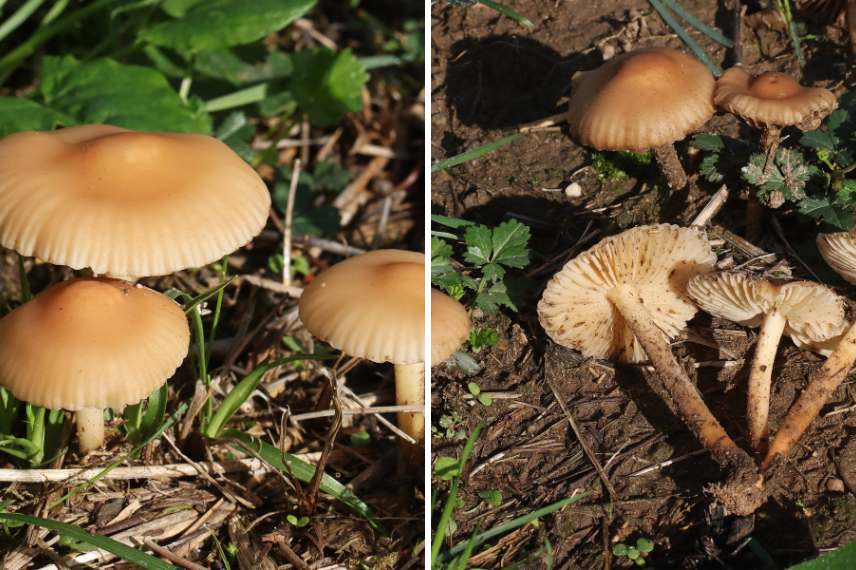
The meadow mushrooms
How to recognise it?
- A small cap, slightly nipple-like, ochre to orange in colour, rather pale. It is often marked with grooves along the edge
- Pale to cream, broad and spaced gills
- A cylindrical, slender stem, hollow and elastic, roughly the same colour as the gills. It can be bent without breaking
- Cream flesh with a sawdust-like or bitter almond scent.
Delicious sautéed or in an omelette; meadow mushrooms are best cooked without the stem, as the stem can be too tough. They dry easily.
The parasol mushrooms (or Macrolepiota procera)
Hard to miss the parasol mushroom, often called the Macrolepiota procera (Macrolepiota procera), without a doubt. Indeed, it is a large mushroom that could evoke a parasol. While it is commonly found in woods, it also grows along paths, in meadows and pastures, on acidic or neutral soils rich in organic matter. It prefers the company of beech trees (Fagus sylvatica). The parasol mushroom is harvested in autumn.
How to recognise it?
- A bulbous, convex cap that flattens with maturity, up to 25 cm in diameter. This cap is notable for its scales, more numerous toward the apex, and it is a grey-brown colour
- White to cream, fairly close gills
- A hollow stem, 10–30 cm tall, light brown with greyish stripes, bearing a double ring
- White to cream flesh with a mushroom scent.
The parasol mushroom is tasty, especially when young. However, only the cap is edible.
The parasol mushroom can be confused with other Lepiotas such as the brunneoincarnate Lepiota (Lepiota brunneoincarnata), smaller with a brown-pink cap and an almost invisible ring, deadly. Or with the poisonous Lepiota (Chlorophyllum brunneum), with a less-scaly cap and a simple ring, which grows near manure or compost. The panther cap (Amanita pantherina) also resembles the parasol mushroom, but with a simple ring. So caution is essential!
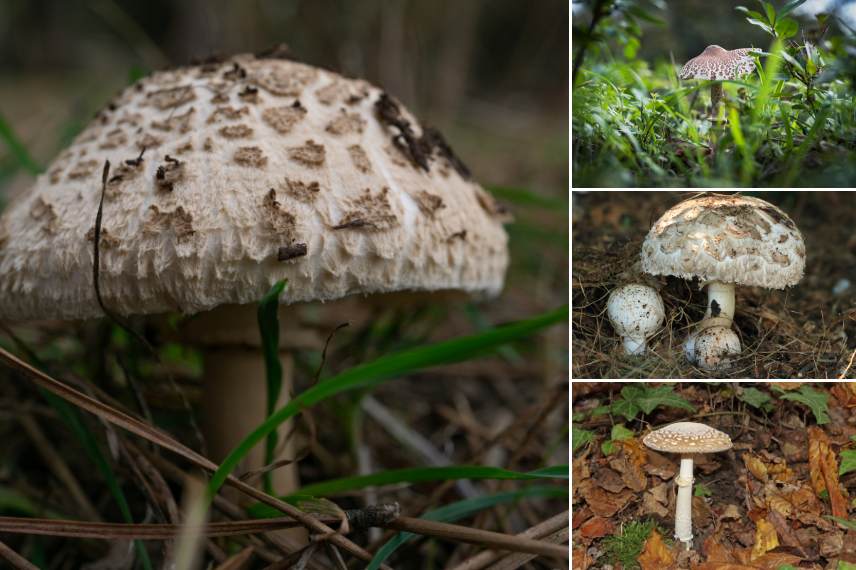
The parasol mushroom (left) should not be confused with the brunneoincarnate Lepiota, the poisonous Lepiota, or the Amanita pantherina
The meadow waxcaps
The meadow waxcap ( or Hygrocybe pratensis) is a small mushroom that grows quite logically in meadows, from autumn to the first winter frosts. It tends to occur in areas above 500 m. It is increasingly rare, as it is sensitive to fertilisers.
How to recognise it?
- A conical, nipple-like cap, orange to salmon, with slightly wavy edges. It does not exceed 6 cm in diameter
- Thick, widely spaced, and especially decurrent gills, meaning they run down the stem
- A white to cream-orange stem, rather stout
- Pale orange flesh with a mild flavour and no particular odour.
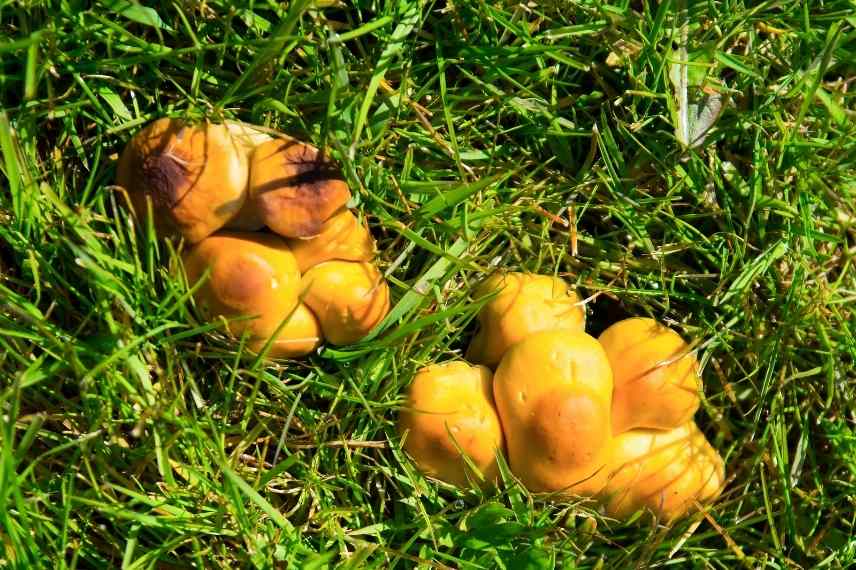
The meadow waxcap
The shaggy ink cap
The shaggy ink cap (Coprinus comatus) is among those meadow and lawn mushrooms fairly common. You’ll easily find it in your garden if it sits at the edge of a wood. It is picked from July to autumn. Often nicknamed “inky cap,” it grows in groups on very nitrogen-rich soils. That’s why there is a good chance you’ll find it in pastures frequented by cattle.
How to recognise it?
- A tall, oval, elongated cap, a little bell-shaped. Cream-white in colour, it is covered with woolly fibres that seem to peel away, earning it its name. With time, the cap darkens and liquefies, hence the nickname “inky drop”
- White gills that turn pink, then black
- A hollow, very tall stem, thus fragile. It bears a fine, detachable ring
- Delicate but tasty flesh.
This mushroom should be eaten very quickly after picking. Handle it gently as well.
The shaggy ink cap can be confused with the coprin pie (Coprinospsis picacea) with a black-and-white cap, which grows alone rather in deciduous woodland. It can also be confused with the black-in-ink coprin (Coprinopsis atramentaria) with a greyish, rather smooth cap, whose consumption can cause alcohol intolerance for at least 72 hours.
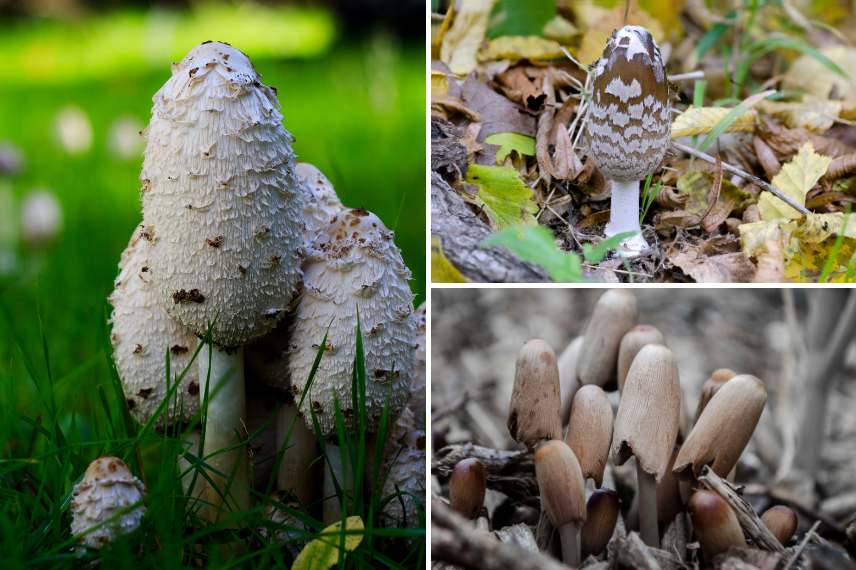
The shaggy ink cap (left) not to be confused with the magpie ink cap and the ink cap
Common morels and half-free morels
If you have common morels (Morchella esculenta), or even half-free morels (Morchella semilibera) in your garden, you’re lucky. For these mushrooms are delights, regarded as festive fare when cooked. Raw, they can be toxic.
Common and half-free morels are harvested in spring, from April to May. They often grow in small groups of two or three, in grassy areas of open woods, at the edges of deciduous trees, and particularly near ash trees (Fraxinus), or in orchards. Morels and half-free morels favour cool, fairly calcareous soils. They enjoy the company of lesser celandine (Ranunculus ficaria) or creeping ivy (Hedera).
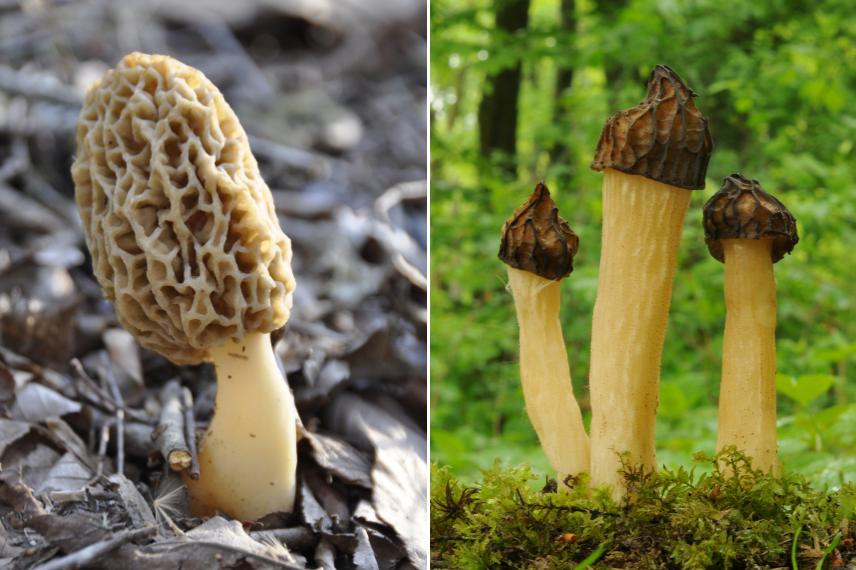
Common morels and half-free morels
How to recognise them?
- A conical cap that ranges from dark brown to blond in morels, rather brown in half-free morels. The cap is hollow and has alveolate pits
- No gills on these mushrooms
- A hollow stem, white to pale cream in morels, ivory to cream and ridged in the half-free morels
- Odourless, very fine and fragile flesh.
It is important to reiterate that morels and half-free morels should only be eaten cooked, as they contain hemolysin, a toxin that destroys red blood cells. Once cooked, enjoy!
- Subscribe!
- Contents
Comments